
Hair loss is one of the most common concerns we see at Perfect B, our medical clinic in Doral, Miami. Patients come in frustrated: they have tried shampoos, supplements, and topical products with limited results, and they want to know what actually works from a clinical standpoint. This post covers what we offer, how we evaluate candidates, and what realistic outcomes look like.
Why Hair Loss Happens: What We Look for First
Before any treatment, we assess the type and cause of hair loss. The two most common patterns we see are:
- Androgenetic alopecia (hormonal, genetic pattern thinning): most common in men along the hairline and crown, and in women as diffuse thinning across the part line
- Telogen effluvium (stress- or deficiency-related shedding): often triggered by illness, hormonal shifts, postpartum changes, or nutritional gaps
We also evaluate for inflammatory scalp conditions, thyroid dysfunction, iron deficiency, and DHT sensitivity. Treatment selection depends on root cause. A patient with stress-related shedding and one with androgenetic alopecia may look similar from the outside but respond to completely different protocols.
Hair Loss Treatments We Offer at Our Miami Clinic
Perfect B is a medically run clinic. Every treatment protocol is designed by licensed medical providers, not estheticians. Here is what we use and why.
Exosomes + PDRN: The Regenerative Foundation
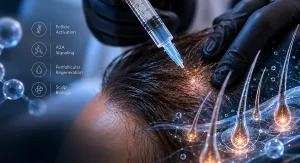
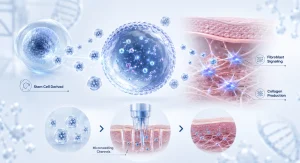
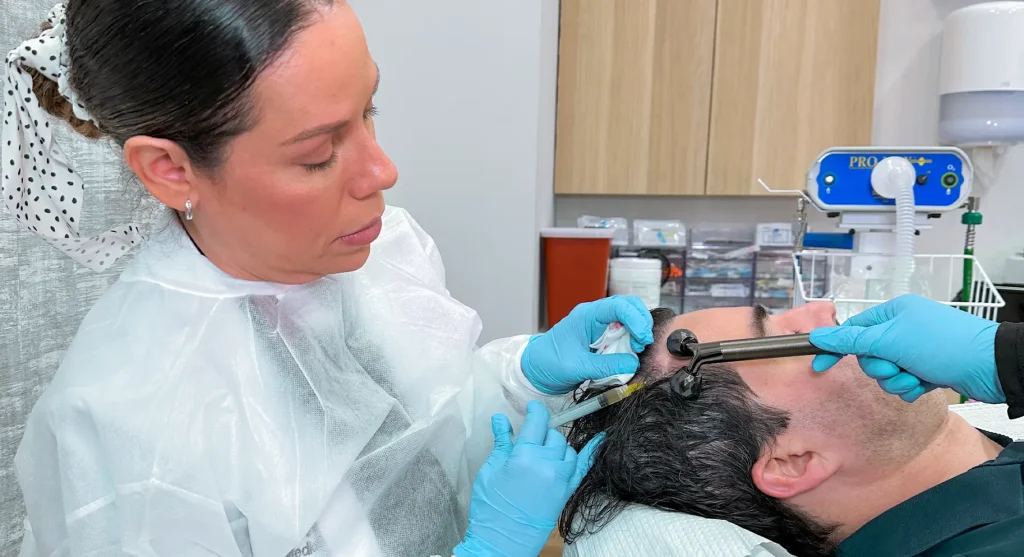
Exosomes are extracellular vesicles derived from stem cells that carry growth factors, proteins, and signaling molecules directly into follicle tissue. When combined with PDRN (polydeoxyribonucleotide), a nucleotide derived from salmon DNA, the protocol promotes cellular repair, reduces follicular inflammation, and stimulates dormant follicles to re-enter the growth phase.
We favor exosomes over PRP for most patients because they deliver a consistent, concentrated growth factor signal without requiring a blood draw. PDRN extends the anti-inflammatory effect and improves local tissue oxygenation, which matters for follicle survival in an inflamed scalp environment. Most patients see measurable density improvement between months 3 and 5.
GHK-Cu Peptide: Systemic Support for Hair and Scalp
GHK-Cu (copper peptide) is a naturally occurring tripeptide that declines with age, playing a key role in collagen synthesis, wound healing, and cellular repair across tissues including the scalp. In the context of hair, it supports dermal papilla activity, reduces scalp inflammation, and improves the structural quality of existing hair strands.
Patients using GHK-Cu as part of their protocol frequently report improvements in hair texture and thickness that they describe as unexpected. It is not a standalone treatment for androgenetic alopecia, but as an add-on for thinning, brittle hair, scalp inflammation, or post-procedure recovery, it earns its place in the stack. Patients on our peptide treatment plan who want to address hair concerns alongside systemic health goals often run GHK-Cu concurrently with CJC-1295/Ipamorelin or MOTS-C.
PRP (Platelet-Rich Plasma): Still a Valid Option for the Right Patient
PRP uses the patient’s own concentrated platelets to deliver growth factors into the scalp. It has a solid body of clinical evidence for androgenetic alopecia and telogen effluvium. We use it when patients prefer an autologous approach or when exosomes are not the right fit for a particular case.
The limitation with PRP is variability: platelet concentration and growth factor yield differ from person to person, which is why results can vary more than with exosomes. For patients with significant androgenetic alopecia, PRP works best as part of a multi-pronged approach rather than a standalone treatment.
When We Refer Out: Surgical and Advanced Cases
We are straightforward about scope. Patients with significant androgenetic alopecia who want hair transplant-level results, patients with scarring alopecia (lichen planopilaris, frontal fibrosing), or patients with active autoimmune conditions affecting the scalp (alopecia areata) are referred to dermatology or a hair transplant specialist. Our protocols are most effective for early-to-moderate diffuse thinning, postpartum shedding, stress-related loss, and adjunct care around other interventions.
Treatment Comparison and Response Timeline
The chart below compares the four most common approaches across five clinical dimensions, followed by a realistic response timeline based on clinical observation. Individual results vary based on hair loss type, stage, and treatment consistency.
Hair Loss in Miami: What the Climate Adds
Miami’s heat and humidity affect scalp health in ways that are underappreciated. Chronic sweat retention around the follicle opening can promote inflammatory scalp conditions that accelerate miniaturization. Patients who spend significant time outdoors, exercise frequently in the heat, or swim in chlorinated pools often have a compounding inflammatory layer on top of their baseline hair loss that worsens the presentation and slows treatment response.
We account for this in our protocols. Patients with visibly irritated or oily scalp conditions receive adjunct scalp care guidance alongside treatment. Addressing the inflammatory environment is not optional: follicles recovering from exosome or GHK-Cu injections need a stable, low-inflammation environment to consolidate gains.
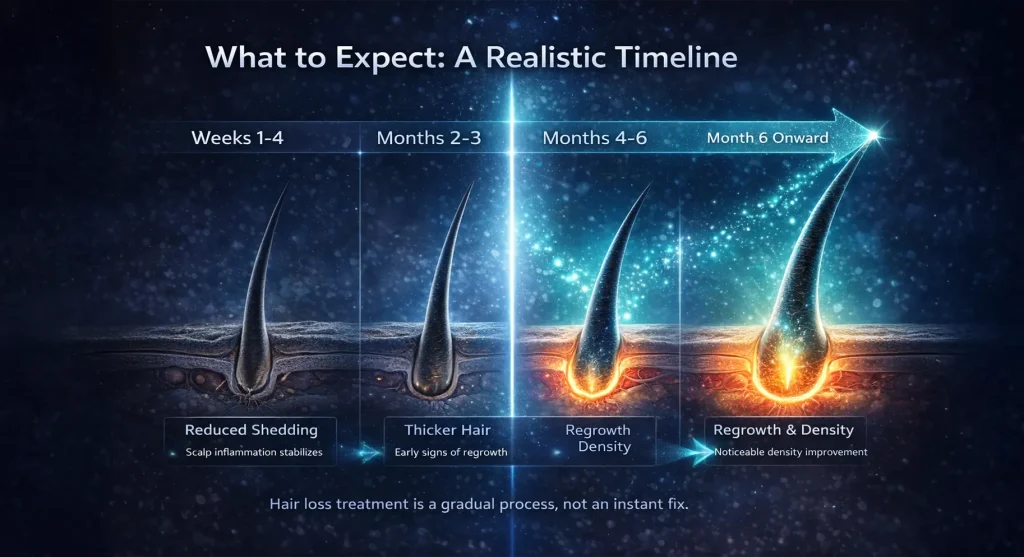
What to Expect: A Realistic Timeline
We are honest with every patient: hair treatment takes time, and no protocol produces overnight results. Here is what a typical timeline looks like for patients who are consistent:
- Weeks 1 to 4: Reduced shedding is often the first sign. The scalp inflammatory environment begins to stabilize. No visible density change yet.
- Months 2 to 3: Existing hair strands may feel thicker. Some patients notice early regrowth, particularly at the hairline edges and part line.
- Months 4 to 6: Measurable density improvement in most patients who respond to treatment. Full assessment at 6 months determines whether to continue, adjust, or consolidate.
- Month 6 onward: Maintenance sessions every 3 to 6 months to sustain results. Hair is living tissue and responds to ongoing support.
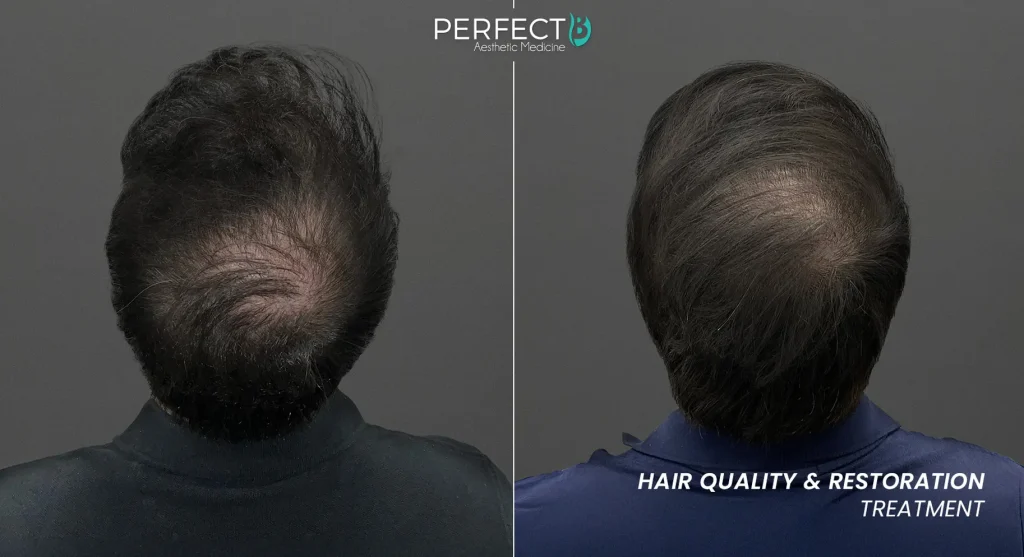
We do not guarantee outcomes. What we can guarantee is a thorough evaluation, honest expectations, and a protocol built on clinical evidence rather than marketing claims.
→ For a peer-reviewed overview of exosome-based hair loss therapy, see: Exosomes for Treating Hair Loss: A Review of Clinical Studies (Dermatol Surg, 2025). For a comprehensive review of androgenetic alopecia treatment options and outcomes, see: Treatment options for androgenetic alopecia: Efficacy, side effects, compliance, financial considerations, and ethics (J Cosmet Dermatol, 2021).
How We Are Different from a Hair Loss Spa
Many hair loss clinics and med spas in Miami offer PRP or “stem cell” treatments performed by estheticians or under minimally supervised protocols. The difference at Perfect B is structural: our medical providers evaluate every patient, interpret labs when relevant, and build a protocol that accounts for the full clinical picture, not just the chief complaint.
We also do not upsell treatments that are not appropriate. A patient who comes in asking for GHK-Cu for androgenetic alopecia will hear honestly that exosomes and PRP are more appropriate for their presentation, and that GHK-Cu makes sense as an adjunct. That honesty is what drives outcomes and patient referrals.
Frequently Asked Questions
1. How do I know which hair loss treatment is right for me?
The right hair loss treatment depends on the type of loss, how long it has been progressing, and your overall health picture. Pattern thinning, stress-related shedding, and inflammatory conditions each respond differently. A consultation is the fastest way to get an accurate answer for your specific case.
2. How many hair loss treatment sessions does it take to see results?
Most hair loss treatment protocols involve an initial series of 3 to 4 sessions spaced 4 to 6 weeks apart, followed by a maintenance phase. Meaningful density improvement typically becomes visible between months 3 and 5. We assess results at the 6-month mark and adjust accordingly.
3. Is hair loss treatment painful?
Scalp injections are tolerable for most patients. A topical numbing agent is applied beforehand, which significantly reduces discomfort. The hair loss treatment procedure itself takes 30 to 45 minutes. Most patients return to normal activity the same day.
4. Can women get hair loss treatment in Miami?
Yes. Exosomes, PDRN, GHK-Cu, and PRP are all appropriate for female hair loss patterns. Women are often more responsive because female pattern hair loss tends to present as diffuse thinning rather than follicle death, meaning more follicles are in a miniaturized but rescuable state. We see strong results in women experiencing postpartum shedding, perimenopausal thinning, and diffuse androgenetic alopecia.
5. Do I need to stop medications before starting hair loss treatment?
Some medications affect platelet function and scalp inflammation. We review your current medications during the hair loss treatment consultation and advise accordingly. Most patients do not need to stop anything, but it is important that we know what you are taking before proceeding.
6. Do you offer financing for hair loss treatment?
Yes. We work with Cherry, Klarna, Afterpay, and CareCredit to make hair loss treatment accessible. Payment plans allow patients to start sooner rather than waiting to pay in full. Ask about financing options during your consultation.
Book Hair Loss Treatment at Perfect B in Doral, FL
- 📍 Perfect B | 3905 NW 107th Ave, Suite 104, Doral FL 33178
- 💉 Exosomes, GHK-Cu peptide, and PRP available standalone or combined with any treatment appointment
- 💳 Buy Now Pay Later: Cherry, Klarna, Afterpay, CareCredit
→ Book your hair loss treatment consultation at Perfect B in Doral, FL