Perfect B, Doral Fl. | 07.07.26 | 8 min read.
This article is for general educational purposes and is not a substitute for an in-person medical evaluation, diagnosis, or treatment. Laser tattoo removal must be assessed and supervised by a licensed medical provider who evaluates your skin type, tattoo characteristics, and health status. Exact pricing and protocols are confirmed at a personal consultation.
Sleeve Tattoo Removal: Timeline, Realistic Expectations, and Is Full Removal Worth It?
A sleeve is the single biggest commitment in laser tattoo removal, and the honest timeline surprises most people. Removing a full arm of ink is not a few quick appointments, it is a staged process measured in seasons, not weeks, because your own immune system does the clearing between sessions. The good news is that you do not always need full removal to get the result you want, and knowing the difference before you start saves you time, money, and disappointment.
This guide walks through the realistic session count and timeline for a full sleeve, why large tattoos take longer than small ones, how the PiQo4 by Lumenis laser makes the process faster and safer on Miami’s diverse skin tones, and how to decide between full removal and fading for a cover-up. The goal is to help you walk into a consultation already understanding what your sleeve will actually require.
Key Takeaways
- Full sleeve removal typically requires 8-12 sessions at 6-8 week intervals, making the timeline 1-2 years or more.
- Partial fading for a cover-up is much faster: 3-5 sessions is often enough to make existing ink easy for a tattoo artist to work over.
- PiQo4 by Lumenis is the fastest, most efficient laser for large areas, with settings that are Fitzpatrick-matched for Miami’s diverse skin tones.
- Sessions are spaced 6-8 weeks apart because your immune system needs time to clear the fragmented ink; treating too soon does not speed results and risks skin damage.
- Full removal versus a cover-up is a real choice: some patients stop after 5-6 sessions and cover with new art, while others commit to full clearance for clean skin.
Why Large-Format Tattoos Take Longer
A sleeve typically covers 150 to 300 square centimeters, which is ten to twenty times more area than a small tattoo on the wrist or ankle. With PiQo4 we treat in passes of overlapping laser pulses, and each pass takes time, so more area means more passes per session and a longer appointment. More importantly, your body’s immune system can only process so much fragmented ink debris per week. Rushing the schedule stalls progress and risks secondary scarring or pigment granulomas, the small ink nodules that form when the body is overloaded.
That is why the 6 to 8 week spacing between sessions is not arbitrary. It is the biological sweet spot where old ink is cleared and your skin is ready for the next round, and respecting it is what protects both your result and your skin.
Realistic Timeline for a Full Sleeve
Here is what a typical full-sleeve removal looks like from start to finish. The chart below shows how ink clears in stages, with the biggest visible change happening early and the final stubborn ink taking the most patience.
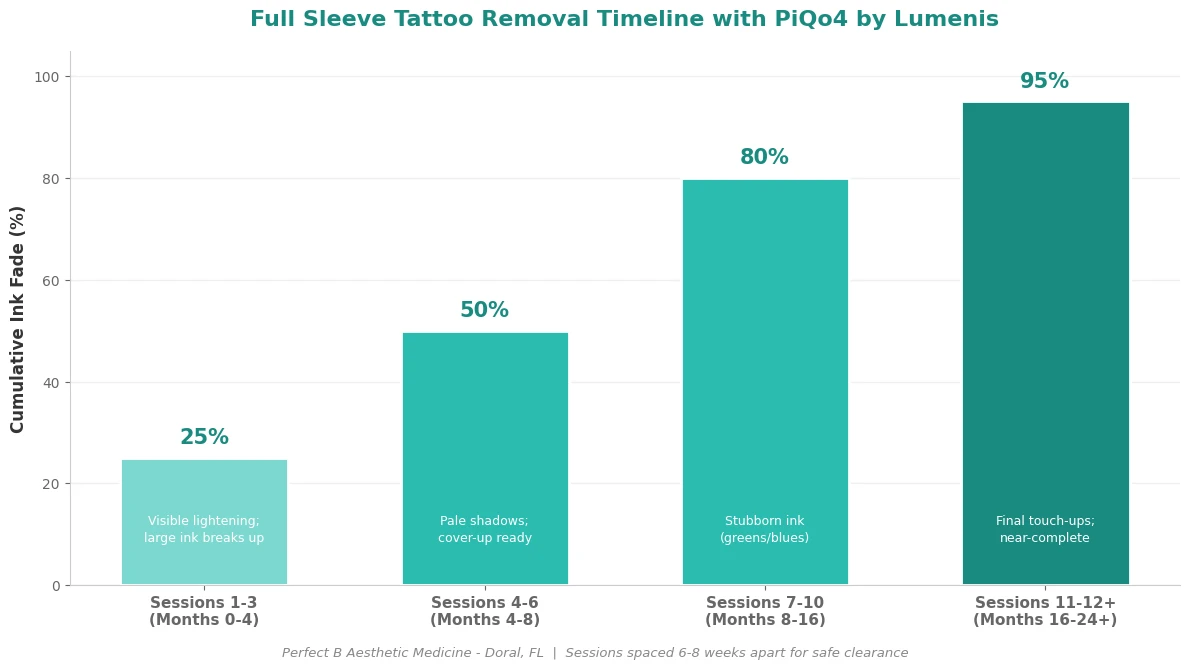
- Sessions 1-3 (Months 0-4): Visible lightening as the largest ink particles break up. The sleeve is still visible from arm’s length but is clearly fading.
- Sessions 4-6 (Months 4-8): Only pale shadows remain, much lighter than the original. This is when many patients consider stopping for a cover-up, which is far easier for a new tattoo artist to design over.
- Sessions 7-10 (Months 8-16): Stubborn residual ink, since greens, blues, reds, and certain blacks are the hardest. Sessions become more about the last twenty percent than fast progress.
- Sessions 11-12 or more (Months 16-24+): Final touch-ups, with any faint ghost images or outlines addressed. A few rare pigments never disappear completely.
Total time for near-complete removal is 12 to 24 months. Aggressive treatment with shorter intervals risks burns and permanent scarring, while conservative spacing protects your skin and delivers a cleaner final result.
Full Removal vs. Fading for a Cover-Up: Which Is Right for You?
This is the most practical decision most patients face, usually after four to six sessions once the ink has clearly begun to lift. The right answer depends entirely on your end goal.
Full Removal
- Goal: Clean, tattoo-free skin by session 10 to 12.
- Commitment: 18 to 24 months of ongoing appointments, with cost scaling across roughly 10 to 12 sessions.
- Ideal for: Patients who regret the tattoo, want to be ink-free, or plan a completely different design later.
- Comfort: Each session is tolerable with numbing cream and cooling, and any discomfort fades within days.
Fading for a Cover-Up
- Goal: Forty to fifty percent lightening by session five or six, enough for a tattoo artist to design over confidently.
- Commitment: Four to six months, after which you book your new artist right away.
- Ideal for: Patients who want new ink and cannot wait two years, or who want a design that creatively incorporates the old one.
- Artist insight: A fifty percent faded sleeve is far easier to cover than a dark original, letting the artist blend, add texture, or design a whole new piece overtop.
Many patients choose the cover-up route. They complete five or six laser sessions over four to six months, pause, and book their cover-up artist immediately, ending up with a fresh sleeve without the full two-year commitment.
PiQo4 by Lumenis: Why It Is the Fastest Laser for Sleeves
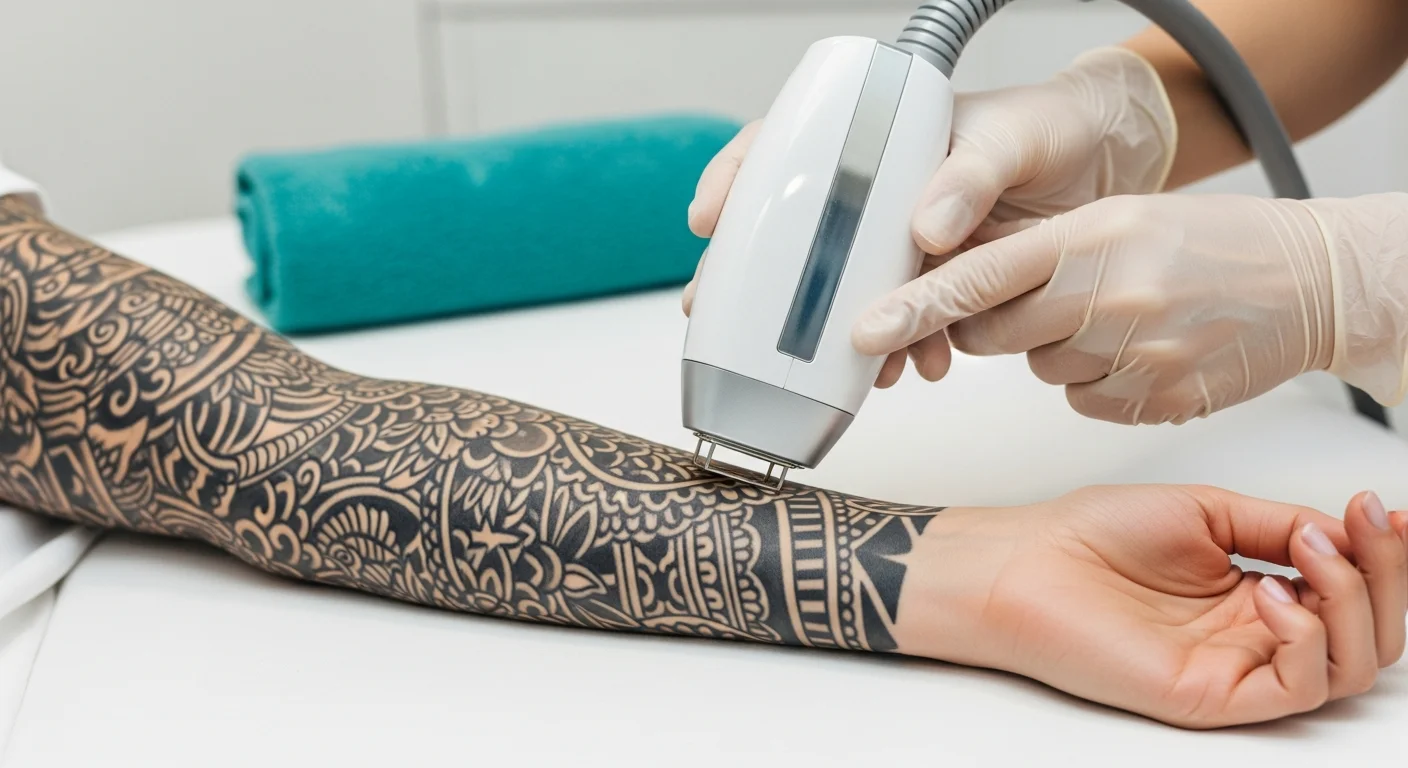
Not all tattoo-removal lasers are equal. At Perfect B in Doral we use PiQo4 by Lumenis, the gold standard for large-area tattoo work, and for a sleeve the device you choose directly affects how many sessions you will need.
- Picosecond pulses: Fragment ink into smaller particles than traditional nanosecond lasers, allowing faster clearance and fewer sessions overall.
- Larger spot size: Covers more ground per pulse, so sleeve sessions are faster and more comfortable than with older systems.
- Multiple wavelengths: Handle a wider range of ink colors, from black and red to green, blue, and yellow, in a single device with no need for outside referrals.
- Fitzpatrick-matched settings: Programmed for Miami’s diverse skin tones across Fitzpatrick I to VI, protecting darker skin from hypopigmentation or hypertrophic scars.
Dark and Tanned Miami Skin: Fitzpatrick-Matched Safety
Doral’s population includes significant numbers of Fitzpatrick III to VI skin tones. Older laser systems were programmed for light skin and caused hypopigmentation, the white spots that appear when pigment is stripped, or keloid scarring on darker tones. PiQo4’s Fitzpatrick calibration adjusts laser energy, pulse duration, and cooling for each skin type, which is what makes safe removal possible on skin of color.
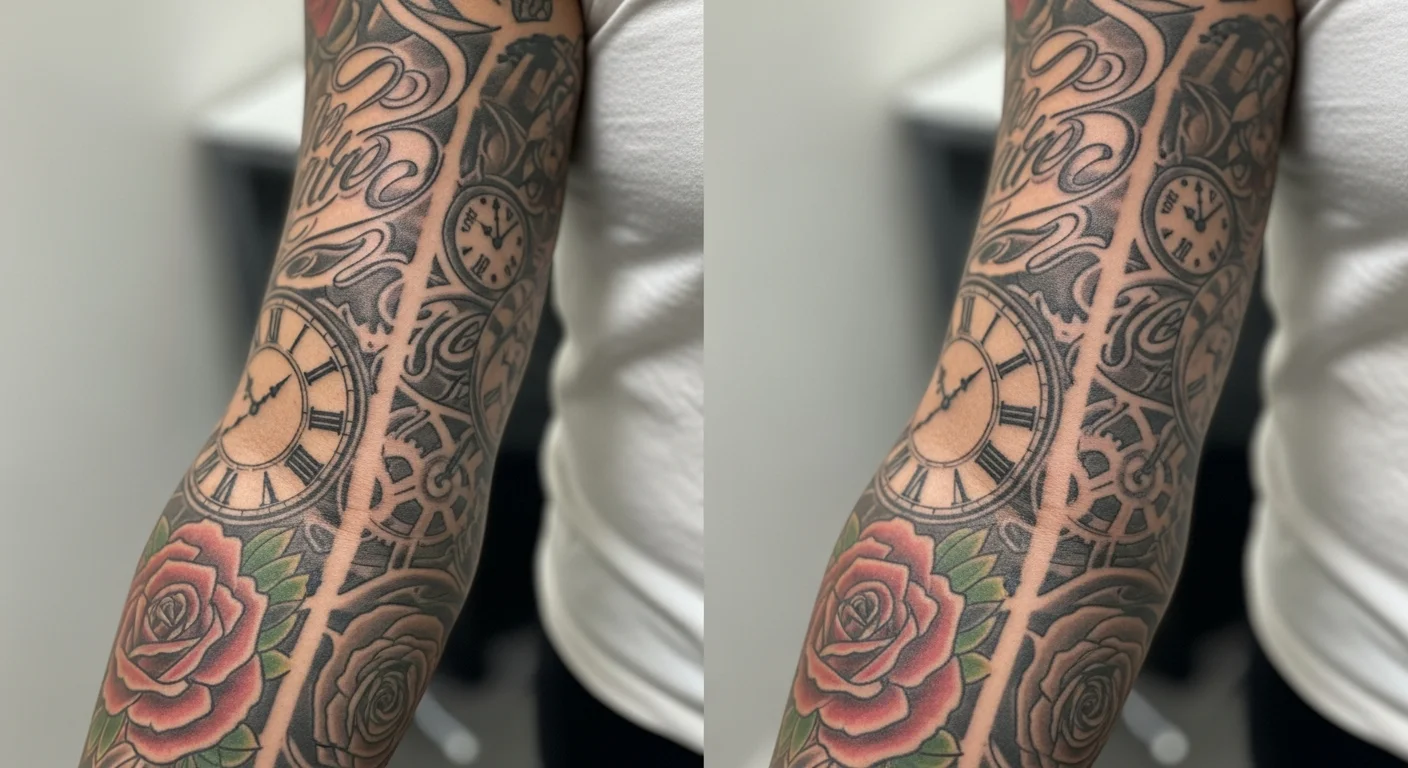
- Fitzpatrick III-IV (olive to light brown): Standard settings with an excellent safety profile and fast clearing.
- Fitzpatrick V-VI (deep brown to Black): Lower energy, longer pulse duration, and active cooling before and after, for safe, controlled fading.
The point is not that darker skin takes longer, it is that darker skin requires smarter settings, and PiQo4 in trained hands delivers exactly that.
How Many Sessions to Get Cover-Up Ready?
If you are a candidate for fading toward a cover-up, which is the route most sleeve patients take, here is the realistic progression to expect.
- Sessions 1-2 (Weeks 0-12): The sleeve drops twenty to thirty percent in intensity and colors begin to separate.
- Sessions 3-4 (Weeks 12-24): Another twenty to twenty-five percent fade, with outlines turning ghostly and solid color areas becoming patchy.
- Sessions 5-6 (Weeks 24-36): Forty to fifty percent total fade, at which point your tattoo artist can confidently design a new piece overtop.
The timeline to cover-up readiness is about six months. After that you are free to book your new artist and get the refresh you wanted, years sooner than full removal would allow.
Cost and Financing in Doral
Sleeve removal cost scales with size and complexity, so at Perfect B in Doral pricing is quoted at your consultation rather than as a flat online figure. No two sleeves are identical once you account for ink density, color variety, skin type, and any scarring history, and a real quote reflects a real evaluation. Packages for the higher session counts a sleeve requires are structured to bring the per-session cost down.
Financing is available through Cherry, Klarna, Afterpay, and CareCredit, so the cost of a full sleeve plan can be spread into manageable monthly payments. For detailed pricing and package options, see our full laser tattoo removal cost guide with session-count breakdowns and financing options for Doral and Miami patients.
What to Expect During and After a Sleeve Session
- Duration: Twenty to forty minutes depending on the size and complexity of the sleeve.
- Sensation: A warm, snapping feeling often compared to the snap of a rubber band, made very tolerable with numbing cream and a cold pack before and after.
- Immediately after: Mild redness and possible pinpoint bleeding, both normal, that resolve within one to two hours.
- Days 1-3: Slight swelling and dark scabbing as the ink debris rises, which is a good sign that fragmentation worked. Keep the area clean, moisturized, and protected with sunscreen.
- Weeks 2-6: Scabs shed and ink continues clearing through lymphatic drainage, so the skin looks lighter every week until your next session.
Frequently Asked Questions
1. Can I speed up sleeve removal by doing sessions every 3 to 4 weeks?
No, and it is unsafe. Your immune system needs six to eight weeks to clear the fragmented ink debris. Treating too soon overloads your lymphatic system and risks secondary scarring or hyperpigmentation, so shorter intervals do not mean faster removal, they mean skin damage.
2. What if my tattoo has a scar or is raised?
Raised or scarred tattoos are trickier. PiQo4 can treat over scars, but we adjust energy to avoid deepening the scar texture. A consultation is essential to map your tattoo’s condition and plan accordingly, so do not delay booking an assessment.
3. Is hypopigmentation permanent?
In rare cases, usually from over-aggressive treatment on darker skin with older lasers, it can be. PiQo4’s Fitzpatrick-matched settings are designed to prevent this, which is another reason to choose a provider experienced with your specific skin type.
4. Can I get a tattoo over a faded sleeve right away, or should I wait?
Wait about two weeks after your final laser session so the skin fully heals. After that most artists will work with you. Bring your treatment history from Perfect B to the new artist so they can adjust ink colors and needle depth if needed.
5. What ink colors are hardest to remove?
Greens and blues are the most stubborn because they reflect certain wavelengths and require more sessions. Reds clear faster, and blacks are usually the quickest. Multi-color sleeves take longer because each color needs targeted wavelengths.
6. How do I decide between full removal and a cover-up?
Ask yourself whether you want clean skin or a new tattoo. If you want ink again, full removal is unnecessary and fading for a cover-up saves you a year or more and reduces cost. If you want to be tattoo-free, commit to full removal. Either path delivers a result you will be happy with.
7. Will my sleeve removal be visible to others while in progress?
Yes, especially in the first three to four sessions when the fading is most dramatic and the sleeve looks noticeably lighter week to week. By session five or six it is a very pale shadow. If the in-progress look concerns you, plan your timing around it.
8. Can laser remove a tattoo that already covers an older tattoo?
Yes, but it is more complex. Two layers of ink mean more sessions and a higher chance of residual scarring, so a consultation is required to map both layers and advise on the safest approach.
Sleeve Removal at Perfect B in Doral: Your Next Step
Whether you are committing to full removal or aiming for cover-up-ready fading, a consultation is your first step. We assess your sleeve’s size, ink density, skin type, and healing history, then give you a realistic timeline and a clear price quote. A sleeve is a big project, but with PiQo4 and a proper plan the process is as fast and safe as it can be.

- 📍 Visit us at Perfect B, 3905 NW 107th Ave, Suite 104, Doral FL 33178
- 📞 Call or message us at (786) 502-2260
- 💳 Financing available through Cherry, Klarna, Afterpay, and CareCredit