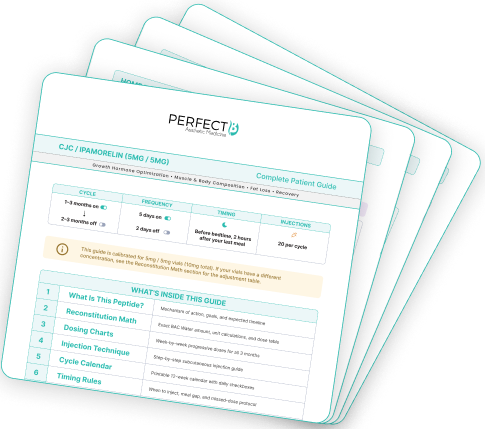
Curious what a medically supervised weight management plan actually looks like?
Perfect B’s protocol tool is built on real clinical data from 2,000+ patients treated in South Florida.
Answer 6 questions and see how supervised patients with similar goals are managed: which medications and peptides are used, typical titration, injection schedule, monitoring, and when a plan is paused or adjusted.
Perfect B, Doral Fl. | 07.16.26 | 12 min read.
This article is for general educational purposes and is not a substitute for an in-person medical evaluation. Tirzepatide is a prescription medication, and any weight management plan involving it is prescribed, dosed, and supervised by a licensed medical provider. Eligibility, availability, and pricing are determined only at a personal consultation.
What Compounded Tirzepatide Actually Is
Tirzepatide is the active ingredient in the brand-name medications Mounjaro and Zepbound, and it is one of the most effective weight management medications available today. It is a dual GIP and GLP-1 receptor agonist, which is a long way of saying it works on two of the body’s appetite and blood-sugar pathways at once. Compounded tirzepatide refers to the same active ingredient prepared by a licensed compounding pharmacy rather than dispensed in the manufacturer’s pre-filled brand-name pen. If you have been searching for compounded tirzepatide in Miami, the most important thing to understand is that it is a supervised medical treatment, not a shortcut you order from a website, and the rules around it changed meaningfully in 2024 and 2025.
This guide explains what compounded tirzepatide is, how it differs from the brand pens, what the end of the FDA shortage means for availability, how it is dosed and administered, who qualifies, and how a supervised clinic in Doral approaches it. For a direct head-to-head on which molecule fits which patient, see our dedicated comparison of how semaglutide and tirzepatide compare for medically supervised weight loss and which one tends to fit which patient.
Key Takeaways
- Compounded tirzepatide uses the same active ingredient as Mounjaro and Zepbound, prepared by a licensed pharmacy rather than in a brand pen.
- The FDA declared the tirzepatide shortage resolved in late 2024, which ended the broad, shortage-era compounding that many online sellers relied on.
- Compounding is still permitted in specific clinical situations for an individual patient, when a provider documents a genuine medical need. It is not a routine cheaper substitute.
- Tirzepatide is titrated slowly, usually starting at 2.5 mg per week and stepping up over months, always guided by how your body responds.
- The value of a program is the supervision: eligibility screening, baseline labs, monitoring, and a provider responsible for your safety.
- Whether compounded or brand tirzepatide, a peptide protocol, or another option is right for you is decided at a consultation, never from an online menu.
How Compounded Tirzepatide Differs From Mounjaro and Zepbound
Mounjaro and Zepbound are Eli Lilly’s brand-name tirzepatide products, sold as pre-filled, fixed-dose pens that have gone through the full FDA approval process. Mounjaro is approved for type 2 diabetes and Zepbound for chronic weight management. Compounded tirzepatide, by contrast, is prepared by a pharmacy, usually as a vial of solution that a patient draws into an insulin syringe. The active molecule is the same, but the presentation, the oversight pathway, and the regulatory status are different.
- Approval status: the brand pens are FDA-approved finished products. Compounded preparations are not FDA-approved; they are made by a pharmacy for a specific prescription.
- Format: brand tirzepatide comes in a single-use pen at set doses. Compounded tirzepatide is typically a vial plus a syringe, which is why understanding units and concentration matters.
- Dose flexibility: a compounded preparation can, in principle, be made at a strength that is not commercially available, which is one of the narrow clinical reasons compounding is still allowed.
- Cost and access: during the shortage, compounded versions were widely marketed as a lower-cost route. That access has narrowed sharply, which we explain next.
Why Clinics Compounded Tirzepatide, and What the FDA Shortage Change Means Now
For a stretch of 2023 and 2024, tirzepatide sat on the FDA drug shortage list. While a drug is officially in shortage, licensed pharmacies are allowed to compound versions of it to help patients who cannot get the brand product. That is why compounded tirzepatide became so widely available and so heavily advertised online during that period. It was a shortage-era allowance, not a permanent open door.
In October 2024 the FDA declared the tirzepatide shortage resolved, and after a brief re-evaluation it confirmed that decision. That change set enforcement timelines through 2025 for pharmacies to stop mass-producing compounded copies of tirzepatide. In plain terms: the era of buying compounded tirzepatide as a routine, cheaper stand-in for the brand pens has largely ended. Anyone still marketing it that way, with no evaluation and no supervision, is a red flag rather than a bargain.
Is Compounded Tirzepatide Still Legal and Available?
Compounding did not become illegal. What changed is the reason a pharmacy is allowed to do it. With the shortage resolved, a licensed pharmacy may still compound tirzepatide for an individual patient when a prescriber documents a specific clinical need that the commercially available product cannot meet. Classic examples include a strength that is not sold commercially or a documented issue with an ingredient in the brand pen. This is a case-by-case medical decision, not a blanket program.
What this means for you as a patient is simple: whether compounded tirzepatide is appropriate and available in your situation is something only a licensed provider can determine after evaluating you. A responsible clinic will tell you honestly whether the brand product, a compounded preparation, a different medication, or a supervised peptide protocol is the right fit, rather than pushing whatever is easiest to sell.
How Tirzepatide Is Dosed and Titrated
Tirzepatide is injected once a week under the skin, and the dose is raised slowly over time. Starting low and stepping up gradually is what keeps the common early side effects, mainly nausea and digestive upset, manageable for most people. A standard schedule usually begins at 2.5 mg per week for the first four weeks, then increases in steps toward a maintenance dose, with each step guided by how you tolerate it and how you respond.
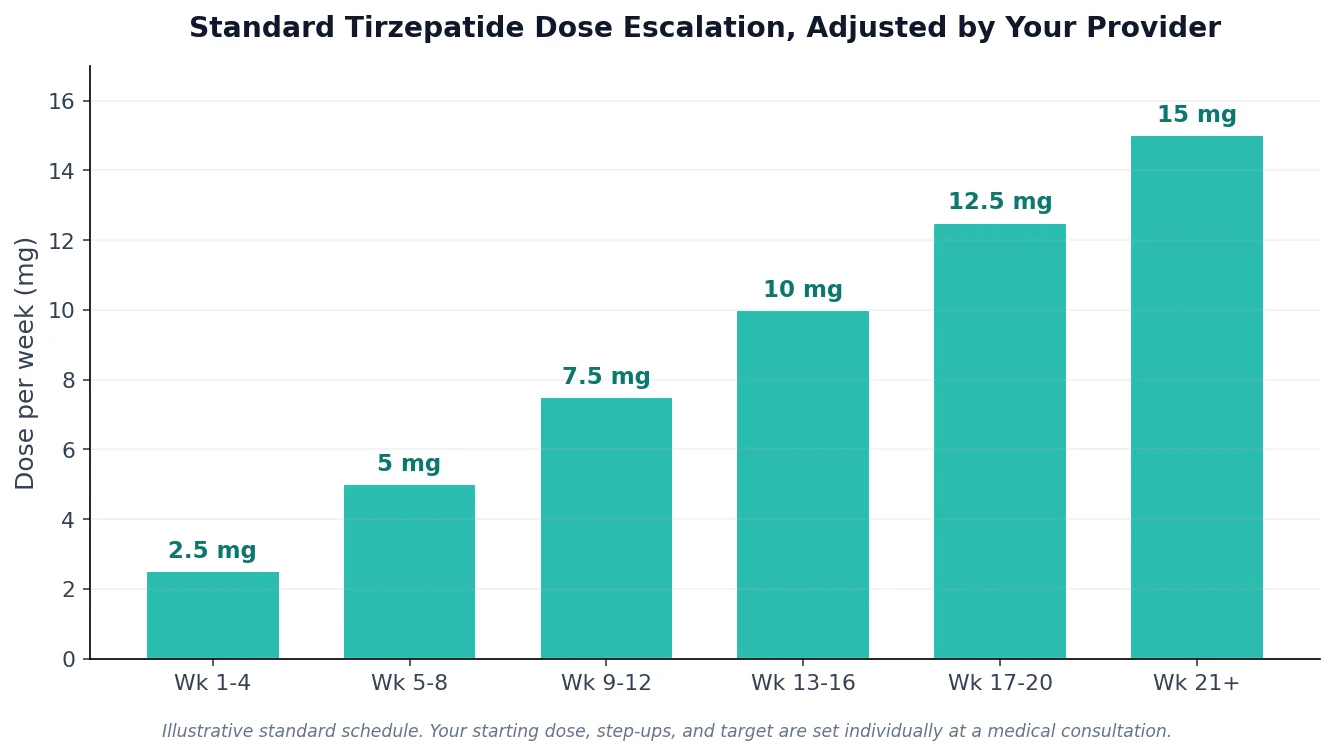
The schedule above is illustrative of a standard titration, not a prescription. Your real starting point, how quickly you move up, and where you settle are set by your provider based on your health, your goals, and your tolerance. This is exactly why a vial-and-syringe compounded product, where you measure units yourself, should never be run without proper instruction and monitoring.
How It Is Administered and Stored
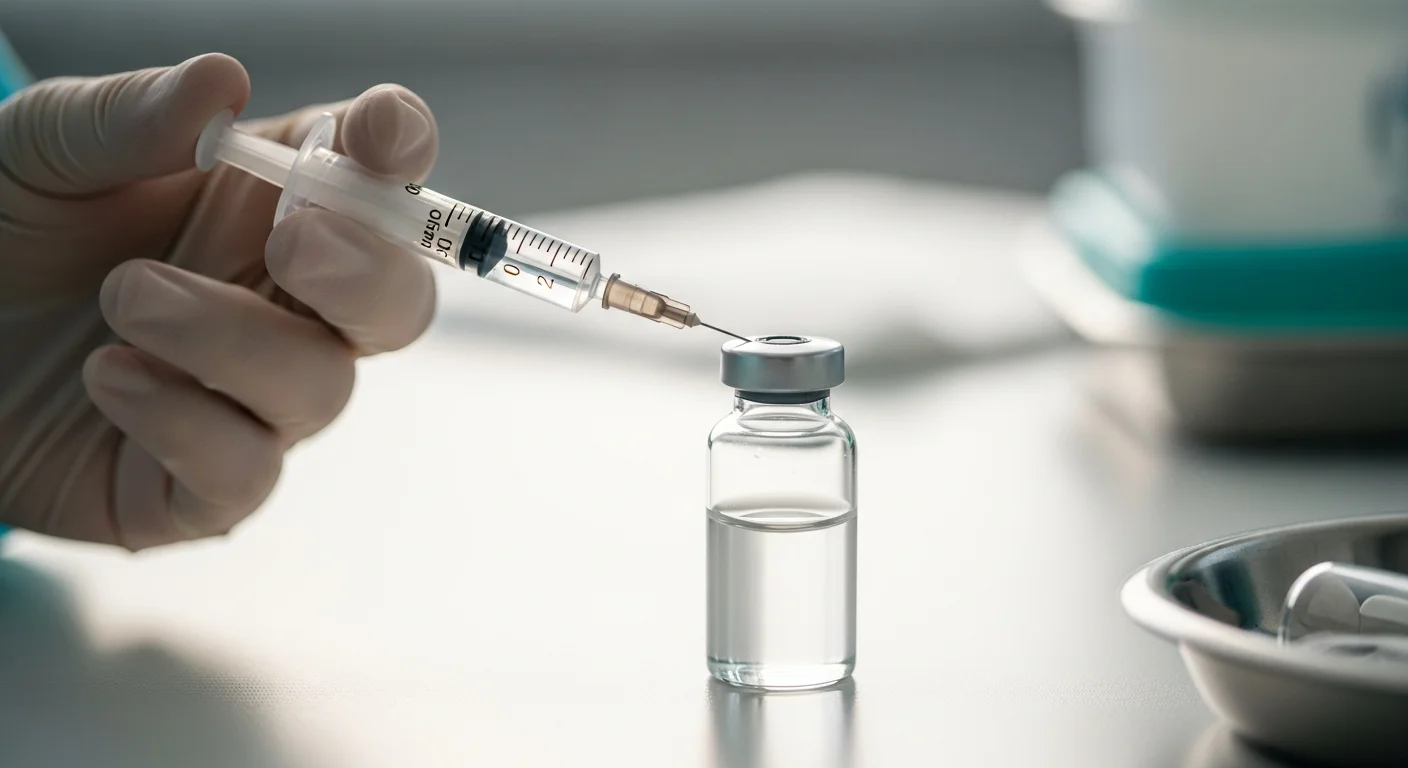
With a brand pen, the dose is fixed and you simply click and inject. With a compounded vial, you draw the prescribed number of units into an insulin syringe and inject subcutaneously, typically in the abdomen or thigh, rotating the site each week. Because you are measuring the dose yourself, clear instruction on concentration and units is essential, and it is a core reason supervision matters more with a compounded preparation than with a fixed pen.
Storage matters too. Tirzepatide preparations are generally kept refrigerated, protected from light, and used within the timeframe your pharmacy specifies. A supervised program walks you through all of this at the start, so you are not guessing from a forum post.
Who Is a Candidate, and How Eligibility Is Decided
Tirzepatide is generally considered for adults managing excess weight or related metabolic goals, usually alongside nutrition and activity changes, when a provider judges the benefits to outweigh the risks for that person. It is not for everyone. A personal and family history of certain thyroid tumors, a history of pancreatitis, pregnancy, and a few other conditions are reasons a provider may rule it out or choose a different path.

Eligibility is decided the same way any responsible medical decision is: a consultation, a review of your health history, and often baseline labs, so there is a clear starting picture and something to measure against. If a seller offers you tirzepatide without any of that, they are skipping the exact steps that keep the treatment safe. To see what a structured, monitored plan feels like month to month, read our walkthrough of what your first month on a medically supervised weight management protocol actually involves in Miami.
Safety, Sourcing, and What Real Medical Supervision Adds
The biggest risk with tirzepatide today is not the molecule itself, which is well studied, but where and how people obtain it. Buying from unregulated online sellers or overseas gray-market vendors carries real dangers around purity, correct dosing, and the complete absence of medical oversight. When a compounded preparation is appropriate, it should come from a licensed pharmacy that follows recognized compounding standards, prescribed by a provider who is responsible for your care.
Supervision is the product. A real program screens you for contraindications, orders baseline labs, teaches you to dose and inject correctly, monitors your response and side effects, and adjusts the plan over time. That is precisely what the cheapest online route lacks, and it is why the savings are rarely worth the gamble. If you want to understand the sourcing question in depth, our guide on how patients at our clinic weigh supervised peptides against GLP-1 medications, and why the choice is individual covers the same principle from the peptide side.
Compounded Tirzepatide vs Peptide Therapy for Weight Loss
Tirzepatide is technically a peptide, but it belongs to the GLP-1 class of medications and is very different from the peptides people mean when they say peptide therapy for body composition, such as Tesamorelin or AOD 9604. GLP-1 medications like tirzepatide act strongly on appetite and blood sugar, which tends to drive larger, faster weight loss. Body-composition peptides work through different mechanisms and are chosen for different goals. They are not interchangeable, and a good clinic treats them as separate tools rather than competing products.
For many patients the honest answer is that the right plan depends entirely on their health, history, and goals, which is the whole reason it is decided in a consultation. Facial changes during rapid weight loss, sometimes called Ozempic face, are a separate topic; if that is your concern, see our guide on how to prevent and manage facial volume loss while using weight loss injections like tirzepatide.
Cost, Value, and What to Expect at a Consultation in Doral
Because the right medication, dose, and monitoring plan are individual, pricing is confirmed at a consultation rather than quoted as a flat number online. That is not evasiveness; it is how responsible medical weight management works, since your plan is built around your evaluation rather than a one-size product. At Perfect B in Doral, financing is available through Cherry, Klarna, Afterpay, and CareCredit so the cost can be spread out once your plan is set.
A first visit typically covers your health history, your goals, a discussion of realistic expectations, and whether tirzepatide, another medication, or a supervised peptide protocol is the best route for you, along with any baseline labs. You leave with a clear, honest plan rather than a product pushed on you.
Frequently Asked Questions
1. What is compounded tirzepatide?
It is the same active ingredient found in Mounjaro and Zepbound, prepared by a licensed compounding pharmacy rather than sold as a brand-name pen, usually as a vial that a patient draws into an insulin syringe. It is a prescription treatment that should be used under medical supervision, not a supplement or an online shortcut.
2. Is compounded tirzepatide the same as Mounjaro or Zepbound?
The active molecule is the same, but the brand pens are FDA-approved finished products at fixed doses, while a compounded preparation is made by a pharmacy for a specific prescription and is not FDA-approved. The format, oversight pathway, and regulatory status differ, which is why a provider decides which is appropriate for you.
3. Is compounded tirzepatide still available after the FDA shortage ended?
The broad, shortage-era compounding largely ended after the FDA declared the tirzepatide shortage resolved in late 2024, with enforcement timelines through 2025. Compounding is still permitted case by case for an individual patient when a provider documents a specific clinical need, so availability is now a medical decision rather than an open program.
4. Is compounded tirzepatide safe?
The tirzepatide molecule is well studied, so the safety question is really about sourcing and supervision. A preparation from a licensed pharmacy, prescribed and monitored by a provider, is very different from a vial bought off an unregulated website. The screening, labs, and monitoring are what make it safe, and those are exactly what the gray market skips.
5. How is tirzepatide dosed?
It is injected once a week and titrated slowly, commonly starting at 2.5 mg per week and stepping up over months as tolerated. Raising the dose gradually keeps early side effects like nausea manageable. Your actual schedule is set by your provider, and with a compounded vial you must be taught how to measure units correctly.
6. How much does compounded tirzepatide cost in Miami?
Because the medication, dose, and monitoring are individual, pricing is confirmed at a consultation rather than quoted as a flat online number. At Perfect B in Doral, financing is available through Cherry, Klarna, Afterpay, and CareCredit once your plan is set, so the cost can be spread out.
7. Who should not take tirzepatide?
Tirzepatide is generally avoided in people with a personal or family history of medullary thyroid carcinoma or MEN 2, a history of pancreatitis, during pregnancy, and in a few other situations. This is why a provider screens your history before prescribing anything and may recommend a different approach if it is not a safe fit for you.
8. Is tirzepatide a peptide, and how is it different from weight loss peptides like Tesamorelin?
Tirzepatide is technically a peptide, but it is a GLP-1 class medication that acts strongly on appetite and blood sugar, which is different from body-composition peptides such as Tesamorelin or AOD 9604. They work through different mechanisms and suit different goals, so a clinic treats them as separate tools and chooses based on your evaluation rather than treating them as interchangeable.
Talk to a Provider About Supervised Weight Loss in Doral
Compounded tirzepatide is not a product to chase on price; it is one option within a supervised medical plan, and whether it fits you is a decision to make with a licensed provider. The safe path is the same one that works for any effective weight management treatment: get evaluated, understand your options honestly, and let a provider build and monitor a plan around you.
If you are ready to find out what the right supervised option is for your health and goals, the providers at Perfect B in Doral will evaluate you, explain tirzepatide and the alternatives plainly, and build a plan that starts on a safe, informed footing.
- 📍 Visit us at Perfect B, 3905 NW 107th Ave, Suite 104, Doral FL 33178
- 📞 Call or message us at (786) 502-2260
- 💳 Financing available through Cherry, Klarna, Afterpay, and CareCredit