
Perfect B, Doral, FL. | 03.19.26 | 8 min read.
Upneeq, Neurotoxin, RF, and Filler: How a Miami Clinic Builds a Non-Surgical Eye Protocol
This content is for educational purposes only and does not constitute medical advice. Consult a qualified medical provider before starting any aesthetic treatment. To understand your options, see how How do I get rid of lines on my face?, and the Botox and treatment options used at Perfect B in Doral.
The Eye Area Is Where Aging Announces Itself First
The eyes are the first place people look when they look at you, and often the first place age makes itself visible. Hooded lids, hollow under-eyes, a brow line that has dropped slightly, fine lines that gather at the corners. These changes are subtle at first. Then one day a patient comes in and says: “I just look tired all the time, and I’m not.” That’s the moment the non-surgical eye lift conversation begins.
Surgery is one answer. Blepharoplasty is highly effective for the right candidate. But a growing number of patients, including many who would qualify for surgery, want results without downtime, without incisions, and without the permanence of an irreversible procedure. Non-surgical eye lifting has become one of the most requested services at our Doral, FL clinic because the tools available today are genuinely capable of producing meaningful change, when combined correctly and matched to the right anatomy.
Key Takeaways
- Non-surgical eye lifting is a combination protocol: Upneeq, neurotoxin, RF, and conservative filler each address different aspects of the eye area. The synergy is what produces results.
- Hooded lids and hollow under-eyes require completely different strategies: using the wrong approach on the wrong anatomy is how you get suboptimal or unnatural outcomes.
- Realistic expectations matter: non-surgical treatments create a refreshed, well-rested version of the eyes. They don’t replicate surgical blepharoplasty.
- Some patients should be referred for surgery: significant excess skin, heavy eyelids, or pronounced fat pads are cases where non-surgical tools reach their limit.
- Around the eyes, less is more: precision and restraint are what separate a natural outcome from one that looks heavy or overdone.
What a Non-Surgical Eye Lift Actually Involves
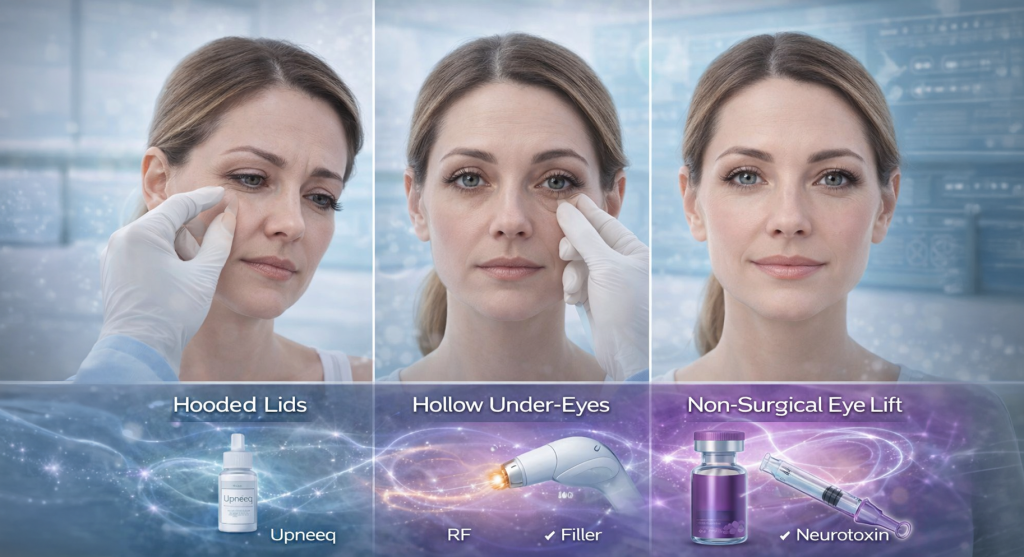
There is no single non-surgical eye lift procedure. The phrase describes a protocol built from multiple tools, each targeting a different structural or functional element of the eye area. At our clinic in Doral, the approach is always customized, but the core toolkit typically includes some combination of the following:
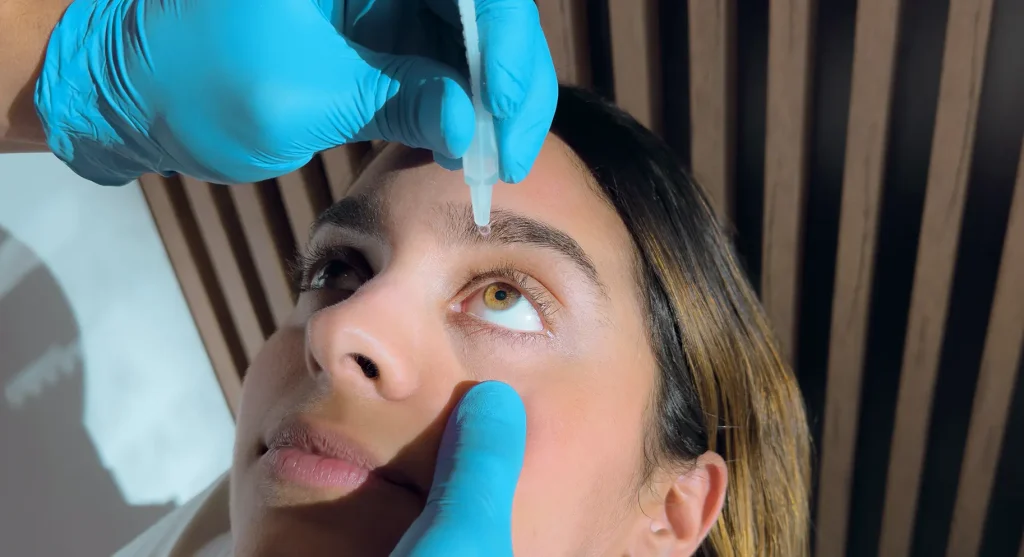
Upneeq (Oxymetazoline Hydrochloride)
Upneeq is an FDA-approved prescription eye drop that works by stimulating the superior tarsal muscle, which controls how open the eye is. The result is a subtle but noticeable lift of the upper eyelid, typically 1 to 2 millimeters, without injections or recovery. For patients considering this approach, see our eye lifting solution treatment plan. It works quickly, with visible effect within minutes of application, and is used daily or on an as-needed basis. For patients whose primary concern is the appearance of drooping or heavy upper lids without significant excess skin, Upneeq can be a standalone option or a complement to other treatments.
Neurotoxin (Brow Depressor Relaxation)
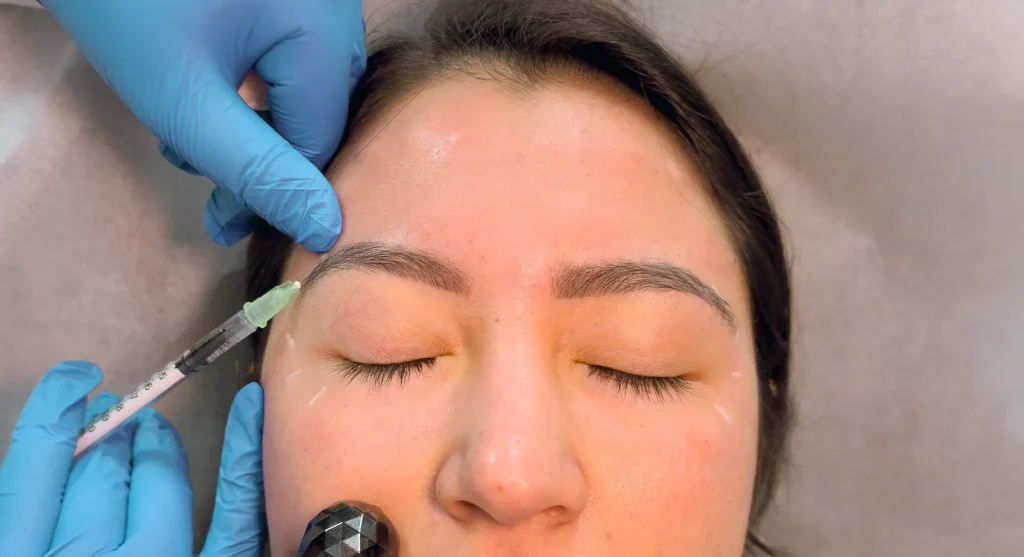
A small and precisely placed amount of neurotoxin relaxes the muscles that pull the brow downward, the brow depressors. See our neurotoxin treatment plan for full protocol details. When these muscles are overactive, they counteract the muscles that lift the brow, and the result is a heavy, low brow that crowds the upper eyelid. Releasing the depressors allows the brow to sit at a higher resting position naturally. This is not the same as a “frozen” or elevated brow. Done correctly, it looks like nothing happened except that the patient looks less tired. The correction is subtle and mobile, not static.
Neurotoxin at the brow and orbital rim also smooths the lines that form at the outer corners of the eyes, which contributes to an overall fresher appearance without altering the fundamental expression of the face.
Radiofrequency (RF) Skin Tightening
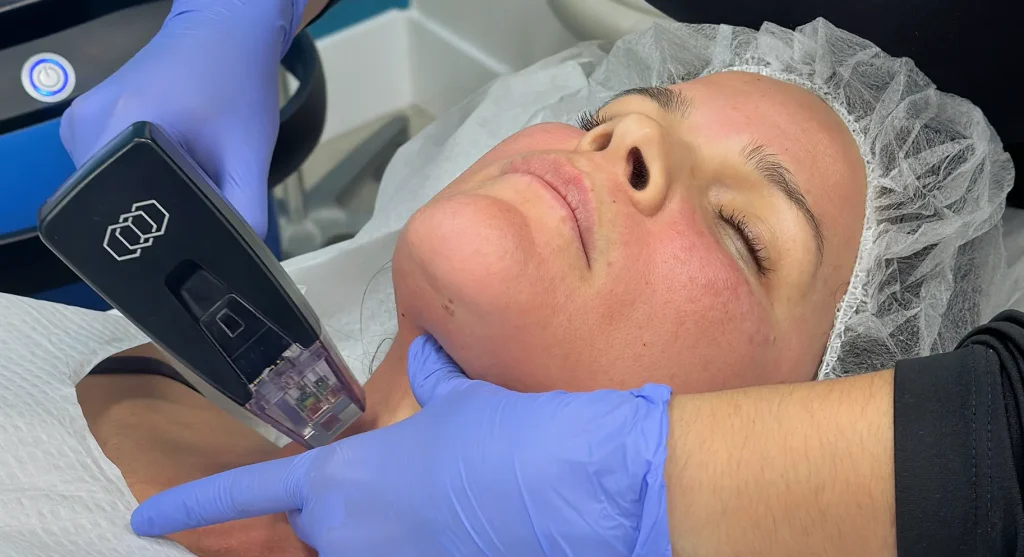
RF energy heats the deeper layers of the periorbital skin, stimulating collagen remodeling and improving tissue firmness over time. For patients with mild skin laxity around the eye, particularly hooding that is driven by loose skin rather than structural brow descent, RF addresses the tissue quality itself. It requires multiple sessions spaced 4 to 6 weeks apart, with results building progressively over 3 to 6 months as new collagen is produced. A clinical study evaluating radiofrequency treatment of the periorbital area, confirming consistent improvement in skin laxity, tissue firmness, and periorbital wrinkle reduction with repeated sessions. Our skin tightening treatment plan covers the full RF protocol we use at Perfect B.
Conservative Filler for Structural Support
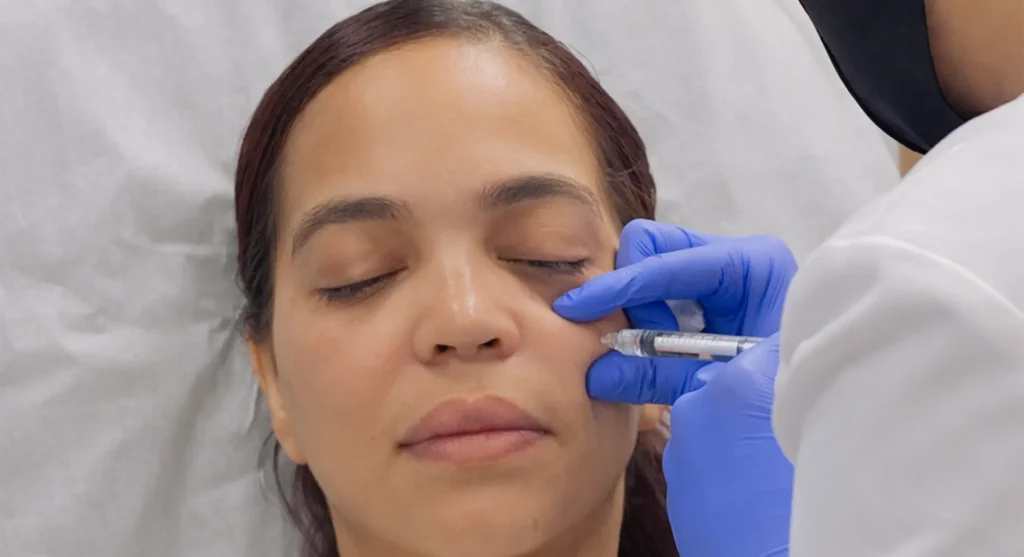
Filler in the eye area must be approached with extreme restraint. A very small amount of hyaluronic acid filler placed at the temple or upper cheek can provide structural support that indirectly lifts the tail of the brow. Under-eye filler addresses the tear trough, which is the hollowing that creates a shadow and makes patients appear exhausted regardless of how much sleep they got. The keyword is conservative. The eye area is unforgiving. Too much filler creates a puffy, heavy appearance that is the opposite of the intended effect. Less is genuinely more here, and building gradually over multiple appointments is safer and more predictable than placing volume aggressively in a single session.
Hooded Lids vs. Hollow Under-Eyes: Two Completely Different Protocols
One of the most important diagnostic distinctions in the non-surgical eye lift consultation is identifying what the patient actually has, because the treatment approach is fundamentally different depending on the anatomy.
Hooded Lids
Hooding occurs when excess skin folds down from the upper eyelid, partially covering the lid margin. The causes can be skin laxity (the skin itself has lost elasticity and droops), brow ptosis (the brow has descended, pushing skin downward), or a combination of both. The non-surgical approach for hooded lids focuses on lifting and tightening: brow depressor neurotoxin to allow the brow to sit higher, Upneeq if ptosis is a factor, and RF to improve skin firmness over time. Volume replacement is typically not the priority here, and adding filler to a hooded lid area can make hooding worse by adding weight where the tissue is already heavy.
Hollow Under-Eyes (Tear Trough)
Hollowing under the eyes is a volume issue. The fat pads that support the under-eye area migrate downward with age, and the bone beneath resorbs, creating a depression that casts a shadow. This shadow reads as darkness and fatigue. Our dark circles treatment plan covers the tear trough anatomy and filler approach in detail. Neurotoxin and RF do not address this because there’s no excess tissue or muscle tone to correct; the problem is absence of volume. Careful placement of a small amount of hyaluronic acid filler in the tear trough or at the mid-cheek to provide structural support is the appropriate intervention. The key precaution: filler placed under-eye must be placed in the right tissue plane. Superficial placement or overfilling leads to a Tyndall effect (a bluish tint visible through thin skin) or to puffiness. This is a treatment that demands technical precision above all else.
Many patients present with both hooding and hollowing, which means the protocol layers techniques from both categories. The sequencing matters: address structure and lift first, then assess volume needs once the architecture is in its correct position.
What Results Look Like: Realistic Expectations
The outcome of a well-executed non-surgical eye lift is this: the patient looks like a well-rested, refreshed version of themselves. The eyes appear more open, the brow sits in a more alert position, shadows are reduced, and fine lines are softened. People who see the patient regularly may not be able to identify what changed. They just notice that the person looks better.
What non-surgical treatment cannot achieve is a structural correction equivalent to surgery. A blepharoplasty removes excess skin and repositions or removes fat pads with precision and permanence that no combination of neurotoxin, filler, and energy devices can fully replicate. The non-surgical approach is powerful within its range. Understanding that range is what allows for an honest consultation and a satisfied patient.
Patients who have had the best responses to non-surgical eye lifting are typically those in their late 30s to mid-50s with mild to moderate changes, patients who had surgery and want to maintain results between procedures, and patients for whom surgery is not possible due to health reasons or personal preference. Patients with very significant excess skin, pronounced fat prolapse, or major structural brow ptosis are candidates for a surgical conversation, even if non-surgical treatment can provide some interim improvement.
When Surgery Is the Right Answer
Part of what makes a non-surgical consultation genuinely useful is knowing when to stop and refer. At Perfect B in Doral, when a patient presents with significant excess skin that physically impairs their field of vision, heavy fat pads that are causing the upper lids to sit low regardless of brow position, or brow descent that is severe enough that neurotoxin alone cannot create meaningful improvement, the honest recommendation is a surgical referral. Guiding a patient toward the right tool for their problem is better care than attempting to manage with non-surgical options that will inevitably underdeliver.
That said, many patients who initially present thinking they need surgery find that non-surgical correction gets them 70 to 80 percent of the way there, and for them, that is genuinely enough. The gap between non-surgical and surgical outcomes depends entirely on the starting anatomy.
Frequently Asked Questions About Non-Surgical Eye Lift
How much of a lift can I realistically expect without surgery?
Most patients see a noticeable improvement in eye openness, reduced shadow under the eye, and a more alert brow position. Quantifying it precisely is difficult because the improvement is cumulative across multiple techniques. The realistic benchmark: you will look like a refreshed, well-rested version of yourself. Browse our eye lifting solution treatment plan to understand what a full protocol looks like at our Doral clinic. You will not look like you had surgery.
How long does a non-surgical eye lift last?
Upneeq provides daily effect, wearing off after several hours. Neurotoxin typically lasts 3 to 4 months. Filler in the under-eye area often lasts 9 to 18 months depending on the product and patient metabolism. RF results build over 3 to 6 months after a treatment series and can persist for 1 to 2 years. Maintaining results requires periodic repeat treatments.
Is there downtime after a non-surgical eye lift?
RF therapy involves no downtime. Upneeq is a daily eye drop with no recovery period. Neurotoxin and filler may cause mild bruising or swelling at injection sites for 24 to 72 hours. The under-eye area is more prone to bruising than other injection sites due to the thin skin and proximity to small vessels. Plan for a few days of potential puffiness after filler in that area.
Can non-surgical eye lift treatments be combined in the same appointment?
Yes, neurotoxin and Upneeq are typically introduced together or in close sequence. Filler is often staged separately so the injector can assess the effect of neurotoxin before adding volume. RF is typically a separate appointment series. Your provider will recommend a sequencing plan based on your specific anatomy and goals.
Who is not a good candidate for non-surgical eye treatments?
Patients with significant upper lid excess skin, pronounced fat pads, severe brow ptosis, or functional issues (vision impairment from lid drooping) are better served by a surgical consultation. Patients with certain eye conditions, glaucoma treated with alpha-agonist drops, or cardiovascular disease should discuss Upneeq carefully with their provider before use. Filler under the eye is contraindicated in patients with a history of certain filler complications or prior procedures that may have altered the tissue plane.
What’s the risk of looking unnatural after non-surgical eye treatments?
The most common cause of unnatural outcomes in the eye area is excess filler volume. The under-eye and periorbital skin is extremely thin, and any filler that is placed too superficially, in too large a quantity, or in the wrong product will be visible. Neurotoxin placed incorrectly around the eye can cause brow asymmetry or a surprised appearance. These risks are minimized by choosing a provider with specific experience in periorbital anatomy and by choosing conservative volume on a first appointment. The eye area rewards a less-is-more approach every time.
If You Are in the Miami Area and Considering Non-Surgical Eye Rejuvenation
The periorbital area is one of the most technically demanding regions to treat in aesthetic medicine. The tools are available, the results are real, and the protocols are well-established at clinics with experience in this work. What separates a good outcome from a great one is knowing which tool to use, in what quantity, in what sequence, and for which anatomy.
Relevant treatment plans at Perfect B: Eye Lifting Solution | Skin Tightening | Neurotoxin | Facial Balancing | Dark Circles | Non-Surgical Face Lift.
At Perfect B in Doral, non-surgical eye lift consultations include a full assessment of lid anatomy, brow position, skin quality, and volume distribution before any treatment is recommended. If surgery is the right answer for your anatomy, we will tell you that clearly rather than oversell what non-surgical options can achieve.
→ Book a non-surgical eye lift consultation at Perfect B, Doral, FL