
Perfect B, Doral Fl. | 05.26.26 | 10 min read.
This content is for educational purposes only and does not constitute medical advice. Peptide therapy for hair growth requires evaluation by a licensed medical provider before starting any protocol. If you are exploring this, it helps to see how medically supervised peptide therapy at Perfect B in Doral works and how each protocol fits a complete, monitored plan. For more on this, see our guide to Can You Drink on Peptides? Alcohol Effect, and how it is evaluated and treated at Perfect B in Doral.
Why “Peptides for Hair Growth” Is Trending and Why Most Online Sources Get It Wrong
Searches for “peptides for hair growth” have grown from 6,600 per month in May 2025 to 27,100 per month in April 2026, a 310 percent increase in 12 months. Most of the SERP is dominated by shopping listicles from beauty media, e-commerce product pages on Amazon and Sephora, telehealth brands selling topical scalp serums, and a small number of peer-reviewed academic papers. What is missing from the top 10 results is the perspective of a medical clinic that actually prescribes injectable peptide protocols and watches real patients respond over 3, 6, and 12 months.
The single most important distinction the trending search misses: a topical peptide serum sold over the counter and an injectable peptide protocol prescribed and supervised by a medical clinic are not the same product, do not deliver the same dose, and do not produce the same clinical outcome. This guide breaks down which peptides actually work for hair growth, which 4 we use clinically at Perfect B in Doral, FL, and what separates a real medical protocol from a shopping cart purchase.
Key Takeaways
- 4 peptides Perfect B uses clinically for hair growth: GHK-Cu (copper peptide), PDRN (salmon DNA), CJC-1295/Ipamorelin (GH pathway), and the BPC-157/TB-500 Wolverine stack.
- GHK-Cu is the most researched peptide for hair growth, with documented effects on VEGF stimulation, follicle repair, and scalp microcirculation.
- Topical peptide serums sold over the counter are not equivalent to injectable clinical protocols. Dose, delivery, and concentration are fundamentally different.
- Clinical peptide protocols start at $445 per 3-month cycle at Perfect B in Doral, FL, including peptide, kit, guide, and provider follow-up. Stack pricing scales to $1,395 for the full 4-peptide protocol.
- Peptides for hair are often combined with Minoxidil or Finasteride based on the patient’s hormonal profile and hair loss pattern, decided at the consultation.
What Peptides Actually Do for Hair: The Science of Follicle Stimulation
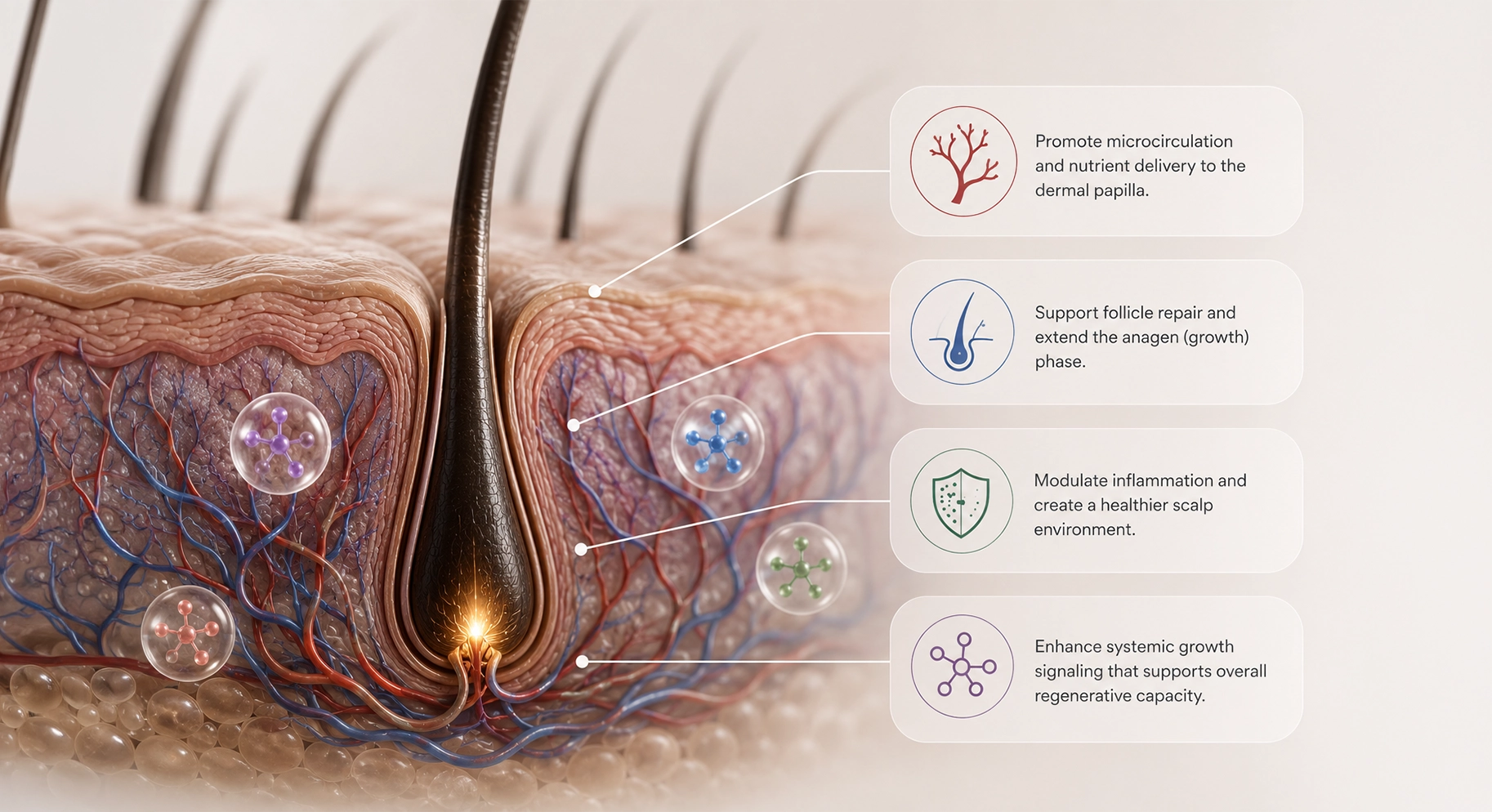
A peptide is a short chain of amino acids that signals specific cellular behavior. For hair growth, the relevant signaling pathways are: vascular stimulation (more blood flow to the dermal papilla), follicle repair (extending the anagen growth phase), inflammation modulation (calming the chronic low-grade inflammation that contributes to follicular miniaturization), and systemic growth signaling (IGF-1 levels that influence overall regenerative capacity).
Different peptides target different pathways. A peer-reviewed overview of short peptides for hair loss in the PMC NIH database confirming that copper peptide GHK-Cu stimulates VEGF production in dermal fibroblasts, supports microvascular angiogenesis, and facilitates collagen and GAG synthesis at the follicle level. A foundational peer-reviewed study in PubMed documenting the early clinical research on copper-peptide complexes and their role in tissue repair and follicular signaling that established the scientific basis for modern hair-growth peptide protocols.
What matters clinically is that no single peptide does everything. The follicle is a complex micro-organ, and a complete protocol typically signals to vascularization, repair, and the systemic GH axis in parallel. This is why our protocols at Perfect B are not single-compound prescriptions but layered combinations chosen for each patient.
The 4 Peptides Perfect B Uses for Hair Growth and What Each One Targets
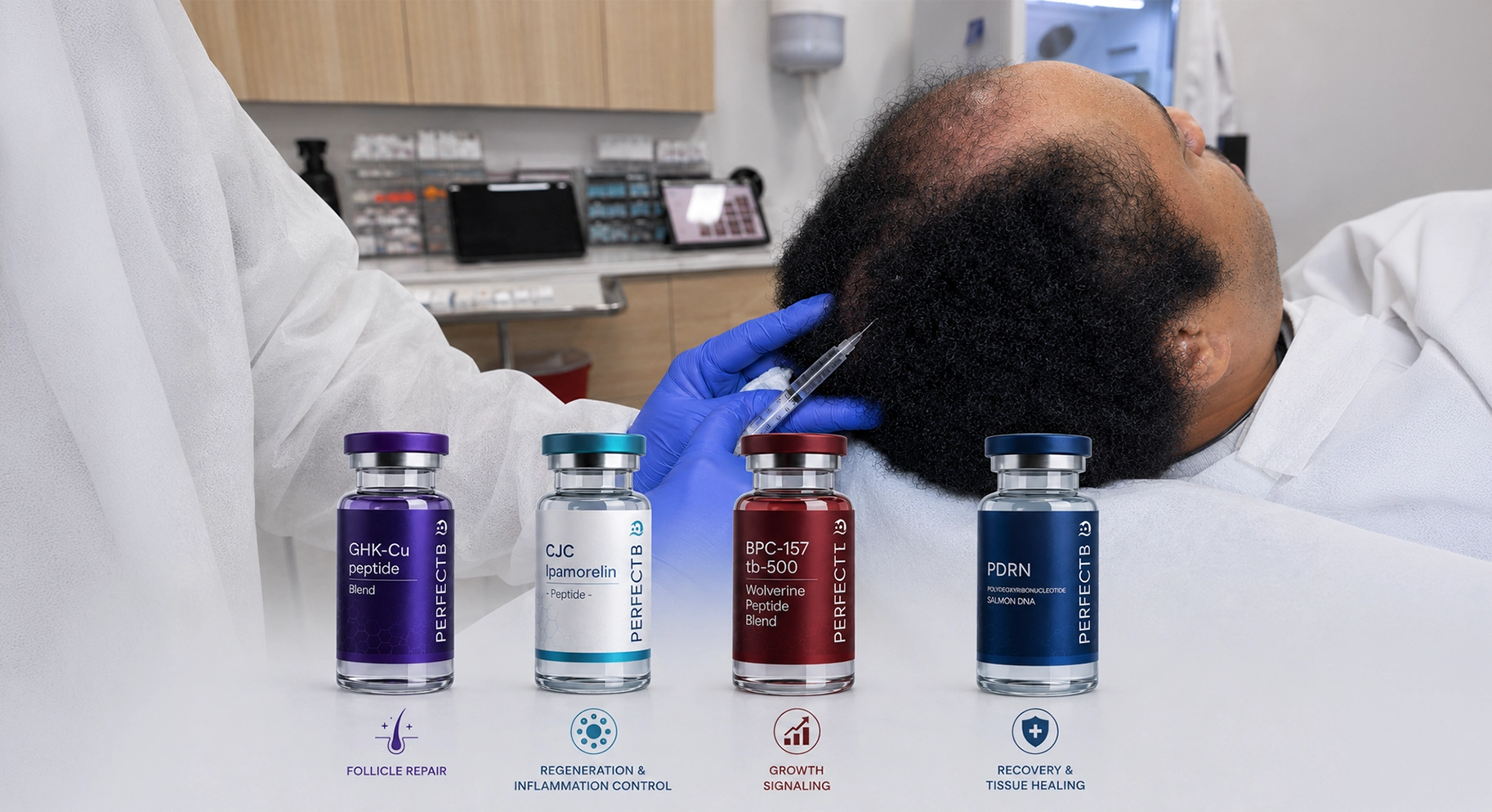
The 4 peptides we use clinically at Perfect B for hair growth are not interchangeable. Each one targets a different pathway and is delivered through a different method. We never prescribe all 4 to every patient. Selection is decided at the $150 initial consultation based on labs, scalp evaluation, hair loss type (androgenetic, telogen effluvium, post-inflammatory, hormonal), and the patient’s overall goals.
- GHK-Cu (Copper Peptide): Follicle repair, VEGF stimulation, scalp microcirculation. Delivered topically or via microneedling depending on protocol.
- PDRN (Polydeoxyribonucleotide / Salmon DNA): Inflammation modulation, tissue regeneration, scalp environment optimization. Delivered as scalp injection.
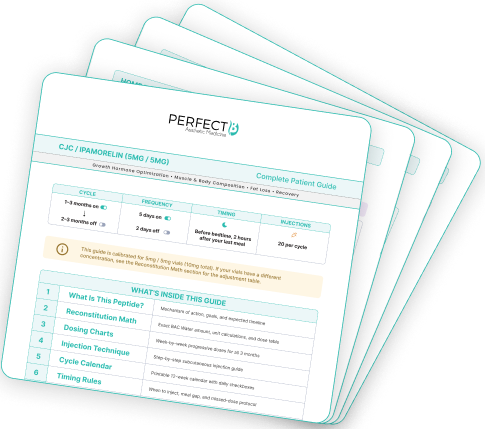
- CJC-1295/Ipamorelin: Systemic growth hormone pathway. Increases IGF-1, supports overall regenerative capacity including hair follicle anagen extension. Delivered subcutaneously.
- BPC-157/TB-500 (Wolverine Stack): Systemic tissue healing and recovery. Used in patients with scalp inflammation, post-inflammatory hair loss, or recovery from procedures. Delivered subcutaneously.
This 4-peptide model is what separates Perfect B from telehealth platforms that prescribe a single compound and ship it. → Review the full peptide treatment plan at Perfect B in Doral, FL and see every protocol tier, what is included in your kit, and how the clinic builds your personalized hair growth protocol.
See how peptides for hair growth fit into a real clinical protocol.
Perfect B’s peptide protocol tool is built on real clinical data from 2,000+ patients treated in South Florida.
Answer 6 questions and see what patients with similar goals are running: which peptides they use, typical dosing, injection schedule, reconstitution steps, cycle length, and when they pause.
GHK-Cu (Copper Peptide): The Most Researched Peptide for Hair Growth
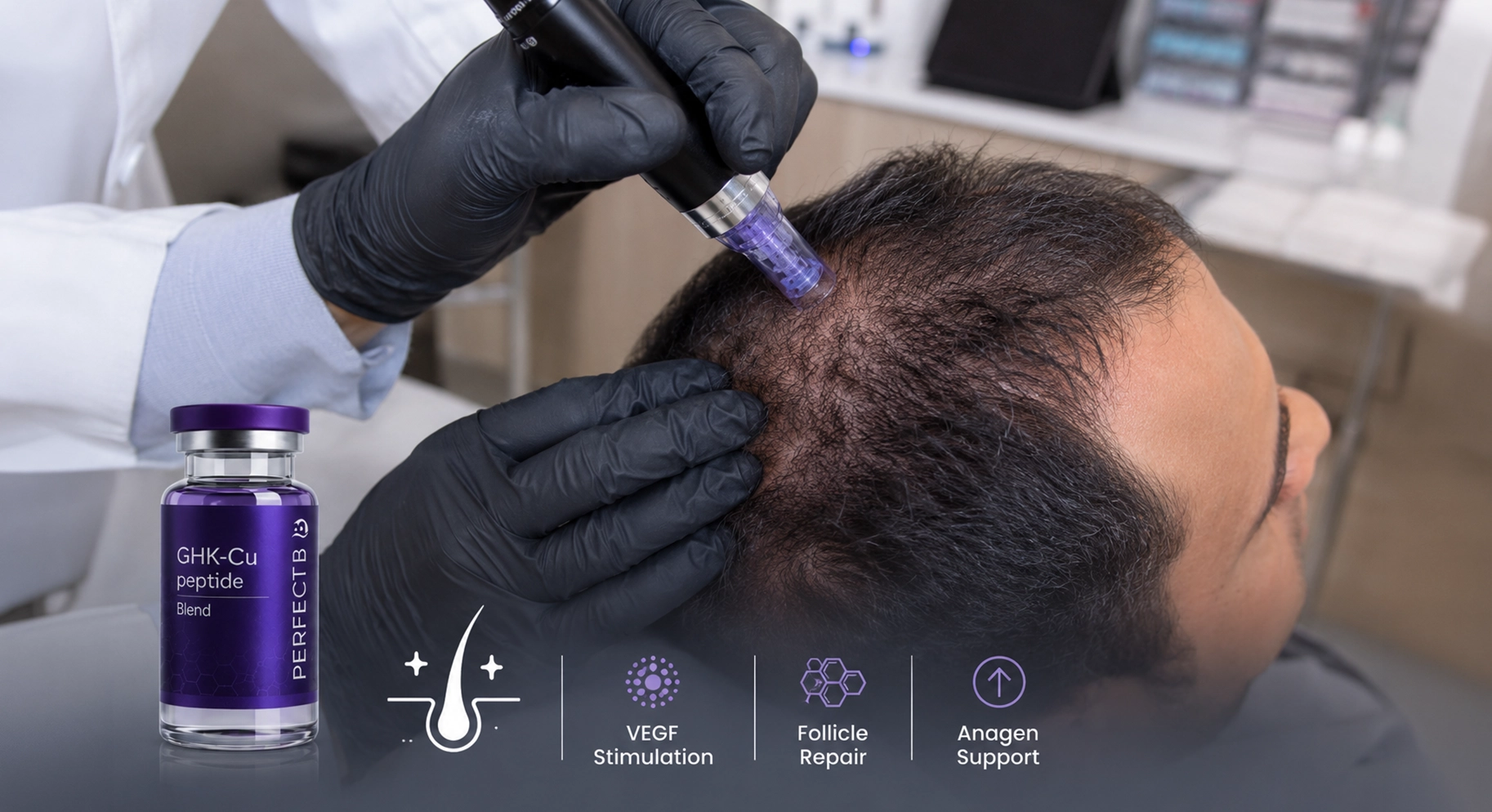
GHK-Cu is a tripeptide of glycine, histidine, and lysine bound to a copper ion. It is the peptide with the deepest research base for hair growth specifically. The documented mechanisms are: VEGF stimulation in dermal fibroblasts that supports the microvascular network feeding the follicle, collagen and glycosaminoglycan synthesis at the follicular basement membrane, anti-inflammatory signaling that calms the chronic micro-inflammation associated with androgenetic alopecia, and direct follicular signaling that extends the anagen growth phase.
At Perfect B, GHK-Cu is delivered through 2 primary methods: topical application combined with microneedling for direct scalp delivery, or scalp injection for higher-dose protocols. The choice depends on hair loss severity and the patient’s prior response to topical treatments. For patients evaluating the full clinical picture of this compound, the complete clinical guide to GHK-Cu copper peptide for hair loss at Perfect B in Doral, FL including mechanism of action, dosing protocol, expected timeline, and patient candidacy is the deep-dive reference for this peptide.
PDRN: The Salmon DNA Peptide for Inflammation and Follicle Repair
PDRN (polydeoxyribonucleotide) is a polymer of DNA fragments extracted from salmon sperm, processed and purified for medical use. It works through a different mechanism than GHK-Cu: PDRN activates the A2A adenosine receptor, which triggers tissue regeneration, dampens inflammation, and supports the cellular metabolism of dermal cells.
For hair, PDRN is most useful in patients whose hair loss has an inflammatory or post-inflammatory component: telogen effluvium after stress, hair loss following autoimmune flares, recovery after hair transplant procedures, or scalp inflammation accompanying conditions like seborrheic dermatitis. It is delivered via direct scalp injection in a clinical setting. At Perfect B in Doral, we have used PDRN extensively in patients who responded poorly to PRP elsewhere or who needed a regenerative input that goes beyond growth factor signaling. The full clinical guide to PDRN for hair loss at Perfect B in Doral, FL covering what salmon DNA peptide does to the scalp, how the injection protocol is run, and what results to expect at 8 and 12 weeks is the dedicated reference for this peptide.
CJC-1295/Ipamorelin: The Growth Hormone Pathway for Hair from Within
CJC-1295/Ipamorelin is a systemic peptide stack, not a topical or scalp injection. CJC-1295 is a GHRH analog that signals the pituitary to release growth hormone over a sustained pulse. Ipamorelin is a GHRP that amplifies the GH release through a parallel receptor. The result is a steady, sustainable increase in endogenous GH and IGF-1, the systemic signals that influence overall regenerative capacity including hair follicle health.
For hair, CJC-1295/Ipamorelin is not a direct follicle stimulator. It is a systemic input that improves the underlying biology supporting hair growth: protein synthesis, tissue repair, sleep quality (which influences hair growth cycles), and the anabolic state that supports anagen phase maintenance. We typically prescribe CJC-1295/Ipamorelin in patients over 35 with diffuse thinning, age-related hair changes, or patients who are also seeking the broader anti-aging and body composition effects of the GH axis. The protocol runs subcutaneously over a 3-month cycle. Patients evaluating this stack against alternatives should review the complete CJC-1295/Ipamorelin cost and pricing breakdown at Perfect B in Doral, FL covering protocol tiers, what is included, and how the clinic compares to subscription-based telehealth peptide platforms.
Topical, Injectable, or Oral: Which Delivery Method Actually Works
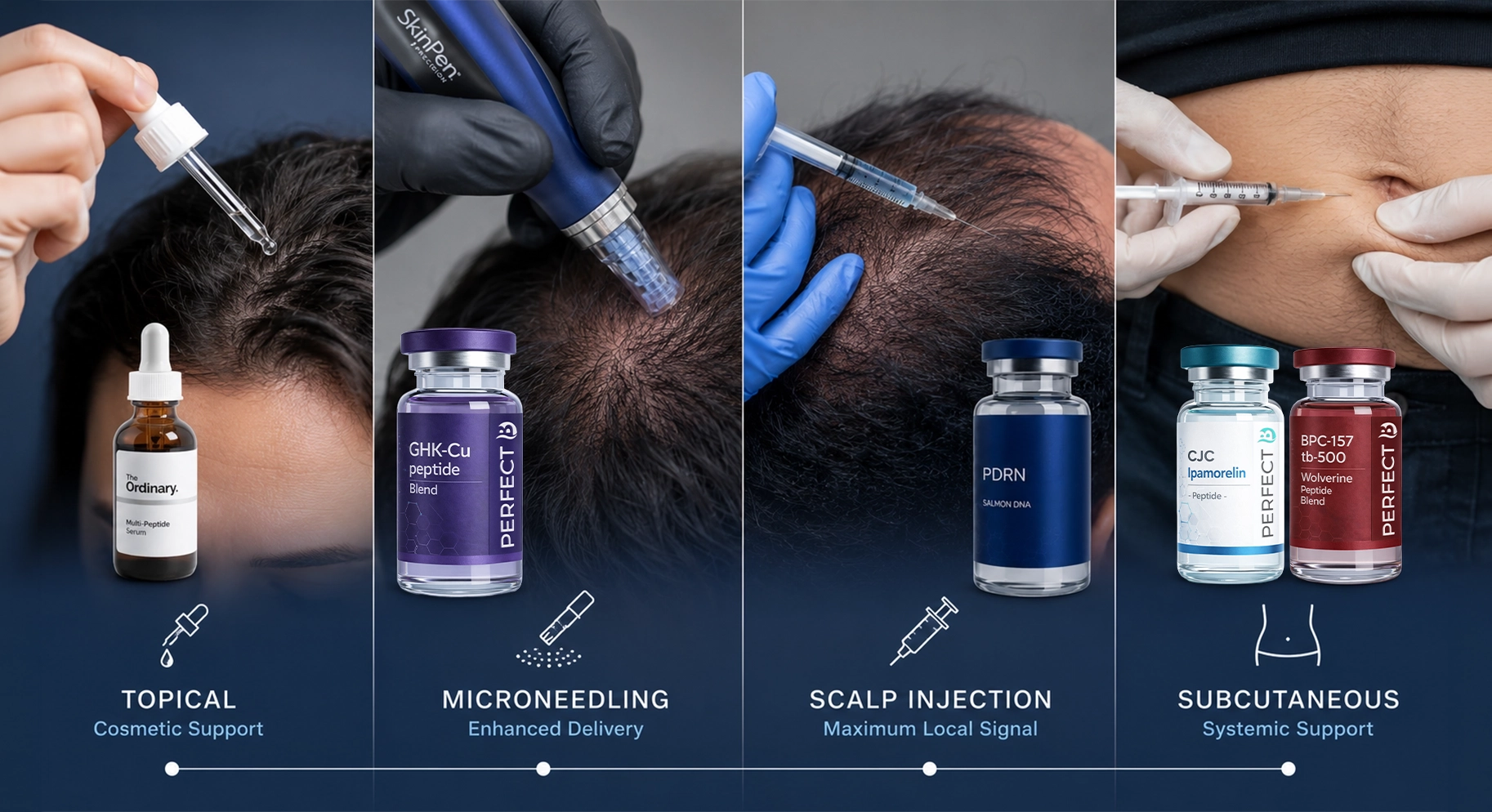
The delivery method matters as much as the peptide itself. The same compound delivered topically through a serum, applied with microneedling, injected directly into the scalp, or injected subcutaneously into the abdomen will produce very different biological effects. Each method has its place. Each one also has limits that the marketing language on consumer products tends to ignore.
- Topical peptide serums (over-the-counter): Products like The Ordinary Multi-Peptide, OGX ProGrowth, or Briogeo Density use peptides at cosmetic-grade concentrations. The peptide molecule itself is large and the skin barrier limits penetration. These products can support scalp environment and produce mild cosmetic improvement, but they do not replicate clinical injectable concentrations.
- Topical + microneedling (in-clinic): Peptides applied directly after microneedling penetrate dramatically deeper because microchannels bypass the stratum corneum. This is how GHK-Cu is most often delivered for hair at Perfect B. The combination is significantly more effective than either modality alone.
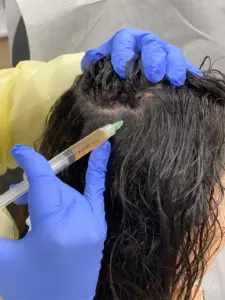
- Direct scalp injection (in-clinic): Peptides like PDRN are injected directly into the scalp at the follicle level. This is the highest local concentration possible and produces the strongest local regenerative signal. Only delivered in a medical clinic by a licensed provider.
- Subcutaneous systemic injection (at home with kit): CJC-1295/Ipamorelin and BPC-157/TB-500 are injected subcutaneously into the abdomen as part of a structured cycle. The patient runs the protocol at home using a prescribed kit with reconstitution supplies and a day-by-day guide. Provider follow-up is included.
- Oral peptides: Most peptides marketed as oral supplements (gummies, capsules) have poor bioavailability because the digestive tract breaks them down. There are exceptions, but for hair growth, oral peptide products generally do not produce the same clinical response as topical-plus-microneedling or injectable protocols.
The decision of which delivery method fits is made at the consultation based on hair loss severity, patient lifestyle, prior treatment history, and budget. A first-time patient with mild thinning often starts with topical-plus-microneedling. A patient with significant diffuse thinning and an interest in the broader anti-aging signal usually adds subcutaneous CJC-1295/Ipamorelin to the protocol.
Not sure if topical, injectable, or oral is right for you?
Perfect B’s peptide protocol tool is built on real clinical data from 2,000+ patients treated in South Florida.
Answer 6 questions and see what patients with similar goals are running: which peptides they use, typical dosing, injection schedule, reconstitution steps, cycle length, and when they pause.
Who Is a Candidate for Peptide Therapy for Hair vs Minoxidil/Finasteride
Peptides are not a replacement for Minoxidil or Finasteride. They are often a complement. Each treatment targets a different mechanism, and the right combination depends on the patient’s biology.
- Minoxidil is a vasodilator. It increases blood flow to the follicle and extends the anagen phase. It is an FDA-approved topical and oral medication, and it works for many patients. It does not address inflammation, hormonal pathways, or systemic regenerative capacity.
- Finasteride blocks the conversion of testosterone to DHT, the hormone that drives androgenetic alopecia. It is FDA-approved for male pattern baldness and used off-label in some female cases. It addresses one specific hormonal mechanism but does not stimulate follicles directly or address inflammation.
- Peptide therapy addresses follicle repair, inflammation, microcirculation, and systemic regenerative capacity. It can be used standalone in patients who cannot or prefer not to use Minoxidil or Finasteride, or stacked with them for complementary effects.
Ideal candidates for peptide therapy for hair at Perfect B include: patients with androgenetic alopecia (especially early to moderate stages), patients with telogen effluvium or post-inflammatory hair loss, patients in perimenopause or post-menopause with hormonal hair changes, patients who responded poorly to Minoxidil or Finasteride alone, and patients seeking a regenerative aesthetic approach combined with broader anti-aging goals. Patients with active scalp infections, certain autoimmune conditions, active malignancy, pregnancy, or unrealistic expectations are typically not candidates and are screened at the consultation. The complete hair loss treatment guide at Perfect B in Doral, FL covering every treatment we offer for hair growth including peptides, PRP, microneedling, and hormonal optimization is the broader reference for patients evaluating their full set of clinical options.
Frequently Asked Questions
1. Which peptide is best for hair growth?
GHK-Cu (copper peptide) is the most researched peptide for hair growth, with documented effects on follicle repair, VEGF stimulation, and scalp circulation. At Perfect B in Doral, FL, we use 4 peptides clinically: GHK-Cu, PDRN, CJC-1295/Ipamorelin, and the BPC-157/TB-500 Wolverine stack. The best peptide depends on the patient’s hair loss type, age, hormonal status, and goals, decided at the initial consultation.
2. Are topical peptides as effective as injectable peptides for hair growth?
No. Topical peptide products (the kind sold on Amazon, Sephora, or by direct-to-consumer brands) deliver lower doses through the skin barrier and produce milder, slower results focused on cosmetic improvement. Clinical injectable protocols delivered at a medical clinic use higher concentrations, prescription compounds, and direct delivery to the follicle area or systemic bloodstream, producing stronger and more measurable outcomes.
3. How long does it take to see results with peptides for hair growth?
Most patients at Perfect B notice the first visible changes between week 8 and week 12 of a structured cycle. Reduced shedding tends to come first, followed by visible thickening between month 3 and month 6. Full protocol responses are evaluated at the 6-month mark with provider follow-up.
4. Are peptides for hair growth FDA approved?
Peptides used in clinical hair growth protocols are sourced from FDA-registered compounding pharmacies under a valid prescription written by a licensed medical provider. The FDA does not approve compounded peptides as branded drugs, but the supply chain is regulated and the prescription pathway is medically supervised. This is the critical difference from research peptide websites, which operate outside the pharmaceutical supply chain.
5. Can I combine peptide therapy with Minoxidil or Finasteride?
Yes. At Perfect B in Doral, FL, peptide protocols are often stacked with Minoxidil for vascular stimulation or Finasteride for DHT inhibition, depending on the patient’s hormonal profile and hair loss pattern. The combination is decided at the consultation based on labs and clinical evaluation.
6. How much does peptide therapy for hair growth cost at Perfect B?
A single-peptide protocol at Perfect B starts at $445 per 3-month cycle, including the compounded peptide, full injection kit, day-by-day protocol guide, and provider follow-up. Stack pricing scales to $795 for 2 peptides, $1,095 for 3, and $1,395 for the full 4-peptide protocol per cycle. The $150 initial consultation is separate and required before any protocol. Call us at (786) 502-2260 to discuss your options.
7. Are there side effects to peptide therapy for hair growth?
Side effects are generally mild and self-limiting when peptides are prescribed and supervised by a licensed clinic. Common reports include localized irritation at the injection site, mild fluid retention with CJC-1295/Ipamorelin, and rare allergic-type reactions. Patients with active infections, certain autoimmune conditions, active malignancy, or pregnancy are typically not candidates and these are screened at consultation.
The Doral Clinic Takeaway: Why Peptides for Hair Growth Belong in a Supervised Protocol
Peptides for hair growth are one of the most legitimate and exciting categories in regenerative aesthetics right now. The science is real. The mechanisms are well documented. The clinical responses, when delivered properly, are meaningful. What the trending search misses is that the product you buy in a serum at the drugstore and the protocol your medical clinic prescribes are not the same intervention, and treating them as if they were leads to disappointment with both.
At Perfect B in Doral, we have delivered 6,700+ personalized treatments to 2,000+ patients across South Florida. Our hair growth protocols combine the 4 peptides above, often stacked with microneedling, Minoxidil, Finasteride, or PRP depending on the patient. If you are evaluating peptides for hair growth and want to understand which protocol fits your biology and goals, the next step is a single consultation.
- 📍 Visit us at Perfect B, Doral FL, serving Miami and South Florida patients seeking peptide therapy for hair growth.
- 📞 Call or message us at (786) 502-2260 to schedule your hair growth peptide consultation with a licensed medical provider.