
Perfect B, Doral FL. | 06.04.26 | 9 min read.
This content is for educational purposes only and does not constitute medical advice. Consult a licensed medical provider before beginning any skin treatment. All treatments referenced require a clinical evaluation from a licensed provider at Perfect B. Results vary by patient, skin concern, and protocol.
Why Most Microneedling Before and After Content Misses the Point
You have seen the photos. Smooth skin on the right, uneven skin on the left, dramatic difference. What those images do not tell you is which device was used, whether a skin booster was applied during the session, how many sessions produced that result, or what skin type the patient had. That context is everything, and without it, before and after photos are closer to marketing than clinical information.
At Perfect B in Doral, FL, our approach to microneedling is built around the FDA-cleared SkinPen, the only microneedling device with clinical trial data for acne scars and neck wrinkles. We stack it with exosomes or PDRN (Salmon DNA) depending on the patient’s concern, and in many cases perform an IPL or Pico laser pass in the same session. That protocol produces compounding results that a single standard microneedling session at a spa simply cannot replicate. This post breaks down what those results actually look like, by concern, by timeline, and by how the protocol changes things.

Key Takeaways
- The SkinPen is the only FDA-cleared microneedling device with clinical trial data for acne scars and neck wrinkles. Device selection is not interchangeable.
- Stacking changes the before and after: SkinPen with exosomes produces measurably better healing quality and faster visible results than SkinPen alone. The microchannels created during treatment allow exosomes and PDRN to penetrate directly to the dermis.
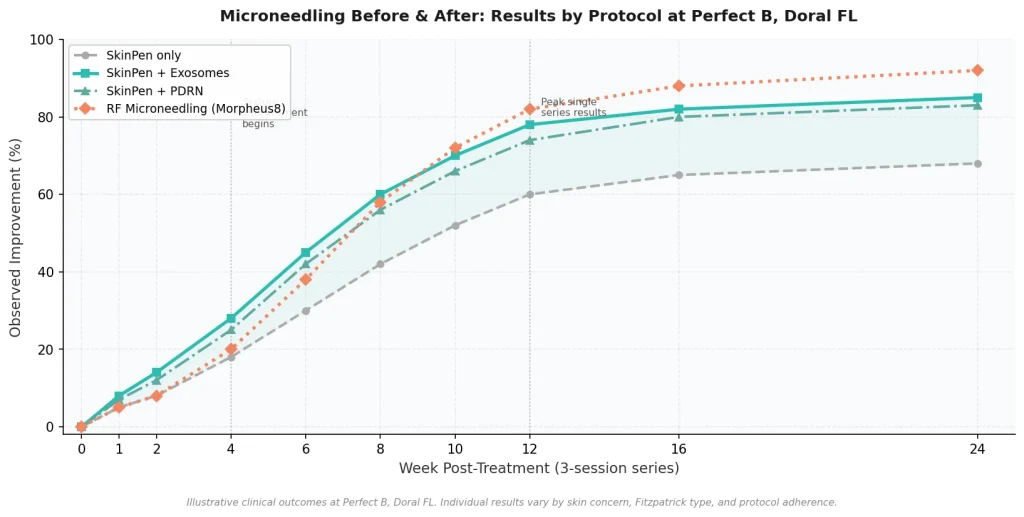
- Results build over 3 to 6 months: Visible improvement begins around weeks 4 to 6 as new collagen matures. Most significant changes appear at the 3-month mark after a full series.
- Skin concern determines the protocol: Acne scars, texture, wrinkles, and hyperpigmentation each respond differently and require different needle depths, booster choices, and session intervals.
- Fitzpatrick type changes everything in South Florida: Patients with Fitzpatrick III to VI skin require a modified protocol to prevent post-inflammatory hyperpigmentation. This is a clinical reality that most generic microneedling content ignores.
What the SkinPen Does That Other Devices Do Not
Most microneedling devices used in med spas and aesthetician studios are not FDA-cleared for the same indications. The SkinPen holds two specific FDA clearances: one for acne scars and one for neck wrinkles. Both required prospective clinical trials demonstrating safety and efficacy before the clearance was granted. That is not a marketing distinction. It is the difference between a device with independent clinical evidence and one without it.
At Perfect B, the SkinPen’s depth precision is what drives the before and after results we see. For texture and surface concerns, we set shallower depths. For atrophic acne scars, we go deeper into the dermis where the fibrous tethering bands are. For under-eye concerns, we use the lowest settings with PDRN as the booster. The device allows that level of customization in a way that less regulated equipment does not.
How Stacking Changes the Before and After
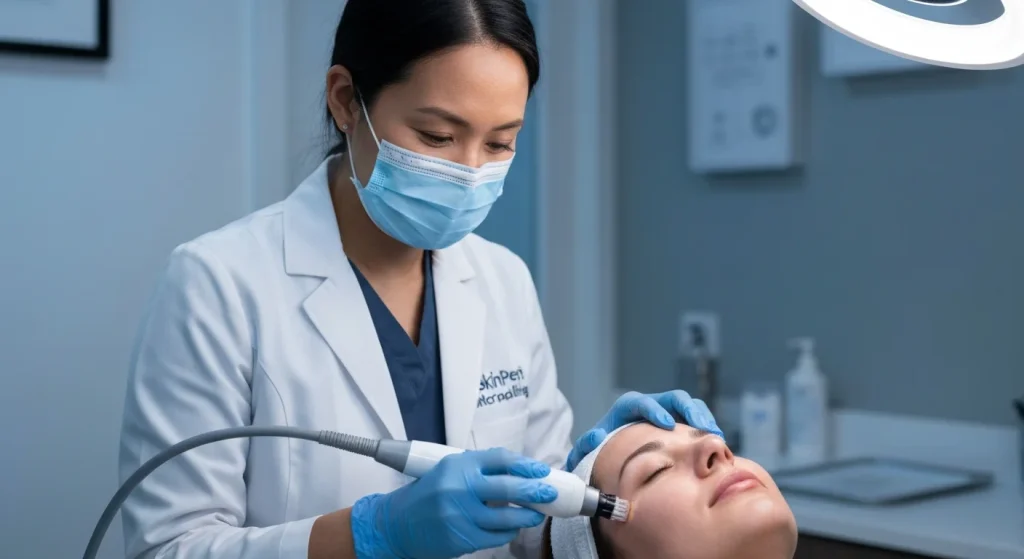
Standard microneedling creates the injury signal. Exosomes and PDRN determine what the skin does with it. When either booster is applied immediately after the SkinPen pass, it enters the microchannels created during the session and delivers growth factors, cytokines, and regenerative proteins directly to the dermis. The result is a qualitatively different healing response, not just faster collagen production but better-organized tissue architecture.
SkinPen + Exosomes
Exosomes are extracellular vesicles that carry signaling molecules between cells. Applied to post-microneedling skin, they activate fibroblasts at a higher rate than standard microneedling alone, which accelerates collagen type I and III production and shortens the redness and sensitivity period after the session. Patients stacking exosomes typically see their skin calm 24 to 48 hours faster than those receiving SkinPen alone. The before and after difference is most visible in texture, pore appearance, and overall skin quality rather than scar depth.
SkinPen + PDRN (Salmon DNA)
PDRN activates the A2A adenosine receptor pathway, which promotes angiogenesis and tissue regeneration at the cellular level. For patients with concerns around skin hydration, laxity, fine lines, and early signs of aging, PDRN stacking produces results that exosomes alone do not. At Perfect B, PDRN is also the preferred booster for under-eye microneedling and for patients with rosacea-prone or sensitive skin where the goal is regeneration without additional inflammatory response. → See the full SkinPen protocol at Perfect B in Doral, FL, including how we determine which booster matches your specific skin concern.
Microneedling Before and After by Skin Concern
Acne Scars
Atrophic acne scars (rolling, boxcar, and shallow ice pick types) respond well to SkinPen microneedling because the mechanical injury signal triggers collagen production in exactly the tissue layer where the structural deficit is. A peer-reviewed study published in the Journal of Clinical and Aesthetic Dermatology objectively evaluating microneedling for atrophic acne scars using skin biopsies to measure collagen density and epidermal thickness at 1 and 3 months post-treatment confirmed measurable increases in both collagen types I and III and epidermal thickness after a series of sessions. The visible before and after for acne scars at Perfect B follows this pattern: minimal visible change in the first 2 weeks, noticeable softening of scar edges at weeks 4 to 6, and the most significant depth and texture improvement between months 3 and 6 as collagen remodeling matures. Deep boxcar scars frequently require RF microneedling (Morpheus8) rather than standard microneedling as the primary device, because the radiofrequency component reaches deeper tethering bands that SkinPen alone cannot fully address.
Skin Texture and Enlarged Pores
This is where the stacked protocol produces the most immediately visible before and after. Patients treating rough texture, enlarged pores, and overall skin quality typically see the “microneedling glow” within the first week as circulation improves and fresh cell turnover begins. By weeks 2 to 4, pores appear tighter and surface texture noticeably smoother. The cumulative effect of 3 sessions spaced 4 to 6 weeks apart produces significantly more even skin tone and refined texture than a single session. Stacking with exosomes amplifies this result because the fibroblast activation signal accelerates the surface quality improvement beyond what mechanical injury alone triggers.
Fine Lines and Wrinkles
Fine lines and early static wrinkles respond to microneedling through dermal thickening: the new collagen gradually plumps the tissue from below, softening the line from within rather than filling it from above. The before and after for wrinkle patients requires patience. Visible softening of fine lines begins around weeks 6 to 8. Deeper static wrinkles require multiple treatment cycles and in many cases a combination with RF microneedling or neurotoxin to achieve meaningful reduction. The honest clinical expectation is texture refinement and line softening, not erasure. Patients who come in expecting the outcome of a neuromodulator from a microneedling series will be disappointed. Those expecting progressive, natural-looking improvement over 3 to 6 months tend to be satisfied.
Hyperpigmentation and Uneven Tone
Microneedling improves hyperpigmentation by accelerating cell turnover and promoting the breakdown of melanin clusters in the epidermis. Results vary significantly by Fitzpatrick type and the cause of the pigmentation. Sun damage and post-inflammatory hyperpigmentation from past acne respond well. Melasma requires specific caution because microneedling can temporarily worsen it if the treatment triggers additional melanocyte activity. At Perfect B, patients with melasma-related pigmentation are assessed separately before any microneedling protocol is initiated, and sessions are often paired with a pre-treatment pigment inhibitor. → For patients treating both active acne scars and post-inflammatory hyperpigmentation, the sequencing of treatments is covered in the full microneedling for acne scars guide at Perfect B.
The Fitzpatrick Factor: Why South Florida Patients Need a Different Approach
Generic microneedling before and after content is overwhelmingly produced for Fitzpatrick I to III skin. South Florida is a different clinical reality. At Perfect B in Doral, the majority of our microneedling patients present with Fitzpatrick III to VI skin, where the risk of post-inflammatory hyperpigmentation is meaningfully higher after any skin injury, including controlled microneedling.
The modifications we make for Fitzpatrick IV to VI patients are not subtle. Needle depth is set more conservatively on the first session to assess the patient’s inflammatory response. A tyrosinase inhibitor pretreatment is standard before any resurfacing session. Post-treatment, a brightening protocol is introduced at 10 to 14 days to prevent PIH from forming. Sessions are spaced further apart to allow complete resolution of any post-treatment erythema before the next pass. The before and after for these patients still shows significant improvement, but the protocol is designed to deliver that result without trading scar improvement for hyperpigmentation. That tradeoff is exactly what happens when Fitzpatrick IV to VI skin is treated with a protocol designed for lighter skin types.
When Standard Microneedling Is Not the Right Starting Point
Not every patient presenting for microneedling at Perfect B ends up on a SkinPen protocol. There are clinical situations where we recommend a different starting point.
Deep boxcar and rolling scars with significant tethering benefit more from RF microneedling (Morpheus8) than standard microneedling, because radiofrequency energy delivered at 2 to 4mm depth reaches the fibrous bands that SkinPen alone cannot fully address. Patients who have already completed a standard microneedling series elsewhere and plateau at a certain level of improvement are good candidates for the upgrade to Morpheus8 as the next clinical step. Active acne is an absolute contraindication for any microneedling session until inflammation is controlled. Microneedling over active breakouts distributes bacteria across the skin and worsens both the acne and the scarring outcome. → The full comparison of standard microneedling vs RF microneedling for acne scars, including which scar types respond to each and what the Morpheus8 before and after timeline looks like at Perfect B, is covered in the RF microneedling guide.
The Week-by-Week Timeline: What to Expect After Each Session
Understanding the timeline is what separates realistic expectations from disappointment. The collagen remodeling that produces the visible before and after is a biological process measured in months, not days.
Days 1 to 3: Redness, tightness, and some sensitivity. This is the inflammatory phase of the wound healing cascade, and it is the mechanism, not a side effect. Patients stacking exosomes typically see this phase resolve 24 to 48 hours faster than with standard microneedling. Days 4 to 7: Redness resolves. Many patients notice a fresh, luminous quality to their skin from improved circulation and early cell turnover. This is the commonly described “microneedling glow.” Weeks 2 to 4: Surface texture begins to refine as new collagen type III is produced. Pores may appear tighter. Skin feels softer. Weeks 4 to 6: The first wave of visible improvement from collagen remodeling. Scars begin to look shallower. Fine lines soften. Tone becomes more even. Weeks 8 to 12: For most patients in a 3-session series, this is when the most dramatic visible change occurs. One full cycle of collagen remodeling is complete. Months 3 to 6: The remodeling phase continues as collagen type III is replaced by stronger type I. Patients treating acne scars see the most significant structural improvement during this period. A comprehensive review published in Cureus reviewing microneedling applications, techniques, and clinical outcomes across dermatological conditions confirms that collagen and elastin production initiated by microneedling is essential for maintaining skin elasticity and continues beyond the visible treatment window.
Frequently Asked Questions
1. How many microneedling sessions do I need to see real results?
For most concerns, a series of 3 sessions spaced 4 to 6 weeks apart produces the most significant and lasting improvement. A single session produces roughly 15 to 30% improvement in the targeted concern and is appropriate for maintenance or as an introductory treatment to assess how your skin responds. Acne scars typically require 3 to 6 sessions depending on scar depth and type.
2. When will I see microneedling results?
The first visible changes in texture and tone typically appear between weeks 2 and 4 after the first session. The most significant improvement, particularly for acne scars and wrinkles, develops between months 3 and 6 as the collagen remodeling process matures. Results look better at 3 months than they do at 3 weeks.
3. Does adding exosomes or PDRN really change the before and after?
Yes, clinically. Exosomes accelerate fibroblast activation and shorten recovery time, which produces earlier visible improvement and better skin quality outcomes than standard microneedling alone. PDRN activates tissue regeneration through a different pathway and is particularly effective for hydration, laxity, and sensitive skin concerns. At Perfect B, the booster is matched to the skin concern at consultation, not offered as a generic upgrade.
4. Is microneedling safe for darker skin tones?
Yes, with a modified protocol. Fitzpatrick IV to VI skin requires conservative needle depth on the first session, tyrosinase inhibitor pretreatment, wider spacing between sessions, and a post-treatment brightening protocol to prevent post-inflammatory hyperpigmentation. At Perfect B in Doral, the majority of our patients have Fitzpatrick III to VI skin and our protocols are specifically calibrated for this patient population.
5. What is the difference between SkinPen microneedling and RF microneedling?
Standard SkinPen microneedling creates mechanical micro-injuries that trigger collagen production at 0.5 to 1.5mm depth. RF microneedling (Morpheus8) adds radiofrequency thermal energy at 2 to 4mm depth, which contracts existing collagen and drives deeper structural remodeling. RF microneedling is the recommended protocol for patients with moderate to severe atrophic acne scars, skin laxity, and patients who have plateaued with standard microneedling results.
6. Can microneedling be done while I have active acne?
No. Active inflammatory acne is a contraindication for microneedling. The procedure over active breakouts distributes bacteria across the skin surface, worsens inflammation, and produces poor scar treatment outcomes. Acne must be controlled first, typically over 4 to 6 weeks of combined in-clinic and topical treatment, before any microneedling session can be initiated.
7. How much does microneedling cost at Perfect B?
SkinPen microneedling at Perfect B starts at $345 per session. Stacked protocols with exosomes or PDRN are priced based on the combination selected at consultation. Buy Now Pay Later options are available through Cherry, Klarna, Afterpay, and CareCredit.
The Clinical Bottom Line on Microneedling Before and After
The difference between generic microneedling before and after results and what we produce at Perfect B comes down to three things: the device, the protocol, and the clinical context. Using the FDA-cleared SkinPen with exosomes or PDRN matched to the specific concern, calibrated for South Florida’s predominant Fitzpatrick types, and delivered as a structured series rather than a one-off session produces compounding, clinical-grade results that generic microneedling content cannot accurately represent with a single photo pair.
The biology of collagen induction takes time. The before and after is built over months, not days. Patients who understand that timeline and commit to the full series are the ones who come back for a second or third concern after seeing what the first series produced.
📍 Perfect B | 3905 NW 107th Ave, Suite 104, Doral FL 33178
📞 Call or message us at (786) 502-2260 to schedule your microneedling consultation with a licensed medical provider.
💳 Buy Now Pay Later: Cherry, Klarna, Afterpay, CareCredit