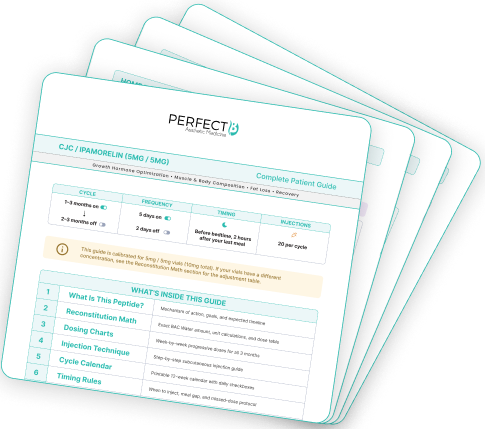
See What Patients With a Similar Lab Picture Are Actually Running.
Perfect B’s peptide protocol tool is built on real clinical data from 2,000+ patients treated in South Florida.
Answer 6 questions and see what patients with similar goals are running: which peptides they use, typical dosing, injection schedule, reconstitution steps, cycle length, and when they pause.
Perfect B, Doral Fl. | 07.07.26 | 9 min read.
This article is for general educational purposes and is not a substitute for an in-person medical evaluation, diagnosis, or treatment. Lab values, reference ranges, and peptide protocols must be reviewed and supervised by a licensed medical provider. This is one part of a larger plan, so see how medically supervised peptide therapy at Perfect B in Doral works and how each protocol fits a complete, monitored plan.
IGF-1 Blood Test: Why Peptide Therapy Should Never Start Without One
An IGF-1 blood test is the single lab value that tells a provider whether a growth hormone axis peptide is actually doing anything. Patients ask us for a peptide by name after reading about it online, but the peptide itself is only half the equation. Without a baseline number to compare against, neither you nor your provider can tell the difference between a protocol that is working, one that is doing nothing, and one that needs a different dose entirely.
This guide explains what an IGF-1 blood test actually measures, why it comes before the first injection rather than after, how often it gets repeated once a protocol starts, and what the number can and cannot tell you on its own. If you are considering a growth hormone axis peptide such as CJC-1295, Ipamorelin, or Tesamorelin, this is the lab conversation that should happen before any prescription is written.
Key Takeaways
- IGF-1 is the messenger, not the peptide: growth hormone axis peptides raise growth hormone pulses, and the liver converts that signal into IGF-1, which is the number labs can actually measure reliably.
- Baseline comes before the first dose: a peptide protocol built without a starting IGF-1 number has no way to prove it changed anything later.
- Reference ranges are age and sex specific: your lab report compares your result to a range built for your age bracket, not a single universal number.
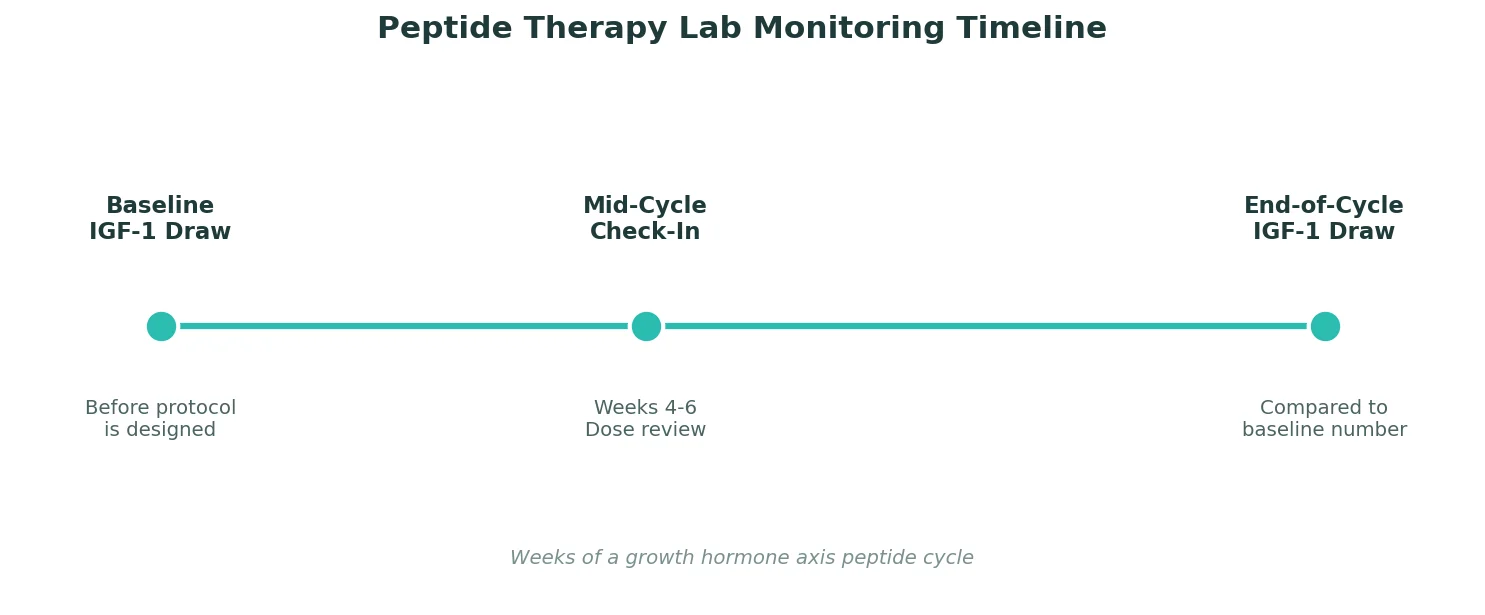
- Monitoring is scheduled, not random: a baseline draw, a mid-cycle check, and an end-of-cycle draw are the three checkpoints that matter most.
- One number is not the whole picture: IGF-1 is read alongside symptoms, other labs, and how you are actually responding, never in isolation.
What Does an IGF-1 Blood Test Actually Measure?
Growth hormone itself is a poor lab target. It is released from the pituitary gland in short pulses, mostly during deep sleep, so a random blood draw can catch a spike, a trough, or anything in between, and the result would be close to meaningless. Insulin-like growth factor 1, the molecule an IGF-1 blood test actually reports, solves that problem. The liver produces IGF-1 in response to growth hormone exposure over time, and IGF-1 stays relatively stable in the bloodstream across the day. That stability is exactly why it functions as the standard proxy for growth hormone activity in clinical practice.
For background on how the test itself works and what the reported units mean, the IGF-1 test overview published by MedlinePlus, the consumer health information service of the United States National Institutes of Health, is a useful reference alongside your provider’s interpretation.
Why Baseline Labs Come Before Your First Injection at Perfect B
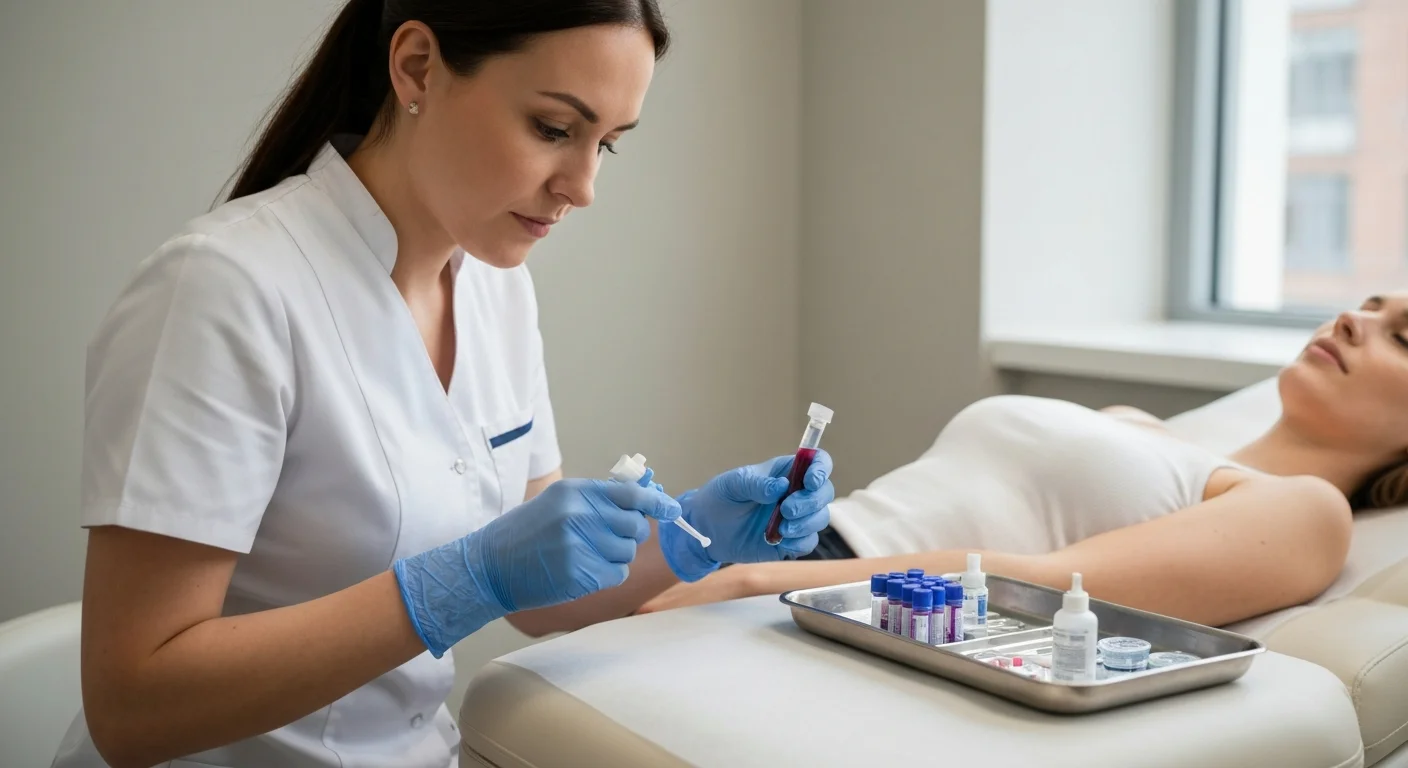
At Perfect B in Doral, a peptide consultation does not start with a prescription. It starts with a conversation about symptoms and goals, followed by baseline labs that include IGF-1, before a protocol is ever designed. There are two reasons this order matters. First, IGF-1 helps confirm that a growth hormone axis peptide is a reasonable fit for what you are describing, rather than treating symptoms that trace back to something else entirely. Second, and just as important, a baseline number is the only way to later prove a protocol worked. Without it, an end-of-cycle IGF-1 result is just a number floating with nothing to compare it against.
This baseline-first approach is part of the same intake process we walk every peptide patient through. If you want the full picture of how a consultation moves from intake to labs to a written protocol, our guide to what defines a supervised peptide therapy clinic and what a Doral medical program actually checks before writing a prescription walks through every step in order.
How Are IGF-1 Reference Ranges Actually Read?
One of the most common misunderstandings about an IGF-1 blood test is expecting a single universal number that means healthy or not healthy. IGF-1 declines with age in essentially everyone, which is a well documented, normal part of the aging process rather than a disease on its own. Because of that decline, every lab report shows your result next to a reference range built specifically for your age bracket and sex, not one flat cutoff that applies to a twenty five year old and a fifty five year old equally. A result that would be flagged as low for someone in their twenties can be entirely unremarkable for someone in their fifties.
This is exactly why a provider reads your IGF-1 number against your specific age bracket rather than comparing it to an internet chart, and why the same raw number can mean different things for two different patients. Bring your own history and symptoms into that conversation, because the number alone does not tell the whole story.

Not Sure If a Peptide Protocol Fits What Your Labs Are Showing?
Which Perfect B Peptides Actually Move This Number?
Not every peptide touches the growth hormone axis, so not every peptide is expected to move an IGF-1 blood test at all. Growth hormone releasing peptides work by prompting the pituitary gland to release its own growth hormone in a pulse, which the liver then converts into IGF-1 over the following days and weeks. At Perfect B, the growth hormone axis peptides on our menu are CJC-1295 and Ipamorelin, typically run together as a combined stack, and Tesamorelin. A peptide like BPC-157 or TB-500, by comparison, works through a completely different, tissue repair focused pathway and is not expected to move IGF-1 in a meaningful way, which is a useful way to think about which lab actually matters for which peptide.
If a growth hormone axis peptide is the direction your labs and goals point toward, our complete clinical guide to the CJC-1295 and Ipamorelin dosing protocol, including cycling and injection technique, that we use once baseline labs confirm candidacy covers what that protocol actually looks like once IGF-1 supports moving forward. Tesamorelin follows a similar labs-first path, detailed in our Tesamorelin dosage and injection protocol guide describing the exact schedule we use once a baseline IGF-1 result supports starting.
When Do You Get Retested Once a Protocol Starts?
Monitoring on a growth hormone axis peptide follows a schedule, not a guess. The first checkpoint after baseline is a mid-cycle check-in, generally around four to six weeks in, where a provider reviews how you are responding and whether the dose needs adjustment before the cycle continues. The second checkpoint sits at the end of the cycle, where a repeat IGF-1 blood test is compared directly against your original baseline number. That comparison is what actually answers the question of whether the protocol worked, rather than relying on how you feel alone, since subjective improvement and a measurable lab change do not always move together at the same pace.
This same mid-cycle and end-of-cycle rhythm is why timelines matter so much when you are deciding whether a peptide is working. For a broader view of how quickly different peptides typically show change, our guide to how long peptides typically take to work, covering the documented timeline for each major peptide on our menu pairs well with the lab schedule described here.
What Other Labs Get Checked Alongside IGF-1?
An IGF-1 blood test rarely stands alone on a requisition. Because growth hormone axis activity interacts with the rest of the endocrine system, a provider typically reviews it alongside thyroid function and fasting glucose, since growth hormone signaling can shift blood sugar handling in some patients. General metabolic and safety labs are also part of a responsible workup, both at baseline and periodically during longer protocols, so any unrelated issue gets caught early rather than after months on a peptide.
This is the same reason peptide protocols are not something to start from an online source without oversight. A provider who can order, interpret, and act on the full lab panel, not just IGF-1 in isolation, is what keeps a peptide protocol safe over time rather than just monitored on paper.
What Can an IGF-1 Number Not Tell You?
It is worth being direct about the limits here. An IGF-1 blood test tells you about growth hormone axis activity, and nothing more. It does not diagnose why you feel tired, it does not measure body composition, and it does not by itself confirm or rule out every symptom that led you to ask about peptides in the first place. Two patients can post similar IGF-1 numbers and respond very differently to the same protocol, because sleep quality, stress, training load, and overall health all shape how a peptide performs in practice.
That is why we read IGF-1 as one input among several rather than a verdict on its own. Growth hormone axis peptides interact with a broader hormonal picture, and if you want to understand where that axis fits relative to the rest of your hormonal health, our clinical guide to which hormonal pathways peptides actually touch and which ones they do not lays out that broader context clearly.
Getting an IGF-1 Blood Test in Doral, FL
If you are in the Doral or greater Miami area and considering a growth hormone axis peptide, the starting point is the same conversation every peptide patient has with us, a review of your goals and history followed by baseline labs including IGF-1. That baseline is what turns a peptide protocol into something a provider can actually measure and adjust, rather than a guess repeated every few weeks. Exact lab logistics and current pricing are confirmed at your consultation, since they can shift with what your specific workup requires.
6 Questions. One Personalized Peptide Protocol. Zero Guesswork.
Instead of guessing which peptide is right for you, answer 6 short questions in our peptide guide and see the protocols real Perfect B patients with your goals are following.
→ Take the 6-question peptide guide at peptides.perfectb.com

Frequently Asked Questions
1. What does an IGF-1 blood test actually measure?
An IGF-1 blood test measures insulin-like growth factor 1, a molecule the liver produces in response to growth hormone exposure. Because growth hormone itself is released in short pulses that are hard to catch on a random draw, IGF-1 works as a stable stand-in that reflects growth hormone activity over time.
2. Why do I need an IGF-1 blood test before starting a peptide?
A baseline IGF-1 blood test gives your provider a starting number to compare against later. Without it, there is no way to prove whether a growth hormone axis peptide protocol actually changed anything, since an end-of-cycle number alone has nothing to measure progress against.
3. Is there one normal IGF-1 number for everyone?
No. IGF-1 reference ranges are built by age bracket and sex, because IGF-1 naturally declines with age in essentially everyone. A number that looks low for someone in their twenties can be unremarkable for someone in their fifties, which is why your provider reads the result against your specific age range.
4. How often is IGF-1 retested during a peptide protocol?
At Perfect B, monitoring generally follows three checkpoints, a baseline draw before the protocol starts, a mid-cycle check-in around four to six weeks in, and an end-of-cycle draw compared directly against the original baseline number.
5. Which peptides at Perfect B are expected to move IGF-1?
Growth hormone axis peptides, specifically CJC-1295 and Ipamorelin and Tesamorelin, are expected to raise IGF-1 over the course of a protocol. Peptides that work through a different pathway, such as BPC-157 or TB-500 for tissue repair, are not expected to move this particular lab in a meaningful way.
6. What other labs are checked along with IGF-1?
Thyroid function and fasting glucose are commonly reviewed alongside IGF-1, since growth hormone signaling can interact with blood sugar handling. General metabolic and safety labs are also part of a responsible baseline and ongoing monitoring plan.
7. Can my IGF-1 be normal but the peptide still not be working?
Yes. IGF-1 reflects growth hormone axis activity only, not every factor that affects how you feel or look. Sleep, stress, training, and overall health all shape how a peptide performs, which is why IGF-1 is read alongside your symptoms and history rather than as a stand-alone verdict.
8. Where can I get an IGF-1 blood test in Doral or Miami?
Perfect B in Doral includes IGF-1 as part of the baseline labs for any growth hormone axis peptide consultation. A provider reviews your history and goals first, then orders labs and builds a protocol only once that baseline is in hand.
Labs First, Then the Protocol
An IGF-1 blood test is not a formality on the way to a peptide prescription. It is the number that lets a provider tell whether a growth hormone axis peptide is a reasonable fit, whether the dose is doing anything at all, and whether it is time to adjust the plan. A protocol built without that baseline is a protocol nobody can actually measure. Established endocrine references, including the aging-related growth hormone decline documented by peer-reviewed research indexed on PubMed Central describing how growth hormone and IGF-1 levels change across the adult lifespan, support the same labs-first approach.
If you are weighing a growth hormone axis peptide and want your protocol built around your own numbers rather than a generic online stack, Perfect B in Doral starts every consultation with a review of your goals and baseline labs, with financing available through Cherry, Klarna, Afterpay, and CareCredit. A number on a lab report is a much better starting point than a guess.
- 📍 Visit us at Perfect B, 3905 NW 107th Ave, Suite 104, Doral FL 33178
- 📞 Call or message us at (786) 502-2260
- 💳 Financing available through Cherry, Klarna, Afterpay, and CareCredit