
Perfect B, Doral Fl. | 07.24.26 | 9 min read.
This article is for general education and is not medical advice. Identifying a scar type at home is a starting point, not a diagnosis. A licensed provider should assess your skin in person before any treatment. If several types show up together, see the order a Doral provider treats icepick, rolling, and boxcar acne scars when several different types appear together on the same face.
What Do Pimple Scars Look Like? The Quick Answer
True pimple scars change the texture of your skin, not just its color. They are either depressed, meaning the skin is pitted or sunken, or raised, meaning firm tissue sits above the surface. If what you see is a flat brown or red spot that you can feel is perfectly smooth, that is usually not a scar at all but a temporary mark that fades over time. Telling these apart is the first and most useful step, because they call for completely different plans.

This visual guide walks through what each kind of pimple scar looks like: the flat marks that only look like scars, the three depressed types, and the raised types. Knowing which you have tells you whether time and sunscreen are enough or whether a texture-focused treatment is the right route.
Key Takeaways
- True scars change skin texture (pitted or raised); flat brown or red spots are usually marks, not scars.
- Depressed (atrophic) scars come in three main shapes: icepick, boxcar, and rolling.
- Icepick are narrow and deep, boxcar are wide with sharp edges, rolling are wide and shallow with a sloping, wavy surface.
- Raised scars (hypertrophic and keloid) sit above the skin and are more common on the jaw, chest, and back.
- Flat dark marks are usually postinflammatory hyperpigmentation and often fade with time, sun protection, and topicals.
- Identifying the type matters because each responds to a different treatment, which is why an in-person assessment comes first.
First, Are They Even Scars, or Just Marks?
The most common mix-up is between real scars and flat marks left behind after a breakout. A flat brown, tan, or gray spot where a pimple used to be is usually postinflammatory hyperpigmentation, which is extra pigment, not a change in the skin surface. A flat pink or red spot is often postinflammatory erythema, which is lingering redness from the healing process. Run a finger over them: if the skin feels smooth and level, it is a mark, not a scar.

The good news is that marks are usually temporary. Postinflammatory hyperpigmentation tends to fade over months, and daily sun protection plus the right topicals can speed it along, as a systematic review of topical options describes (a systematic review of topical treatments for postinflammatory hyperpigmentation and how flat dark marks fade). A true scar, by contrast, is a permanent change in the skin structure and does not simply fade, which is why the distinction matters so much before you spend money on treatment.
Atrophic Scars: The Three Depressed Types
Most pimple scars are atrophic, meaning the skin is depressed because collagen was lost during healing. Dermatologists sort them by size, shape, and depth, and a widely used system groups them into three shapes, which is exactly what you can learn to recognize in the mirror (a study classifying atrophic acne scars by their size, shape, and number for reliable assessment).
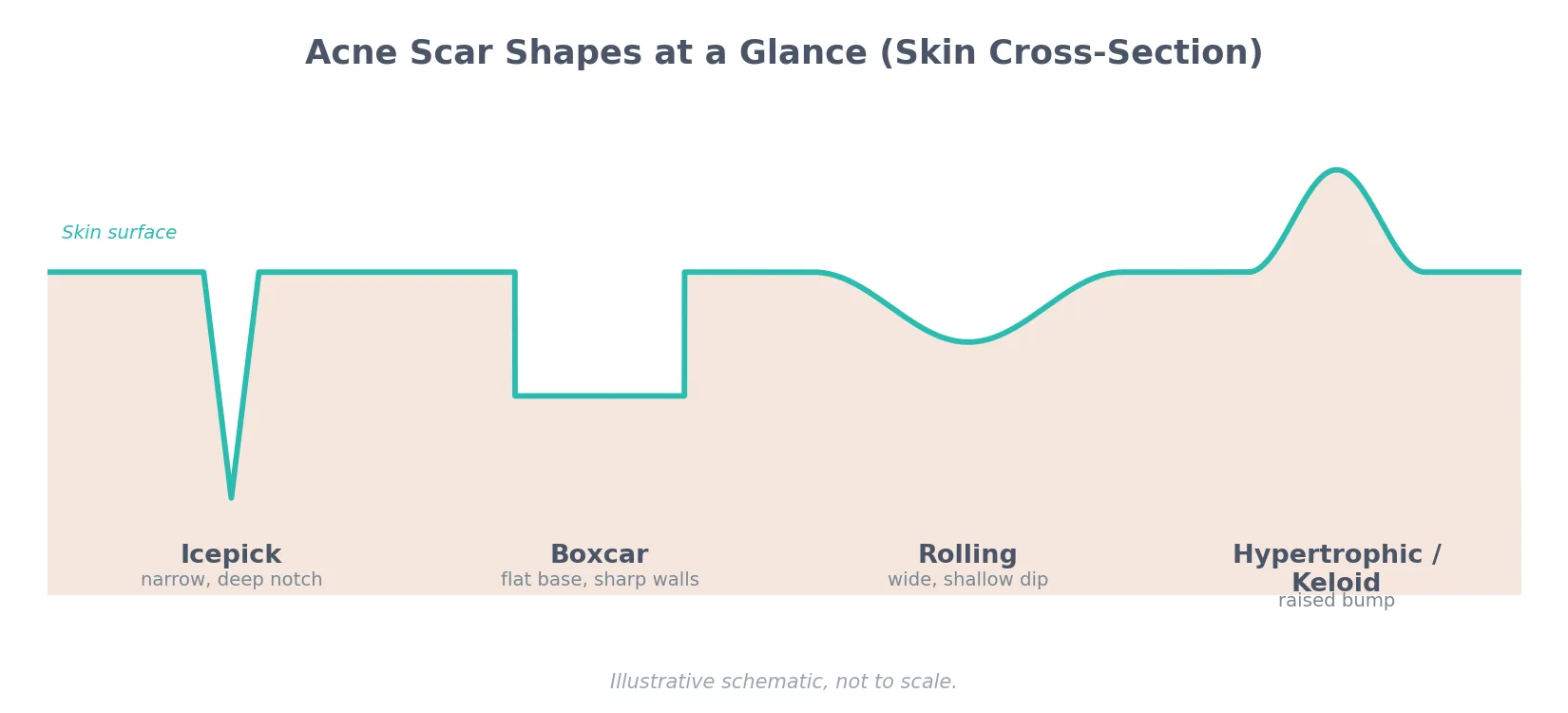
Icepick scars
Icepick scars are narrow and deep, like a tiny puncture made by an ice pick. They look like small, deep holes or oversized, stretched pores, usually less than two millimeters across, and they taper to a point below the surface. Because they run deep, they are often the most stubborn shape to smooth out.
Boxcar scars
Boxcar scars are wider, round or oval depressions with sharp, well-defined vertical edges and a flat base, a bit like the marks left by chickenpox. They can be shallow or deep, and their crisp borders make them look almost stamped into the skin. They show up most on the cheeks and temples.
Rolling scars
Rolling scars are wide and shallow with gently sloping edges, giving the skin an uneven, wavy, or undulating look, especially under side lighting. Instead of sharp borders, they blend into normal skin. They are caused by fibrous bands that tether the surface down from underneath, which is why they often improve when those bands are released. You can read how subcision releases the fibrous bands that tether rolling acne scars beneath the skin at our Doral clinic.
Raised Scars: Hypertrophic and Keloid
Not every pimple scar is a pit. Some are raised, firm bumps that sit above the skin because the body made too much collagen while healing. A hypertrophic scar stays within the borders of the original blemish, while a keloid grows beyond them and can keep enlarging. Both are more common on the jawline, chest, shoulders, and back than on the cheeks, and they are more likely in people prone to keloids. Raised scars are managed very differently from depressed ones, and current scar-management guidelines lean on non-invasive measures first (updated practical guidelines on managing hypertrophic and keloid scars with non-invasive and invasive measures).
Why the Type You Have Changes the Treatment
Identifying the shape is not just trivia. Each type responds best to a different approach, and matching the treatment to the scar is what separates real improvement from wasted effort. Deep icepick scars, sharp-edged boxcars, tethered rolling scars, and raised scars each have their own logic, which is why classifying a scar is the first step toward treating it well (a review of treatment options organized around the acne scar classification system that matches each scar type to a plan).

In practice, most faces show more than one type at once, so a plan often layers a few methods rather than relying on one. Because different scars also heal on different timelines, expectations should be set per type. You can see a realistic timeline for how long acne scar treatment takes broken down by the type of scar you have, and the specifics belong in a consultation rather than a one-size-fits-all promise online.
Pimple Scars on Skin of Color in Miami
In a diverse market like Miami and Doral, the mark-versus-scar question is especially important. Richer skin tones are more prone to postinflammatory hyperpigmentation, so the most visible thing after a breakout is often a dark mark rather than a true scar, and that mark usually fades with patience and sun protection. Treating a fading mark as if it were a permanent scar can waste time and, with the wrong aggressive approach, even cause more pigment. This is why assessment in person, with attention to skin tone, matters so much.
How We Assess Scar Type at Perfect B in Doral
An in-person assessment does what a mirror cannot. A provider looks at your skin under good, angled lighting to read texture, gently stretches the skin to see which depressions flatten out (a clue that rolling scars are tethered), and factors in your skin tone and history. From there, the type or, more often, the mix of types guides the plan. Because every plan is personalized, pricing is quoted at your consultation rather than as a flat number online, and financing is available through Cherry, Klarna, Afterpay, and CareCredit.
Frequently Asked Questions
1. How can I tell a pimple scar from a dark mark?
Feel it. A true scar changes the skin surface, so it is pitted or raised. A dark or red spot that is flat and smooth to the touch is usually a mark, such as postinflammatory hyperpigmentation or erythema, and those tend to fade over months with sun protection and the right topicals.
2. What do icepick scars look like?
Icepick scars look like small, narrow, deep holes or oversized stretched pores, usually under two millimeters wide, that taper to a point below the surface. They are the deepest and narrowest of the depressed scars, which makes them the most stubborn shape.
3. What is the difference between boxcar and rolling scars?
Boxcar scars have sharp, well-defined vertical edges and a flat base, so they look stamped into the skin. Rolling scars have soft, sloping edges that blend into normal skin and give a wavy, undulating look, because they are tethered from underneath rather than sharply walled.
4. Are raised bumps after acne also scars?
Yes. Firm bumps that sit above the skin are hypertrophic or keloid scars, formed when the body makes too much collagen while healing. Hypertrophic scars stay within the original spot, while keloids grow beyond it. They are more common on the jaw, chest, shoulders, and back, and they are managed differently from depressed scars.
5. Do pimple scars go away on their own?
Flat marks usually do fade on their own over months. True scars, whether depressed or raised, are permanent changes in the skin structure and do not simply disappear, though texture-focused treatments can improve how they look. That is why telling a mark from a scar first is so useful.
6. Can I identify my scar type at home?
You can get a good first impression using a mirror, side lighting, and the finger test for texture. But most faces have a mix of types, and depth is hard to judge yourself, so an in-person assessment is the reliable way to confirm the type and build a plan that fits it.
Get a Scar-Type Assessment in Doral
If you are not sure what you are looking at, that is exactly what an assessment is for. A provider can tell a fading mark from a true scar, identify the shapes you have, and explain which options actually fit them, honestly and without overpromising.
- 📍 Visit us at Perfect B, 3905 NW 107th Ave, Suite 104, Doral FL 33178
- 📞 Call or message us at (786) 502-2260
- 💳 Financing available through Cherry, Klarna, Afterpay, and CareCredit