Perfect B, Doral FL. | 03.21.25 | 9 min read.
This content is for educational purposes only and does not constitute medical advice. Consult a qualified medical provider before beginning any aesthetic treatment.
What Is Ozempic Face and Why Are So Many Patients Concerned About It?
Ozempic face is not a medical diagnosis. It is a cultural shorthand that emerged as GLP-1 medications like Semaglutide and Tirzepatide became mainstream weight loss tools. The term describes the hollow, sunken, or aged appearance that some patients develop after significant weight loss, particularly when that loss happens quickly. The face loses fat volume alongside the rest of the body, and because facial fat is structural, its loss has consequences that are immediately visible.
At our clinic in Doral, FL, we see this regularly in patients who have achieved meaningful results on GLP-1 protocols. They come in proud of their weight loss and concerned about their face. The underlying issue is not the medication itself, it is the speed and degree of fat loss combined with the natural role that facial fat plays in maintaining a youthful, supported appearance. Understanding what is actually happening anatomically is the first step toward addressing it effectively.
Key Takeaways
- Ozempic face is caused by fat pad depletion: The cheeks, temples, and under-eye areas lose structural fat, causing a hollowed, older appearance.
- Speed matters more than total weight lost: Rapid weight loss depletes facial volume faster. Gradual recomposition with muscle preservation reduces the effect.
- Biostimulators first, RF microneedling second: Radiesse and Sculptra produce visible results within 6 to 8 weeks and are the preferred first-line treatment. RF microneedling requires 3 sessions and 12 weeks for collagen remodeling to peak.
- Starting treatment early is better than waiting: Prevention and active collagen stimulation during the weight loss process is less costly and more effective than correction after significant volume loss.
- GHK-Cu and CJC/Ipamorelin add-ons help: These peptides support muscle preservation and skin firmness during weight loss, reducing the magnitude of Ozempic face.
What Actually Happens to Your Face When You Lose Weight on GLP-1s
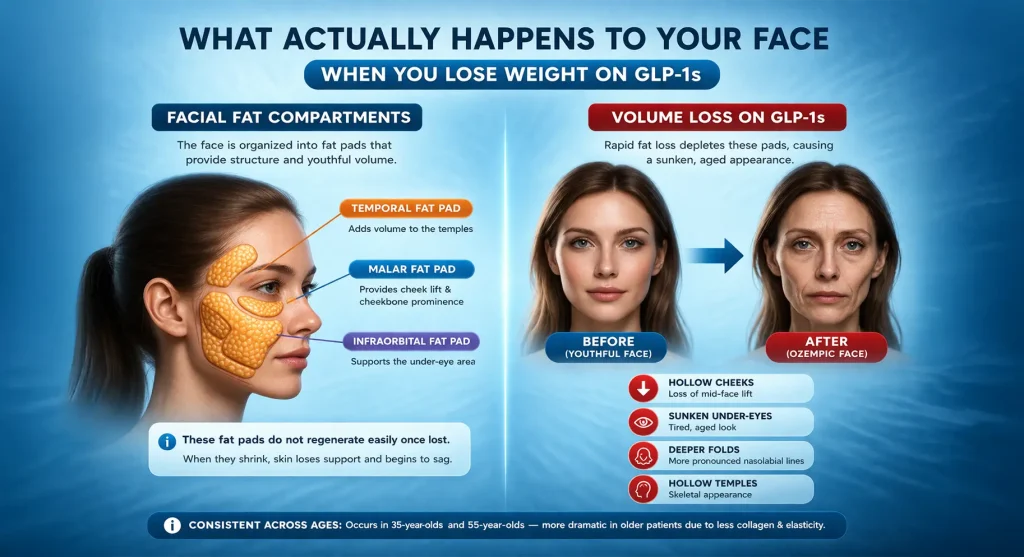
The face is organized around a series of fat compartments, called fat pads, that give it its three-dimensional structure. The malar fat pad in the cheek provides the lifted, prominent cheekbone appearance associated with youth. The temporal fat pad fills the temples. The infraorbital fat pad supports the under-eye area. These fat compartments do not regenerate easily once depleted. When they shrink, the overlying skin has less support and begins to sag or hollow.
When patients lose a substantial amount of weight on GLP-1s, they experience volume loss in these facial fat pads and appear sunken in, often looking older than their actual age. The specific anatomical changes follow a predictable pattern. Patients lose volume in the cheeks, which are the primary lifting structures of the mid-face. Without cheek volume, the skin descends, the nasolabial folds deepen, and the jawline becomes less defined. The temples hollow, creating a skeletal appearance at the sides of the face. The under-eyes sink, producing a chronically tired look that does not resolve with sleep or concealer.
The appearance is consistent across patient ages, though older patients tend to experience it more dramatically because they have less collagen reserve and less skin elasticity to compensate for the structural changes. A 35-year-old and a 55-year-old losing the same amount of weight on Tirzepatide may end up with similar volume loss, but the 55-year-old’s skin will show it more severely.
When Does Ozempic Face Start? Speed of Loss Matters More Than Total Weight
One of the most important clinical insights for patients on GLP-1 protocols is that the trigger for facial volume loss is not primarily how much weight is lost, it is how fast it comes off. When patients lose weight too quickly, the body depletes fat stores rapidly, including the structural fat in the face and glutes. A patient who loses 30 pounds over six months will typically experience less facial deterioration than a patient who loses the same amount in three months.
This is why it is so important to focus on muscle mass and body fat percentage when designing a weight loss plan, rather than simply targeting a number on the scale. Body recomposition, which means losing fat while maintaining or building lean muscle, is a fundamentally different physiological process than rapid weight reduction. Recomposition preserves the structural integrity of the body, including the face and other areas prone to volume loss, because lean muscle tissue signals the body to maintain protein synthesis and tissue repair rather than breaking down structural compartments for fuel.
Patients on GLP-1 protocols at our Doral clinic are monitored continuously for muscle mass and body fat percentage, not just total weight. This approach allows the clinical team to adjust the protocol before significant volume loss occurs, rather than trying to reverse it afterward.
What Treatments Address Ozempic Face? The Sequence That Works at Our Miami Clinic
When facial volume loss has already occurred, treatment sequencing matters. The most effective protocol at Perfect B for Miami patients dealing with Ozempic face starts with biostimulator treatments before moving to radiofrequency microneedling.
Step 1: Biostimulators (Radiesse and Sculptra)
Biostimulators are the preferred first-line treatment for Ozempic face because they stimulate the body’s own collagen production rather than just adding temporary volume. Radiesse and Sculptra both work by creating a scaffold that the body then populates with new collagen over weeks to months, producing a natural-looking volume enhancement that reflects the patient’s own tissue biology.
Biostimulators are performed first because results are seen more immediately and peak at approximately six to eight weeks. This provides visible improvement relatively quickly, which matters for patients who are still actively losing weight and need to see progress without committing to permanent filler too early. Radiesse can also be done during the active weight loss period to begin stimulating collagen before significant volume loss accumulates.
For a comprehensive overview of facial volume restoration options available at our clinic, see our facial balancing treatment plan at Perfect B in Doral, FL.
Step 2: RF Microneedling
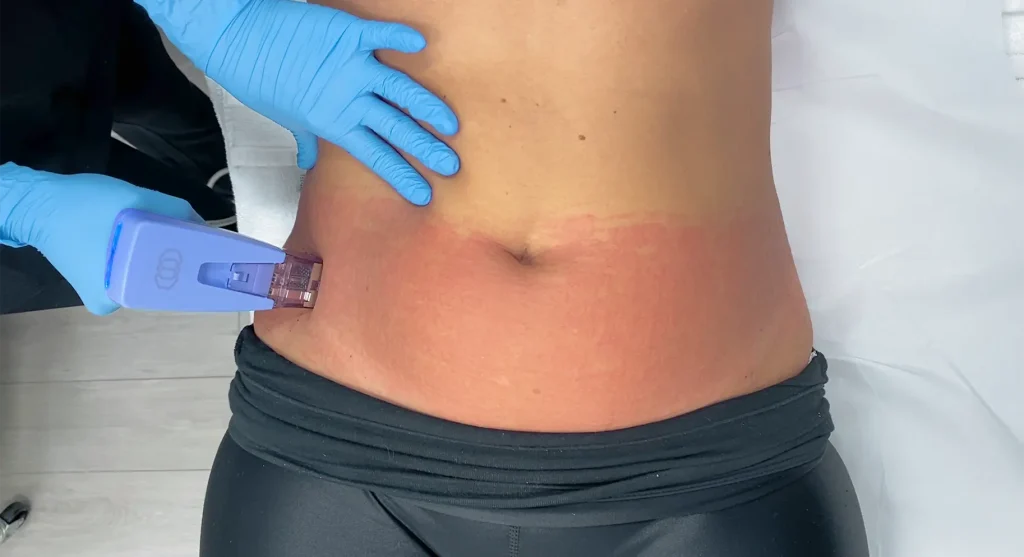
Radiofrequency microneedling addresses the skin quality and texture changes that accompany facial volume loss, particularly skin laxity, fine lines, and reduced dermal density. RF microneedling delivers thermal energy into the dermis through micro-channels, triggering a controlled wound healing response and collagen remodeling that tightens and thickens the skin from within.
RF microneedling is performed after biostimulators because it takes longer for results to fully mature. Three sessions are required, and collagen production peaks approximately twelve weeks after the final session. Sequencing biostimulators first allows the patient to see facial improvement early while the RF microneedling protocol runs its longer course in the background. By the time the RF results mature, the biostimulator collagen is also fully expressed, and the combined effect is significantly better than either therapy alone.
Can You Prevent Ozempic Face Before It Starts?
Yes, and prevention is significantly more effective and less costly than correction. There are several evidence-supported strategies that South Florida patients on GLP-1 protocols can use to minimize facial volume loss during active weight loss.
- Continuous muscle mass and body fat monitoring: Any weight loss protocol that tracks only total pounds on a scale is insufficient. Monitoring lean muscle mass and body fat percentage allows clinicians to catch early muscle loss before it translates into significant facial volume depletion.
- Gradual weight loss over rapid loss: A slower, more controlled caloric deficit preserves more structural tissue. Where clinically appropriate, titrating GLP-1 dosing to allow a slower rate of loss reduces the severity of Ozempic face.
- Radiesse biostimulator during the weight loss plan: Starting biostimulator treatment while still actively losing weight pre-loads the collagen stimulation process. By the time weight loss plateaus, the collagen response is already underway, and the face has more structural support to maintain.
- GHK-Cu + CJC/Ipamorelin peptide combination: GHK-Cu supports collagen synthesis and skin firmness, while CJC-1295 combined with Ipamorelin maintains growth hormone release to preserve lean muscle. This combination, used as an adjunct to the weight loss protocol, directly addresses the two mechanisms behind Ozempic face: collagen loss and muscle/structural tissue depletion.
For patients on GLP-1 protocols who want to understand how peptide therapy can support their weight loss results, our weight loss treatment plan at Perfect B in Doral covers the full clinical approach including adjunctive peptide protocols. You can also explore how our peptide treatment program at Perfect B supports body composition and skin quality during and after weight loss.

Is It Ever Too Early or Too Late to Treat Ozempic Face?
This is one of the questions patients most frequently ask, and the clinical answer is clear: it is almost always better to start earlier than later.
Starting treatment proactively, before reaching goal weight, allows clinicians to prevent collagen loss rather than reverse it. Prevention requires fewer treatment sessions and fewer syringes or vials than correction. A patient who begins a biostimulator protocol while still on their GLP-1 journey may need one or two sessions to maintain facial structure. A patient who waits until they have lost 40 pounds and allowed the collagen to atrophy may need four to six sessions and additional treatments to restore what was lost.
The concern about starting too early is legitimate but applies primarily to traditional hyaluronic acid fillers, not biostimulators. Hyaluronic acid filler placed when a patient still has significant weight to lose may need to be adjusted as the facial volume continues to shift. Biostimulators, which work by stimulating the body’s own collagen rather than adding a static volume, are more adaptable to ongoing changes and are therefore appropriate to begin during active weight loss. At Perfect B, the treatment plan is calibrated to the patient’s stage in their weight loss journey and adjusted as goals are reached.
A review in Aesthetic Surgery Journal confirming that calcium hydroxylapatite biostimulators produce progressive collagen induction over 12 months, making them superior to hyaluronic acid for patients with ongoing structural changes supports the clinical logic of using biostimulators early and adaptively in weight loss patients.
Traditional Filler vs Biostimulators for Ozempic Face: What Is the Difference?
Patients researching Ozempic face treatment often encounter both hyaluronic acid (HA) fillers and biostimulators as options and are unsure which to choose. The distinction matters clinically.
HA fillers add immediate volume by introducing a gel substance under the skin. Results are visible the same day, can be dissolved with hyaluronidase, and typically last 12 to 18 months depending on product and placement. They are excellent for precise volume correction in a stable face. For patients who have finished losing weight and want targeted volume restoration in specific areas, HA fillers remain a valid option.
Biostimulators do not add immediate volume. Instead, they stimulate the body’s fibroblasts to produce new collagen. The result is a gradual, progressive improvement that reflects the patient’s own tissue biology. Because the improvement comes from the patient’s own collagen, it looks natural and integrates with surrounding tissue more seamlessly than filler. For patients still losing weight, biostimulators are the more appropriate choice because they can be used adaptively without creating structural mismatches as the face continues to change. Research in Dermatologic Surgery demonstrating that poly-L-lactic acid biostimulators produce durable collagen induction with results that persist for up to two years in patients with facial volume loss reinforces their clinical role in longer-term structural restoration.
Frequently Asked Questions
1. Does everyone on Ozempic or Tirzepatide get Ozempic face?
Not everyone experiences significant facial volume loss, but it is common among patients who lose weight rapidly or who lose a substantial percentage of body weight. Older patients and patients with naturally leaner faces are at higher risk. The most reliable predictor is the rate of weight loss, not the total amount. Patients who lose weight gradually while monitoring muscle mass and body fat percentage typically experience less facial deterioration.
2. What is the difference between Ozempic face and normal facial aging?
Normal facial aging involves gradual fat pad descent, collagen thinning, and bone resorption over decades. Ozempic face compresses similar structural changes into months, which is why patients often describe looking significantly older than before they started their weight loss journey. The mechanisms overlap, but the timeline is dramatically accelerated by rapid fat loss. Treatments that work for age-related facial volume loss, including biostimulators and RF microneedling, work equally well for GLP-1-related volume loss.
3. When should I start treating Ozempic face?
As early as clinically appropriate. For biostimulators, treatment can begin during active weight loss because the mechanism (collagen stimulation) adapts to ongoing changes. For hyaluronic acid fillers, it is generally preferable to wait until weight is stable or close to goal. For RF microneedling, it can be started at any time to improve skin quality. At Perfect B in Doral, we assess each patient individually and create a treatment sequence timed to their weight loss progress.
4. How many Radiesse or Sculptra sessions are needed for Ozempic face?
This depends on the degree of volume loss and the patient’s collagen-producing capacity. Most patients see meaningful improvement after one to two biostimulator sessions. Patients with more significant volume loss or older patients with lower collagen reserves may require two to three sessions spaced six to eight weeks apart. The collagen response continues to build for up to six months after the final session, so patience in assessing final results is part of the protocol.
5. Can peptides help prevent Ozempic face?
Yes. GHK-Cu (copper peptide) directly supports collagen synthesis and skin firmness, making it a useful adjunct for patients on GLP-1 protocols who want to maintain skin quality during weight loss. CJC-1295 combined with Ipamorelin stimulates growth hormone in a pulsatile pattern that supports lean muscle preservation, which is the primary driver of gradual rather than rapid fat loss. Together, these peptides address both the skin quality side and the structural preservation side of Ozempic face prevention. Our peptide treatment plan at Perfect B in Doral includes these combinations for patients on active weight loss protocols.
6. What does RF microneedling do for Ozempic face that biostimulators do not?
Biostimulators address volumetric loss by stimulating deep collagen production. RF microneedling addresses skin quality changes, specifically skin laxity, surface texture, and dermal thinning, that often accompany Ozempic face. The two treatments are complementary: biostimulators rebuild structure from the inside out, while RF microneedling tightens and refines the skin itself. Most patients with significant Ozempic face benefit from both in sequence. Our skin tightening treatment plan at Perfect B in Doral, FL covers RF microneedling and how it is sequenced with other facial treatments.
7. Does stopping the GLP-1 medication reverse Ozempic face?
If weight is regained after stopping the medication, some facial volume may return. However, most patients who discontinue GLP-1s either maintain their weight loss or regain slowly, and the facial fat pads do not reliably replenish through weight regain alone. The collagen that was lost during rapid weight loss does not return on its own. Patients who stop the medication and keep their weight loss will typically retain the facial volume changes unless treated actively.
Closing: What Doral, FL Patients Should Know Before, During, and After GLP-1 Weight Loss
Ozempic face is a predictable consequence of rapid fat loss, not a reason to avoid effective weight loss treatment. The clinical approach that works is proactive: monitor muscle mass and body fat throughout the weight loss process, begin collagen-stimulating treatment early rather than waiting for visible deterioration, and sequence treatments strategically based on the patient’s current stage. Biostimulators first because they are adaptable and produce early results. RF microneedling to address skin quality while the deeper collagen response matures. Peptide adjuncts to preserve the muscle and skin integrity that prevent volume loss from accumulating in the first place.
At Perfect B in Doral, FL, patients on GLP-1 protocols are not managed in isolation from their aesthetic health. The weight loss journey and the aesthetic outcome are treated as connected, because they are. If you are in the Miami area and beginning, currently on, or recently finishing a GLP-1 weight loss protocol, a consultation at Perfect B will help you understand what your face needs now and what to plan for ahead.
- 📍 Visit us at Perfect B, 3905 NW 107th Ave, Suite 104, Doral FL 33178
- 📞 Call or message us today to schedule your facial volume assessment