Perfect B, Doral Fl. | 07.06.26 | 11 min read.
This article is for general educational purposes and is not a substitute for an in-person medical evaluation, diagnosis, or treatment. Acne type, severity, and skin tone vary from person to person, and prescription medications and in-office procedures must be selected and supervised by a licensed medical provider. Exact pricing and protocols are confirmed at a personal consultation.
Benzoyl Peroxide vs Salicylic Acid: The Two Actives Every Acne Aisle Sells You
If you have ever stood in a Miami pharmacy aisle comparing labels, the question of benzoyl peroxide vs salicylic acid has probably stopped you in your tracks. Both promise clearer skin, both are sold over the counter, and both sit on the shelf as if they do the same job. They do not. One is built to fight the bacteria behind red, angry pimples, and the other is built to clear out the clogged pores behind blackheads and whiteheads. Picking the wrong one is the reason so many routines stall for months without real progress.
This guide breaks down how each ingredient actually works, which breakout each one suits, whether you can use them together, and how to apply them without turning your skin red and raw. It also covers the point where over the counter care reaches its ceiling and a medical provider in Doral becomes the smarter move. The goal is simple, to help you stop guessing and start treating the acne you actually have.
Key Takeaways
- Different jobs: benzoyl peroxide kills acne causing bacteria and calms inflamed pimples, while salicylic acid exfoliates inside the pore to clear blackheads and whiteheads.
- Match the ingredient to the breakout: red and painful bumps point to benzoyl peroxide, congested and bumpy texture points to salicylic acid.
- Strength matters: the right benzoyl peroxide strength for acne is usually lower than most people reach for, and higher is not better.
- They can work as a team: used carefully at different times, the two actives can complement each other rather than compete.
- Know the ceiling: when shelves stop working or dark marks appear, medical acne treatment Miami and Doral patients trust is the next step.
What Actually Causes Acne in the First Place?
Before you pick between two actives, it helps to know what you are actually fighting. Acne starts inside the pore, where a mix of excess oil, dead skin cells that do not shed cleanly, and a naturally occurring bacteria called Cutibacterium acnes combine to block the follicle. When that plug traps oil and bacteria, the body responds with inflammation, and that is the moment a quiet clogged pore turns into a red, tender pimple. Hormones sit behind much of it, since they drive how much oil your skin produces, which is why breakouts often flare with monthly cycles, stress, and the humidity of a Miami summer.
This matters for choosing between the two actives, because each one interrupts a different step of that process, one targeting the bacteria and inflammation and the other clearing the plug itself. If hormones seem to drive your breakouts, our guide to why hormonal acne breakouts happen and the practical, provider-informed steps that help calm them before they start is a useful companion read.
What Is the Real Difference Between These Two Acne Ingredients?
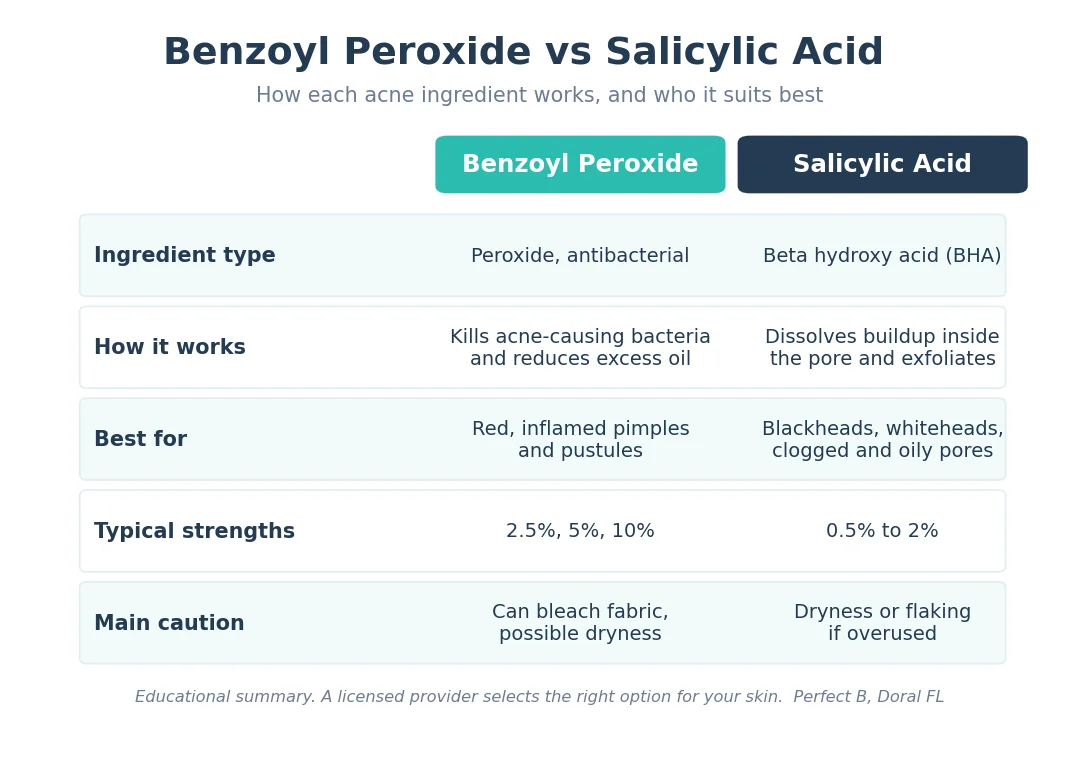
The benzoyl peroxide vs salicylic acid comparison comes down to two very different jobs. Benzoyl peroxide is an antibacterial ingredient. It releases oxygen into the pore, and because the bacteria linked to acne cannot survive well in that environment, it reduces the inflammation that turns a clogged pore into a swollen, tender pimple. It also helps lower the excess oil that feeds breakouts. Salicylic acid is a beta hydroxy acid, which means it is oil soluble and can travel down into the pore to dissolve the mix of dead skin and sebum that forms a plug. In plain terms, one attacks the bacteria and redness, the other clears out the clog.
Understanding that split is the whole point, because it tells you which product belongs in your routine. According to the patient education library maintained by the American Academy of Dermatology on how acne forms and how it is treated, both ingredients are proven first line options, but they target different stages of a breakout. That is why the ideal benzoyl peroxide strength for acne varies from person to person, and why the same routine that clears one friend leaves another peeling and frustrated.
How Does Benzoyl Peroxide Work on Acne?
Benzoyl peroxide is the go to for inflammatory acne, the red and pus filled pimples that feel sore to the touch. By reducing acne causing bacteria and cutting excess oil, it shrinks active breakouts and helps prevent new ones from forming. You will find it in cleansers, leave on gels, and spot treatments, usually at concentrations of 2.5 percent, 5 percent, and 10 percent. Here is the part that surprises people, the lowest concentration is often as effective as the highest for many patients, and it comes with far less dryness and irritation. The right benzoyl peroxide strength for acne is the one your skin can tolerate consistently, not the strongest number on the box.
Learning how to use benzoyl peroxide correctly matters as much as the ingredient itself. Applied too aggressively, it can leave skin tight, flaky, and more reactive than before, which pushes many people to quit before it ever had a chance to work. Applied thoughtfully, it becomes one of the most reliable tools in an acne routine. A quick warning worth remembering in a laundry heavy, active Miami lifestyle, benzoyl peroxide can bleach fabric, so light colored towels, pillowcases, and shirts are at risk if you are not careful.
How Does Salicylic Acid Work on Acne?
Salicylic acid takes a gentler, more exfoliating approach. Because it is oil soluble, it slips into the pore and dissolves the buildup of dead skin cells and sebum that creates blackheads and whiteheads. It also has mild anti inflammatory properties, so it can calm smaller bumps while it clears congestion. Dermatologists often reach for salicylic acid for acne that shows up as blackheads and clogged pores, along with the rough, uneven texture that many people describe as bumpy skin. Over the counter products usually range from 0.5 percent to 2 percent.
Choosing salicylic acid for acne makes the most sense when your main complaint is texture and congestion rather than deep, painful cysts. It is often better tolerated than benzoyl peroxide for people with combination or sensitive skin, though it can still cause dryness if overused. If you want a deeper look at how this ingredient fits into a full routine, our team explains it further in this detailed guide to how salicylic acid for acne clears clogged pores, smooths rough texture, and calms congested breakout prone skin. Matching the acid to your actual skin concern is what turns a random purchase into a working routine.
Which One Should You Choose for Your Breakout Type?
When it comes to benzoyl peroxide vs salicylic acid, the right pick depends on the kind of breakout you see most in the mirror. If your skin is dotted with red, inflamed, tender pimples and pustules, benzoyl peroxide is usually the stronger match because it targets the bacteria and inflammation driving them. If your main issue is blackheads, whiteheads, and a rough, congested surface, salicylic acid is often the better fit because it clears the pore from the inside. Oily skin tends to do well with either, while very dry or sensitive skin usually tolerates salicylic acid more easily.
Real skin rarely fits into one neat box, though. Many people have a mix of clogged pores and occasional inflamed bumps, which is exactly why the choice can feel confusing. If you already use salicylic acid for acne and still break out in painful bumps, benzoyl peroxide may be the missing piece. If persistent, cyclical, or hormonal acne is the pattern, neither over the counter active alone may be enough, and comparing prescription options like those in our overview of how tretinoin, retinol, and adapalene differ and which one best fits long term acne control for your skin type is a logical next step.
What Should You Pair These Actives With to Protect Your Skin Barrier?
Strong acne actives work best when the rest of your routine keeps the skin barrier calm, and this is where most people go wrong. Pairing benzoyl peroxide or salicylic acid with soothing, hydrating ingredients is what lets you stay consistent instead of quitting over dryness. Niacinamide helps calm inflammation and regulate oil, ceramides and hyaluronic acid rebuild and hold moisture in the barrier, and a gentle non-comedogenic moisturizer buffers irritation without clogging pores. A daily broad spectrum sunscreen is not optional either, because both actives make skin more sensitive to strong South Florida sun.
The one pairing to handle with care is a retinoid. Using a retinoid and benzoyl peroxide in the very same step can be too much at once and, with certain older retinoids, can reduce potency, so most providers separate them, often one in the morning and one at night. If you want a simple framework, our complete step by step acne skincare routine that shows how to layer actives, hydration, and sunscreen without overwhelming your skin lays out the order.
Can You Use Benzoyl Peroxide and Salicylic Acid Together?
Many people assume benzoyl peroxide vs salicylic acid is an either or decision, but the two can be layered carefully for skin that struggles with both clogged pores and inflamed breakouts. The catch is that using both at full strength at the same time is a fast track to irritation, redness, and peeling. The safer approach is to separate them, for example a salicylic acid cleanser or product in the morning and a benzoyl peroxide treatment in the evening, or alternating days while your skin adjusts. Starting with one active first, then introducing the second slowly, lets you see how your skin responds before you combine forces.
This is also where a hydrating, barrier supporting moisturizer and a daily sunscreen become non negotiable, because both actives can make skin more sensitive. Pairing strong ingredients without protecting the skin barrier is one of the most common mistakes we see, and it usually causes more breakouts, not fewer. If you are combining actives and your skin keeps reacting, that is a signal to get professional eyes on your routine rather than pushing through the irritation.
How to Use Benzoyl Peroxide Without Irritating Your Skin
The safest way to learn how to use benzoyl peroxide is to start low and slow. Begin with a lower concentration, apply it every other day, and use only a thin layer on the areas that break out. As your skin builds tolerance over a couple of weeks, you can increase frequency if needed. Follow with a gentle, non comedogenic moisturizer to protect the barrier, and never skip sunscreen during the day, especially under strong South Florida sun. Choosing a benzoyl peroxide strength for acne is a balance between power and tolerance, and a lower strength used consistently almost always beats a high strength that your skin cannot handle.
A few habits make a real difference. Patch test a new product on a small area first, avoid layering it with other harsh actives on the same night when you are starting out, and give any routine at least six to eight weeks before judging results. If you notice stinging that does not settle, cracking, or worsening redness, scale back rather than pushing harder. Reference resources such as the acne overview published by MedlinePlus, the consumer health information service of the United States National Institutes of Health reinforce that consistency and gentleness, not intensity, are what clear skin over time.
Cleanser, Gel, or Spot Treatment, and What About Body Acne?
The same active behaves differently depending on the format, so how it is delivered matters as much as the ingredient. A rinse-off cleanser gives brief contact and is the gentlest way to introduce either active, a leave-on gel or lotion stays on the skin for a stronger, sustained effect, and a spot treatment concentrates the ingredient on a single stubborn blemish. Beginners usually tolerate a cleanser best, then step up to a leave-on product as the skin adjusts. Salicylic acid is common in cleansers and toners, while benzoyl peroxide shows up in both washes and leave-on gels.
Acne is not only a face problem, and this is where washes really shine. Breakouts on the back, chest, and shoulders respond well to a benzoyl peroxide body wash, which is far easier to use over a large area than a leave-on product and rinses away before it can bleach fabric. For a deeper look at those areas, see our guide to what actually clears back, chest, and shoulder acne and how it differs from treating breakouts on the face.
Does Benzoyl Peroxide Bleach Skin or Cause Purging?
Two worries come up constantly, and both deserve a clear answer. Benzoyl peroxide does not bleach your skin, but it absolutely can bleach fabric, so the color loss people notice on towels and pillowcases is on the cotton, not the complexion. The second concern is the early flare that can happen when you start a new active. Some of that is simple irritation, and some can be a purging phase as cell turnover speeds up. Knowing the difference matters, which is why we walk through it in our explainer on how to tell normal skin purging apart from a genuine bad reaction so you know when to keep going or when to stop a product.
For patients with deeper skin tones, which is a large part of the Miami and Doral community, there is an added reason for care. Aggressive use of any active can trigger post inflammatory hyperpigmentation, the stubborn dark marks that linger long after a pimple heals. This is one more argument for going gentle and, when marks are already forming, having a provider guide the plan so the treatment does not create a second problem while solving the first.
Are Benzoyl Peroxide and Salicylic Acid Safe During Pregnancy?
This is a question worth pausing on, because pregnancy changes the rules. Benzoyl peroxide is often considered acceptable in limited topical use during pregnancy, and low strength topical salicylic acid is generally viewed as low risk, while high strength or peel-level salicylic acid is usually avoided, and guidance can shift with each trimester. Because every pregnancy is different, none of this replaces personal medical advice.
The safe move is simple, confirm any acne routine with your provider before using it while pregnant or breastfeeding, since some acne treatments, especially retinoids and certain prescription options, are restricted during this time. A provider can build a pregnancy-appropriate plan, which is exactly what we cover in our guide to which acne treatments are considered safe to use during pregnancy and which ones are best paused until after delivery.
When to See a Provider for Acne Treatment in Miami
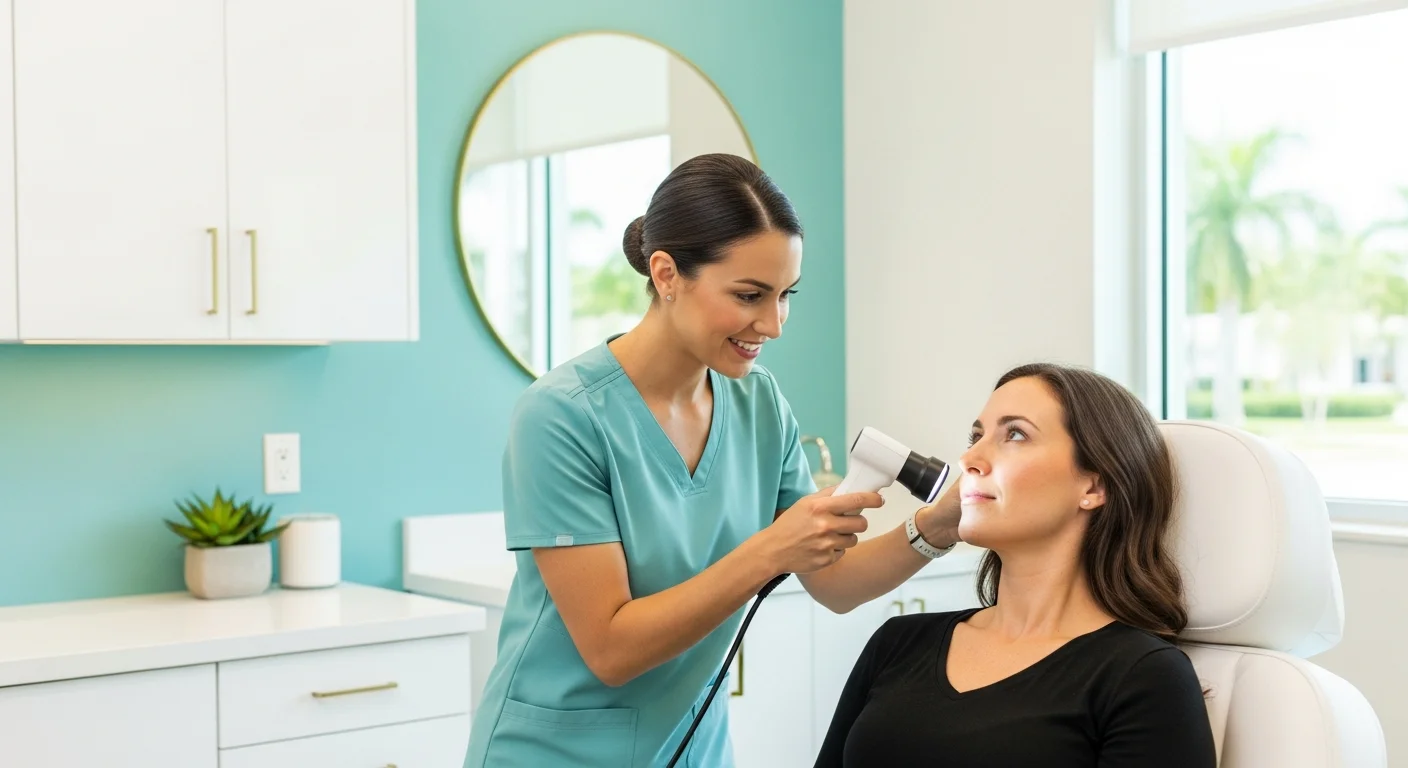
Framing benzoyl peroxide vs salicylic acid as the whole solution is where many people stall for months. Over the counter actives are excellent starting tools, but they have a ceiling. If your acne is cystic, painful, cyclical, leaving scars or dark marks, or simply not responding after a couple of consistent months, that is the signal to escalate. Only a licensed provider can diagnose your specific acne type, prescribe stronger medication, and combine treatments safely. A spa facial alone cannot diagnose or prescribe, so it rarely resolves persistent acne on its own. That is where medical acne treatment Miami residents trust becomes the next step.
At Perfect B in Doral, a provider looks at your skin, your history, and your goals, then builds a plan that may combine prescription topicals, in office treatments, and the right supporting products for your skin tone. A dedicated acne treatment Miami clinic like Perfect B can also address the dark marks and texture changes that over the counter products often leave behind. To see how the full range of options fits together, our hub on every acne treatment method compared for Miami and Doral patients, from topicals to in office procedures lays out the path from shelf products to medical care.
Frequently Asked Questions
1. Is the benzoyl peroxide vs salicylic acid choice different for sensitive skin?
Often yes. Sensitive and dry skin usually tolerates salicylic acid more comfortably, while benzoyl peroxide can be more drying. Sensitive skin can still use benzoyl peroxide at a low concentration, applied sparingly and paired with a good moisturizer, but going slowly is essential.
2. What benzoyl peroxide strength for acne should a beginner use?
Most beginners do well starting at the lower end, around 2.5 percent, because it is nearly as effective as higher strengths for many people while causing far less irritation. Choosing a benzoyl peroxide strength for acne is about what your skin can use consistently, not the highest number available.
3. Is salicylic acid for acne safe to use every day?
Many people use a low percentage of salicylic acid for acne daily, but it depends on your skin. If you notice tightness, flaking, or irritation, cut back to a few times a week. Daily use is easier to tolerate in a cleanser than in a strong leave on product.
4. How do I learn how to use benzoyl peroxide without drying out my skin?
The key to how to use benzoyl peroxide comfortably is to start every other day with a thin layer, follow with a non comedogenic moisturizer, and use daily sunscreen. Increase frequency only once your skin adjusts, and scale back at the first sign of persistent stinging or peeling.
5. Can I use both ingredients at the same time?
You can use both, but not at full strength in the same step. Separate them by time of day or alternate days, and introduce the second active only after your skin tolerates the first. If irritation keeps returning, that is a good moment to ask a provider to structure the routine for you.
6. Why is my acne not improving with over the counter products?
Over the counter actives have limits. Cystic, hormonal, or persistent acne often needs prescription medication or in office treatment that shelves cannot provide. If two consistent months bring no change, or if scarring and dark marks are appearing, a professional evaluation is the smart next move.
7. Where can I find medical acne treatment Miami providers actually supervise?
Perfect B in Doral offers provider led acne care for the greater Miami area, where a licensed provider diagnoses your acne type and builds a supervised plan. That level of medical acne treatment Miami patients can rely on goes beyond what any single shelf product is designed to do.
8. Does either ingredient help with acne scars or dark marks?
Neither benzoyl peroxide nor salicylic acid is designed to erase established scars or deep pigmentation. They help prevent new breakouts, which reduces future marks, but existing scars and stubborn dark spots usually need targeted in office treatment guided by a provider.
Start With the Right Ingredient, Then Build the Right Plan
The benzoyl peroxide vs salicylic acid question is a smart place to start, and an even smarter place to bring to a provider. Match benzoyl peroxide to red, inflamed breakouts and salicylic acid to clogged, congested skin, introduce actives slowly, and protect your barrier along the way. Do that, and you give an over the counter routine its best possible chance to work before you ever spend on anything stronger.
When the shelves reach their limit, you do not have to keep guessing on your own. For acne treatment Miami and Doral patients can count on, Perfect B builds a plan around your skin, your skin tone, and your goals, with financing that keeps a medical plan within reach. Reach out and let a licensed provider take it from here.
- 📍 Visit us at Perfect B, 3905 NW 107th Ave, Suite 104, Doral FL 33178
- 📞 Call or message us at (786) 502-2260
- 💳 Financing available through Cherry, Klarna, Afterpay, and CareCredit