GHK-Cu Dosage: What the Clinical Protocol Actually Looks Like
Most of what is written about GHK-Cu copper peptide and what it does at the cellular level focuses on the mechanism. This post covers the part that matters just as much: how much, how often, and how to actually use it. The GHK-Cu dosage protocol at Perfect B uses a 30-day active cycle with a dose escalation built into the second half. Here is exactly how it works.
GHK-Cu Dosing: Five Clinical Facts You Need Before Starting
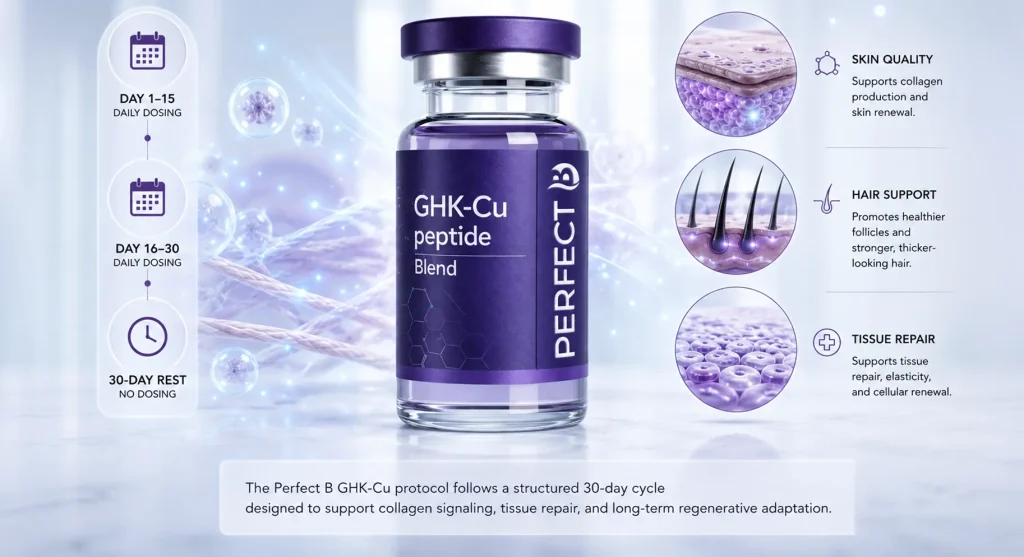
- The standard GHK-Cu dosage at Perfect B is 1 mg/day (4 units) for days 1-15, escalating to 2 mg/day (8 units) for days 16-30.
- The cycle is 30 days on, 30 days off. Continuous dosing without a rest period is not the protocol.
- Injections are subcutaneous (SQ) using an insulin syringe, administered at home after the first clinic injection.
- The vial is reconstituted with 2 mL of bacteriostatic water, yielding a 500 mcg/mL (0.5 mg/mL) concentration.
- Inject before bed, at least 2 hours after your last meal. Rotate injection sites across the abdomen.
The 30-Day GHK-Cu Injection Cycle: Loading Phase, Maintenance Phase, and What to Expect
The GHK-Cu dosage protocol is divided into two 15-day phases within a 30-day active window, followed by a 30-day rest period before the next cycle begins.
Phase 1: Days 1-15 (1 mg/day)
During the first 15 days, the dose is 4 units on an insulin syringe, which equals 1 mg per injection. This phase establishes tissue exposure to the peptide without overwhelming the signaling pathways. Patients inject once daily, before sleep, at least 2 hours after their last meal. The first injection is administered at Perfect B so the patient can learn the technique under clinical guidance. The remaining 14 injections in Phase 1 are taken home.
Phase 2: Days 16-30 (2 mg/day)
From day 16 onward, the dose doubles to 8 units (2 mg per injection). This escalation is intentional. GHK-Cu’s mechanism depends on cumulative tissue signaling rather than peak concentration. The higher dose in the second half of the cycle is designed to reinforce the collagen synthesis, sirtuin activation, and anti-inflammatory pathways initiated in Phase 1. Patients in our Doral clinic who complete both phases consistently report more visible skin texture changes than those who stop early.
The 30-Day Rest
After day 30, the patient stops injections for 30 full days before beginning the next cycle. This rest period is not optional. GHK-Cu works by signaling, not by accumulation. Continuous dosing without a break blunts receptor sensitivity and reduces the efficacy of subsequent cycles. If you miss a day during the active phase, skip it and continue from where you left off. Do not double-dose to compensate.
How to Reconstitute Your GHK-Cu Vial: Step-by-Step Before Your First Injection
GHK-Cu arrives as a lyophilized (freeze-dried) powder. Before the first injection, the vial must be reconstituted. The standard preparation uses 2 mL of bacteriostatic water, which yields a concentration of 0.5 mg per mL (500 mcg/mL). At this concentration, 4 units on an insulin syringe delivers 1 mg, and 8 units delivers 2 mg.
- Wipe both vials: Clean the top of the peptide vial and the bacteriostatic water vial with an alcohol swab.
- Draw the water: Using a 3 mL syringe, draw 2 mL of bacteriostatic water.
- Inject slowly into the peptide vial: Direct the water toward the inner wall of the vial, not directly onto the powder.
- Roll, do not shake: Gently roll the vial between your palms until fully dissolved.
- Refrigerate immediately: Store the reconstituted vial in a closed box in the refrigerator. Never freeze.
At 0.5 mg/mL, a single vial contains enough for the full 30-day cycle at both dose levels.
How to Inject GHK-Cu Subcutaneously at Home: Syringe, Site, and Rotation
GHK-Cu is administered subcutaneously (SQ), meaning just under the skin rather than into muscle. The recommended injection site is the abdomen, in the soft tissue lateral to the navel. Rotate the injection site with each dose to avoid local tissue buildup.
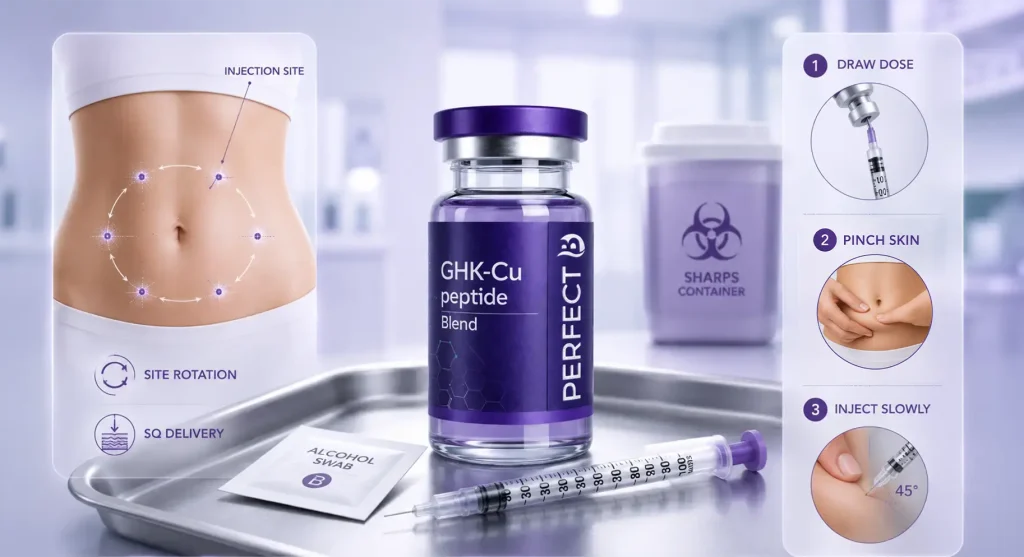
- Wash hands and gather supplies: Insulin syringe, alcohol swabs, and your reconstituted GHK-Cu vial.
- Wipe the injection site: Use an alcohol swab on the abdomen and allow to dry.
- Draw the correct units: Pull back the syringe plunger to 4 units (Phase 1) or 8 units (Phase 2).
- Pinch the skin: Gently pinch a small fold of skin and insert the needle at a 45-degree angle.
- Inject slowly: Push the plunger down slowly and steadily until the full dose is delivered.
- Rotate sites: Each injection should go to a different location on the abdomen to avoid lipohypertrophy.
- Dispose properly: Place used syringes in a sharps container. Bring it to the clinic for disposal.
Not sure which peptide protocol fits your goals?
Perfect B’s peptide protocol tool is built on real clinical data from 2,000+ patients treated in South Florida.
Answer 6 questions and see what patients with similar goals are running: which peptides they use, typical dosing, injection schedule, reconstitution steps, cycle length, and when they pause.
What Each GHK-Cu Dosage Level Actually Produces: Skin, Hair, and Healing Outcomes
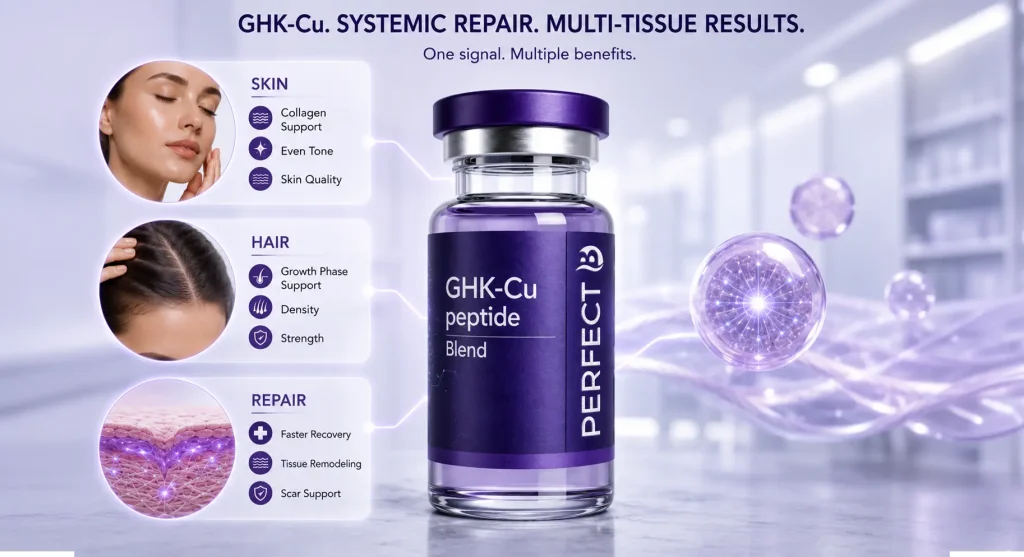
GHK-Cu acts as a systemic repair signal, not a targeted treatment for one area. At clinical doses, the peptide activates collagen synthesis, accelerates cell turnover, and modulates the inflammatory response across multiple tissue types. What patients notice first depends on their individual baseline.
Skin and Collagen
The most consistent outcome at the doses used in our Miami-area protocol is improved skin texture. Patients report faster pigmentation correction, more even tone, and a general quality that they describe as their skin looking more like it did years earlier. This is consistent with GHK-Cu’s known role in upregulating collagen synthesis in dermal fibroblasts, a mechanism confirmed in a comprehensive review in Biomolecules documenting GHK-Cu’s influence across more than 4,000 human genes involved in tissue remodeling and repair. Collagen production declines about 1% per year from the mid-20s onward. The peptide does not reverse that trend, but it re-activates a signaling pathway that age progressively suppresses.
Hair Quality
Improved hair quality is one of the most frequently reported surprises among patients who started GHK-Cu primarily for skin. The peptide activates Wnt signaling in dermal papilla cells, which plays a role in the anagen (growth) phase of the hair cycle, a signaling pathway studied in depth in research examining copper peptide effects on follicle cycling and dermal papilla cell activity. Patients on the Perfect B Hair Quality Restoration program in Doral, FL who include GHK-Cu as part of their protocol often report noticeably denser, stronger hair by the end of the second cycle. For androgenetic alopecia (pattern hair loss), GHK-Cu is an add-on, not a primary treatment. Exosomes or PRP carry more evidence for that indication.
Wound Healing and Tissue Repair
GHK-Cu accelerates wound closure and reduces scar formation. In post-procedure patients at our Doral clinic (post-microneedling, post-laser), the peptide is used as an adjunct to accelerate recovery and improve the quality of new tissue. The mechanism involves upregulation of matrix metalloproteinases (MMPs) and their inhibitors, which remodel collagen in a more organized way than unassisted healing. This mechanism is supported by Pickart’s foundational research on GHK-Cu and tissue remodeling, which established the peptide’s role in accelerating wound closure and improving the structural quality of regenerated tissue. For comparison, GHK-Cu differs from NAD+ therapy, which targets cellular energy pathways rather than tissue remodeling. They serve different purposes and stack well together in regenerative protocols.
GHK-Cu Contraindications: Patients Who Should Not Use This Peptide
GHK-Cu has a strong safety profile at clinical doses. However, it is contraindicated in patients with active malignancies. The peptide promotes cell growth and tissue repair signals that could theoretically support cancer cell proliferation. Patients with a history of hormone-sensitive cancers should discuss GHK-Cu with their oncologist before beginning a protocol. Pregnancy and breastfeeding are also contraindications due to insufficient safety data. Outside of these conditions, GHK-Cu is generally well-tolerated, with minor injection site redness as the most common reported reaction.
See how GHK-Cu fits into real patient protocols.
Perfect B’s peptide protocol tool is built on real clinical data from 2,000+ patients treated in South Florida.
Answer 6 questions and see what patients with similar goals are running: which peptides they use, typical dosing, injection schedule, reconstitution steps, cycle length, and when they pause.
Stacking GHK-Cu with Other Peptides
GHK-Cu stacks cleanly with most peptides used in regenerative protocols. It occupies a different mechanistic category from cognitive peptides like Semax or energy peptides like NAD+, which means there is no redundancy in combining them. The key rule: never mix different peptides in the same syringe or vial. Each peptide is injected separately, from its own vial, using its own syringe. Patients in South Florida who are managing multiple goals simultaneously (skin quality, energy, recovery) often run GHK-Cu alongside NAD+ or other peptides in the Perfect B Peptide Treatment Plan in Doral, FL. The timing of injections from different peptides does not need to be offset unless a specific protocol specifies otherwise.
Frequently Asked Questions
1. What is the standard GHK-Cu dosage?
At Perfect B, the standard GHK-Cu dosage is 1 mg per day (4 units on an insulin syringe) for days 1-15, escalating to 2 mg per day (8 units) for days 16-30. The cycle is 30 days on, 30 days off. The vial is reconstituted with 2 mL of bacteriostatic water to achieve a 0.5 mg/mL concentration.
2. Why does the dose increase in the second half of the cycle?
The dose escalation in days 16-30 is designed to reinforce the signaling pathways activated in Phase 1. GHK-Cu works through cumulative tissue exposure, not peak concentration. Starting at a lower dose allows tissues to respond without overstimulation, then the higher dose in Phase 2 extends and deepens that response. This is the same logic behind loading protocols in many peptide therapies.
3. Can I inject GHK-Cu more than once a day?
No. The protocol is one injection per day. Splitting the dose or adding a second daily injection is not part of the clinical protocol and may not improve outcomes. GHK-Cu’s mechanism depends on gradual tissue accumulation over the cycle, not on high single-day concentrations.
4. What if I miss a day?
Skip the missed day and continue with the next scheduled injection. Do not double-dose. The 30-day cycle is designed with a margin for occasional missed days. Missing one or two days in a cycle will not significantly affect outcomes. Missing multiple consecutive days should prompt a discussion with your provider about whether to restart the cycle.
5. How long before I see results from GHK-Cu dosage?
Most patients begin noticing skin texture improvements toward the end of the first 30-day cycle. Hair quality improvements are more commonly observed after the second cycle. The most consistent pattern in Miami-area patients at Perfect B is that the first cycle establishes a baseline response, and the second cycle (after the 30-day rest) produces more visible outcomes. The peptide is not a fast-acting intervention. Its results are cumulative.
6. Can GHK-Cu be used with botox or other aesthetic treatments?
Yes. GHK-Cu is often used alongside neurotoxin treatments, microneedling, and laser procedures at Perfect B in Doral. It does not interfere with neurotoxin mechanisms and may actually improve the quality of new collagen laid down post-procedure. If combining with an active treatment, timing recommendations should come from your provider. In general, GHK-Cu can continue through most non-invasive aesthetic procedures without pausing the cycle.
Book GHK-Cu Peptide Therapy at Perfect B in Doral, FL
See what patients like you are running at Perfect B.
Perfect B’s peptide protocol tool is built on real clinical data from 2,000+ patients treated in South Florida.
Answer 6 questions and see what patients with similar goals are running: which peptides they use, typical dosing, injection schedule, reconstitution steps, cycle length, and when they pause.
- 📍 Perfect B | 3905 NW 107th Ave, Suite 104, Doral FL 33178
- 📞 Call or message us at (786) 502-2260 to schedule your GHK-Cu consultation with a licensed medical provider.
- 💳 Buy Now Pay Later: Cherry, Klarna, Afterpay, CareCredit
→ Book your GHK-Cu peptide consultation at Perfect B in Doral, FL