

Perfect B, Doral Fl. | 05.25.26 | 11 min read.
This article is for educational purposes only. MOTS-c protocols at Perfect B are prescribed following a full medical intake and APRN evaluation. Results vary by patient. This is not a substitute for medical advice. To understand where this fits, learn how supervised peptide therapy at Perfect B in Doral is structured and how it supports safe, monitored use of peptides.
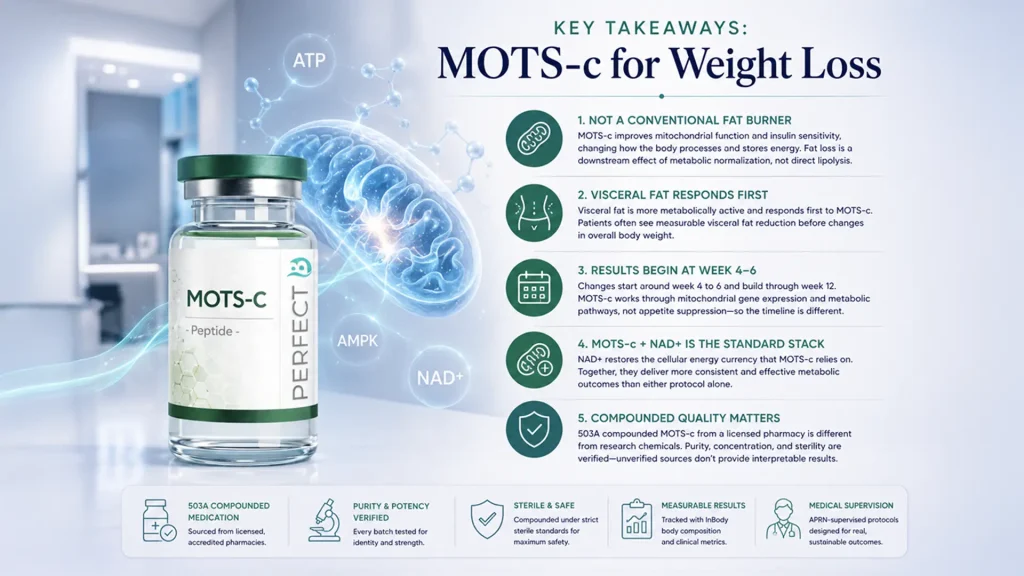
Key Takeaways: MOTS-c for Weight Loss
- MOTS-c is not a fat burner in the conventional sense: it works by improving mitochondrial function and insulin sensitivity, which changes how the body processes and stores energy at the cellular level. The fat loss that follows is a downstream effect of metabolic normalization, not direct lipolysis stimulation.
- Visceral fat responds before subcutaneous fat: the metabolic activity of visceral adipose tissue makes it more responsive to the insulin-sensitizing and AMPK-activating mechanisms of MOTS-c. Patients tracking body composition with InBody at Perfect B often see measurable visceral fat reduction before visible changes in overall body weight.
- Results typically begin at week 4 to 6 and compound through week 12: because MOTS-c works through mitochondrial gene expression and metabolic pathway activation rather than appetite suppression, the timeline is slower than GLP-1 therapies but produces different, complementary changes in metabolic function.
- MOTS-c + NAD+ is the standard stack at Perfect B: both act on mitochondrial function through different mechanisms. NAD+ restores the cellular energy currency that MOTS-c relies on to activate its downstream pathways. The combination produces more consistent metabolic outcomes than either protocol alone.
- 503A compounded MOTS-c from a licensed pharmacy is categorically different from research chemicals: purity, concentration, and sterility are verified. Results from unverified sources are not interpretable as evidence about what MOTS-c itself does.
Patients interested in weight loss protocols at Perfect B also review the weight loss treatment plan at Perfect B in Doral which covers all metabolic and fat-reduction options offered at the clinic, including MOTS-c protocols within the full clinical framework.
What MOTS-c Is and Why It Declines With Age
MOTS-c (Mitochondrial Open Reading Frame of the 12S rRNA Type-c) is a peptide encoded in the mitochondrial genome, not the nuclear genome. It was identified in 2015 and has since become one of the most researched mitochondria-derived peptides for metabolic applications. Unlike most peptides that are produced in glands or organs and travel to target tissues, MOTS-c originates inside the cell and acts as a local and systemic signal of mitochondrial stress and energy status.
MOTS-c levels decline with age and with metabolic dysfunction. Research has documented lower circulating MOTS-c in patients with obesity, type 2 diabetes, and insulin resistance, and higher levels in populations with healthy metabolic aging. This is not a supplementary compound filling a theoretical gap. It is a peptide the body produces in response to metabolic demand and that declines when that capacity is impaired.
Not sure which peptide protocol fits your metabolic goals?
Perfect B’s peptide protocol tool is built on real clinical data from 2,000+ patients treated in South Florida. Answer 6 questions and see which protocol patients with similar goals chose: single peptide at $445, Wolverine Stack at $795, or a custom multi-peptide cycle.
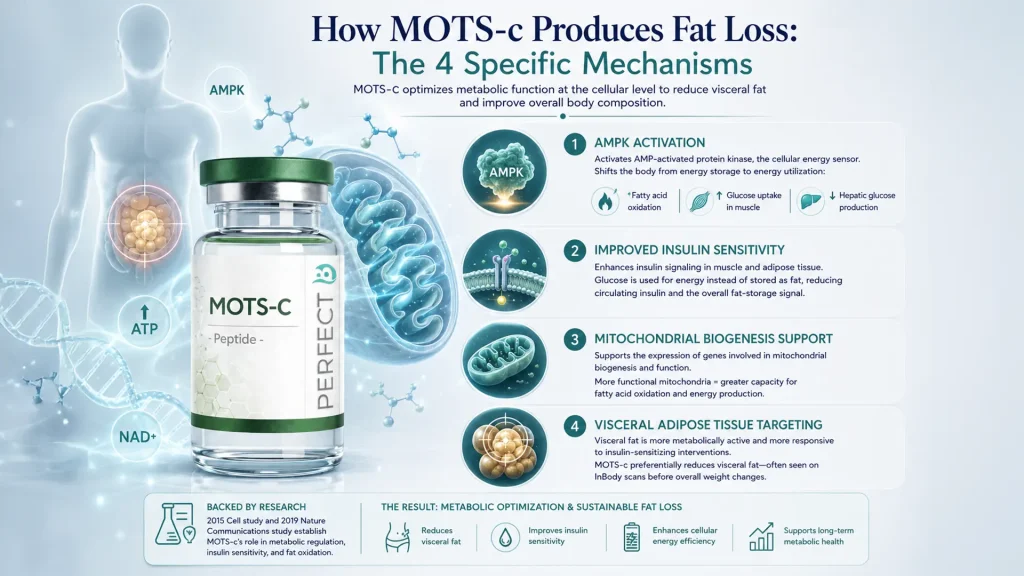
How MOTS-c Produces Fat Loss: The 4 Specific Mechanisms
Patients researching MOTS-c in the Miami area typically also review the MOTS-c clinical guide at Perfect B and the MOTS-c dosage and injection protocol used at the Doral clinic before their consultation.
The metabolic research behind MOTS-c is substantive. A landmark 2015 Cell study documenting MOTS-c as a mitochondrial-derived peptide that regulates AMPK activation and improves insulin sensitivity in mice established the scientific basis for its use in metabolic optimization protocols. A 2019 study in Nature Communications confirming MOTS-c\’s role in exercise-induced metabolic signaling and its effects on glucose regulation and fat oxidation supports the clinical rationale at Perfect B for stacking MOTS-c with NAD+ in patients with insulin resistance or visceral fat accumulation.
Understanding the mechanism matters because it determines what to expect and when. MOTS-c does not suppress appetite, does not directly stimulate lipolysis, and does not block fat absorption. It changes the metabolic environment in ways that make the body more effective at using fat as fuel and less prone to storing excess energy as visceral adipose tissue.
- AMPK activation: MOTS-c activates AMP-activated protein kinase, the enzyme that functions as the cellular energy sensor. When AMPK is activated, the body shifts from energy storage mode to energy utilization mode: fatty acid oxidation increases, glucose uptake by muscle tissue improves, and hepatic glucose production decreases. This is the same pathway targeted by metformin, but through a different upstream mechanism.
- Improved insulin sensitivity: MOTS-c enhances insulin signaling in skeletal muscle and adipose tissue. In patients with insulin resistance — which is extremely prevalent in the South Florida population given dietary patterns and sedentary lifestyle factors — this means glucose is diverted to muscle tissue for energy use rather than converted to triglycerides for fat storage. The reduction in circulating insulin that follows reduces the fat-storage signal throughout the body.
- Mitochondrial biogenesis support: MOTS-c supports the expression of genes involved in mitochondrial biogenesis and function. More functional mitochondria means greater capacity for fatty acid oxidation. This is particularly relevant for patients with metabolic syndrome where mitochondrial dysfunction is part of the disease mechanism.
- Visceral adipose tissue targeting: visceral fat — the fat stored around internal organs that drives metabolic disease risk — is metabolically active and more responsive to insulin-sensitizing interventions than subcutaneous fat. MOTS-c preferentially reduces visceral adipose tissue in the research literature, which is why InBody-tracked patients at Perfect B often see visceral fat changes before overall weight changes.
The MOTS-c Weight Loss Timeline: What to Expect at Weeks 4, 8, and 12
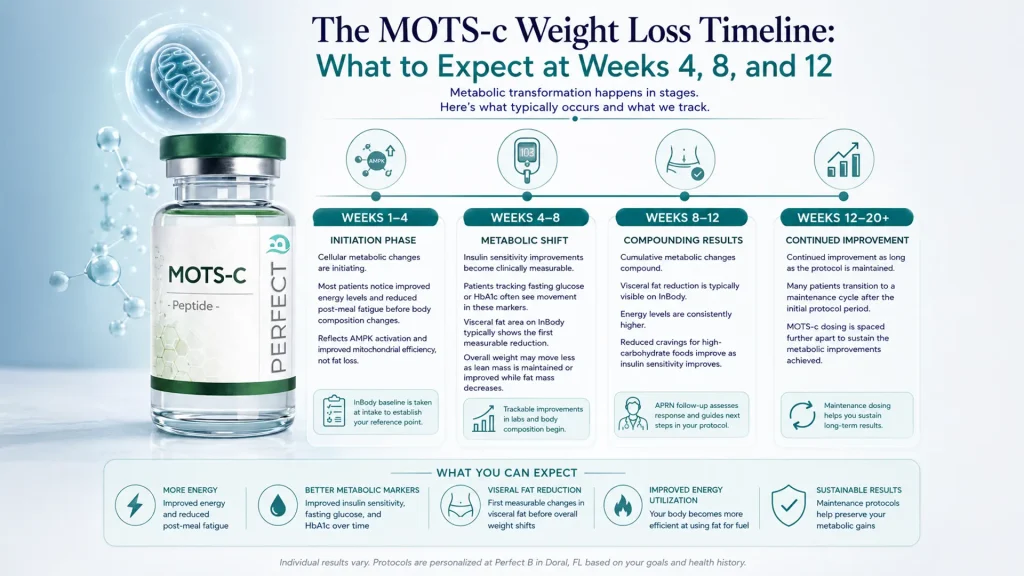
- Weeks 1 to 4: cellular metabolic changes are initiating. Most patients notice improved energy levels and reduced post-meal fatigue before they notice body composition changes. This reflects the AMPK activation and improved mitochondrial efficiency rather than fat loss itself. InBody baseline is taken at the intake evaluation to establish a documented reference point.
- Weeks 4 to 8: insulin sensitivity improvements become clinically measurable. Patients tracking fasting glucose or HbA1c often see movement in these markers. Body composition changes begin: visceral fat area on InBody typically shows the first measurable reduction in this window. Overall weight may move less than expected because lean mass is often maintained or improved while fat mass decreases.
- Weeks 8 to 12: cumulative metabolic changes compound. Visceral fat reduction is typically visible on InBody. Energy levels are consistently higher. Patients report reduced cravings for high-carbohydrate foods, which is a downstream effect of improved insulin sensitivity rather than a direct appetite-suppressing mechanism. The APRN follow-up at this stage assesses response and determines whether protocol continuation, dose adjustment, or stack modification is appropriate.
- Weeks 12 to 20 and beyond: continued improvement as long as the protocol is maintained. Many patients transition to a maintenance cycle after the initial protocol period, with MOTS-c dosing spaced further apart to sustain the metabolic improvements achieved.
Not sure which peptide protocol fits your metabolic goals?
Perfect B’s peptide protocol tool is built on real clinical data from 2,000+ patients treated in South Florida. Answer 6 questions and see which protocol patients with similar goals chose: single peptide at $445, Wolverine Stack at $795, or a custom multi-peptide cycle.
MOTS-c for Weight Loss vs Other Peptides at Perfect B
MOTS-c does not replace the other fat loss peptides offered at Perfect B. It serves a different function in the metabolic architecture and is often most effective as part of a combined protocol.
- MOTS-c vs Tesamorelin: Tesamorelin stimulates growth hormone release, which drives visceral fat reduction through a different pathway: increased GH → increased IGF-1 → direct lipolysis in visceral adipose tissue. MOTS-c targets the upstream metabolic dysfunction that makes visceral fat accumulate in the first place. They can be combined, and in patients with both growth hormone deficiency and insulin resistance the combination addresses the problem from two directions simultaneously.
- MOTS-c vs AOD 9604: AOD 9604 is a fragment of human growth hormone that directly stimulates fat cell breakdown (lipolysis) and inhibits fat cell formation (lipogenesis). It acts faster on fat mass than MOTS-c but does not address insulin sensitivity or mitochondrial function. MOTS-c changes the metabolic environment; AOD 9604 acts more directly on fat cells. Different mechanisms, complementary roles.
- MOTS-c vs CJC-1295/Ipamorelin: the CJC/Ipa stack drives growth hormone pulsatile release, improving body composition through anabolic effects on muscle and lipolytic effects on fat. MOTS-c is not an anabolic peptide. For patients whose primary goal is metabolic health improvement and visceral fat reduction rather than body recomposition, MOTS-c is often a better primary choice or a complementary addition to the CJC/Ipa stack.
The MOTS-c + NAD+ Stack: Why Perfect B Combines Them for South Florida Patients
MOTS-c and NAD+ act on mitochondrial function through different but complementary mechanisms. MOTS-c activates AMPK and mitochondrial gene expression pathways. NAD+ is the cellular energy currency — nicotinamide adenine dinucleotide — that these pathways consume. A cell that is activating MOTS-c-mediated metabolic improvement but is depleted of NAD+ is like an engine receiving a better fuel signal but running low on fuel itself.
NAD+ levels also decline with age and with metabolic dysfunction. In South Florida patients presenting with metabolic syndrome, insulin resistance, or obesity-related fatigue, both deficits tend to be present simultaneously. The MOTS-c + NAD+ stack at Perfect B restores both the signaling mechanism (MOTS-c) and the energy substrate (NAD+), producing more consistent improvements in metabolic energy, body composition, and insulin sensitivity than either protocol alone. Perfect B already holds top organic rankings for MOTS-c and NAD+ combination queries, which reflects the clinical relevance of this stack for the patient population served.
Who Sees the Best MOTS-c Weight Loss Results at Perfect B in Doral
MOTS-c produces the most consistent fat loss outcomes in patients whose primary metabolic challenge is insulin resistance, visceral fat accumulation, or mitochondrial dysfunction rather than caloric surplus or sedentary lifestyle alone. The South Florida patient profile presenting at Perfect B frequently fits this description: desk-based professionals, patients who have tried dietary changes and exercise with limited visceral fat response, patients with pre-diabetic or borderline metabolic markers, and patients in their 40s and 50s experiencing the metabolic slowdown associated with declining mitochondrial function and declining MOTS-c production.
Patients who track body composition with InBody throughout the protocol get the most complete picture of their response, because weight on a scale captures total mass changes without distinguishing between visceral fat reduction, lean mass improvement, and water changes. The InBody assessment at Perfect B is the baseline document that makes MOTS-c protocol outcomes interpretable rather than subjective.

Not sure which peptide protocol fits your metabolic goals?
Perfect B’s peptide protocol tool is built on real clinical data from 2,000+ patients treated in South Florida. Answer 6 questions and see which protocol patients with similar goals chose: single peptide at $445, Wolverine Stack at $795, or a custom multi-peptide cycle.
What the Research Shows — and What It Does Not
MOTS-c has a growing body of peer-reviewed research behind it. Studies published in Cell Metabolism and Nature Communications document its effects on AMPK activation, insulin sensitivity, exercise performance, and metabolic aging in animal models and early human studies. The mechanisms are well-characterized and scientifically credible.
What the research does not yet include is large-scale randomized controlled trial data in humans for fat loss as a primary endpoint. Most human studies have been small or have examined metabolic markers as surrogate outcomes. This does not invalidate the mechanism, but it is honest context. At Perfect B, MOTS-c is prescribed as part of a clinically supervised protocol where the individual patient’s response is tracked and the protocol is adjusted based on observed outcomes, not extrapolated from population averages. This is what distinguishes a medical protocol from a research chemical purchase based on internet reading.
Frequently Asked Questions
1. How long does MOTS-c take to work for weight loss?
Measurable metabolic changes — improved energy, reduced post-meal fatigue, early insulin sensitivity improvement — typically appear between weeks 2 and 4. Visceral fat reduction measurable on InBody typically begins between weeks 4 and 8. Significant body composition changes compound through weeks 8 to 12 and beyond on a continuous protocol. MOTS-c works through metabolic normalization, not appetite suppression, so the timeline is slower than GLP-1 drugs but produces different and complementary changes.
2. Does MOTS-c work without diet and exercise changes?
MOTS-c improves the metabolic environment and produces measurable results in patients who have not made significant lifestyle changes. However, the combination of MOTS-c with improved dietary insulin load and regular activity produces substantially better outcomes than the peptide alone. At Perfect B, the APRN intake evaluation includes a discussion of lifestyle factors that compound the protocol’s effectiveness.
3. Can MOTS-c be stacked with other peptides for weight loss?
Yes. At Perfect B, MOTS-c is frequently stacked with NAD+ for the mitochondrial synergy described above. It can also be combined with Tesamorelin or AOD 9604 for patients with multiple fat loss mechanisms to address. The appropriate stack is determined at the APRN consultation based on the patient’s metabolic profile, InBody results, and primary goals. See the MOTS-c dosage protocol at Perfect B for detail on how the injection cycle is structured.
4. How much does MOTS-c cost at Perfect B in Doral?
MOTS-c protocols at Perfect B start at $445 per cycle. The MOTS-c + NAD+ stack is priced based on the combined protocol designed at the APRN consultation. Pricing is confirmed at the intake evaluation after the provider reviews the patient’s goals and metabolic history. More detail on protocol structure and pricing is available at the peptide treatment plan page.
5. Is MOTS-c better than Ozempic for weight loss?
They work through entirely different mechanisms and are not directly comparable. Ozempic (semaglutide) is a GLP-1 receptor agonist that produces significant appetite suppression and slows gastric emptying, resulting in substantial caloric deficit-driven weight loss. MOTS-c does not suppress appetite. It improves mitochondrial function, AMPK activity, and insulin sensitivity. For patients who cannot tolerate GLP-1 side effects, who have already lost weight with GLP-1 therapy and want to sustain metabolic health, or whose primary issue is insulin resistance and visceral fat rather than caloric surplus, MOTS-c addresses a different problem. Many patients at Perfect B use both approaches in sequence or combination under APRN supervision.
6. Can MOTS-c be used if I have insulin resistance or pre-diabetes?
MOTS-c’s primary mechanism directly targets the insulin signaling pathways impaired in insulin resistance and pre-diabetes. Patients with these conditions are frequently among those who see the most significant metabolic response. However, because MOTS-c affects glucose metabolism, patients on diabetes medications require careful monitoring and potential dose adjustments during the protocol. This is one of the specific reasons a medical intake and licensed prescriber involvement is essential before starting MOTS-c, not optional.
A Metabolic Peptide That Works at the Source of the Problem
Most fat loss interventions work around metabolic dysfunction: they reduce calories in, increase calories out, or suppress the appetite that drives overconsumption. MOTS-c works at the source of a specific metabolic problem: the decline in mitochondrial function and insulin sensitivity that makes fat accumulation, particularly visceral fat accumulation, increasingly resistant to conventional interventions as patients age. For patients in the South Florida demographic who have already tried dietary changes, exercise, and sometimes GLP-1 therapies, and who are still dealing with stubborn visceral fat and declining metabolic energy, MOTS-c addresses the cellular mechanism that the other approaches do not reach.
At Perfect B in Doral, the MOTS-c protocol begins with an InBody baseline, a full metabolic intake evaluation, and a protocol designed around the individual patient’s markers and goals. The results are tracked against that baseline throughout the protocol. That clinical infrastructure is what separates a MOTS-c protocol from a purchase decision and produces outcomes that can be understood, adjusted, and built on.
- 📍 Visit us at Perfect B, Doral FL, serving Miami and South Florida patients seeking metabolic and weight loss peptide therapy.
- 📞 Call or message us at (786) 502-2260 to schedule your MOTS-c consultation with a licensed medical provider.