Perfect B, Doral Fl. | 04.21.26 | 11 min read.
This content is for educational purposes only and does not constitute medical advice. Consult a qualified medical provider before beginning any peptide therapy protocol. All peptide medications referenced on this page require a clinical evaluation and prescription from a licensed provider. Results vary by patient.
What Is MOTS-c and Why Has It Become One of the Fastest-Growing Peptide Therapies?

MOTS-c is a 16-amino-acid peptide encoded directly in your mitochondrial DNA, specifically by the 12S ribosomal RNA gene. Unlike most peptide therapies, which target receptors in the pituitary or in soft tissue, MOTS-c works at the cellular energy level: it activates the AMPK pathway, regulates how mitochondria handle metabolic stress, and translocates into the cell nucleus to influence gene expression that controls metabolism. Search volume on MOTS-c has nearly tripled in the last six months, climbing from roughly 22,000 monthly searches to over 60,000, which tells you exactly how quickly metabolic and longevity medicine is moving toward it.
At Perfect B in Doral, FL, we prescribe MOTS-c for a specific clinical profile: patients with metabolic slowdown, persistent fatigue, exercise intolerance, stubborn visceral fat, and insulin sensitivity issues that have not responded to diet, training, and standard interventions alone. MOTS-c is not a weight-loss shortcut. It is a mitochondrial signaling tool that helps patients whose cells are not running their energy systems efficiently.
Key Takeaways on What Is MOTS-c
- MOTS-c is a 16-amino-acid mitochondrial-derived peptide encoded in your mitochondrial DNA, not in your nuclear genome. It is the first peptide of its kind to enter clinical use.
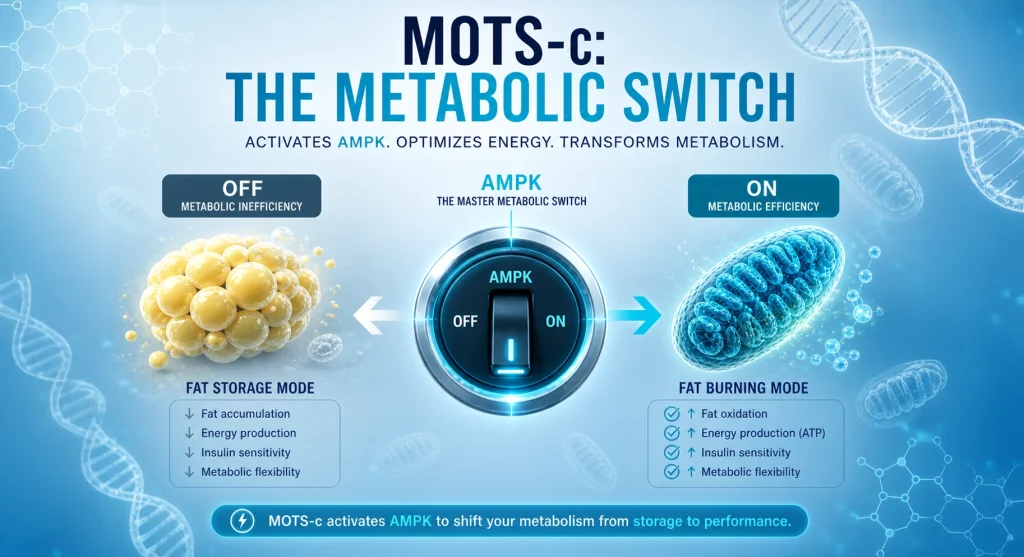
- The primary mechanism is AMPK activation, the master metabolic regulator. AMPK turns on when cells need to produce more energy and improve insulin sensitivity, and MOTS-c reliably triggers it.
- The strongest clinical use cases are metabolic slowdown, fatigue, exercise intolerance, insulin resistance, and visceral fat in patients who have plateaued with diet and training alone.
- MOTS-c levels naturally decline with age and with metabolic disease. Restoring the signal is the rationale for therapeutic supplementation.
- At Perfect B in Miami, we prescribe MOTS-c in supervised cycles, often paired with NAD+ for patients pursuing mitochondrial-focused longevity protocols.
The Full Answer to What Is MOTS-c at the Molecular Level
MOTS-c stands for “mitochondrial open reading frame of the 12S rRNA type-c.” That mouthful describes exactly what it is: a small protein encoded by a short open reading frame inside the mitochondrial 12S ribosomal RNA gene. Most peptides used in medicine are derivatives of nuclear-encoded hormones (like growth hormone, insulin, or GHRH). MOTS-c is fundamentally different. It comes from the mitochondria themselves, the energy-producing organelles inside every cell, and that origin defines what it does.
The peptide sequence is MRWQEMGYIFYPRKLR, a 16-amino-acid chain. When metabolic stress hits the cell (low energy, high oxidative load, glucose imbalance), MOTS-c is released from the mitochondria, enters the cytoplasm, and ultimately translocates into the cell nucleus where it regulates expression of stress-adaptation genes. That nuclear translocation under metabolic stress is documented in the published literature: a peer-reviewed study in Cell Metabolism demonstrating that MOTS-c translocates to the nucleus to regulate nuclear gene expression in response to metabolic stress in an AMPK-dependent manner describes the exact mechanism.

How MOTS-c Actually Works
- AMPK pathway activation: AMPK (AMP-activated protein kinase) is the cell’s master metabolic switch. When AMPK is on, the cell burns fat, increases glucose uptake into muscle, suppresses unnecessary protein synthesis, and shifts toward energy production. MOTS-c reliably activates this pathway.
- Folate-AICAR-AMPK axis: MOTS-c influences folate metabolism, which produces AICAR (a natural AMPK activator), which then turns on AMPK. This is the most-studied indirect mechanism by which MOTS-c affects metabolism.
- GLUT4 regulation: MOTS-c increases the translocation of GLUT4 glucose transporters to the muscle cell membrane, improving how muscle takes up glucose from the bloodstream. This is the direct mechanism by which MOTS-c improves insulin sensitivity.
- Exercise-induced expression: Endogenous MOTS-c levels rise during exercise. The peptide is part of how your body adapts to physical training, which is why supplementation tends to amplify the benefits of training rather than replace them.
- Anti-inflammatory cytokine modulation: MOTS-c has been shown to reduce certain pro-inflammatory cytokines while preserving normal immune function, which contributes to its broader metabolic effects.
The foundational mechanism paper that established MOTS-c as a therapeutically relevant peptide is also worth citing directly: a peer-reviewed Cell Metabolism study by Lee and colleagues showing that the mitochondrial-derived peptide MOTS-c promotes metabolic homeostasis and reduces obesity and insulin resistance through the AMPK pathway. This paper is what put MOTS-c on the clinical map.
What Is MOTS-c Used For in a Medical Clinic
The MOTS-c uses we see most often in our Miami peptide practice fall into four categories: metabolic slowdown and insulin resistance, persistent fatigue and exercise intolerance, visceral fat resistant to standard approaches, and longevity-focused protocols layered with NAD+. The published literature supports each of these clinical applications, with the strongest evidence in the metabolic and exercise domains.
Not sure which peptide protocol fits your goals?
Perfect B’s peptide protocol tool is built on real clinical data from 2,000+ patients treated in South Florida.
Answer 6 questions and see what patients with similar goals are running: which peptides they use, typical dosing, injection schedule, reconstitution steps, cycle length, and when they pause.
Metabolic Slowdown and Insulin Sensitivity
This is the most common indication we treat. Patients in their 40s, 50s, and 60s often hit a metabolic wall: weight gain that did not happen at 30, fasting glucose climbing into the high-90s or low-100s, fatigue that does not match their workload, and a feeling that their body is no longer responding to the things that used to keep them lean. MOTS-c targets the cellular machinery underneath these symptoms by activating AMPK and improving glucose uptake into muscle. Patients on a consistent MOTS-c protocol often see fasting glucose stabilize, energy steady out, and exercise tolerance improve over 8 to 12 weeks.
Persistent Fatigue and Exercise Intolerance
Patients who have ruled out thyroid disease, hormone deficiencies, and obvious sleep issues but still feel persistently low-energy are often dealing with mitochondrial dysfunction at the cellular level. MOTS-c is one of the few therapies that targets this layer directly. The reduction in subjective fatigue is typically the first benefit patients notice, often by week 3 to 4 of a protocol.
Visceral Fat Resistant to Diet and Exercise
For patients who have been disciplined with diet and training but still carry stubborn deep abdominal fat, MOTS-c is one of several peptides we consider. The mechanism (improved muscle glucose uptake plus AMPK activation) shifts how the body partitions calories, often producing visible body composition changes by week 8 to 12. For patients whose primary goal is direct visceral fat reduction with the strongest clinical evidence base, we typically use Tesamorelin instead, and the comparison is detailed in our complete guide to Tesamorelin peptide, what it is, how it works, and why visceral fat searches are skyrocketing.
Longevity and Anti-Aging Protocols
The mitochondrial decline associated with aging is one of the most well-documented contributors to age-related disease. Patients pursuing longevity-focused protocols often pair MOTS-c with NAD+ for a comprehensive mitochondrial-cellular approach. The clinical literature supports this combination: a peer-reviewed review on MOTS-c as the most recent mitochondrial-derived peptide in human aging and age-related diseases outlines the evidence base across diabetes, cardiovascular, neurodegenerative, and aging applications. For patients building this kind of stack at our Miami clinic, the framework is in our Peptide Treatment Plan page covering every peptide we prescribe and how we stack them.
MOTS-c Benefits Our Miami Patients Actually Report
The MOTS-c benefits patients report in our Doral clinic follow a fairly consistent timeline across patient profiles, with the magnitude varying based on baseline metabolic health, age, training status, and how aggressively the protocol is paired with lifestyle interventions.
- Weeks 1 to 3: Energy starts to feel more stable across the day. Patients often describe the first noticeable shift as less afternoon crash and steadier cognitive focus.
- Weeks 3 to 6: Exercise tolerance improves. Workouts that used to leave patients depleted feel more sustainable. Recovery between training sessions shortens.
- Weeks 6 to 8: Insulin sensitivity changes show up on labs in patients with prior glucose dysregulation. Fasting glucose typically stabilizes or improves.
- Weeks 8 to 12: Body composition begins to visibly shift. Patients pursuing fat loss alongside MOTS-c often break through plateaus during this window. Lean mass typically holds or improves.
- Post-cycle: Benefits persist into the rest period when the protocol is built with appropriate cycling on and off, which is the standard at our clinic.

How MOTS-c Is Administered
MOTS-c is administered as a subcutaneous injection using a small insulin-size needle, typically into the abdomen or thigh with daily site rotation. The protocol structure is more cycle-based than daily-continuous: a defined number of injection days followed by scheduled rest periods. This cycling approach prevents tachyphylaxis (loss of effect from constant exposure) and aligns with how endogenous MOTS-c naturally pulses in response to metabolic stress.
The exact dose, frequency, and cycle length we use at Perfect B is broken down in our dedicated MOTS-c dosage and injection protocol guide covering reconstitution, timing, and cycle structure. Patients pursuing longevity-focused stacks often layer MOTS-c with NAD+ therapy for a complementary mitochondrial-plus-cellular-energy approach, which we cover in our NAD+ Treatment Plan at Perfect B in Miami.
MOTS-c Side Effects and Safety Profile
MOTS-c has a generally mild side effect profile. The reactions we see in clinic are typically dose-related and transient. The human safety dataset is smaller than for older peptides because MOTS-c is a relatively recent therapeutic, but the available evidence and clinical experience point to a clean profile in healthy patients without contraindications.
Not sure which peptide protocol fits your goals?
Perfect B’s peptide protocol tool is built on real clinical data from 2,000+ patients treated in South Florida.
Answer 6 questions and see what patients with similar goals are running: which peptides they use, typical dosing, injection schedule, reconstitution steps, cycle length, and when they pause.
- Injection site reaction: Brief redness or mild soreness at the injection site. Most common side effect, typically resolves within hours.
- Mild fatigue or low energy in the first week: Occasional, often described as the body adjusting to changed metabolic signaling. Resolves quickly.
- Headache: Uncommon, generally transient.
- Mild gastrointestinal changes: Rare, usually resolves within the first week.
- Lightheadedness or low blood sugar in patients on glucose-lowering medications: Patients on insulin or sulfonylureas need closer monitoring because MOTS-c improves insulin sensitivity, which can amplify the effect of those medications.
Who Should Not Start MOTS-c
Pregnancy and breastfeeding are absolute contraindications. Patients with active malignancy or specific cancer histories should not pursue MOTS-c without specialist supervision. Patients on tightly-titrated diabetes medications need a careful intake to avoid hypoglycemia from amplified insulin sensitivity. Patients with severe liver or kidney disease may not be candidates depending on the case. The standard of care, as with any peptide, is a full clinical intake before any prescription is written.
How MOTS-c Fits into a Broader Peptide Treatment Plan
MOTS-c rarely runs in isolation. The most common pairings we use at Perfect B in Miami:
- MOTS-c + NAD+: The longevity-focused stack. NAD+ supports mitochondrial energy production through the NAD+/NADH ratio. MOTS-c targets AMPK and mitochondrial gene expression. They complement each other at the cellular level.
- MOTS-c + GLP-1 medications: For patients on semaglutide or tirzepatide who want to preserve insulin sensitivity gains and improve mitochondrial function alongside the GLP-1 weight-loss effect.
- MOTS-c + CJC-1295/Ipamorelin: For patients pursuing both metabolic optimization and growth hormone support. Different mechanisms, complementary effects on body composition. The full stack reasoning is in our medical provider’s guide to CJC-1295/Ipamorelin and how it fits into a broader peptide protocol.
- MOTS-c standalone: Appropriate for patients with focused metabolic-energy goals who do not need additional GH-pathway or anti-aging support.

Frequently Asked Questions
1. What is MOTS-c and what does it actually do?
MOTS-c is a 16-amino-acid peptide encoded inside your mitochondrial DNA. It activates the AMPK pathway, the cell’s master metabolic regulator, and influences how the body handles glucose, fat, and energy production. Practical effects include improved insulin sensitivity, increased exercise tolerance, reduced fatigue, and shifts in body composition.
2. How long does it take to see results from MOTS-c?
Most patients notice improved energy stability within the first 2 to 3 weeks. Exercise tolerance and recovery typically improve at 3 to 6 weeks. Insulin sensitivity changes on labs often appear by 6 to 8 weeks. Visible body composition changes typically settle in over 8 to 12 weeks of consistent therapy.
3. Is MOTS-c a weight loss peptide?
Not directly. MOTS-c is a metabolic signaling peptide that improves how cells handle energy and glucose. The body composition changes patients see are downstream effects of better metabolic function, not direct fat loss. For patients whose primary goal is weight loss, MOTS-c works best paired with diet, training, and sometimes a GLP-1 medication or another peptide rather than as a standalone weight-loss tool.
4. What are the side effects of MOTS-c?
The most common side effects are mild and transient: brief injection site reaction, occasional mild fatigue in the first week as the body adjusts, infrequent headache, and rare gastrointestinal changes. Patients on insulin or other glucose-lowering medications need closer monitoring because MOTS-c improves insulin sensitivity, which can amplify the effect of those medications.
5. Can MOTS-c be combined with NAD+?
Yes. MOTS-c plus NAD+ is one of the most common longevity-focused stacks we use at Perfect B in Miami. The two work on different but complementary parts of cellular energy metabolism: NAD+ supports the NAD+/NADH ratio essential to mitochondrial function, and MOTS-c activates the AMPK pathway and regulates mitochondrial gene expression.
6. Is MOTS-c safe for long-term use?
The available human data is smaller than for older peptides because MOTS-c is a relatively recent therapeutic. The mechanism (activating a natural endogenous pathway) and the cycling protocols (on for a defined window, then off) reduce concerns about long-term receptor desensitization or accumulation effects. Patients running MOTS-c long-term should have periodic lab review (fasting glucose, IGF-1, lipid panel) as part of routine peptide therapy supervision.
7. How does MOTS-c differ from CJC-1295/Ipamorelin or Tesamorelin?
MOTS-c works at the cellular metabolic level (AMPK pathway, mitochondrial signaling). CJC-1295/Ipamorelin and Tesamorelin work at the pituitary level (growth hormone release). Different mechanisms, different goals. Patients with metabolic slowdown and fatigue benefit most from MOTS-c. Patients pursuing growth hormone optimization for sleep, recovery, lean mass, or visceral fat reduction benefit more from the GHRH-pathway peptides. They are often used together rather than as alternatives.
Not sure which peptide protocol fits your goals?
Perfect B’s peptide protocol tool is built on real clinical data from 2,000+ patients treated in South Florida.
Answer 6 questions and see what patients with similar goals are running: which peptides they use, typical dosing, injection schedule, reconstitution steps, cycle length, and when they pause.
8. How much does a MOTS-c protocol cost at Perfect B?
At Perfect B all peptides are priced equally per stack size and cycle count. A single-peptide MOTS-c protocol is priced as a 1-peptide stack with 1, 2, or 3 cycle options. Stacked protocols (MOTS-c plus NAD+, for example) are priced as multi-peptide stacks. Flexible financing through Cherry is available for patients spreading the cost into monthly payments.
Closing: The Clinical Bottom Line on What Is MOTS-c
MOTS-c is a mitochondrial-derived signaling peptide with a narrow, high-confidence clinical use case: amplifying AMPK-driven metabolic function in patients who have plateaued with diet, training, and standard interventions. It is not a weight loss shortcut, it is not a hormone replacement, and it is not a generic energy supplement. It is a specific cellular metabolic tool that works for a specific clinical profile, and the search volume tripling in six months reflects how many patients are realizing that their metabolic slowdown does not have a conventional answer.
The difference between a MOTS-c protocol that delivers and one that does not is rarely the peptide itself. It is the intake, the dose, the cycle structure, the stacking decisions, and the integration with diet and training. That is what supervised clinical care at Perfect B in Doral provides and what direct-to-consumer research-peptide models cannot.
- 📍 Visit us at Perfect B, Doral FL, serving Miami, Coral Gables, Brickell, Aventura, and South Florida patients seeking supervised peptide therapy.
- 📞 Call (786) 502-2260 or message us today to schedule your MOTS-c consultation with a licensed medical provider.