
Perfect B, Doral Fl. | 06.01.26 | 8 min read.
This content is for educational purposes only and does not substitute for medical advice. Peptide therapy must be prescribed and supervised by a licensed medical provider.
Skip Ahead to the Perfect B Peptide Protocol Tool. See Reconstitution, Daily Units, and Cycle Structure.
Perfect B’s peptide protocol tool is built on real clinical data from 2,000+ patients treated in South Florida.
Answer 6 questions and see what patients with similar goals are running: which peptides they use, typical dosing, injection schedule, reconstitution steps, cycle length, and when they pause.
Why Storage Conditions Determine Whether Your Peptides Actually Work
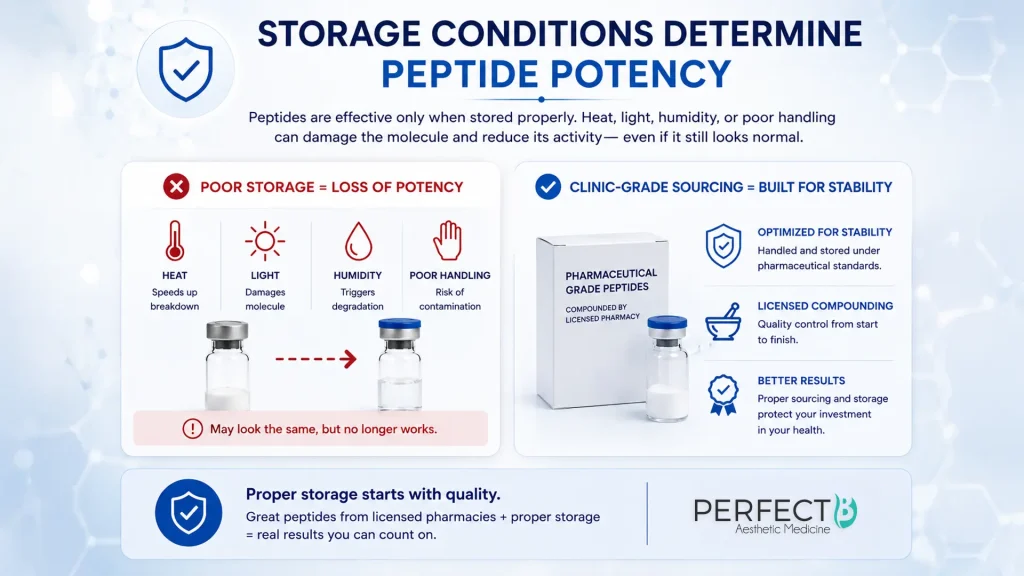
Peptides are short chains of amino acids, and that structural simplicity is also their vulnerability. Unlike small-molecule drugs that are chemically stable across a wide range of conditions, peptides can hydrolyze, oxidize, and aggregate under conditions most people would consider normal, such as room temperature, moderate humidity, or standard kitchen lighting. When that happens, the molecule loses its biological activity. It may still look like a clear solution or a white powder, but it no longer does what it was prescribed to do. If you are exploring this, it helps to see how supervised peptide therapy at Perfect B in Doral is structured and how it supports safe, monitored use of peptides.
The peptides prescribed at medical clinics arrive from licensed compounding pharmacies already optimized for stability. Our breakdown of compounding pharmacy peptides versus unregulated online research peptides explains why pharmaceutical-grade sourcing is the foundation of any storage protocol that actually holds up, because a peptide that was never stored correctly during manufacturing is already compromised before it reaches the patient.
Key Takeaways
- Lyophilized peptides unopened: store at 2 to 8 degrees Celsius in the refrigerator for up to 12 to 24 months, or at -20 degrees Celsius in the freezer for 2 or more years.
- Reconstituted peptides: refrigerate at 2 to 8 degrees Celsius and use within 28 to 60 days depending on the peptide; bacteriostatic water extends shelf life versus sterile water.
- The four degradation factors are heat fluctuation, light and UV exposure, repeated freeze-thaw cycles, and contamination from non-sterile technique.
- Never shake: swirl gently when reconstituting; shaking creates foam and mechanical stress that breaks peptide bonds.
- Label every vial with the reconstitution date; reconstituted peptides do not show visible degradation until it is advanced.
How to Store Lyophilized Peptides Before Reconstitution
Lyophilized peptides, also called freeze-dried peptides, are the form dispensed by most compounding pharmacies for clinical protocols. The powder is significantly more stable than the reconstituted liquid because water, which drives hydrolysis and microbial growth, has been removed. That said, lyophilized peptides are not inert. They degrade slowly under the wrong conditions.
Refrigerator vs Freezer for Unopened Vials
For vials that will be used within the next few weeks to months, standard refrigerator storage at 2 to 8 degrees Celsius is adequate. Most lyophilized peptides remain stable at this temperature for 12 to 24 months when kept dry and away from light. For long-term storage beyond one year, or for vials from a multi-month supply that will not be opened for extended periods, the freezer at -20 degrees Celsius is the better choice, extending stability to two years or more.
The refrigerator is the practical default for most patients because it avoids the freeze-thaw risk that comes with repeated removal from the freezer. A vial left in the freezer and only removed once for use will retain full potency. A vial pulled from the freezer, partially used, refrozen, and pulled again has experienced multiple freeze-thaw cycles that progressively damage the peptide structure, as noted in Bachem’s pharmaceutical handling and storage guidelines for peptides, which outline how thermal cycling degrades peptide integrity at the molecular level even before visible changes occur.
How Long Do Lyophilized Peptides Last?
Shelf life varies by peptide sequence and amino acid composition. Peptides with methionine, cysteine, or tryptophan residues are more prone to oxidation and may have shorter shelf lives than those without these amino acids. As a practical guideline for the peptides most commonly prescribed at Perfect B:
- BPC-157: 12 to 18 months refrigerated, 2 or more years frozen
- CJC-1295/Ipamorelin: 18 to 24 months refrigerated, 2 or more years frozen
- TB-500: 18 to 24 months refrigerated, 2 or more years frozen
- GHK-Cu: 12 to 18 months refrigerated (particularly light-sensitive, keep in original dark vial)
- MOTS-c: 18 to 24 months refrigerated, 2 or more years frozen
- Epithalon: 18 to 24 months refrigerated, 2 or more years frozen
- Semax: 12 to 18 months refrigerated
How to Reconstitute Peptides Correctly
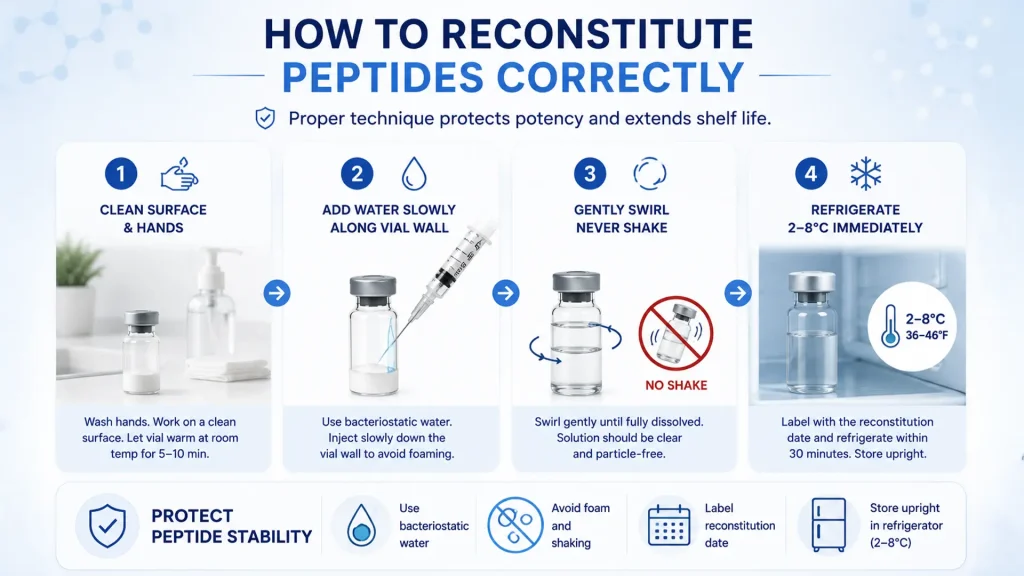
Reconstitution is the step where most storage problems begin. A peptide vial handled incorrectly at this stage compromises shelf life regardless of how well it was stored before. The steps below are the same ones we use with patients at our clinic before they take their kit home.
Step 1: Prepare the Workspace
Wash hands for 20 seconds. Work on a clean, flat surface. Allow the peptide vial to equilibrate at room temperature for 5 to 10 minutes before opening to minimize condensation inside the vial.
Step 2: Clean Both Vial Stoppers
Wipe the rubber stopper of both the peptide vial and the bacteriostatic water vial with separate fresh alcohol swabs. Allow each to air dry for 10 seconds before proceeding.
Step 3: Draw the Correct Volume of Bacteriostatic Water
Using your reconstitution syringe, draw air equal to the required water volume, inject that air into the bacteriostatic water vial to equalize pressure, then draw the water to the correct graduation mark on the syringe. Your clinic will provide a reconstitution chart that specifies the exact amount for each peptide and desired concentration.
Step 4: Inject Water Slowly at an Angle Along the Vial Wall
Insert the needle into the peptide vial stopper at a slight angle so the water runs down the inner glass wall rather than landing directly on the peptide powder. Inject slowly to minimize foaming and mechanical disruption to the peptide structure.
Step 5: Equalize Pressure
After injecting all the water, lift the needle tip so it sits above the liquid line but remains below the rubber stopper. Release the plunger to allow pressure to equalize naturally. This makes drawing doses later more accurate and prevents air locks.
Step 6: Swirl Gently: Do Not Shake
Roll the vial gently between your palms or swirl slowly until the powder is fully dissolved. The solution should be clear and free of particles. Shaking creates foam and exposes peptide molecules to air-liquid interface stress, which accelerates oxidation and aggregation.
Step 7: Label the Vial with the Reconstitution Date
Write the reconstitution date directly on the vial using a permanent marker or label. Shelf life starts from this date, not from the original manufacture date.
Step 8: Refrigerate Immediately
Place the reconstituted vial in the refrigerator at 2 to 8 degrees Celsius within 30 minutes of reconstitution. Do not leave it at room temperature. Store upright to minimize stopper contact with the solution.
How to Store Peptides After Reconstitution
Once in solution, peptides are significantly more vulnerable than in powder form. Water reactivates the degradation pathways that lyophilization suppressed. The practical implication: refrigerate, use within the labeled shelf life, and avoid exposing the vial to repeated temperature fluctuation.
Shelf Life in the Refrigerator by Peptide Type
Bacteriostatic water, which contains 0.9% benzyl alcohol, inhibits bacterial growth and extends reconstituted shelf life significantly compared to sterile water alone. These ranges reflect standard clinical use with bacteriostatic water:
- BPC-157: 60 days refrigerated. See our complete BPC-157 dosage protocol for cycle length, dosing frequency, and timing guidance for patients at Perfect B in Doral, FL.
- CJC-1295/Ipamorelin: 28 to 30 days refrigerated
- TB-500: 60 days refrigerated
- GHK-Cu: 28 to 30 days refrigerated : the most light-sensitive of the common peptides; keep in a dark location within the fridge
- MOTS-c: 28 days refrigerated
- Epithalon: 28 days refrigerated
- Semax: 28 days refrigerated
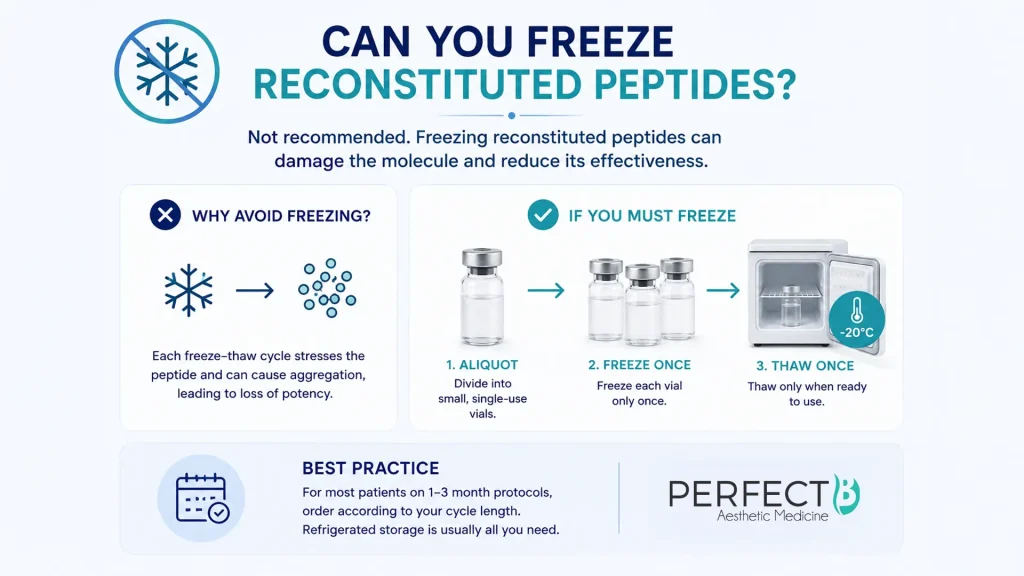
Can You Freeze Reconstituted Peptides?
Freezing reconstituted peptides is not generally recommended for clinical protocols. Each freeze-thaw cycle stresses the peptide in solution and can cause aggregation, the process by which peptide molecules clump together and lose biological activity. If a vial needs to be preserved beyond the refrigerated shelf life, the better strategy is to aliquot the reconstituted solution into smaller single-use vials before freezing, so each vial is only thawed once. For most patients on standard one- to three-month cycles, this situation should not arise if ordering is timed appropriately to protocol length.
The Four Enemies of Peptide Stability
1. Heat and Temperature Fluctuation
Temperature is the primary driver of peptide degradation. Elevated temperatures accelerate all chemical reaction rates, including hydrolysis and oxidation. More damaging than steady warmth, however, is temperature fluctuation. Vials stored at the back of the refrigerator maintain a consistent 4 degrees Celsius. Vials stored in the door experience temperature cycling every time the refrigerator is opened and closed. For patients in South Florida, the heat outside the refrigerator is an especially important factor: a peptide vial left on a counter in a Doral kitchen during summer is exposed to ambient temperatures that can reach the mid-80s Fahrenheit or higher, which meaningfully accelerates degradation for any reconstituted solution left out during injection preparation. The solution: remove the vial from the fridge, draw the dose immediately, and return the vial to the refrigerator before injecting.
2. Light and UV Exposure
UV light breaks peptide bonds directly and accelerates oxidation of light-sensitive amino acid residues. GHK-Cu is the most sensitive of the commonly prescribed peptides to light exposure. Most clinical vials come in amber glass or are shipped in dark protective packaging for this reason. Store vials away from windowsills, countertop exposure, or any location that receives direct sunlight. When drawing a dose, work quickly and return the vial to dark, cold storage.
3. Repeated Freeze-Thaw Cycles
Each time a peptide solution transitions from frozen to liquid, ice crystals form and melt within the solution. This mechanical process disrupts peptide structure and promotes aggregation. Three or more freeze-thaw cycles on a reconstituted peptide will produce measurable loss of activity in most sequences. The practical rule: never refreeze a reconstituted vial that has been thawed and partially used unless it has been aliquoted into single-use fractions first.
4. Contamination and Oxidation from Poor Technique
Every time a needle punctures the stopper of a reconstituted vial, there is a small opportunity for contamination. Bacteriostatic water limits bacterial growth but does not eliminate it entirely under poor technique. Using a new sterile syringe for every draw, cleaning the stopper with alcohol before each puncture, and never drawing from a vial while sick or working in a non-clean environment are the practical controls. Oxygen exposure accelerates oxidation of cysteine and methionine residues specifically. Minimize the time the vial spends with the stopper off or the needle inserted.
Traveling with Peptides: What Patients Need to Know
Patients traveling with peptide protocols face two main risks: temperature exposure during transit and customs or airport security concerns. For domestic travel, an insulated medication case with ice packs maintains adequate temperature for 24 to 48 hours. For flights, peptide vials should be carried in checked luggage only if the hold is temperature-controlled, which most commercial aircraft holds are. Hand luggage is preferable for temperature stability and reduces the risk of checked-bag delays leaving vials stranded at room temperature.
For international travel, check destination country regulations on peptide importation before departure. Carry a copy of your prescription and the pharmacy documentation from your prescribing provider. Patients traveling from the Miami area who need documentation for travel can contact our clinic directly for a travel letter.
How to Tell If Your Peptides Have Degraded
Most peptide degradation is invisible. A solution that has lost 30 or 40 percent of its activity looks identical to a fresh, fully potent one. That is why date labeling and adherence to shelf life guidelines matter more than visual inspection. That said, visible signs of degradation do occur and should prompt discarding the vial:
- Cloudiness or turbidity: a clear solution that has become hazy indicates aggregation or contamination
- Visible particles: floating matter in the solution that was not present after reconstitution
- Discoloration: yellowing or browning of a solution that was originally clear or faintly colored
- Unusual odor: any smell that differs from the faint characteristic scent of the peptide after reconstitution
- Loss of efficacy with proper dosing: if a patient is following the protocol correctly and no longer seeing any effects, degraded peptide should be considered before assuming the protocol needs adjustment
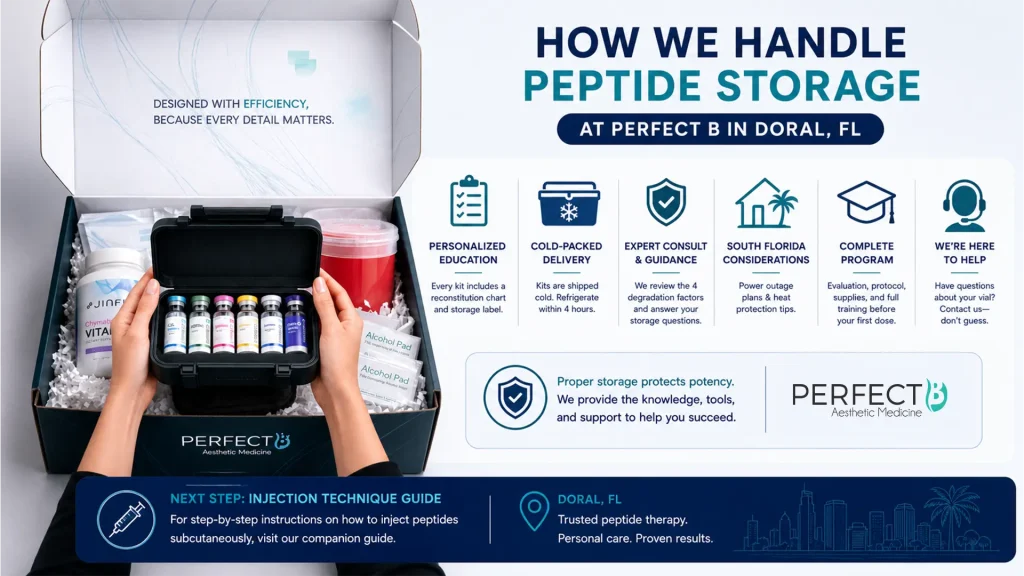
How We Handle Peptide Storage at Perfect B in Doral, FL
At our clinic in Doral, FL, every peptide kit we dispense includes a written reconstitution chart and a dated storage label. Patients receive their kit cold-packed and are instructed to refrigerate within four hours of pickup. During the initial patient consultation, one of our providers covers the four degradation factors and answers storage questions specific to the patient’s home environment, including South Florida-specific considerations like power outage protocols during hurricane season (for patients with large kit inventories) and how to handle vials during outdoor activities in the Miami heat.
Our peptide therapy program at Perfect B includes the clinical evaluation, protocol design, compounded peptide kit with reconstitution supplies, and full patient education on storage, reconstitution, and injection technique before the first dose is taken at home. For patients who have already reconstituted their peptides and have questions about whether a vial is still good, contact our clinic directly rather than guessing.
For the injection technique side of your protocol, our companion guide on how to inject peptides subcutaneously covers syringe selection, injection sites, the 8-step technique, and the most common errors patients make in the first weeks of self-administration at Perfect B in Doral.
Frequently Asked Questions
1. Should peptides be stored in the fridge or freezer?
Lyophilized peptides that will be used within the next few months should be stored in the refrigerator at 2 to 8 degrees Celsius. Freeze at -20 degrees Celsius only for long-term storage of vials that will not be opened for an extended period, and avoid repeated freeze-thaw cycles. Reconstituted peptides should always be refrigerated, not frozen.
2. How long do reconstituted peptides last in the fridge?
Most reconstituted peptides remain stable for 28 to 60 days when refrigerated at 2 to 8 degrees Celsius using bacteriostatic water. BPC-157 and TB-500 have a 60-day window. CJC-1295/Ipamorelin, GHK-Cu, MOTS-c, Epithalon, and Semax are typically used within 28 to 30 days. Always date-label vials at reconstitution and discard after the applicable window.
3. Can you freeze peptides after reconstitution?
Freezing reconstituted peptides is not recommended for regular use because freeze-thaw cycles cause aggregation and loss of activity. If freezing is necessary to extend shelf life, aliquot the solution into single-use fractions first so each small vial is only thawed once. Lyophilized peptides, by contrast, freeze well.
4. What happens if peptides are not stored properly?
Improperly stored peptides degrade without visible change in most cases. The molecule loses biological activity through hydrolysis, oxidation, or aggregation while the solution still looks clear. The patient continues dosing without therapeutic effect. In cases where contamination occurred due to poor technique, injection site reactions may also appear. A peer-reviewed study in the Journal of Pharmaceutical Sciences confirming that temperature and moisture are the primary drivers of lyophilized peptide degradation during storage provides the scientific basis for these refrigeration requirements.
5. Do you need bacteriostatic water to reconstitute peptides?
For multi-dose vials, yes. Bacteriostatic water contains 0.9% benzyl alcohol that inhibits bacterial growth between uses, which is what makes a 28 to 60 day refrigerated shelf life safe. Sterile water without preservative should only be used for single-dose vials that will be fully consumed immediately after reconstitution.
6. How do you store GHK-Cu peptide specifically?
GHK-Cu is the most light-sensitive of the commonly prescribed peptides. Store lyophilized vials in the original amber glass or dark packaging, away from any direct or indirect light source including natural window light. After reconstitution, keep in a dark area of the refrigerator and draw doses quickly to minimize light exposure during use. The 28 to 30 day reconstituted shelf life applies with bacteriostatic water under dark storage conditions.
Not Sure Which Peptides to Start? See What Perfect B Patients With Similar Goals Are Running.
Perfect B’s peptide protocol tool is built on real clinical data from 2,000+ patients treated in South Florida.
Answer 6 questions and see what patients with similar goals are running: which peptides they use, typical dosing, injection schedule, reconstitution steps, cycle length, and when they pause.
Closing: Storage Is the Last Line of Defense on a Peptide Protocol
The clinical outcome of a peptide protocol is determined by three variables in sequence: the quality of the peptide source, the correctness of the dosing, and the integrity of the storage. Most patients pay close attention to the first two and underestimate the third. Peptides do not announce their degradation. They simply stop working, and the most common interpretation is that the protocol itself is not effective. In most cases where a patient on a well-designed protocol reports no response after an appropriate trial period, storage handling is among the first things we review at our clinic in Doral.
South Florida patients have an added environmental challenge. Heat, humidity, and frequent power interruptions during storm season all create conditions where storage discipline matters more, not less. Follow the guidelines in this post, label every reconstituted vial, and contact your provider before guessing on whether a peptide is still good.
- 📍 Visit us at Perfect B, Doral FL, serving Miami and South Florida patients seeking clinical peptide therapy.
- 📞 Call or message us at (786) 502-2260 to schedule your peptide therapy consultation with a licensed medical provider.