
Perfect B, Doral Fl. | 05.19.26 (updated 06.30.26) | 14 min read.
This article is for educational purposes and does not replace a medical evaluation. Peptide sourcing and prescribing require a licensed medical provider in Florida. Information reflects the current FDA regulatory framework (as of June 2026) and clinical best practices in pharmaceutical compounding and research-grade laboratory supply.
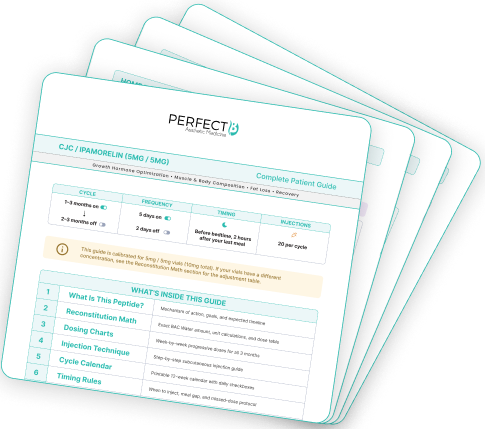
Skip Ahead to the Perfect B Peptide Protocol Tool. See Reconstitution, Daily Units, and Cycle Structure.
Perfect B’s peptide protocol tool is built on real clinical data from 2,000+ patients treated in South Florida.
Answer 6 questions and see what patients with similar goals are running: which peptides they use, typical dosing, injection schedule, reconstitution steps, cycle length, and when they pause.
The real sourcing question for clinical peptide therapy in 2026 is not “compounded or online.” It is “which peptides can a compounding pharmacy legally prepare today, and which can only come from a research-grade laboratory?” The answer surprises most patients. Federal compounding rules restrict 503A pharmacies to a narrow list of permitted peptides. In practice, that list is largely the GLP-1 weight-loss class and a small number of FDA-approved agents. Most clinical peptides used in supervised therapy today, including BPC-157, TB-500, CJC-1295, ipamorelin, MOTS-c, epithalon, semax, GHK-Cu, and AOD-9604, are not on it. They are supplied by research-grade laboratories that test every batch to pharmaceutical analytical standards. This guide walks through the regulatory framework, the two legitimate sourcing pathways a medical clinic actually uses, and the criteria that separate a quality research-grade laboratory from an internet retail vendor.
Key Takeaways: Research Labs vs Compounding Pharmacies for Peptides in 2026
- The 2019 BPCIA framework restricts 503A compounding pharmacies to five narrow categories of peptides. Most clinical peptides do not fall into these categories.
- What a 503A pharmacy can actually prepare today is short: GLP-1 weight-loss agents (semaglutide, tirzepatide) when on FDA shortage status, FDA-approved peptides such as sermorelin, and a handful of agents on the 503A Bulks List.
- Peptides like BPC-157, TB-500, CJC-1295, ipamorelin, MOTS-c, epithalon, semax, GHK-Cu, and AOD-9604 currently cannot be compounded. The only legitimate clinical-grade source is a research-grade laboratory that meets pharmaceutical analytical standards.
- A quality research-grade laboratory tests every batch with HPLC for identity and potency, USP <71> sterility, LAL endotoxin, and a verifiable Certificate of Analysis. The molecule meets the same analytical specifications used in compounded preparations.
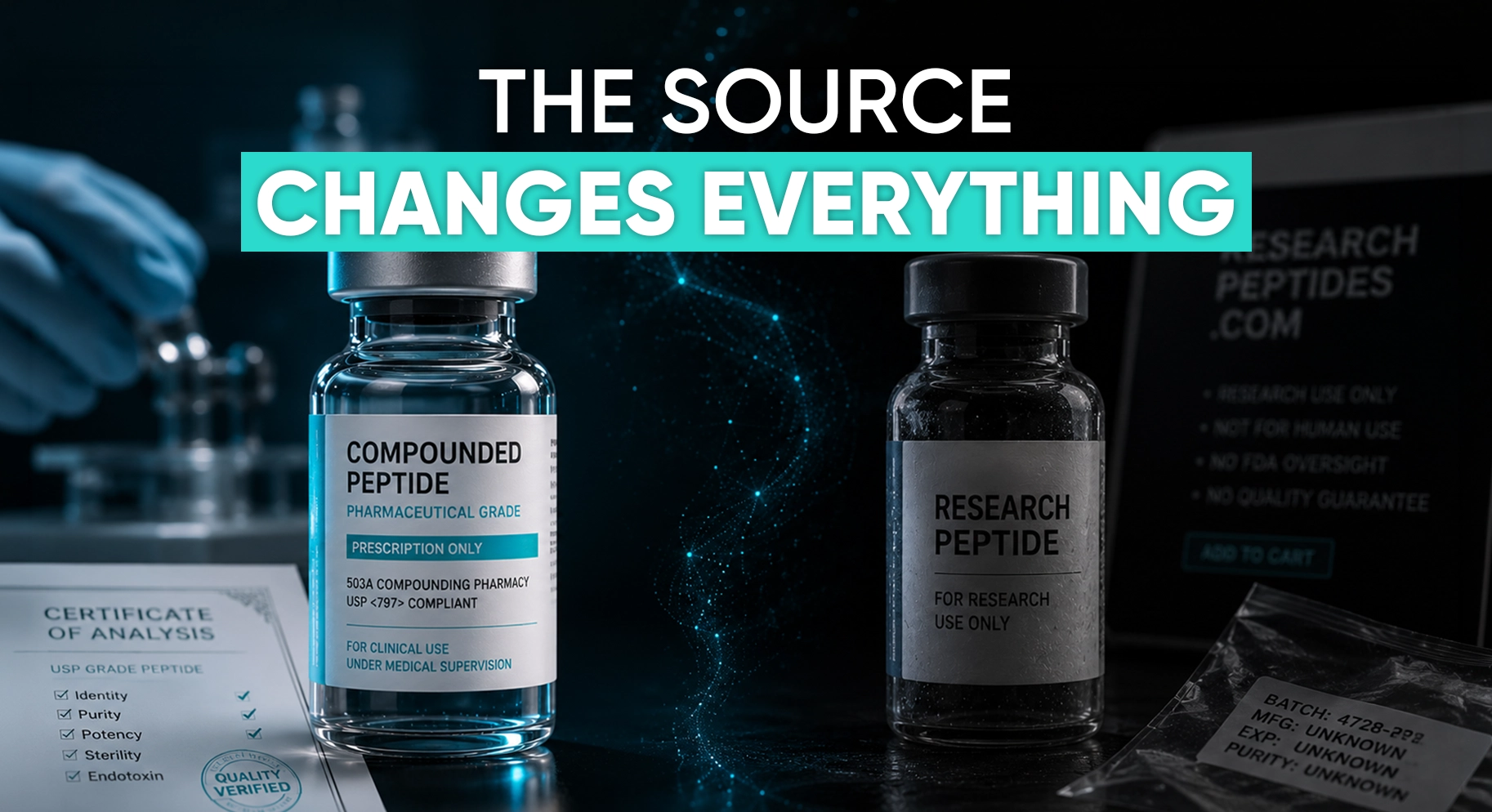
- Internet retail vendors selling vials with no testing, no traceable CoA, and no quality controls are a different market. A clinic should not source from them, and a patient buying online without medical guidance has no way to tell the two apart.
- The PCAC meeting on July 23-24, 2026 will evaluate Category 2 peptides for inclusion on the 503A Bulks List. Until and unless a peptide moves to that list, research-grade laboratory supply remains the only legal clinical pathway for it.
- What protects the patient is source plus supervision, not source alone: a quality-tested batch combined with a licensed medical provider running the protocol with bloodwork, dosing customization, and follow-up.
How Peptides Are Legally Manufactured: The 2019 BPCIA Framework
In 2019, Congress passed the Biologics Price Competition and Innovation Act (BPCIA) as part of the larger healthcare overhaul. The act established a critical definition for pharmacy compounding: peptides are amino acid chains with fewer than 40 amino acids. Anything with 40 or more amino acids is classified as a “biologic,” which requires a biologics license to compound.
This one distinction changed the supply chain. Most 503A compounding pharmacies (state-licensed, patient-specific Rx compounders) do not have and cannot easily obtain a biologics license. So they can only compound peptides that fall into five strict categories:
- FDA-approved peptides for human use (e.g., sermorelin)
- FDA GRAS (Generally Recognized as Safe) peptides (historical regulatory status)
- Peptides with a USP monograph (United States Pharmacopeia standard)
- Peptides on the FDA 503A Bulks List (official pre-approved list for compounders)
- Peptides in Category I of the interim 503A Bulks List (temporary pathway, under review)
Nearly all peptides marketed for wellness, recovery, or longevity (as noted in regulatory guidance from Frier Levitt legal authority on peptide compounding and the American Medical Association on injectable peptides) do not fall into these five categories. They sit in regulatory limbo: neither approved as drugs nor explicitly banned, but not eligible for 503A compounding. This is the gap that research-grade laboratories fill for the clinical market.
What a 503A Compounding Pharmacy Can Actually Prepare in 2026
Despite the public perception that compounding pharmacies make every clinical peptide, the working list is short. Under the five permitted categories, today’s 503A pharmacy in Florida can typically prepare:
- GLP-1 receptor agonists for weight loss (semaglutide, tirzepatide) when these medications are on FDA shortage status. When a shortage ends, compounding of the branded molecule generally must stop unless a documented clinical exception applies.
- FDA-approved peptides such as sermorelin (a growth hormone releasing peptide).
- A handful of agents on the 503A Bulks List or with a USP monograph, such as glutathione and methylcobalamin (B12).
- Documented combinations and modifications that a medical provider justifies as patient-specific and that fall within these categories.
That is essentially the practical list. Most peptides patients ask about for connective tissue repair, growth hormone modulation, longevity, cognitive support, or skin and tissue health are not on it. The regulatory category, not the science, is what keeps them off the compounding shelf.

What 503A Compounding Pharmacies Currently Cannot Make
These widely used clinical peptides are not eligible for 503A compounding under current rules:
- BPC-157 (Body Protective Compound, used for tendon, ligament, and gut-lining repair)
- TB-500 / Thymosin Beta-4 fragment (recovery and inflammation modulation)
- CJC-1295 (GHRH analog, used for growth hormone optimization)
- Ipamorelin (selective GH secretagogue)
- MOTS-c (mitochondrial-derived peptide, metabolic and longevity research)
- Epithalon (Epitalon) (telomere-supporting longevity peptide)
- Semax (cognitive and neuroprotective peptide)
- GHK-Cu (copper tripeptide for skin and tissue regeneration)
- AOD-9604 (modified fragment of growth hormone, studied for fat metabolism)
These peptides are widely studied. Several have decades of published safety and efficacy data and are routinely used in supervised clinical protocols. The reason they cannot be compounded is regulatory, not scientific. The 2019 BPCIA framework was written before this clinical category was as developed as it is today, and the PCAC review process has not yet moved these molecules onto the 503A Bulks List.
For these peptides, the only legitimate clinical-grade supply pathway is a research-grade pharmaceutical laboratory operating to the same analytical standards as the compounded supply chain.
Research-Grade Laboratories: The Legitimate Supply Channel for Non-Compoundable Peptides
A research-grade pharmaceutical laboratory is a manufacturer that synthesizes peptides to pharmaceutical analytical specifications and supplies them to clinical researchers, university programs, and medical clinics. This is the channel Perfect B works with for peptides that fall outside the 503A compounding list. We partner with research-grade laboratories that test every batch and provide third-party documentation, because for these peptides there is no other legal clinical pathway.
A quality research-grade laboratory delivers, for every batch:
- HPLC purity above 98%, with traceable chromatograms that can be cross-checked against the Certificate of Analysis
- USP <71> sterility testing for any product intended as an injectable
- LAL endotoxin testing to confirm absence of bacterial lipopolysaccharides
- Karl Fischer moisture analysis to confirm the peptide is properly dried and stable
- A verifiable Certificate of Analysis from an accredited third-party laboratory, not an in-house unverified document
- Lot traceability with manufacturing date, batch number, storage records, and recall procedures
The peptide that comes out of this process meets the same analytical specifications a compounded preparation would meet. The chemical product is pharmaceutical grade. The label often reads “for research use only” because that is the regulatory category the molecule occupies, not a statement about the quality of the synthesis.
How to Tell a Quality Research-Grade Laboratory From an Internet Retail Vendor
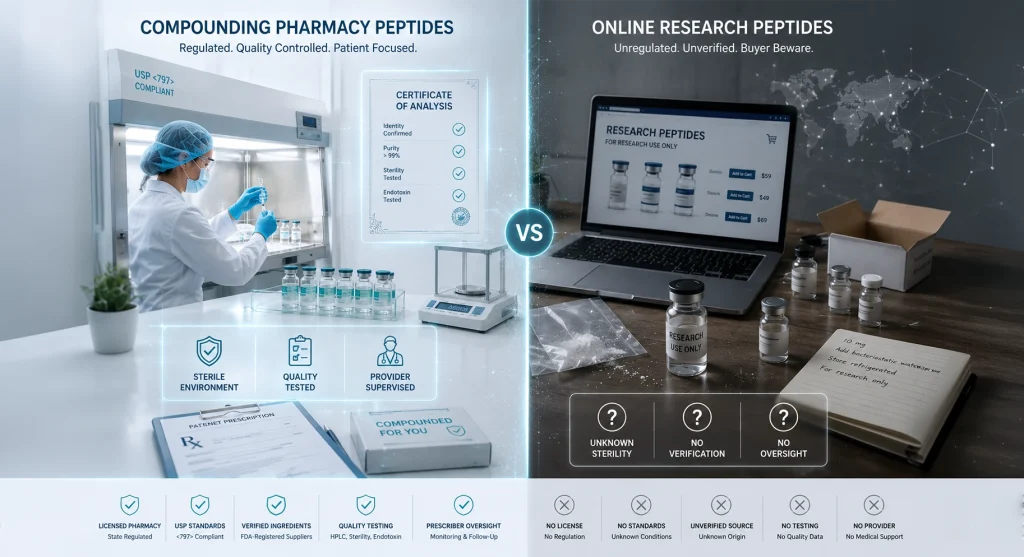
Not every entity that sells peptides online is the same. The market includes a small number of serious research-grade laboratories that supply universities, clinical researchers, and medical clinics, and a much larger number of internet retail vendors that ship vials with no traceable testing, no third-party CoA, and no quality assurance. A clinic should only source from the first group. A patient buying directly online has no way to verify which group a website belongs to.
Markers of a quality research-grade laboratory:
- Every batch has a third-party Certificate of Analysis from an accredited analytical lab, with chromatogram and signed report
- USP <71> sterility and LAL endotoxin testing for any injectable, with documentation
- ISO certification of the manufacturing process
- Long-term reputation supplying clinical and research customers
- Transparent lot tracking, defined expiry, and a documented recall procedure
- Established business identity with verifiable address, regulatory contact, and quality systems
Markers of an internet retail vendor to avoid:
- Generic “research use only” labels with no traceable testing data behind them
- CoAs that cannot be independently verified, are missing, or appear fabricated
- Anonymous business identity, drop-shipped product, no physical address
- Prices significantly below market for the same molecule (a strong signal of unverified source)
- No sterility verification for injectables, no endotoxin data
- No published quality procedures, no recall pathway
The risks the public typically associates with “research peptides” (contamination, dose variability, unknown excipients, no recourse) apply almost entirely to this second group. A clinic that has done its supplier due diligence is not sourcing from these vendors. A patient self-purchasing online without medical guidance often is, without realizing the difference.
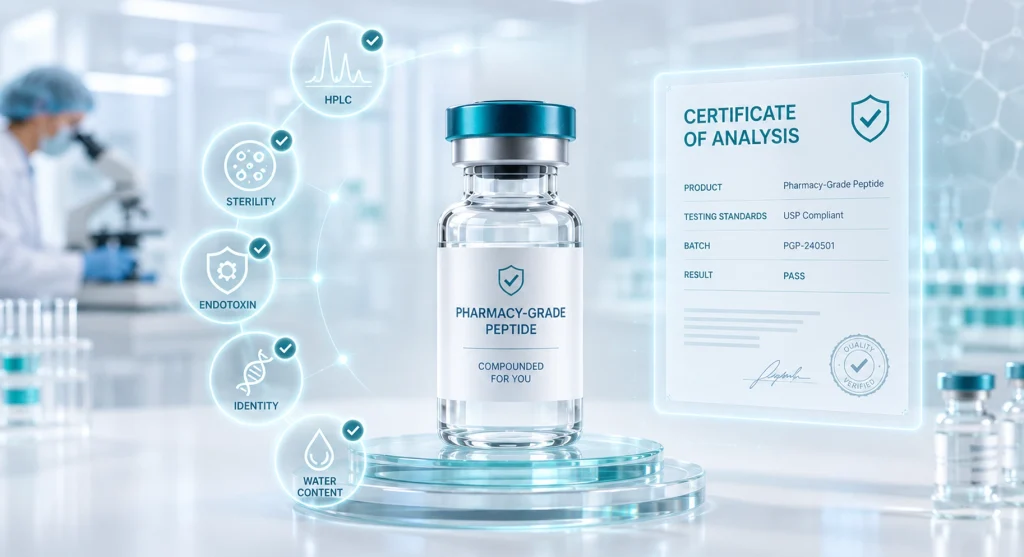
The Quality Control Standard: HPLC, Sterility, Endotoxin, and Certificate of Analysis
The standard that defines clinical-grade peptide quality is the same whether the supplier is a 503A compounding pharmacy sourcing active ingredient from an FDA-registered API supplier, or a research-grade laboratory synthesizing the peptide directly. For a deeper look at how peptide therapy is monitored clinically, see our guide on Are Peptides Safe? Clinical Safety and Monitoring Framework.
Pharmaceutical-grade testing includes:
- HPLC (High-Performance Liquid Chromatography): Confirms the peptide is what it claims to be and at the stated potency.
- Sterility testing (USP <71>): For injectable peptides, confirms absence of viable bacteria, fungi, or other microorganisms.
- Endotoxin testing (LAL): Detects bacterial lipopolysaccharides that can trigger immune reactions even in sterile solutions.
- Identity testing: Confirms the amino acid sequence matches the specification.
- Water content (Karl Fischer): Ensures the peptide is properly dried and stable for long-term storage.
A quality research-grade laboratory runs all of this and ships the peptide with a third-party Certificate of Analysis. An unverified internet retail vendor typically reports none of it, and any CoA provided is often from a non-accredited lab or is not independently verifiable. The molecule on the label may be the same. The chain of evidence behind it is not.
The FDA Category 2 Framework and the July 2026 PCAC Meeting
In 2023, the FDA created a list of 19 peptides classified as “Category 2”: substances that do not currently fit the five legal compounding categories but have enough clinical interest and accumulated safety data to warrant regulatory review. These include many of the most widely used clinical peptides, the same molecules currently supplied to medical clinics by research-grade laboratories.
The FDA Pharmacy Compounding Advisory Committee (PCAC) is scheduled to meet July 23-24, 2026 to evaluate these Category 2 peptides. If the committee votes to move a peptide to the 503A Bulks List, that peptide becomes legally compoundable on a patient-specific Rx basis. The supply pathway for that peptide would then shift from research-grade laboratory to compounding pharmacy.
If the vote is no, the peptide remains where it is today: outside 503A compounding, supplied by research-grade laboratories under clinical supervision, while the regulatory category catches up to the clinical evidence. Either way, the supervised clinical model itself does not change. What changes is which pathway supplies which molecule.
The 3 Real Risks of Buying Peptides Yourself Online
Buying peptides directly from an internet retail vendor, without a clinic in the loop, carries risk that has nothing to do with the regulatory category and everything to do with quality control and clinical oversight.
1. Contamination and Sterility Risk
Injectable peptides manufactured outside pharmaceutical-grade environments can be contaminated with bacteria (especially Bacillus, Clostridium, or skin flora) or fungi. Even if the powder is sterile, contamination can occur during reconstitution if done outside a controlled environment. A contaminated injection can cause localized infection, systemic infection, or sepsis. Internet retail vendors typically do not test for this. A quality research-grade laboratory does, and a clinic verifies it on receipt.
2. Dose Variability and Efficacy Loss
Without HPLC testing or manufacturing controls, two vials sold as “10 mg” can contain 5 mg or 15 mg. Your dosing protocol becomes unpredictable. Over time, you have no way to know whether you are getting therapeutic benefit or wasting money. A research-grade laboratory batch-tests every preparation. An unverified vendor does not.
3. No Clinical Context, No Recourse
The vial is one variable. Dose, timing, cycle length, your individual health status, contraindications, baseline labs, follow-up monitoring, and side-effect screening are all variables. A self-purchased vial gives you a tool with no protocol around it. If something goes wrong, there is no medical provider to call, no liability insurance, and no documented treatment record.
Medical Clinic Oversight: What You Actually Get
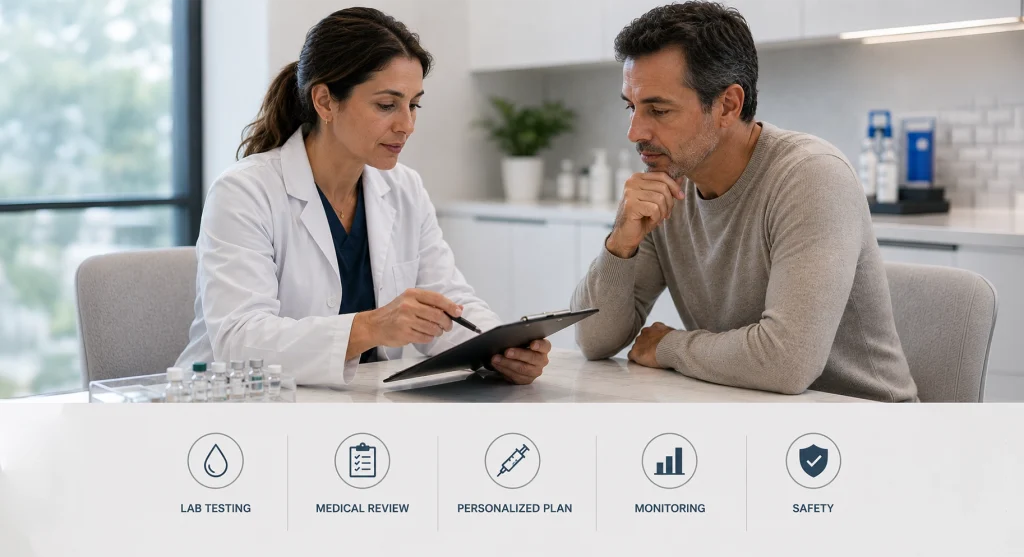
When you receive peptide therapy through a licensed medical clinic (like Perfect B in Doral), the value is not the vial itself. It is the protocol around it. The vial may come from a 503A compounding pharmacy or from a vetted research-grade laboratory, depending on which peptide is being prescribed. What does not change is the medical supervision:
- Pre-treatment bloodwork: Baseline hormone levels, metabolic panel, inflammatory markers. These establish a before-picture.
- Medical history review: Contraindications (pregnancy, active cancer, certain medical conditions) are identified before prescribing.
- Dose customization: Your peptide dose is based on your age, weight, health status, and therapy goals, not a generic online protocol.
- Injection training: You learn proper mixing, storage, injection technique, site rotation, and needle safety from a trained clinician.
- Interval monitoring: At 4 weeks, 8 weeks, and 12 weeks, follow-up labs measure your response. Hormones, liver function, kidney function are tracked.
- Adverse effect screening: Changes in appetite, mood, energy, water retention, or joint symptoms are discussed. Dose adjustments follow your individual response.
- Written documentation: Your entire peptide therapy course is documented in medical records. Future providers can see what you have done, at what dose, with what results.
This overhead is what makes peptide therapy safer, more effective, and clinically defensible regardless of the sourcing pathway. Our Peptide Therapy Treatment Plan breaks down what supervised therapy includes.
Comparing research-grade peptides vs compounded peptides for your protocol?
Perfect B’s peptide protocol tool shows real patient data from 2,000+ South Florida patients on supervised protocols across both sourcing pathways.
Answer 6 questions and see the exact peptides patients chose, dosing, and what their cycles look like.
The Cost Reality: Supervised Peptide Therapy at $200 to $400 per Month
Supervised peptide therapy from a licensed clinic typically runs $200 to $400 per month for most agents. This price covers a quality-tested peptide (whether compounded or supplied by a vetted research-grade laboratory), medical consultation and prescription oversight, baseline and follow-up bloodwork, and injection training and support. See our transparent BPC-157 pricing breakdown for a real per-cycle example.
The same molecule purchased on the open internet at $100 to $150 per month from an unverified vendor seems cheaper until you factor in failed dosing from variability, lost efficacy from contaminated or degraded product, follow-up provider visits to investigate unexplained symptoms, and potential ER visits from infection or adverse reaction. The visible cost of supervised therapy is lower than the hidden cost of unmonitored use.
Peptide Therapy in Doral and Miami: How Perfect B Sources Across Both Pathways
Florida’s regulatory framework for compounding pharmacies is strict. The state requires 503A pharmacies to be licensed, inspected, and held to USP standards. Doral and Miami have one of the highest concentrations of compounding pharmacies in the country, driven by demand for weight-loss peptides and hormone optimization.
Perfect B uses both legitimate sourcing pathways, depending on what the peptide is and what current regulation allows.
For peptides that can be compounded (the GLP-1 weight-loss class and the few FDA-approved agents like sermorelin), we partner with Florida-licensed 503A compounding pharmacies. Our pharmacy partners maintain USP <797> sterile compounding standards, source active ingredients from FDA-registered suppliers, and provide a Certificate of Analysis for each batch.
For peptides that cannot be compounded (BPC-157, TB-500, CJC-1295, ipamorelin, MOTS-c, epithalon, semax, GHK-Cu, AOD-9604, and others currently on the Category 2 list), we work with research-grade laboratories that meet the same analytical standards as the compounded supply chain. Every batch has HPLC purity testing, USP <71> sterility testing for injectables, LAL endotoxin testing, and a third-party Certificate of Analysis. We do not source from anonymous internet retail vendors.
Across both pathways, every protocol is prescribed and monitored by a Florida-licensed medical provider. Patients receive pre-treatment labs, dosing customized to their age, weight, health status, and therapy goals, injection training, follow-up labs at 4, 8, and 12 weeks, and written documentation. The supervision is the same regardless of which pathway supplies the peptide. For an overview of weight-loss specific protocols, see our peptide therapy for weight loss and optimization guide.
See how supervised peptide protocols are structured at Perfect B.
Before deciding between a compounded peptide and a research-grade laboratory peptide, see what a licensed clinic protocol looks like in practice.
Answer 6 questions and see exactly which peptides, dosing, schedule, and cycle length similar patients are running.
Frequently Asked Questions: Research Labs vs Compounding Pharmacies for Peptides
1. Why can’t compounding pharmacies make BPC-157, CJC-1295, ipamorelin, and other widely used peptides?
The 2019 BPCIA framework restricts 503A compounding pharmacies to five categories: FDA-approved peptides, FDA GRAS, peptides with a USP monograph, peptides on the 503A Bulks List, and Category I interim Bulks List peptides. Most clinical peptides do not fit these categories. They are widely studied and supported by clinical data, but the regulatory category has not yet caught up. The FDA Pharmacy Compounding Advisory Committee meets July 23-24, 2026 to consider whether to move some of these peptides to the 503A Bulks List.
2. What peptides CAN a compounding pharmacy legally prepare in 2026?
In practice, the working list is short: GLP-1 weight-loss agents (semaglutide, tirzepatide) when on FDA shortage status, FDA-approved peptides such as sermorelin, and a small number of agents on the 503A Bulks List (such as glutathione and methylcobalamin). Most other peptides used in clinical practice today are not on this list.
3. Is a research-grade laboratory peptide the same molecule as a compounded peptide?
For most clinical peptides, the molecule is identical. The peptide is synthesized to the same amino acid sequence and tested against the same analytical specifications (HPLC purity, USP <71> sterility, LAL endotoxin, identity). The chemical product is the same. The difference is the regulatory category of the supplier, not the molecule itself.
4. What separates a quality research-grade laboratory from an internet vendor?
A quality laboratory provides a verifiable third-party Certificate of Analysis for every batch, USP <71> sterility testing for injectables, LAL endotoxin testing, ISO-certified manufacturing, transparent lot tracking, and a defined recall procedure. An internet retail vendor often provides none of these, or provides unverified documents. A clinic should only source from the first group. A patient buying directly online has no reliable way to verify which group a website belongs to.
5. Why is the “research use only” label not the same as “low quality”?
The “research use only” label is a regulatory artifact. It indicates the molecule has not been added to the 503A Bulks List, not that the chemical product is low quality. A peptide synthesized by an ISO-certified laboratory to more than 99% HPLC purity, tested for sterility and endotoxin, with a third-party CoA, is the same chemical product whether the regulatory label says “research” or not. The label describes the regulatory pathway. The CoA describes the molecule.
6. What is the difference between a 503A and 503B pharmacy?
A 503A pharmacy is state-licensed and prepares patient-specific medications based on individual prescriptions. A 503B is an FDA-registered “outsourcing facility” that prepares larger batches for hospital and clinic use under stricter cGMP requirements. Both are legitimate. For individual peptide therapy, 503A compounders are typical.
7. Can peptides be compounded without a prescription?
No. Compounding pharmacies are licensed to prepare medications only against specific prescriptions from licensed prescribers. Any pharmacy offering peptides without a prescription is operating outside its license. If a website claims its peptides are “compounded” but does not require a prescription, that representation is inaccurate.
8. What does a Certificate of Analysis actually prove?
A CoA is a document from an analytical laboratory confirming that a batch of active ingredient meets specifications. A legitimate CoA includes identity (amino acid sequence), purity by HPLC (usually above 95%), potency, moisture content, and for injectables, sterility and endotoxin testing. CoAs from accredited third-party laboratories are traceable and verifiable. CoAs from in-house unaccredited labs, or undated and unsigned documents, are not.
9. What changes after the July 2026 PCAC meeting?
If the FDA Pharmacy Compounding Advisory Committee votes to add Category 2 peptides to the 503A Bulks List, the affected peptides become eligible for compounding by 503A pharmacies. The supply pathway for those peptides would shift from research-grade laboratory to compounding pharmacy. Peptides that are not approved remain in the current category, supplied by research-grade laboratories under clinical supervision. The supervised clinical model continues either way.
10. What should I do if I have been buying peptides online without a clinic?
Schedule a consultation with a licensed medical provider who offers peptide therapy. Bring documentation of what you have been using (vendor, lot number, dosing protocol, frequency, duration). A provider can assess your health status, run bloodwork, and discuss whether and how to continue therapy under supervision with a vetted source. Do not abruptly stop ongoing peptide use; discuss a transition plan with a provider.
The Bottom Line: Source Plus Supervision, Not Source Alone
The same peptide molecule (semaglutide, sermorelin, CJC-1295, BPC-157 for tendon and gut-lining repair) can come from a compounding pharmacy when current regulation allows, or from a research-grade laboratory when it does not. What determines patient safety is the pairing of a quality-tested batch with a licensed medical provider running the protocol.
A compounded peptide self-injected without medical supervision still carries risk. A research-grade peptide administered under a clinic protocol with bloodwork, dosing customization, and follow-up is the established standard of care for the many peptides that fall outside the 503A compounding list.
The binary that the peptide industry sometimes presents (compounded equals safe, research equals unsafe) is incomplete. The real questions a patient should ask are: Is the batch tested to pharmaceutical analytical standards? Is there a verifiable third-party Certificate of Analysis? Is a licensed medical provider supervising the protocol? Are there baseline and follow-up labs? Is the dose customized to me?
When the answer to all of those is yes, the regulatory category of the supplier matters far less than the rigor of the program around it.
If you are considering peptide therapy, start with a consultation at a licensed medical clinic in Florida. We can explain which peptides are eligible for compounding under current rules, which require research-grade laboratory sourcing, and what a supervised protocol looks like month by month for your specific health goals.
📍 Perfect B Medical Aesthetic Clinic, Doral, FL
📞 +1 (786) 502-2260
→ Read our detailed guide on Peptides for Weight Loss and Health Optimization