Perfect B, Doral FL. | 06.05.26 | 11 min read.
This content is for educational purposes only and does not constitute medical advice. Active ingredients like tretinoin and benzoyl peroxide carry individual tolerance considerations. Consult a licensed medical provider before starting or changing an acne treatment routine.
Why Most Acne Skincare Routines Fail
An acne skincare routine fails for one of two predictable reasons. The first is overload: ten products, four actives, and a barrier so compromised that the skin reacts to everything. The second is sequence: the right ingredients used at the wrong time of day, where one active cancels out or irritates against another. Most people searching for the perfect routine are not missing a product. They are missing the logic that tells them what goes where and when.
At our clinic in Doral, FL, the acne skincare routine we build for patients comes down to four functional steps, not ten products. Cleanse, treat, moisturize, protect. The actives that do the real work, benzoyl peroxide and a retinoid like tretinoin, are separated by time of day for a specific clinical reason. The rest of this guide walks through that structure step by step, including how to introduce tretinoin without destroying your barrier, and how the routine changes for oily skin, dry skin, and the Fitzpatrick III to VI skin tones we treat most often in the Miami area.
Key Takeaways
- An effective acne routine has four functional steps, not ten products: cleanse, treat, moisturize, protect. Adding more actives usually makes acne worse, not better.
- Benzoyl peroxide goes in the morning, tretinoin goes at night. Separating them by time of day avoids the long-standing concern that benzoyl peroxide can oxidize and degrade tretinoin when applied together.
- Moisturizer is not optional, even for oily skin. A compromised barrier is the single most common reason acne actives fail. Hydration is what lets you keep using the actives that work.
- Tretinoin should be introduced slowly: 2 to 3 nights per week to start, buffered with moisturizer, increasing as the skin builds tolerance over several weeks.
- Daily sunscreen is part of the acne routine, not separate from it. Retinoids increase sun sensitivity, and in Fitzpatrick III to VI skin, sun exposure deepens the dark marks acne leaves behind.
The Only Four Steps an Acne Routine Actually Needs
Every functional acne skincare routine, no matter how simple or advanced, is built on four jobs. Once you understand the job each step does, you stop buying products you do not need and start using the few that matter correctly.
- Cleanse: remove oil, sweat, and debris without stripping the skin. A gentle, non-foaming or low-foaming cleanser is enough. Harsh scrubs and high-pH bar soaps damage the barrier and make acne worse.
- Treat: apply the active ingredient that targets acne at its root. Benzoyl peroxide kills acne-causing bacteria, and a retinoid like tretinoin normalizes how skin cells shed so pores stop clogging.
- Moisturize: restore the barrier the actives stress. This is the step most people with oily, acne-prone skin wrongly skip, and skipping it is why their actives stop being tolerable.
- Protect: daily broad-spectrum sunscreen. Non-negotiable when using retinoids and essential for preventing the dark marks that acne leaves on deeper skin tones.
The treat step is where the two most effective over-the-counter and prescription actives live, and where sequencing matters most. For a deeper look at how the retinoid options differ, see the clinical guide comparing tretinoin, retinol, and adapalene at Perfect B and how to choose the right retinoid strength for your skin.
Your Morning Acne Skincare Routine, Step by Step
The morning routine has one job beyond cleansing and protecting: it is where benzoyl peroxide belongs. Here is the order, and why each step sits where it does.
Step 1: Gentle cleanser
Wash with a gentle cleanser and lukewarm water. In the morning your skin is not dirty in the way it is at night, so this step is about preparing a clean surface, not deep cleaning. Skip the foaming, tight-feeling cleansers. That tight feeling is barrier damage, not cleanliness.
Step 2: Benzoyl peroxide
Benzoyl peroxide is the morning active because it works best when it is not competing with tretinoin, and because it pairs naturally with the sunscreen that follows. Start with a lower concentration. A 2.5 percent benzoyl peroxide is as effective as 5 or 10 percent for most patients and far less irritating. Apply a thin layer to the areas that break out, not just individual spots, since acne forms below the surface before you see it.
Step 3: Moisturizer and Step 4: Sunscreen
Follow benzoyl peroxide with a lightweight, non-comedogenic moisturizer, then finish with a broad-spectrum sunscreen of at least SPF 30. In the South Florida sun, sunscreen is doing double duty: protecting against UV damage and preventing the post-inflammatory hyperpigmentation that turns a healed pimple into a dark mark that lingers for months. A good niacinamide-containing moisturizer can help here, since the clinical breakdown of what niacinamide actually does for the skin at Perfect B explains how it supports the barrier and helps calm the redness that acne actives can trigger.
Your Night Acne Skincare Routine, Where Tretinoin Goes
The night routine is where the most powerful acne active, tretinoin, does its work. Tretinoin is a retinoid that normalizes skin cell turnover so dead cells stop clogging pores. It is photosensitive, which is another reason it belongs at night, away from sun exposure.
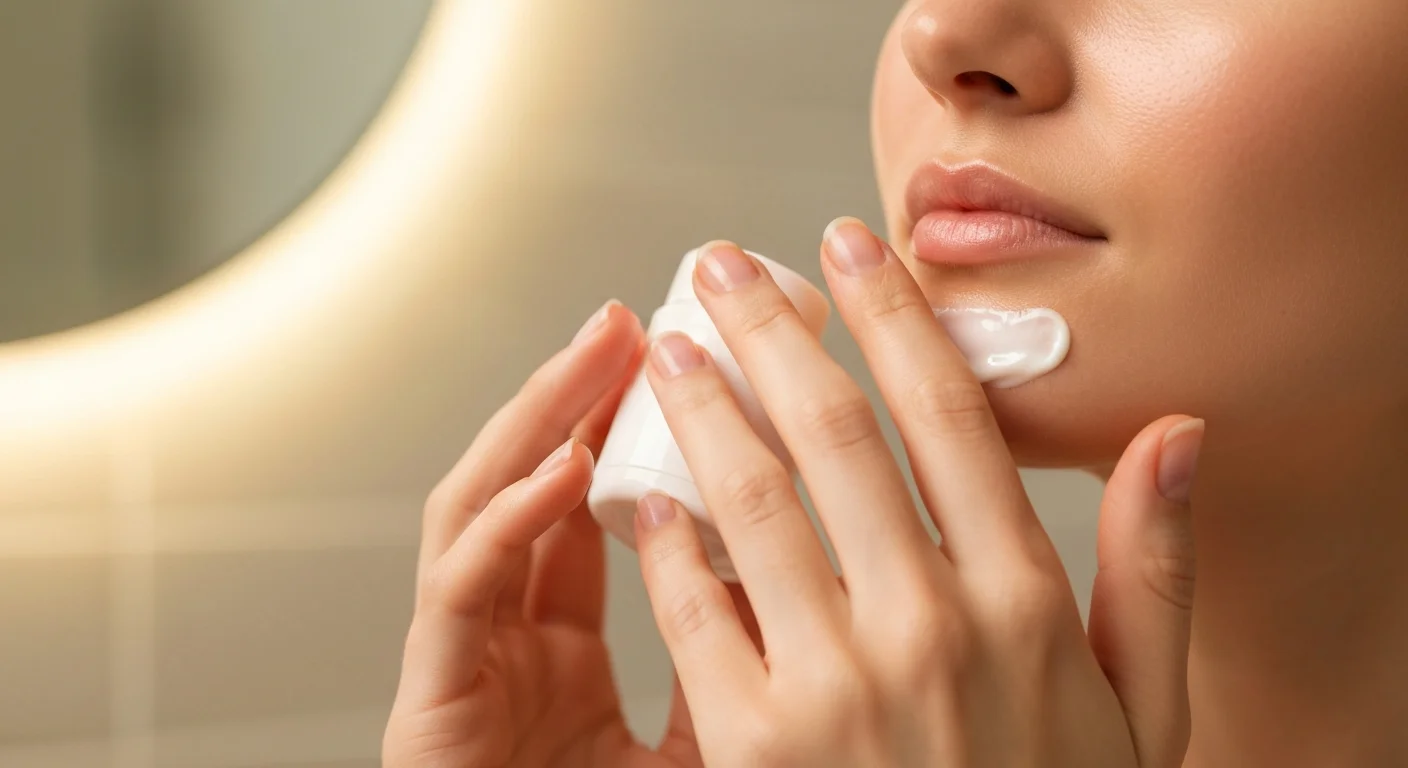
The night sequence: cleanse, tretinoin, moisturize
Cleanse to remove the day, including sunscreen and any benzoyl peroxide residue. Wait until your skin is fully dry, around 10 to 20 minutes, because applying tretinoin to damp skin increases penetration and irritation. Apply a pea-size amount of tretinoin across the whole face, not just on spots. Then follow with moisturizer. A pea-size amount is genuinely enough for the entire face: using more does not work faster, it only increases irritation.
Expect things to look worse before they look better
In the first few weeks of tretinoin, many people break out more. This is purging, not a sign the product is failing. Tretinoin speeds up cell turnover, which pushes microcomedones that were already forming up to the surface faster. Telling purging apart from a genuine bad reaction matters, and the distinction is covered in detail in the clinical explanation of acne purging at Perfect B, including how to tell a true purge from a reaction that means you should stop.
Why Benzoyl Peroxide and Tretinoin Are Separated by Time of Day
This is the single most important sequencing decision in an acne routine, and the reason most generic routines get it wrong. Benzoyl peroxide goes in the morning and tretinoin goes at night, not because of a rigid rule, but because of two real concerns.
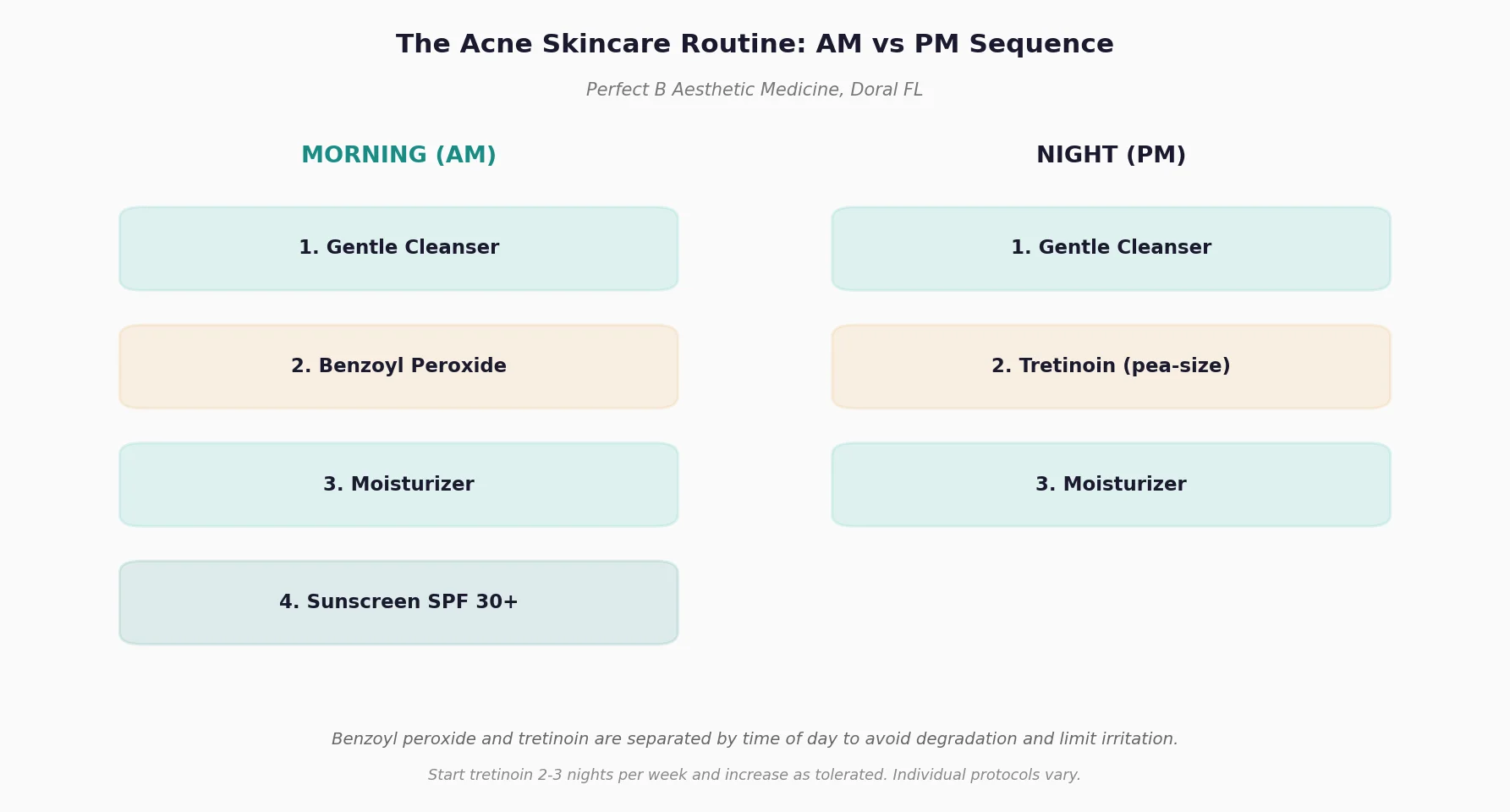
The first concern is chemical. For decades, clinicians have separated the two out of concern that benzoyl peroxide can oxidize and degrade tretinoin when the two are applied at the same time, reducing the tretinoin’s effectiveness. A study published in the Journal of Clinical and Aesthetic Dermatology examining tretinoin stability when combined with benzoyl peroxide, which documents why clinicians have traditionally recommended applying benzoyl peroxide in the morning and tretinoin at night explains the basis for this practice. While some newer formulations are designed to be stable together, separating them by time of day remains the safe, simple default.
The second concern is irritation. Both ingredients are drying and potentially irritating on their own. Stacking them in the same application multiplies that irritation, which compromises the barrier and ends up making acne worse. Splitting them across morning and night lets the skin tolerate both. This is the kind of sequencing logic that the American Academy of Dermatology emphasizes in the American Academy of Dermatology guidance on caring for acne-prone skin, which stresses gentle handling and introducing actives carefully rather than all at once.
How to Add Tretinoin Without Wrecking Your Skin Barrier
The fastest way to fail with tretinoin is to use it every night from day one. The skin is not ready, the barrier breaks down, and people quit within two weeks convinced it does not work. The approach we use with patients is gradual on purpose.
- Weeks 1 to 2: apply tretinoin 2 to 3 nights per week only, on non-consecutive nights. On the off nights, just cleanse and moisturize.
- The moisturizer sandwich: apply moisturizer, wait a few minutes, apply tretinoin, then moisturizer again. This buffers the active and reduces irritation while the skin adapts.
- Weeks 3 to 5: if the skin is tolerating it well, increase to every other night.
- Week 6 and beyond: work toward nightly use if your skin allows, but many people do well long term at every other night. Nightly is not the goal, consistency is.
If you reach a point where your skin is flaking, stinging, or red, that is the barrier telling you to slow down, not push harder. Drop back a step in frequency and let it recover. Patients in the Miami area often find that the humidity helps with tolerance, but air conditioning indoors can be just as drying as a dry climate.
Adjusting the Routine for Oily, Dry, and Fitzpatrick III to VI Skin
The four-step structure stays the same. What changes is the texture of the products and the attention paid to pigmentation.
Oily and acne-prone skin
Use gel or lightweight lotion textures rather than heavy creams. Do not skip moisturizer: oily skin can still be barrier-compromised, and skipping hydration drives more oil production, not less. A salicylic acid cleanser can be a useful addition for oily skin, since it is oil-soluble and clears the pore lining. The way to use it day to day is covered in the daily-use guide to salicylic acid for acne at Perfect B, which explains how to use it as a BHA without over-exfoliating the skin.
Dry and combination skin
Use cream textures, apply the moisturizer sandwich technique with tretinoin from the start, and consider reducing benzoyl peroxide to spot use rather than full-face if dryness is significant.
Fitzpatrick III to VI skin in South Florida
This is where our Miami patient population needs the most specific guidance. In deeper skin tones, the real long-term problem is often not the acne itself but the post-inflammatory hyperpigmentation it leaves behind: the dark marks that can last far longer than the pimple did. Two rules matter most here. First, never pick or aggressively treat a breakout, since trauma drives more pigment. Second, sunscreen every single day is non-negotiable, because sun exposure darkens existing marks and slows their fading. Irritation itself can trigger pigment in deeper skin, which is another reason the slow, barrier-protective approach to actives matters more, not less, for these patients.
When a Skincare Routine Is Not Enough
A consistent routine clears or significantly improves a large share of mild to moderate acne. But a routine has limits, and recognizing them saves months of frustration. If you have been consistent with a proper routine for 12 weeks and seen little change, if you have deep, painful cystic nodules, or if you are developing scars, a routine alone is not the answer. Those situations need in-office treatment: prescription-strength protocols, chemical peels, or procedures that a topical routine cannot replicate.
At Perfect B in Doral, FL, we build the home routine and the in-office plan together, because they reinforce each other. The routine maintains the gains between visits, and the in-office work addresses what the routine cannot reach. The full set of options is laid out in the acne treatment plan at our clinic.
Frequently Asked Questions
1. What is the correct order for an acne skincare routine?
In the morning: cleanser, benzoyl peroxide, moisturizer, then sunscreen. At night: cleanser, tretinoin once skin is dry, then moisturizer. The four functional steps are cleanse, treat, moisturize, and protect. The treat step is split across morning (benzoyl peroxide) and night (tretinoin).
2. Can I use benzoyl peroxide and tretinoin together?
The simplest and safest approach is to separate them by time of day: benzoyl peroxide in the morning, tretinoin at night. This avoids the long-standing concern that benzoyl peroxide can oxidize and degrade tretinoin when applied together, and it reduces the combined irritation that can compromise your skin barrier. Some newer formulations are designed to be stable together, but separating them remains the reliable default.
3. How long does it take for an acne skincare routine to work?
Most acne actives take 8 to 12 weeks to show clear improvement, and skin often looks worse in the first few weeks due to purging. Consistency matters more than intensity. If you have been fully consistent for 12 weeks with no improvement, that is the point to seek professional evaluation rather than adding more products.
4. Do I really need moisturizer if my skin is oily?
Yes. Skipping moisturizer is one of the most common reasons acne routines fail. Oily skin can still have a damaged barrier, and stripping it of hydration can actually drive more oil production. Use a lightweight, non-comedogenic gel or lotion. Moisturizer is what makes it possible to keep using the active ingredients that clear acne.
5. Why is my skin breaking out more after starting a new routine?
If the new routine includes a retinoid like tretinoin, the initial breakout is usually purging: the active speeds up cell turnover and brings already-forming clogs to the surface faster. Purging typically happens in areas you normally break out and clears within a few weeks. A reaction that spreads to new areas, burns, or causes swelling is different and means you should stop and reassess.
6. Is sunscreen really part of an acne routine?
Yes, especially when using retinoids, which increase sun sensitivity. In Fitzpatrick III to VI skin tones common in the Miami area, daily sunscreen is also the most important step for preventing post-inflammatory hyperpigmentation, the dark marks acne leaves behind. Use a broad-spectrum SPF 30 or higher, every day, regardless of weather.
7. How many products should an acne routine have?
Four functional steps: cleanser, treatment active, moisturizer, and sunscreen. That can be as few as four products total. More products usually means more irritation and more chances for ingredients to conflict. A simple, consistent routine outperforms a complicated one almost every time.

Closing: A Simple Routine, Used Correctly, Beats a Complicated One
The acne skincare routine that works is almost always simpler than the one people arrive with. Four steps, the right two actives separated by time of day, a barrier kept intact, and consistency measured in months rather than days. Benzoyl peroxide in the morning, tretinoin at night, moisturizer at both ends, and sunscreen every single day. That structure handles a large share of mild to moderate acne when it is followed patiently.
What a routine cannot do is replace clinical care for cystic acne, scarring, or acne that has not responded after a fair trial. That is the line where a supervised plan matters, and at Perfect B in Doral, FL, we build the at-home routine and the in-office treatment as one plan rather than two competing ones. If your routine has plateaued, the next step is an evaluation, not another product.
📍 Perfect B | 3905 NW 107th Ave, Suite 104, Doral FL 33178
📞 Call or message us at (786) 502-2260 to schedule your acne consultation with a licensed medical provider.
💳 Buy Now Pay Later: Cherry, Klarna, Afterpay, CareCredit