
Perfect B, Doral Fl. | 05.18.26 | 11 min read.
This article is for educational purposes only and does not replace personalized medical advice. Acne is a medical condition. If you have moderate to severe acne, cystic lesions, scarring, or have tried over-the-counter products without success, schedule a consultation with a licensed medical provider before starting or stopping any treatment.
Key Takeaways on Salicylic Acid for Acne
- It dissolves the plug, not the bacteria: salicylic acid is a beta hydroxy acid (BHA) that is oil soluble, so it penetrates inside the pore and breaks down the mix of sebum and dead skin cells that traps acne.
- Best for blackheads, whiteheads, and clogged pores: for inflammatory or cystic acne, benzoyl peroxide or a prescription retinoid usually performs better in clinical studies.
- Concentrations matter more than people think: 0.5% to 2% is daily-use territory, 20% to 30% is a chemical peel performed in a clinic.
- Daily use is not the same as a peel: a daily 2% leave-on serum and a 30% in-office peel are two different protocols with two different risk profiles.
- It can pair safely with niacinamide, with caution alongside retinoids or benzoyl peroxide: stacking active ingredients without spacing or buffering is the most common reason patients in Miami report irritation, not the salicylic acid itself.
What Salicylic Acid Actually Does to Acne
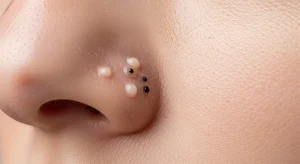
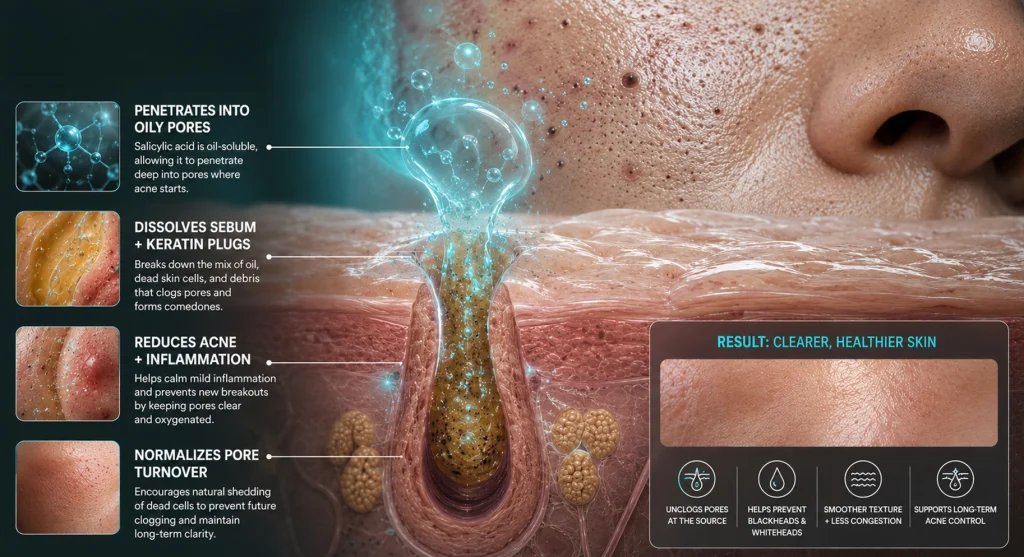
Salicylic acid is the only beta hydroxy acid in widespread cosmetic and medical use, and that single chemical detail is the reason it earned a permanent place in acne care. The molecule is lipophilic, meaning it is soluble in oil. Because the inside of a clogged pore is a mix of sebum and shed keratinocytes, salicylic acid can travel into that environment and start working where the problem actually lives.
Once it is inside the pore, salicylic acid does three things at once. It loosens the bonds holding dead skin cells together, a process called keratolysis, so the plug can release instead of compacting further. It calms inflammation through a mechanism similar to aspirin, which is the parent molecule of salicylic acid, reducing redness around active lesions. And it normalizes the way the pore lining sheds skin going forward, which is why consistent use over weeks lowers the rate of new blackhead and whitehead formation.
Why BHA Beats AHA Inside the Pore
Alpha hydroxy acids such as glycolic acid and lactic acid are water soluble. They exfoliate the surface of the skin and can improve overall texture and tone, but they do not have efficient access to the inside of an oil-filled pore. That single property is why salicylic acid wins for comedonal acne, the medical term for blackheads and whiteheads. It is also why combining a daily AHA with a periodic BHA can be a strong routine for patients dealing with both texture and clogged pores at the same time.
Which Acne Type Wins With Salicylic Acid (And Which Doesn’t)
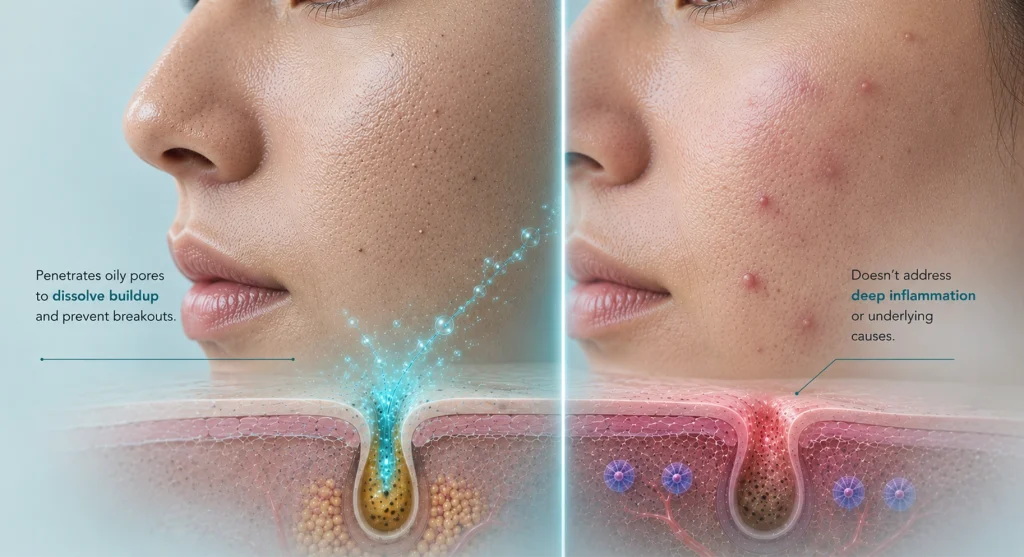
One of the more useful framings from the American Academy of Dermatology is that salicylic acid has a clear, narrow win zone. For non-inflammatory acne, the kind dominated by blackheads, whiteheads, and clogged pores, it is the strongest topical ingredient on the over-the-counter shelf. For inflammatory acne, the red papules and pustules that come and go, benzoyl peroxide has stronger evidence because it directly kills the C. acnes bacteria involved in those lesions. For cystic acne, the deep painful nodules under the skin, salicylic acid as a stand-alone product is not enough and patients should be evaluated by a medical provider for prescription options.
Quick Decision Matrix
- Blackheads on nose, chin, forehead: salicylic acid is the right first move.
- Whiteheads and clogged texture across the face: salicylic acid as a daily leave-on plus oil-free moisturizer.
- Red, inflamed pimples in clusters: benzoyl peroxide is the better evidence-based pick, with salicylic acid as a supporting player.
- Deep, painful cysts: a clinical consultation is appropriate. Topical salicylic acid alone will not address this acne pattern.
- Acne that scars or leaves marks: our team usually layers a salicylic acid routine with in-office care, see our guide on how clinical chemical peels for acne accelerate results when daily salicylic acid alone has reached a plateau.
Concentrations: What Percentage to Use and What Form
The same molecule behaves very differently at different concentrations, which is why patients get confused when one product feels gentle and another seems to strip their skin. Understanding the three concentration tiers protects the skin barrier and helps patients pick the right product for the right job.
- 0.5% to 2%, daily-use cosmetic range: this is the leave-on range used in cleansers, toners, and serums. Most people tolerate 2% if it is well formulated and paired with a good moisturizer. This is the daily-use tier this entire article is centered on.
- 2% to 10%, transitional range: spot treatments, masks, and short-contact products that should not be used as full-face daily care. These products typically state on the label that they are short-contact.
- 20% to 30%, professional peel range: only performed in a clinical setting by a trained provider. A salicylic acid peel at this concentration is a controlled, supervised procedure, not a home product. If you are interested in this route, our comprehensive acne treatment plan at Perfect B in Doral evaluates whether a clinical peel adds value on top of your daily routine.
Cleanser, Toner, or Serum: Which Format Should You Pick?
Format matters because contact time matters. A cleanser sits on the skin for 30 to 60 seconds before being rinsed off, so the dose is low and the irritation risk is lower. A toner with salicylic acid is left on, so the effective contact time is longer. A serum is the highest-impact daily-use format because it stays on the skin for hours and is engineered for stability. For most patients in the Miami area starting out, we recommend a 2% cleanser two to three times a week, then upgrading to a leave-on toner or serum if tolerance is good and acne persists.
How to Add Salicylic Acid to Your Routine Without Wrecking Your Skin Barrier
The most common reason a salicylic acid routine fails is starting too aggressively. The second most common reason is stacking it on top of other actives without spacing. Both of those mistakes overwhelm the skin barrier, cause redness and flaking, and lead patients to abandon the ingredient before it had a fair chance to work.
The 6-Week Build-Up Protocol We Use at Our Clinic
- Week 1 and 2: apply a 2% salicylic acid product two evenings per week, on non-consecutive days. Pair with a fragrance-free moisturizer immediately after.
- Week 3 and 4: increase to three evenings per week. Continue moisturizer.
- Week 5 and 6: if no redness, peeling, or stinging beyond the first 30 seconds of application, move to every other evening or daily evening use.
- Mornings: always apply broad spectrum SPF 30 or higher. Salicylic acid does not technically cause photosensitivity at low concentrations, but the exfoliating action exposes fresh skin that is more vulnerable to ultraviolet damage and post inflammatory pigmentation.
- If irritation appears: step back one frequency level and stay there for two weeks before trying to advance again.
What to Combine It With (And What to Avoid)
Most of the irritation patients blame on salicylic acid is actually irritation caused by stacking active ingredients without thought. The molecule itself is well tolerated at daily-use concentrations. What goes wrong is layering.
Pairs Well With
- Niacinamide: reinforces the skin barrier and reduces redness, complementing salicylic acid’s exfoliating action. For the supporting evidence on this pairing, see our deep dive on how niacinamide pairs with exfoliating acids to maintain barrier integrity and reduce post-inflammatory pigmentation in acne-prone skin.
- Hyaluronic acid: hydration anchors any active routine. Apply on damp skin before moisturizer.
- Azelaic acid: complementary action on inflammation and post-inflammatory hyperpigmentation, generally well tolerated together.
- Mineral SPF in the morning: non-negotiable, especially in South Florida.
Use With Caution
- Retinoids (tretinoin, retinol, adapalene): both are exfoliating in different ways. Most patients alternate nights rather than stacking. For a full comparison of options our patients ask about, see our breakdown of how tretinoin, retinol, and adapalene differ in strength, tolerability, and combination strategy with other acne actives.
- Benzoyl peroxide: both can dry the skin. If both are needed, use benzoyl peroxide in the morning and salicylic acid at night, or alternate days.
- Vitamin C (L-ascorbic acid): typically used in the morning and salicylic acid at night to keep the pH environments separate.
Avoid Combining
- Salicylic acid plus glycolic acid plus retinoid all in the same routine without supervision. This is the recipe for an overstripped barrier, persistent redness, and acne that gets worse, not better.
- Physical scrubs. Salicylic acid is already exfoliating chemically. Adding mechanical exfoliation creates microtears and increases inflammation.
Common Mistakes That Make Salicylic Acid Fail
At our clinic in Doral, FL, we see the same six errors over and over when patients tell us salicylic acid did not work for them.
- Quitting at week three. Salicylic acid takes 6 to 12 weeks to show meaningful improvement on a comedonal acne pattern. The first 4 weeks often look like nothing is changing.
- Skipping moisturizer. A bare salicylic acid routine without barrier support causes the tightness and flaking that patients mistake for the active “working.”
- Using it on inflamed cystic lesions only. Salicylic acid is most useful applied to the entire affected area as prevention, not spot-applied to existing cysts.
- Buying a 2% product and using it daily from day one. Build-up matters. The skin needs time to adapt.
- Skipping SPF. Especially relevant for patients in Miami and South Florida where ultraviolet exposure is year-round.
- Using it for cystic or hormonal acne in isolation. Cystic and hormonal acne typically need internal or prescription intervention, not just topical salicylic acid. Our article on what actually works for cystic acne in a clinical setting versus over-the-counter approaches covers when topical care is enough and when it is not.
Side Effects, Safety, and Pregnancy
Salicylic acid at cosmetic concentrations is one of the best-tolerated acne actives. That said, every active has a safety profile worth understanding before use.
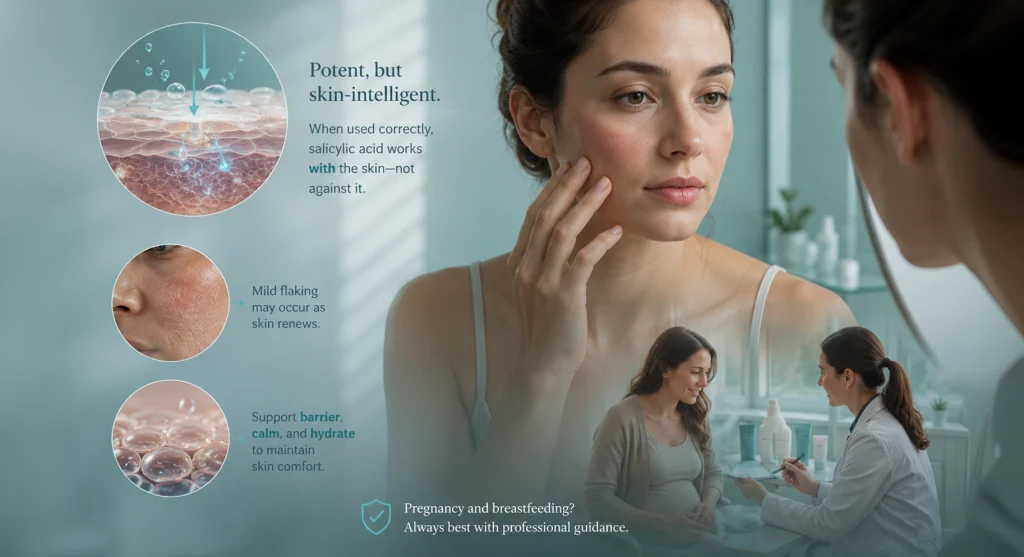
Common, Expected Effects
- Mild tingling for 30 seconds: normal on application, especially during the first week.
- Light flaking around day 4 to 7: the keratolytic action is working. Pair with moisturizer.
- Initial “purge” of 2 to 4 weeks: microcomedones already in formation come to the surface faster, so the first few weeks can look worse before they look better.
When to Stop and Call a Provider
- Persistent redness, burning, or swelling beyond the first hour of application.
- Skin that becomes shiny, tight, and feels permanently stripped, which is a sign of barrier damage.
- New breakouts that are deeper and more painful than baseline.
- Any signs of an allergic reaction (hives, intense itching, swelling).
Pregnancy and Breastfeeding
The American College of Obstetricians and Gynecologists (ACOG) considers low-concentration topical salicylic acid (under 2%) generally acceptable during pregnancy in small areas of application. Salicylic acid peels and high-concentration leave-on products are not recommended during pregnancy. Oral salicylates (aspirin family) are a separate clinical question, and patients should discuss with their obstetrician. For peer-reviewed guidance on this topic, see this comprehensive review from the National Institutes of Health on a clinical analysis published in the journal Skin Therapy Letter examining the safety profile of common topical acne ingredients during pregnancy and lactation.
Salicylic Acid in Miami: Humidity and Fitzpatrick IV-VI Factors
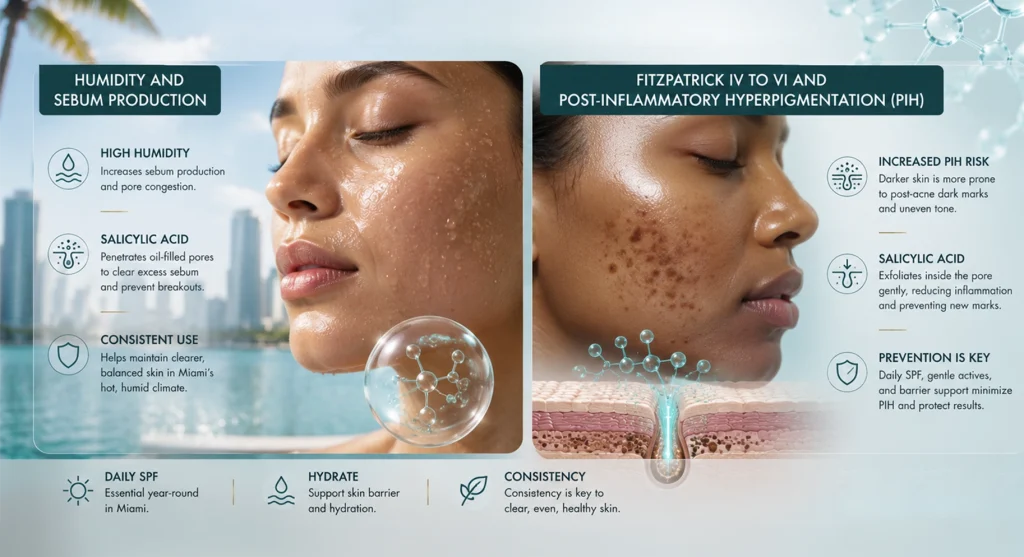
The vast majority of dermatology content online is written for a generic climate and a generic skin type. South Florida is neither. At our clinic in Doral, Miami, we treat a patient population that is heavily Fitzpatrick III to V, with year-round heat, humidity above 70% for most of the calendar, and high ultraviolet exposure. These three factors change how salicylic acid behaves in real life.
Humidity and Sebum Production
High humidity does not increase oil production, contrary to popular belief, but it does interfere with how the skin sheds dead cells. Sweat and humidity slow down stratum corneum turnover, which is one of the reasons clogged pores are so common in our patient population. Salicylic acid restores normal turnover and is particularly well suited to this climate.
Fitzpatrick IV to VI and Post-Inflammatory Hyperpigmentation
Patients with deeper skin tones have a higher baseline risk of post-inflammatory hyperpigmentation (the dark marks left after an acne lesion resolves). The right salicylic acid routine reduces this risk by shortening the inflammatory window of each lesion. The wrong routine, meaning a routine that is too aggressive and damages the barrier, can actually increase the risk. This is one of the reasons we favor the 6-week build-up protocol described above for our South Florida patients.
When to See a Medical Provider Instead of Trying Another Cleanser
Salicylic acid is a real medical-grade ingredient at the right concentration, and for the right type of acne it is genuinely effective. But there is a category of acne where over-the-counter products will simply not be enough, and the cost of trying product after product for months is scarring and pigmentation that takes much longer to undo.
Schedule an evaluation with a medical provider if any of the following apply: you have deep, painful, recurring nodules; your acne is leaving scars or persistent dark marks; you have tried two or more over-the-counter regimens consistently for 12 weeks without improvement; or your acne is affecting your quality of life or self-confidence. The American Academy of Dermatology emphasizes early professional care as the strongest predictor of avoiding long-term acne scarring, a point reinforced in official clinical guidance from the American Academy of Dermatology on when over-the-counter acne care should be escalated to a medical provider.
Frequently Asked Questions
1. Is salicylic acid good for daily use?
Yes, at concentrations of 0.5% to 2%, salicylic acid is formulated for daily use in cleansers, toners, and serums. Most patients tolerate a 2% leave-on product applied once daily once the skin has adapted. Build up gradually over 4 to 6 weeks rather than starting at every-day frequency from the first application.
2. Can I use salicylic acid every day if I have oily skin?
Oily skin generally tolerates salicylic acid better than dry or sensitive skin, but daily use should still be built up gradually. Oily skin still has a skin barrier that can be damaged by aggressive routines. Start every other evening, then move to nightly if comfortable.
3. How long does salicylic acid take to clear acne?
Expect 6 to 12 weeks of consistent use for meaningful improvement in comedonal acne (blackheads, whiteheads, clogged pores). The first 2 to 4 weeks can include a mild purge as microcomedones surface faster. Inflammatory acne typically needs supporting actives such as benzoyl peroxide or a prescription retinoid for clearer results.
4. Is salicylic acid or benzoyl peroxide better for acne?
It depends on the acne pattern. Salicylic acid wins for blackheads, whiteheads, and clogged pores because it penetrates inside the pore. Benzoyl peroxide wins for inflammatory acne (red papules and pustules) because it directly kills the C. acnes bacteria. Many patients benefit from both, used at different times of day or on alternating nights.
5. Can salicylic acid make acne worse before it gets better?
Yes, this is called a purge. Microcomedones (acne lesions that were already forming under the surface) come up faster during the first 2 to 4 weeks of use. This is different from irritation, which presents as persistent redness, burning, or new types of breakouts. A purge resolves on its own within 6 weeks. Irritation calls for stepping down frequency or stopping the product.
6. Can I use salicylic acid while pregnant?
Topical salicylic acid at concentrations under 2% applied to small areas of skin is generally considered acceptable during pregnancy by ACOG. Salicylic acid peels and high-concentration leave-on products should be avoided. Oral salicylates are a separate question for your obstetrician. Always confirm with your medical provider before starting any active ingredient during pregnancy.
7. Why is my salicylic acid not working after 4 weeks?
Four weeks is usually too early to judge salicylic acid’s effect on comedonal acne. Give it 8 to 12 weeks with consistent use. If you are using it for inflammatory or cystic acne, the product may genuinely not be the right tool, and the right next step is a medical evaluation to consider benzoyl peroxide, prescription retinoids, or other clinical options.
8. Should I see a provider in Doral or Miami for stubborn acne?
Yes, if your acne is leaving marks or scars, if you have deep cystic lesions, or if you have consistently used over-the-counter products for 12 weeks without improvement. At Perfect B in Doral, FL, we map out a treatment plan that combines daily topical care with in-office options such as chemical peels and corrective procedures, calibrated for South Florida skin types and lifestyles. You can reach us at (786) 502-2260 to schedule an evaluation.
The Doral Clinic Takeaway on Salicylic Acid
Salicylic acid earns its place in acne care because it does one thing extremely well: it dissolves the mix of sebum and dead skin that forms blackheads and whiteheads, from the inside of the pore. Used at the right concentration, built up at the right pace, and supported with the right moisturizer and sunscreen, it gives most patients with comedonal acne a real path to clearer skin within 6 to 12 weeks. Where it falls short is on inflammatory, cystic, or hormonally driven acne. Those patterns need supporting actives or prescription care, and the difference between a routine that works and a routine that wastes 6 months of your life often comes down to that distinction.
The reason patients come into our Doral clinic is not because they have not tried products. Most have tried five or six. The reason they come in is to stop guessing. A clinical evaluation maps your acne pattern, identifies the right concentrations and combinations for your skin type and South Florida environment, and folds in clinical procedures only when they accelerate progress beyond what topical care alone can deliver.
- 📍 Visit us at Perfect B, 8200 NW 41st St, Doral FL 33166
- 📞 Call or message us at (786) 502-2260