Perfect B, Doral Fl. | 06.15.26 | 12 min read.
Educational content only. This article is not a substitute for medical advice, diagnosis, or treatment. Peptide therapy involves prescription compounds that should always be evaluated, prescribed, and monitored by a licensed medical provider.
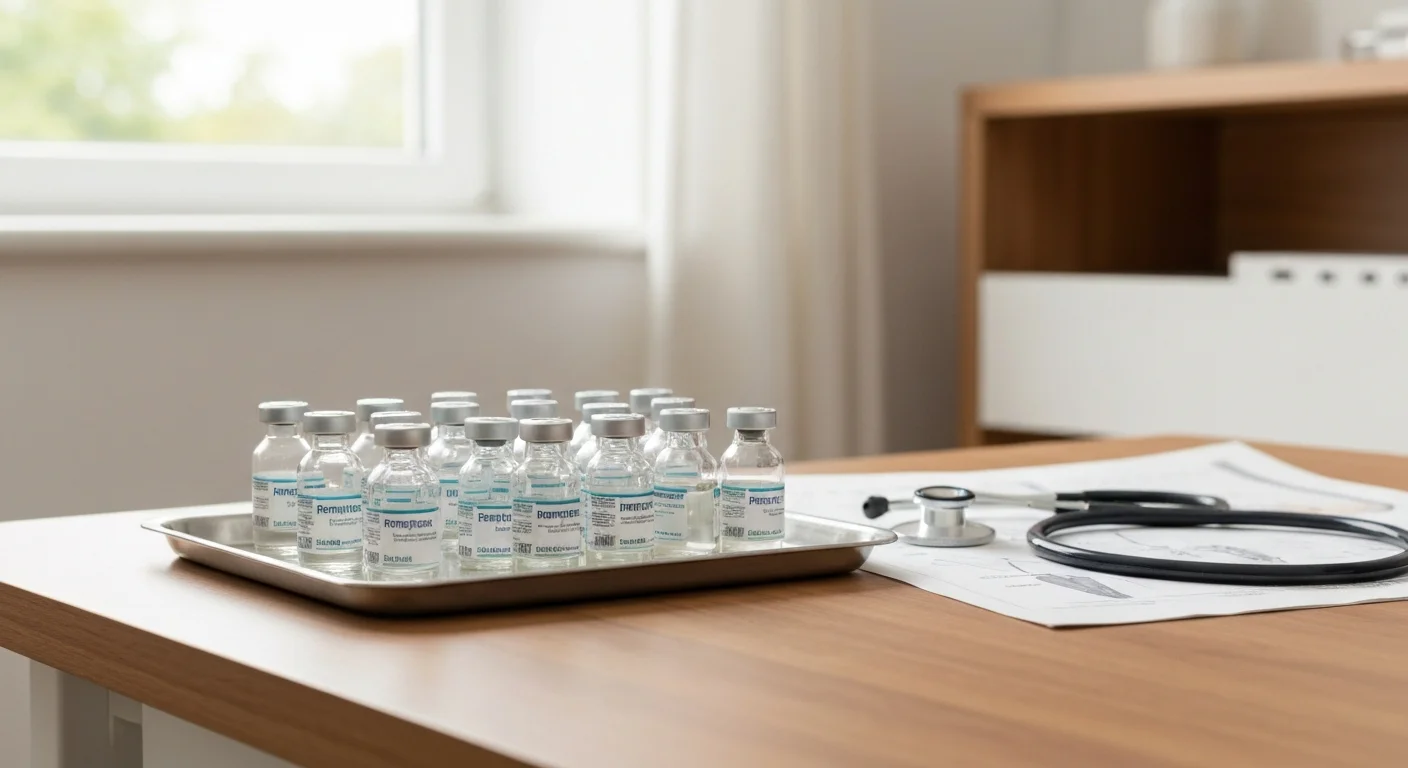
What a peptide therapy clinic near me should actually look like
If you searched for a peptide therapy clinic near me, you probably ran into a confusing mix of providers: integrative medicine offices, hormone optimization clinics, longevity centers, virtual telehealth services, and wellness centers that added peptides to a long menu of cosmetic treatments. They all use the same language. Few of them practice the same standard of care. The difference between a result and a regret often lives in details that are not visible on a homepage.
This guide is written from the operating standards of a medical clinic in Doral, FL that runs peptide therapy as a clinical program: prescription only, lab-anchored, physician supervised, sourced from a compounding pharmacy, and reviewed in person at every follow-up. The goal is not to talk you into peptides. The goal is to give you a framework you can use to evaluate any clinic in Miami, South Florida, or anywhere else, so you can ask the right questions before you book a consultation, swipe a card, or self-administer anything.
Key takeaways
- Supervised peptide therapy is a clinical program, not a product: labs, prescription, in-person follow-up, and documented dosing protocol are non-negotiable.
- Where your peptide is compounded matters more than the brand of the clinic: a US-licensed 503A or 503B compounding pharmacy is the minimum standard.
- Peptides are prescription-only in the United States: any clinic, website, or research peptide vendor offering them without an evaluation and a prescription is operating in a grey area.
- A real peptide doctor near me will run baseline labs before any injection: if a provider skips this step, the program is not clinically supervised.
- The right clinic answers your questions before the sale, not after: transparency about indication, dosing, side effects, and follow-up is the strongest trust signal you can find.
What does “peptide therapy clinic near me” actually mean in 2026
The phrase carries a lot of baggage. A patient searching for peptide therapy in Miami today is being offered everything from BPC-157 for joint recovery to CJC-1295 with Ipamorelin for sleep and body composition, to Tesamorelin for visceral fat, to Semaglutide and Tirzepatide for weight loss, to GHK-Cu for skin and hair. These are not interchangeable molecules and they should not share a single intake form, a single price tier, or a single dosing schedule.
A peptide therapy clinic, in the clinical sense of the phrase, is a medical practice where a licensed provider evaluates a candidate, identifies the indication, selects the specific peptide, writes a prescription, has it dispensed by a compounding pharmacy, instructs the patient on reconstitution and self-administration, and reviews progress at scheduled follow-ups. Anything less than that is a wellness service borrowing the vocabulary of medicine.
At our clinic in Doral, FL, the operating principle is simple. Every peptide on our menu corresponds to a documented patient need, a documented protocol, and a documented follow-up cadence. You can read the peptide-by-peptide breakdown in → our beginner-friendly guide to peptide therapy at Perfect B in Doral, including how each peptide fits a specific clinical goal.
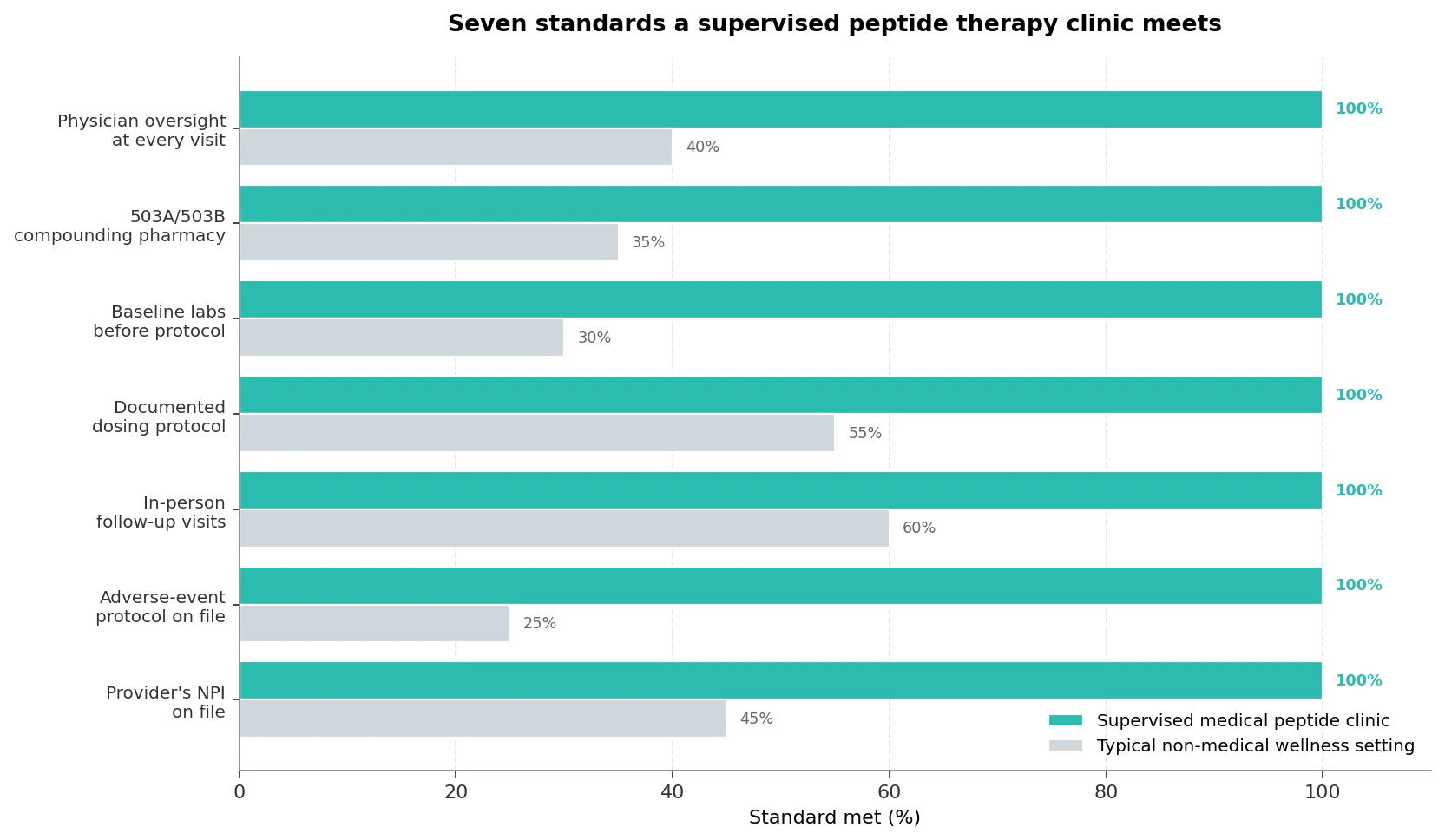
The seven standards that define a supervised medical peptide program
These are the seven standards a clinic should meet before you let it inject anything into your body. Treat the list as a checklist you can use during your consultation. If a provider hesitates on any of them, that hesitation is your answer.
1. A licensed physician oversees your case at every visit
Peptide therapy involves prescription compounds. That means a physician, nurse practitioner, or physician assistant with prescriptive authority must be the person evaluating, prescribing, and re-evaluating you. Ask for the provider’s NPI number. Verify it in the public NPI registry if you want. A clinic that cannot or will not name the medical provider behind the prescription is not the right clinic.
2. Your peptides come from a 503A or 503B compounding pharmacy
This is the single most important detail and the one most patients never ask about. A 503A compounding pharmacy fills patient-specific prescriptions. A 503B outsourcing facility manufactures larger batches under FDA oversight. Both operate under strict United States Pharmacopeia standards for sterility, identity, potency, and stability. A peptide that arrives from a 503A or 503B facility comes with documentation. A peptide that arrives from a website that calls itself research only comes with nothing.
3. Baseline labs are drawn before any prescription is written
The lab panel varies by indication. A patient evaluated for CJC-1295 and Ipamorelin will have IGF-1 measured. A patient evaluated for Tesamorelin will have lipid markers, fasting glucose, and waist circumference documented. A patient evaluated for BPC-157 will have a relevant musculoskeletal history reviewed. Skipping baseline labs is the most common shortcut a non-clinical provider takes, and it is the shortcut that turns peptide therapy into a guess.
4. The dosing protocol is documented in writing
You should leave your first appointment with a written protocol: the peptide name, concentration, reconstitution instructions, injection site, dose, frequency, expected duration, and follow-up schedule. A protocol drawn on a sticky note or texted in a chat thread is not documentation. The written protocol is what protects you if anything unexpected happens.
5. Follow-up visits are in person or at least face to face
Telehealth has a real role in peptide therapy. It is reasonable to do an intake by video, to renew a prescription remotely once the program is stable, and to send progress photos between visits. It is not reasonable to never see your provider in person. A 90-day program that includes one in-person check-in is the floor. Programs that operate entirely through a portal often miss the side effects and the wins.
6. An adverse-event protocol exists before you need it
Ask: what do you do if I have an injection-site reaction, an unexpected systemic symptom, or a result outside the expected range? The answer should be specific. There should be a callback line, a clinical contact, and a documented decision tree for adjusting, pausing, or discontinuing the peptide. If the answer is send us a message and we will get back to you when we can, the program is not supervised in any meaningful way.
7. The clinic publishes its provider and its standards
Look at the website. A real peptide therapy clinic publishes its medical director, lists the peptides it actually prescribes, explains its dosing philosophy, and answers patient questions before the sale. A clinic that hides behind schedule a consultation to learn more is not necessarily wrong, but it is asking you to commit time and money before you know what you are buying. Patients in the Miami area who use the published-information test as a filter end up with a short list quickly.
Why compounding pharmacy quality matters more than the brand of the clinic
Two patients can receive the same peptide name and walk away with very different molecules. The clinic does not synthesize peptides. The pharmacy does. The clinic writes the prescription and the pharmacy fills it. Which pharmacy fills it determines whether what you inject matches the label.

503A compounding pharmacies operate under state board of pharmacy oversight and prepare patient-specific prescriptions. 503B outsourcing facilities operate under FDA registration and prepare larger batches that clinics can stock for office use. Both are required to meet USP 797 standards for sterile compounding. National Public Radio summarized the safety argument plainly in their 2026 reporting on the wellness boom: peptides bought from a compounding pharmacy under physician supervision carry meaningfully different risk than peptides bought directly from an online vendor. You can read their full reporting in an NPR investigation explaining how the rise of DIY peptides has created a gap between what consumers buy online and what regulated pharmacies actually dispense under medical supervision.
When you ask a clinic where their peptides are compounded, the answer should be a specific pharmacy name. If the answer is vague, that is the answer. The clinic that runs your weight loss peptide protocol should be just as transparent as → the peptide treatment plan at Perfect B in Doral, which lists every peptide on the menu, the indication it addresses, and the expected schedule of care.
What questions to ask a peptide doctor near me before your first appointment
Treat your first call or consultation as a short interview. A clinic that earns your trust will answer all of these without friction. A clinic that flinches at any of them is telling you something useful.
- Who will write my prescription: name, credentials, and the role of any supervising physician.
- Where will my peptide be compounded: the pharmacy name, its 503A or 503B status, and whether you can request a certificate of analysis.
- What labs do I need before starting: the panel, what each marker is screening for, and how often it will be repeated.
- What is the protocol you would propose for me: dose, frequency, expected timeline, and the indication you are treating.
- How are follow-ups handled: in person or virtual, at what cadence, and who I contact between visits.
- What are the contraindications and known side effects: the provider should be able to list them without consulting a script.
- What does it cost in total: consultation, labs, the peptide itself, and follow-up visits priced separately, not bundled into a vague membership.
- What is your discontinuation plan: what happens if it does not work, if I want to stop, or if I experience a side effect.
Patients who arrive at our clinic in Doral with these questions in hand consistently make better decisions than patients who arrive with a peptide name they read on a podcast. The question list is the filter.
Are peptides legal in Florida and what prescription only really means
The short answer for South Florida patients: peptides used for clinical indications are legal when they are prescribed by a licensed provider and dispensed by a licensed pharmacy. The longer answer is more useful.
Peptides like Sermorelin, Tesamorelin, BPC-157, CJC-1295, Ipamorelin, GHK-Cu, and others are not over the counter substances. In the United States they are dispensed under a prescription from a licensed provider, compounded by a licensed pharmacy, and used by a specific patient for a specific indication. The FDA has, since 2023, narrowed which peptides 503A pharmacies can compound, which is one reason a serious clinic will tell you exactly which peptides remain available through which pharmacy partners. You can review the U.S. Food and Drug Administration’s official communication on the regulatory framework in an FDA compounding overview that explains the difference between 503A patient-specific compounding and 503B outsourcing facilities and how each is supervised under federal law.
The other side of the legal question is the grey market: websites selling vials labeled research only or not for human consumption. These vendors operate in a category that is not legally available for therapeutic use. The peptides may be the right molecule, may be the wrong molecule, may be the right molecule at the wrong concentration, or may carry contaminants from manufacturing facilities that do not meet pharmaceutical standards. South Florida patients dealing with chronic stressors or recovering from injuries are not the demographic that should be running that risk.
How a Doral medical clinic structures peptide therapy from labs to follow-up
Specifics make the difference. Below is the structure a supervised peptide program follows at our clinic in Doral. Other clinics will use slightly different cadences, and that variation is normal. The bones of the program should be similar.
- Initial consultation: a clinical intake covering symptoms, goals, medication history, prior peptide exposure, and family history. A physical exam where indicated.
- Baseline labs: panel selected based on the suspected indication. Results reviewed before any prescription is written.
- Protocol design: peptide selected, dose calculated, frequency set, expected response window estimated, contraindications reviewed.
- Pharmacy dispensing: prescription transmitted to a 503A or 503B pharmacy. Patient receives a documented kit with reconstitution instructions and a written protocol.
- Self-administration education: in-person teaching of subcutaneous injection technique, storage, and what to do if a dose is missed.
- Mid-cycle check-in: typically at four to six weeks. Symptom review, side effect review, dose adjustment if indicated.
- End-of-cycle review: repeat labs, comparison to baseline, decision on continuation, transition, or discontinuation.
The mechanics of self-administration deserve their own attention. If you have never reconstituted a peptide or never injected yourself before, the clinic should walk you through it without making you feel rushed. We cover the practical side in detail in → our step-by-step guide to injecting peptides safely at home, including site rotation, needle gauge, and how to recognize an injection-site reaction. A clinic that hands you a kit without that teaching is asking you to do clinical work without clinical instruction.
What grey market peptides actually means and why your search shouldn’t end there
The term grey market gets used loosely. In peptide therapy it has a specific meaning: vials sold online by vendors who label them research only or not for human consumption and ship them to consumers who use them on themselves anyway. The label is the legal disclaimer. The contents are the gamble.
The risks are concrete. Identity: the vial may not contain the peptide on the label, or may contain a similar molecule with a different effect. Purity: trace contaminants from manufacturing facilities that do not operate under USP standards can include endotoxins, heavy metals, or residual solvents. Concentration: the labeled dose may be wildly off, which means even an accurate calculation can deliver a wrong amount. Sterility: vials filled outside of a cleanroom can carry bacterial contamination that an injection delivers straight into your tissue.
None of this is hypothetical. It is the reason regulated pharmacy networks exist. A clinic that genuinely cares about long-term outcomes will not just decline to recommend grey market sources, it will explain why. Search intent for terms like best grey market peptides list is a signal that a patient is shopping the wrong shelf. The cleaner search is for a peptide doctor near me who can run labs, write a real prescription, and partner with a licensed pharmacy.
How to evaluate the cost of a peptide therapy program honestly
Cost transparency separates clinical programs from sales programs. A serious clinic will break the cost into its components rather than quote a single membership number that buries the details.
- Consultation fee: a one-time clinical evaluation. Sometimes credited toward the program.
- Lab fees: baseline panel and any follow-up panels. These vary by lab and by indication.
- Peptide itself: the compounded prescription, priced by the pharmacy. Patients pay the pharmacy directly or through the clinic.
- Follow-up visits: in person or virtual, billed per visit or bundled into a defined-length program.
- Adjunct testing if indicated: imaging, additional labs, or specialist referrals that the clinical picture requires.
You can review the structure of how a Perfect B program is built around your goal and not around a single product in → our peptide stack guide, which walks through how peptides are layered and timed in a supervised program rather than used as one-off purchases. If a quote you receive does not break down into components like the ones above, ask for the breakdown. Vague numbers usually mean vague care.
Not sure which peptide protocol fits your skin or recovery goal?
Perfect B’s peptide protocol tool is built on real clinical data from 2,000+ patients treated in South Florida. Answer 6 questions and see which protocol patients with similar goals chose: a single peptide at $445, the Wolverine Stack at $795, or a custom multi-peptide cycle priced by indication.
Flexible payment options through Cherry financing, with 7 to 25 monthly installments starting from approximately $17 per month depending on the protocol selected.
Frequently Asked Questions
1. What is a peptide therapy clinic and how is it different from a wellness center?
A peptide therapy clinic is a medical practice where a licensed provider evaluates you, prescribes a specific peptide based on labs and clinical findings, partners with a 503A or 503B compounding pharmacy to dispense it, and follows you through the program with documented in-person visits. A wellness center may offer peptides as one of many services, often without baseline labs or in-person follow-ups. The difference is structural, not cosmetic.
2. Can I get peptide therapy through telehealth only?
Some elements work well by telehealth: intake, prescription renewal after the program is established, and progress check-ins. Other elements do not. Initial physical evaluation, injection technique teaching, and complex side-effect management benefit from being in person. A reasonable hybrid model includes at least one in-person visit per cycle. A fully virtual program with no in-person touchpoint should raise questions.
3. Are peptides legal in Florida?
Peptides prescribed by a licensed Florida provider and dispensed by a licensed 503A or 503B compounding pharmacy are legal for the specific patient they are prescribed to. Peptides sold online as research only and shipped directly to consumers are not legally available for human therapeutic use. The clinic you choose should be transparent about the legal pathway it uses.
4. How long before I notice results from peptide therapy?
Timeline depends on the peptide and the indication. Recovery peptides like BPC-157 may show changes in inflammation and tissue tolerance within two to four weeks. Growth hormone secretagogue stacks like CJC-1295 with Ipamorelin typically show changes in sleep quality and recovery in four to eight weeks, with body composition shifts taking longer. Skin and hair peptides like GHK-Cu work on the timeline of skin and hair cycles, which is months, not days.
5. What labs should I expect before starting peptide therapy?
The panel depends on the indication. A common baseline includes a comprehensive metabolic panel, complete blood count, lipid panel, fasting glucose and hemoglobin A1c, and indication-specific markers such as IGF-1 for growth hormone secretagogues. Programs that skip labs entirely are skipping the baseline you need to know whether the program is working.
6. How much does peptide therapy cost at a medical clinic?
Cost varies by peptide, dose, frequency, and program length, and a single number quoted without that breakdown is rarely informative. A serious clinic will price the consultation, the labs, the peptide itself, and the follow-up visits as separate line items so you can see what you are paying for. At Perfect B in Doral, FL, every peptide on the menu has a documented price and a documented schedule of care that you can review before you commit.
7. What happens if I have a side effect or it does not work?
A supervised program has a written discontinuation plan. Common adjustments include reducing dose, lengthening the interval between injections, rotating to a different peptide in the same class, or stopping entirely. The decision is clinical, not commercial. If the program is built around selling you the next vial regardless of how you are responding, the program is not built around you.
Closing: the Doral takeaway on choosing a peptide therapy clinic
The right peptide therapy clinic near me is the one that treats peptide therapy as medicine. That means a licensed provider, a compounding pharmacy, baseline labs, a written protocol, in-person follow-ups, an adverse-event plan, and pricing you can read line by line before you decide. None of that is exotic. All of it is the baseline a clinical program should clear without effort.
If you are weighing options in Miami, Doral, or anywhere in South Florida, the difference between a result and a regret is rarely the peptide itself. It is the structure around it. Supervised care is not a marketing claim. It is a checklist a clinic either meets or does not.
- 📍 Perfect B | 3905 NW 107th Ave, Suite 104, Doral FL 33178
- 📞 Call or message us at (786) 502-2260
- 💳 Buy Now Pay Later: Cherry, Klarna, Afterpay, CareCredit