Perfect B, Doral Fl. | 06.15.26 | 12 min read.
Educational content only. This article is not a substitute for medical advice, diagnosis, or treatment. The Wolverine Stack and any peptide combination should be evaluated, prescribed, and monitored by a licensed medical provider.
What “Wolverine Stack near me” actually means in a clinical setting
When patients search for a Wolverine Stack near me, they are usually asking a specific question: where can I find a real clinic that prescribes BPC-157 and TB-500 together, sources them from a licensed pharmacy, and supervises the program from start to finish. That is a very different search from the one most websites answer. Most online results are pure explainers, vendor pages that ship vials marked research only, or generic peptide therapy menus from spas that do not actually carry the protocol.
This guide is written from the operating standards of a medical clinic in Doral, FL that runs the Wolverine Stack as a clinical program. The goal is not to talk you into the protocol. The goal is to give you a framework you can use to evaluate any clinic in Miami, South Florida, or anywhere else before you hand over a credit card or self-inject anything.
Key takeaways
- The Wolverine Stack is a supervised clinical protocol, not a product: labs, prescription, written dosing schedule, and in-person follow-up are the floor.
- BPC-157 plus TB-500 work on different mechanisms: BPC-157 acts locally and acutely on tissue and gut, TB-500 acts systemically on cell migration and recovery. Stacking them is a clinical decision, not a default.
- The compounding pharmacy decides what is actually in the vial: a 503A or 503B partner is the single most important detail patients never ask about.
- Recovery response varies by indication: acute tendon and post-surgical patients respond on different curves than chronic joint pain patients. A supervised program calibrates for that.
- A real Wolverine Stack near me program has clear pricing and an exit plan: if a clinic cannot tell you the total cost and what happens if the protocol does not work, the program is not built around the patient.
Where to find a supervised Wolverine Stack program in Miami and Doral
Searching for Wolverine Stack near me in Miami pulls back a confusing mix of providers: regenerative medicine clinics that handle BPC-157 and TB-500 separately, med spas that list peptide therapy without naming protocols, telehealth platforms that ship vials to a Florida address after a video intake, and online vendors selling research-only material. They all share search terms. They do not share standards of care.
A supervised Wolverine Stack program, in the clinical sense of the phrase, has five elements you can verify before you start:
- A licensed provider evaluates you in person: a physician, APRN, or PA with prescriptive authority reviews your history, indication, and contraindications.
- Baseline labs anchor the decision: bloodwork is ordered before any vial is opened, not after the patient is already cycling.
- Prescription dispensed by a licensed pharmacy: the vials come from a 503A or 503B compounding facility, not a research vendor.
- Written protocol with documented endpoints: reconstitution instructions, dose, frequency, expected timeline, and what to monitor.
- Follow-up that is face to face at least once per cycle: not just a portal message.
If a Miami clinic cannot demonstrate all five before taking payment, the program is not supervised in the way the word usually implies. You can compare any clinic against the same checklist we use for the broader peptide cluster in → our framework for choosing a peptide therapy clinic near me, including the seven standards a supervised medical program should meet before anyone injects anything.
What a Doral medical clinic does differently when prescribing the Wolverine Stack
The mechanism of BPC-157 and TB-500 is the same everywhere. What changes is the workflow around the vial. At our clinic in Doral, FL, the workflow has six checkpoints that determine whether the protocol is actually clinical or just commercial.
Indication-first, peptide-second
The intake starts with the injury or symptom, not the peptide. Patients arriving with acute soft-tissue injuries get evaluated differently from patients with chronic joint pain or patients planning post-surgical recovery. The Wolverine Stack is selected only when the clinical picture supports both BPC-157 and TB-500 together. If the picture supports only one, we run only one. The decision is documented in the chart.
Labs before the prescription is written
Baseline labs cover what the indication requires: a comprehensive metabolic panel, complete blood count, inflammatory markers when chronic inflammation is suspected, and indication-specific markers when relevant. Results are reviewed before the prescription is transmitted to the pharmacy. Skipping this step is the most common shortcut a non-clinical provider takes.
Provider’s NPI on every patient file
Patients have the right to verify who is prescribing their compound. Every patient at our Doral clinic can name the provider on their case, see the provider’s credentials, and find the NPI number in the public CMS registry. A clinic that does not let you do this is asking you to trust a transaction you cannot audit.
Pharmacy partner named in writing
The compounding pharmacy is named in the dispensing paperwork. Patients can request a certificate of analysis if they want to verify identity, purity, and potency of the batch. A clinic that cannot tell you which pharmacy compounded the vial is a clinic that does not control its supply chain.
In-person injection technique teaching
BPC-157 and TB-500 are typically self-administered as subcutaneous injections at home. The first reconstitution and the first injection are taught in person, not over video. You can see the practical details of subcutaneous self-administration in → our step-by-step guide to injecting peptides safely at home, including site rotation, needle gauge, and how to recognize an injection-site reaction.
Follow-up cadence built into the program
A 12-week Wolverine Stack cycle typically includes a mid-cycle check-in at week four to six and an end-of-cycle review at week twelve. Each visit reviews symptom response, side effects, injection-site tolerance, and adjusts dose if indicated. A program that never sees the patient again after the first appointment is not running the protocol, it is selling the vials.

How a supervised Wolverine protocol is built around your specific recovery goal
Response patterns to the Wolverine Stack vary by indication. The same protocol applied to an acute tendon injury and a chronic joint pain case will produce two very different timelines. A supervised program counsels patients on what to actually expect, not on the most aggressive curve someone read on a podcast.
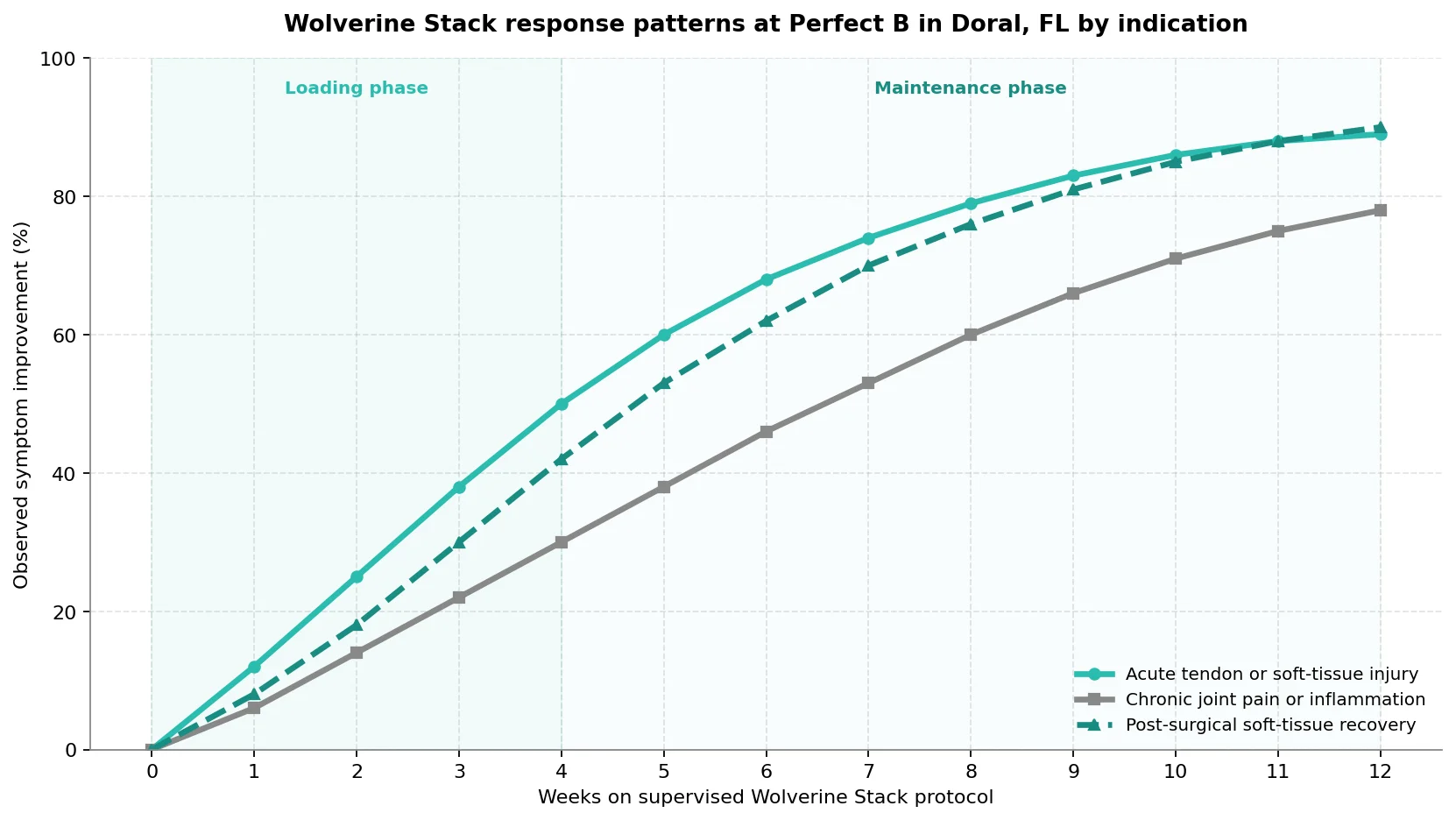
Three indications cover the majority of Wolverine Stack candidates at our Doral clinic. Each follows a different trajectory across a 12-week supervised cycle:
- Acute tendon and soft-tissue injuries: the fastest responders. Symptom improvement is usually noticeable inside three to four weeks, with the steepest gains during the loading phase. Most acute patients reach roughly 80 percent of their target improvement by week eight.
- Chronic joint pain and inflammation: slower and more linear. Patients with long-standing knees, shoulders, or hips need the full 12 weeks to assess fairly. Improvement is real but builds week over week rather than appearing as a sudden change.
- Post-surgical soft-tissue recovery: the longest plateau then the strongest finish. Loading weeks one to four are spent stabilizing tissue. The biggest gains usually arrive between week six and week ten as the tissue remodels.
The mechanism difference matters here. BPC-157 acts locally on cytoprotection, angiogenesis, and gut signaling. TB-500 contributes systemic cell migration and tissue remodeling. The clinical detail on each peptide individually is documented in → our clinical comparison of BPC-157 vs TB-500 covering mechanism, indication, and when a provider chooses one over the other.
South Florida patients dealing with injuries from the South Florida climate, weight training, paddleboarding, padel, or post-cosmetic-surgery healing often sit in the acute-injury or post-surgical buckets. That is where the Wolverine Stack response curve is the steepest.
The Wolverine Stack supply chain: 503A and 503B compounding pharmacies and what they change
Two patients can receive the same peptide name on the label and inject two very different molecules. The clinic does not synthesize peptides. The pharmacy does. Which pharmacy compounds the vial decides whether the molecule matches the label, the concentration is accurate, and the contents are sterile.
- 503A compounding pharmacies: operate under state board of pharmacy oversight, fill patient-specific prescriptions, and must meet USP standards for sterility and identity. Each batch traces back to a specific patient and a specific prescriber.
- 503B outsourcing facilities: operate under FDA registration, produce larger lots that clinics can stock for office use, and must follow current good manufacturing practice standards.
- Online research vendors: ship vials labeled research only or not for human consumption to retail customers. These vendors operate outside the legal pathway for human therapeutic use. Identity, purity, concentration, and sterility are not guaranteed.
NewYork-Presbyterian’s Health Matters publication summarized the supervision argument plainly when peptide demand started to spike: peptide products purchased outside the regulated pharmacy network carry risks that supervised programs are specifically designed to avoid. You can read their full physician interview in a NewYork-Presbyterian Health Matters review of peptide therapy explaining why physicians recommend regulated pharmacy compounding over online research vendors.
When you ask a clinic offering Wolverine Stack near me where the vial is compounded, the answer should be a specific pharmacy name. Vague answers are the answer. Patients who care about long-term outcomes also care about supply chain. The two are connected.
What the Wolverine Stack costs at Perfect B and how to finance it
Cost transparency separates clinical programs from sales programs. A serious clinic prices the consultation, the labs, the peptide kit, and the follow-up visits as separate line items the patient can read before committing.
- Consultation: a one-time clinical evaluation. Sometimes credited toward the program for new patients.
- Baseline labs: panel selected based on indication. Lab pricing varies by network.
- Wolverine Stack kit: the compounded BPC-157 plus TB-500 prescription, dispensed by a licensed pharmacy partner.
- Follow-up visits: mid-cycle and end-of-cycle, either in person or hybrid depending on stability.
- Adjunct work if indicated: imaging, additional labs, or specialist referrals when the clinical picture calls for it.
Not sure if the Wolverine Stack is the right protocol for your recovery goal?
Perfect B’s peptide protocol tool is built on real clinical data from 2,000+ patients treated in South Florida. Answer 6 questions and see which protocol patients with similar goals chose: a single peptide at $445, the Wolverine Stack at $795, or a custom multi-peptide cycle priced by indication.
Flexible payment options through Cherry, Klarna, Afterpay, or CareCredit, with 7 to 25 monthly installments starting from approximately $17 per month depending on the protocol selected.
If a Miami clinic offering the Wolverine Stack quotes a single bundled number without separating these line items, ask for the breakdown. Vague numbers usually mean vague care.
Who is actually getting the Wolverine Stack at our Doral clinic
The candidate profile for a supervised Wolverine Stack program is narrower than the explainer pages suggest. At our clinic in Doral, FL the patients who consistently respond to the protocol fall into a few buckets:
- South Florida athletes with acute soft-tissue injuries: tendinopathy, partial tears, recurring strains. Recovery time matters more than aesthetics, and the protocol is selected for tissue repair speed.
- Post-cosmetic-surgery recovery patients: some patients use the Wolverine Stack alongside post-procedure rehabilitation, with provider approval and clearance from the surgeon.
- Active adults with chronic joint pain: shoulders, knees, lower back. The protocol is positioned as one tool inside a broader plan that includes physical therapy, weight management, and indication-specific workups.
- Post-orthopedic-surgery patients in the soft-tissue phase: typically four to twelve weeks out of surgery, with surgeon sign-off and a clear remodeling window ahead.
The Wolverine Stack is not the right protocol for every patient who asks about it. Patients with active cancer, certain bleeding disorders, pregnancy, or untreated systemic conditions are not candidates regardless of how strong the recovery interest is. A supervised program will say no when the clinical picture requires it.
How the Wolverine Stack fits into a broader supervised peptide program
The Wolverine Stack is a recovery-focused protocol. It does not replace a hormone optimization program, a longevity peptide cycle, or a metabolic peptide for weight loss. At our Doral clinic the stack is one element inside a broader supervised peptide map.
- Recovery cluster: Wolverine Stack (BPC-157 plus TB-500), used for acute injury, chronic joint, and post-surgical indications.
- Growth hormone axis cluster: CJC-1295 with Ipamorelin, used for sleep, recovery quality, and body composition support.
- Metabolic and visceral fat cluster: Tesamorelin and similar protocols.
- Longevity and mitochondrial cluster: MOTS-c and Epithalon protocols for patients prioritizing cellular function.
- Skin and hair cluster: GHK-Cu and copper peptide blends for collagen and follicle support.
How the Wolverine Stack layers with these other clusters is a clinical conversation, not a self-prescribed stack. The logic our providers use to combine peptides safely is documented in → our peptide stack guide explaining which combinations Perfect B actually runs and why specific indications require specific layering decisions.
Frequently Asked Questions
1. What is the Wolverine Stack and why is it called that?
The Wolverine Stack combines two tissue-repair peptides, BPC-157 and TB-500, used together to support recovery across soft tissue, tendon, joint, and post-surgical contexts. The nickname references the Marvel character’s regenerative healing trait and was adopted across the peptide community to describe the BPC-157 plus TB-500 combination specifically.
2. Where can I get a supervised Wolverine Stack near me in Miami?
A supervised Wolverine Stack near me program in Miami should be run from a medical clinic with a licensed provider on staff, a 503A or 503B compounding pharmacy partner, baseline labs, and in-person follow-up. Perfect B in Doral, FL runs the protocol as a clinical program with these standards built in. Telehealth-only platforms that ship vials without an in-person visit do not meet the supervised threshold most patients are searching for.
3. How long is a typical Wolverine Stack cycle?
A typical supervised Wolverine Stack cycle runs about 12 weeks, broken into a four-week loading phase and an eight-week maintenance phase. The first follow-up review is usually at week four to six. The end-of-cycle review with repeat labs and indication assessment is at week twelve. Some indications justify shorter or longer cycles based on response.
4. What does the Wolverine Stack cost at a medical clinic?
Cost varies by clinic and indication. At Perfect B in Doral, FL the Wolverine Stack starts at $795 USD for the compounded kit, with separate line items for consultation, labs, and follow-up visits. Patients can finance the program through Cherry, Klarna, Afterpay, or CareCredit, with installment plans ranging from 7 to 25 monthly payments. A program that quotes a single bundled number without itemized pricing is not following the cost-transparency standard.
5. Are the BPC-157 and TB-500 in the Wolverine Stack legal?
BPC-157 and TB-500 dispensed by a licensed 503A or 503B compounding pharmacy under a prescription from a licensed Florida provider are legal for the specific patient they are prescribed to. Vials sold online as research only and shipped directly to consumers are not legally available for human therapeutic use. The clinic running your protocol should be transparent about its legal pathway.
6. What are the side effects of the Wolverine Stack?
The most common patient-reported effects with supervised Wolverine Stack use are mild injection-site reactions, transient fatigue during the loading phase, and occasional gastrointestinal sensitivity that usually resolves with dose timing adjustment. Less common effects are reviewed at intake and during follow-up. Any unexpected reaction is reported through the clinic’s adverse-event protocol and triggers a documented response, not a generic chat reply.
7. How is the Wolverine Stack different from BPC-157 or TB-500 alone?
BPC-157 alone is a local-acting peptide most clinically useful in acute soft-tissue and gut indications. TB-500 alone is a systemic-acting peptide most clinically useful for broader cell migration and tissue remodeling demands. The Wolverine Stack runs them together when the clinical picture calls for both local and systemic action, typically in patients with overlapping acute and chronic features.
8. Can I do the Wolverine Stack entirely through telehealth?
Some elements of the protocol work well through telehealth: prescription renewal once the program is stable, symptom check-ins, and progress photos. Initial evaluation, injection technique teaching, and any complex side-effect management benefit from being in person. A fully virtual program with no in-person touchpoint should raise questions, especially for the first cycle.
Closing: the Doral takeaway on choosing a Wolverine Stack program
The right Wolverine Stack near me program is the one that treats BPC-157 and TB-500 as medicine, not as a product. That means a licensed provider, a 503A or 503B compounding pharmacy partner, baseline labs, a written protocol, in-person follow-up, an adverse-event plan, and pricing you can read line by line before you decide. None of that is exotic. All of it is the baseline a clinical program should clear without effort.
If you are weighing options in Miami, Doral, or anywhere in South Florida, the difference between a real recovery program and a vial purchase is the structure around the protocol. Supervised care is not a marketing claim. It is a checklist a clinic either meets or does not.
- 📍 Perfect B | 3905 NW 107th Ave, Suite 104, Doral FL 33178
- 📞 Call or message us at (786) 502-2260
- 💳 Buy Now Pay Later: Cherry, Klarna, Afterpay, CareCredit