Perfect B, Doral Fl. | 07.23.26 | 9 min read.
This article is for general educational purposes and is not medical advice. Chemical peels should be evaluated and performed by a licensed provider, and your candidacy, plan, and pricing are decided at a consultation. If your main goal is clearer, less acne-prone skin, start with our guide to how chemical peels are used specifically to treat acne and how they fit into a full acne plan at our clinic. This guide is about how often you can safely repeat a peel.
How Often Can You Get a Chemical Peel? The Short Answer
Here is the honest answer up front: it depends mostly on the depth of the peel. A light, superficial peel is gentle enough that it is often done as a short series spaced a few weeks apart, then spaced out for maintenance. A medium-depth peel is stronger, so it is done far less often with longer gaps to let the skin fully recover. There is no single number that fits everyone, because the right interval also depends on your skin, your goal, and how your skin responds. At Perfect B in Doral, we set the rhythm to your skin rather than to a calendar, which keeps results steady without over-treating.
Key Takeaways
- How often you can peel depends mostly on the depth of the peel, not on a single fixed number.
- Light, superficial peels are gentle and are often done as a short series a few weeks apart, then maintained.
- Medium-depth peels are stronger and are done much less often, with longer recovery gaps.
- Your skin type, your goal, and how your skin responds all shape the right interval.
- Spacing peels correctly protects your skin barrier and gives better, safer results than over-peeling.
- Your schedule and pricing are decided at a consultation, and financing options are available.
What a Chemical Peel Actually Does
A chemical peel applies a solution that removes the outermost layers of skin in a controlled way, prompting fresher, smoother skin to surface and encouraging renewal underneath. Peels are grouped by how deeply they work, from superficial to medium and deeper, and that depth is the single biggest factor in how often you can repeat one. Superficial peels are popular precisely because they are gentle, effective, and have little downtime, which is why they can be repeated more frequently. A clinical review describes how superficial peels are used across many skin concerns in everyday practice (a clinical review of the role and application of superficial chemical peels in today’s practice).
How Often for a Light (Superficial) Peel
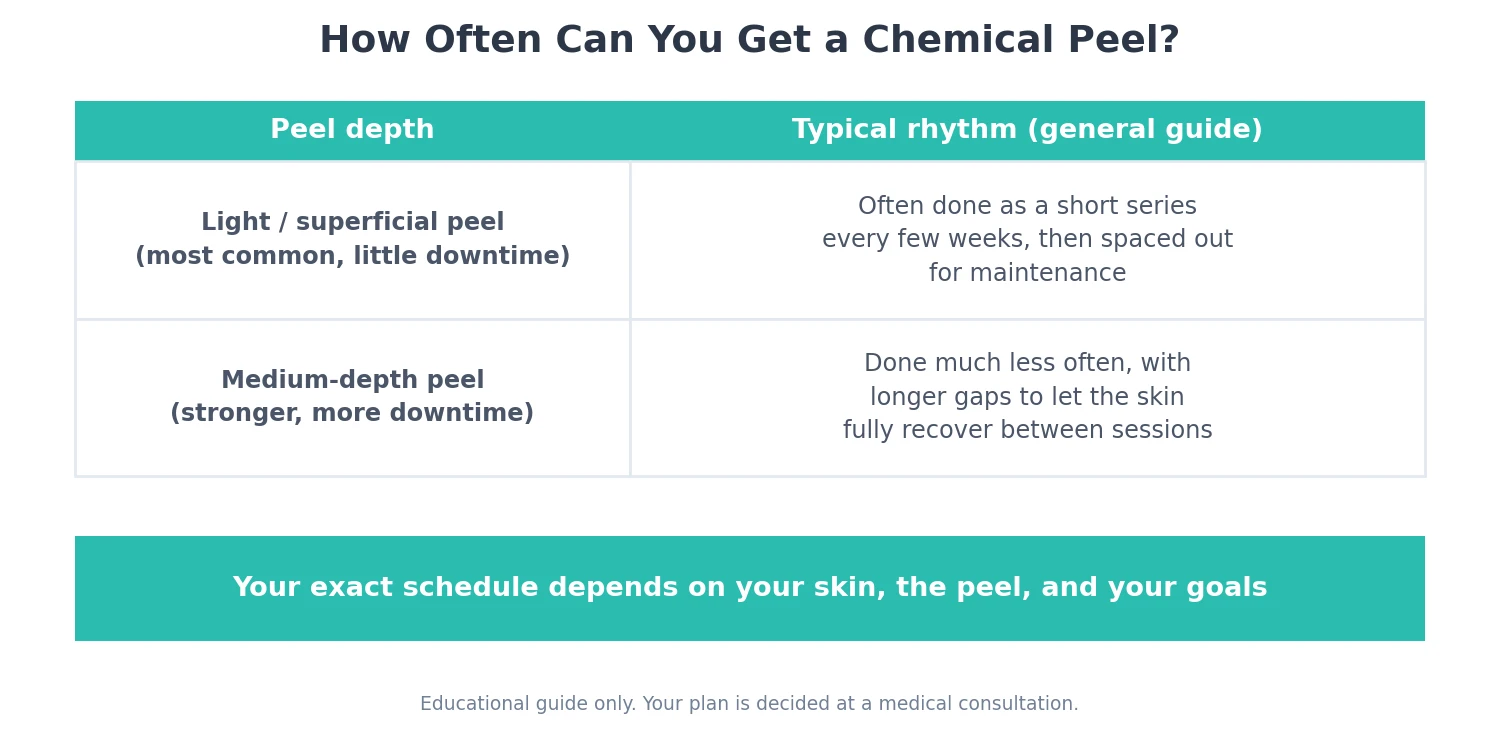
Light peels are the ones most people are asking about, because they are the everyday, keep-your-glow option. They are commonly done as a short course of a few sessions spaced a few weeks apart to build results, then continued at a lighter maintenance pace. The exact spacing lets your skin finish renewing between visits, which is what makes the results add up instead of irritating the skin. For a sense of how a superficial peel refreshes the skin, our guide to how a glycolic acid chemical peel works to rejuvenate your skin and refine tone and texture over time is a helpful read alongside this one.
How Often for a Medium-Depth Peel
Medium-depth peels reach further into the skin, so they do more in a single session but also ask more of your skin to recover. That means they are repeated far less often, with longer gaps between treatments and sometimes only once or a few times a year depending on your goal. Trying to repeat a stronger peel too soon does not speed up results, it just risks irritation and a longer recovery. This is exactly why matching peel depth to a sensible interval matters, a point emphasized in a practical review of peel fundamentals and safe protocols (a practical review of chemical peel fundamentals and a step-by-step protocol for safe treatment).
Why the Right Interval Matters
Your skin has a protective barrier that needs time to rebuild after any peel. Space your peels well and each one builds on the last, giving smoother texture and a brighter tone over time. Crowd them too close together and you can end up with redness, sensitivity, and a compromised barrier, which sets your skin back rather than forward. More is not better here; the right amount, at the right spacing, is better. That is the whole philosophy behind how we plan peels, and it is why we would rather do fewer, well-timed treatments than push your skin faster than it wants to go.
What Changes Your Ideal Frequency
A few things move the dial on how often you should peel. Your skin type and sensitivity matter, as does your goal, since maintaining a glow is different from working on texture or dark marks. The season and sun exposure matter too, which is a real consideration in Miami, where strong year-round sun means diligent sun protection between peels is not optional. Skin tone is important as well: darker and easily pigmented skin can do beautifully with peels, but the type and spacing should be chosen carefully to improve the skin without triggering dark marks, which is one more reason to be assessed in person rather than following a generic schedule.
Peels for a Glow vs Peels for Acne
How often you peel also depends on why you are peeling. If your goal is general radiance and smoother texture, a light peel on a comfortable maintenance rhythm usually does the job. If you are treating active breakouts, the plan and cadence can look a little different, and peels are often one piece of a larger routine rather than the whole answer. Chemical peels have good evidence behind them for acne, especially for comedonal breakouts (a systematic review of randomized trials on chemical peels for acne vulgaris and their effect on lesions). For that use, our dedicated guide to how chemical peels treat acne, which peels suit acne-prone skin, and how they fit into an acne-prone routine is the better starting point.
Building a Safe Peel Schedule at Our Doral Clinic

At your consultation we look at your skin, ask about your goals and history, and recommend a peel depth and spacing that fit you. For most people that means starting with a light peel, seeing how your skin responds, and settling into a comfortable maintenance rhythm from there. We also build in sun protection and simple aftercare, because what you do between peels is as important as the peels themselves. If a stronger peel is appropriate, we plan the longer recovery gaps it needs. The point is a schedule you can keep safely, not the most peels you can squeeze in.
Cost and Financing at Perfect B in Doral
Because the right peel and the number of sessions vary from person to person, cost is quoted at your consultation once we have assessed your skin and mapped out a plan. We would rather give you an honest, personalized estimate for a full course than a single misleading number. If you would like to spread the cost, ask us about financing so your peel plan fits your budget.
- 📍 Visit us at Perfect B, 3905 NW 107th Ave, Suite 104, Doral FL 33178
- 📞 Call or message us at (786) 502-2260
- 💳 Financing available through Cherry, Klarna, Afterpay, and CareCredit
Frequently Asked Questions
How often can you get a light chemical peel?
Light, superficial peels are often done as a short series spaced a few weeks apart to build results, then continued at a lighter maintenance pace. The exact spacing depends on your skin and how it responds, which your provider confirms at a consultation.
How often can you get a medium-depth peel?
Much less often than a light peel. Medium-depth peels are stronger and need longer recovery, so they are repeated with bigger gaps, sometimes only once or a few times a year depending on your goal.
Can you get a chemical peel too often?
Yes. Peeling too frequently can irritate the skin and weaken its protective barrier, causing redness and sensitivity. Correct spacing lets each peel build on the last, which is safer and gives better results than over-peeling.
Is a chemical peel safe for darker skin tones?
It can be, when the peel type and spacing are chosen carefully for your skin. A skin-tone-aware approach improves the skin while lowering the risk of dark marks, which is why an in-person assessment in Doral matters.
How long should I wait between peels?
Long enough for your skin to finish recovering, which is a few weeks for light peels and considerably longer for medium-depth peels. Your provider sets the interval based on the peel and your skin, not a fixed calendar rule.
How much does a chemical peel cost?
Cost depends on the peel and the number of sessions, so it is quoted at your consultation after we assess your skin. Financing is available through Cherry, Klarna, Afterpay, and CareCredit.
If you want a peel plan that fits your skin and your schedule, the team at Perfect B in Doral will assess your skin and set a safe, effective rhythm for you. →