Losing hair on a weight loss medication and want a plan that protects it?
Perfect B’s protocol tool is built on real clinical data from 2,000+ patients treated in South Florida.
Answer 6 questions and see how supervised patients with similar goals are managed: how weight loss is paced, how nutrition is protected, and which supportive treatments a provider may add.
Perfect B, Doral Fl. | 07.16.26 | 11 min read.
This article is for general educational purposes and is not a substitute for an in-person medical evaluation. Hair loss has many causes, and the right approach is confirmed by a licensed provider after evaluating you. Weight management medications are prescribed and supervised by a licensed provider.
Is Ozempic Really Causing Your Hair Loss?
If you started a weight loss medication like Ozempic, Wegovy, Mounjaro, or Zepbound and noticed more hair in your brush a few months later, you are not imagining it, and you are not alone. Hair shedding is one of the most common worries people bring up on GLP-1 medications. The reassuring part is that in most cases it is not the drug itself damaging your hair, it is the rapid weight loss and the changes in nutrition that come with it, and that kind of shedding is usually temporary. Understanding why it happens is the first step to protecting your hair while you reach your goals.
This guide explains why GLP-1 weight loss can trigger shedding, whether it is the medication or the weight loss, the timeline to expect, how to reduce it, what actually helps hair recover, and when to see a provider. If you are still choosing a medication or a provider, our local guide to how to find and vet a supervised semaglutide provider near you in Miami and what to expect is a good place to start.
Key Takeaways
- Hair loss on GLP-1 medications is usually telogen effluvium, a temporary shedding triggered by rapid weight loss and nutritional shifts, not direct damage from the drug.
- Shedding typically starts two to three months after the rapid change, peaks, and then recovers over the following months.
- Losing weight more gradually, protecting protein intake, and covering key nutrients are the most effective ways to reduce it.
- Supportive treatments a provider may consider include nutritional correction and, in some cases, regenerative options for the scalp.
- Persistent or patchy loss, or shedding that does not recover, deserves an evaluation to rule out other causes like thyroid or iron issues.
- A supervised weight management plan is designed to reach your goals at a pace that is easier on your hair.
Why GLP-1 Weight Loss Can Trigger Hair Shedding
The type of shedding people see on weight loss medications is almost always a condition called telogen effluvium. In simple terms, a stressor pushes a larger than normal share of your hair follicles out of their growing phase and into a resting and shedding phase all at once. A few months later, that hair falls out together, which is why it can feel sudden and alarming even though the follicles themselves are healthy.
Rapid weight loss is a classic trigger for exactly this response. When your body loses weight quickly and your calorie and protein intake drop, it prioritizes essential functions over hair growth, and follicles shift into that resting phase. The medication is the tool that made the fast weight loss possible, but the shedding is driven by the speed of the change and the nutritional gap, not by the molecule attacking your hair.
Is It the Medication or the Rapid Weight Loss?
This is the question almost everyone asks, and the distinction matters because it changes what you do about it. The current understanding is that semaglutide and tirzepatide do not directly cause hair loss. In the large clinical trials, hair loss was reported more often at the higher weight-loss doses, and researchers attribute it to the magnitude and speed of weight loss rather than a direct effect of the drug on the follicle.
That is actually good news. It means the shedding is a response you can influence by how the weight loss is managed, and it is the same kind of temporary shedding people experience after other big stressors like surgery, illness, or crash dieting. It also means the answer is not to abandon a medication that is working, but to support your body through the change.
The Shedding Timeline: When It Starts and When It Recovers
Telogen effluvium runs on a fairly predictable schedule, which helps set expectations. The shedding usually does not begin right when you start the medication. Instead it shows up two to three months after the rapid weight loss gets going, builds to a peak, and then settles as your weight and nutrition stabilize.
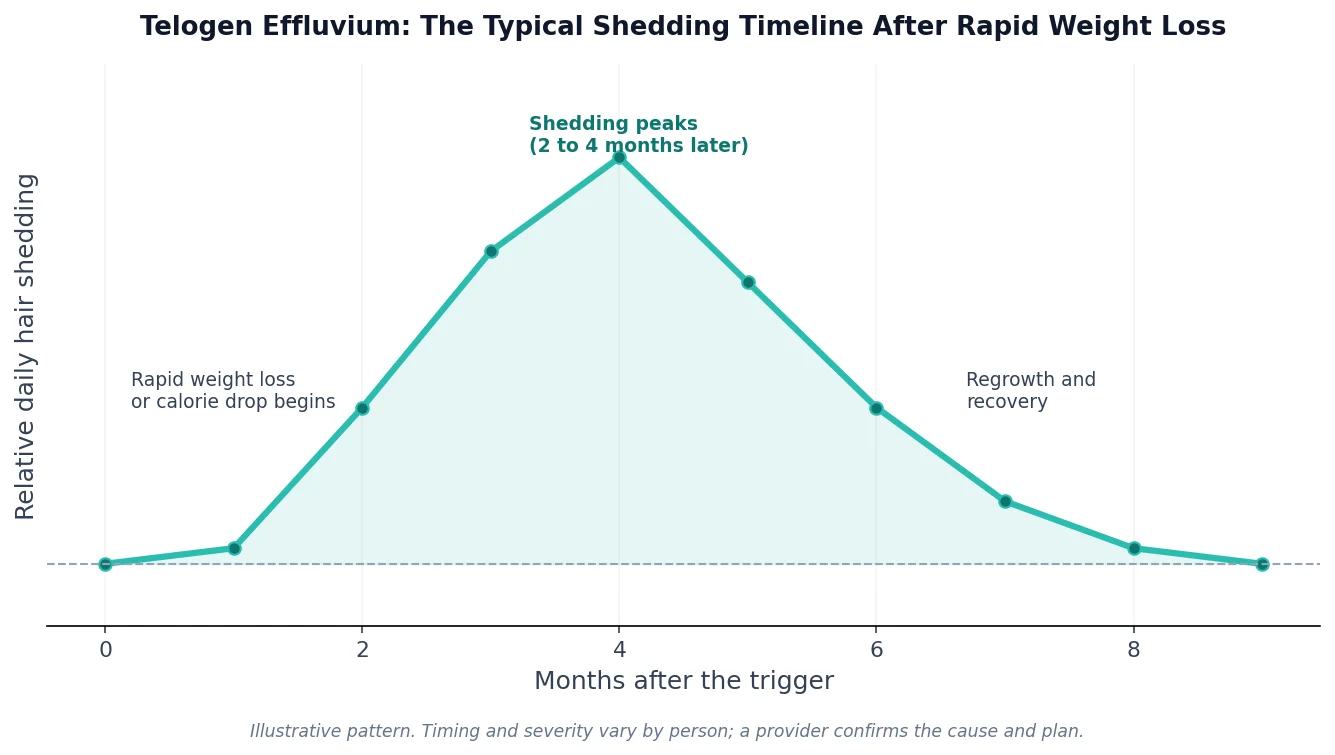
For most people the heavy shedding lasts a few months and then eases, with visible regrowth following over the next several months once the trigger has passed. Because the follicles are not damaged, hair generally grows back. The timeline is individual, and shedding that keeps going well beyond this pattern is a signal to get evaluated rather than to wait it out.
How to Reduce Hair Loss While Using Semaglutide or Tirzepatide
Because the shedding is driven by the pace and the nutritional gap of rapid weight loss, the most effective steps are the ones that soften that shock. None of these require stopping a medication that is working for you.
- Lose weight at a steadier pace: a supervised titration that avoids crash-level calorie drops is easier on your hair than the fastest possible loss.
- Protect your protein: appetite suppression makes it easy to under-eat protein, which hair needs. Prioritizing enough protein daily is one of the highest-impact habits.
- Cover key nutrients: iron, zinc, vitamin D, and B vitamins all matter for hair, and they are easy to fall short on when you are eating much less.
- Be gentle with your hair: avoid tight styles, excessive heat, and harsh treatments while you are shedding, so you are not adding mechanical stress.
- Stay consistent with your provider: check-ins let your plan be adjusted before shedding becomes a bigger worry.
What Actually Helps Hair Recover
Since the follicles are usually healthy, recovery is mostly about removing the trigger and supporting regrowth. The foundation is correcting the nutritional gap and letting your weight stabilize, which on its own resolves most cases over time. From there, a provider can tailor support to your situation.
For patients who want to support the scalp more actively, regenerative options exist. One that comes up often is the copper peptide GHK-Cu, which is studied for its role in hair and scalp health. Our detailed guide explains how the copper peptide GHK-Cu is used to support hair and scalp health and what the research shows. Which supportive treatment, if any, makes sense for you is a decision to make with a provider after your shedding is properly diagnosed, not a one-size recommendation.
When to See a Provider About Hair Shedding
Some shedding during rapid weight loss is expected and self-limited, but certain patterns deserve a professional look rather than patience. See a provider if the shedding is heavy and not easing after several months, if you notice distinct bald patches rather than diffuse thinning, if the hairline is receding in a pattern, or if the loss is accompanied by other symptoms like fatigue that could point to a thyroid or iron problem.

An evaluation matters because not all hair loss is telogen effluvium, and treating the wrong cause wastes time. A provider can confirm what is happening, check for contributing factors, and build a plan that fits. If your concern is broader than medication-related shedding, our overview of the common causes of hair loss in women and the supervised treatment options available in Miami covers the wider picture.
Ozempic Hair Loss vs Other Causes of Hair Loss
It is worth separating medication-related shedding from other kinds of hair loss, because they look and behave differently. Telogen effluvium from rapid weight loss is diffuse, meaning it thins fairly evenly across the scalp, and it is temporary. Pattern hair loss, by contrast, follows a genetic, gradual pattern and does not simply recover on its own. Patchy, well-defined loss can point to other conditions entirely.
This is also different from the facial volume changes people call Ozempic face, which are about fat loss in the face rather than the hair. If that is part of what you are noticing, our guide on how to prevent and manage facial volume loss while using weight loss injections like semaglutide and tirzepatide addresses it directly. Getting the cause right is what makes the plan work, which is the whole reason an evaluation comes first.
Frequently Asked Questions
1. Does Ozempic directly cause hair loss?
The current understanding is no, not directly. The shedding people see is telogen effluvium triggered by rapid weight loss and nutritional changes, not the medication damaging the follicle. In trials it was reported more at higher weight-loss doses, which points to the speed of weight loss as the driver. That is why it is usually temporary.
2. When does hair loss start on GLP-1 medications?
It usually begins two to three months after the rapid weight loss gets going, not the day you start the medication. It then builds to a peak and eases as your weight and nutrition stabilize. This delay is a normal feature of telogen effluvium and is one of the clues that rapid change, not the drug itself, is the trigger.
3. Will my hair grow back?
In most cases yes. Because telogen effluvium does not damage the follicles, hair generally regrows once the trigger passes and your body stabilizes, with regrowth following over the months after the shedding peaks. Recovery is individual, and loss that does not improve should be evaluated to rule out another cause.
4. Should I stop my weight loss medication if my hair is shedding?
Not on your own. The shedding is usually temporary and tied to the pace of weight loss, so the better approach is to talk to your provider about pacing, protein, and nutrients rather than abruptly stopping a medication that is working. Any change to your plan should be a decision you make together.
5. How can I prevent hair loss on semaglutide or tirzepatide?
Lose weight at a steadier, supervised pace, prioritize enough protein daily, cover key nutrients like iron, zinc, vitamin D, and B vitamins, and be gentle with your hair while you are shedding. These steps address the actual driver, which is the shock of rapid loss and the nutritional gap, rather than the medication.
6. Do hair supplements or treatments help?
Correcting a real nutritional gap helps, and letting your weight stabilize is the foundation. Beyond that, a provider may consider supportive options for the scalp, such as the copper peptide GHK-Cu, based on your situation. What is appropriate depends on a proper diagnosis, so it is best decided with a provider rather than self-prescribed.
7. Is Ozempic hair loss the same as Ozempic face?
No. Ozempic hair loss is shedding from the scalp driven by rapid weight loss, while Ozempic face refers to facial volume loss from losing fat in the face. They are separate effects of fast weight loss and are managed differently, though both are reasons to lose weight at a steadier, supervised pace.
8. When should I see a provider about hair loss?
See a provider if the shedding is heavy and not easing after several months, if you see distinct bald patches rather than even thinning, if your hairline is receding in a pattern, or if there are other symptoms like fatigue. These can point to causes beyond telogen effluvium, such as thyroid or iron issues, that need their own treatment.
Protect Your Hair While You Reach Your Goals, in Doral
Hair shedding on a weight loss medication is common, usually temporary, and very manageable when your plan is built with it in mind. The goal is not to choose between losing weight and keeping your hair, it is to lose weight at a pace and with the nutritional support that protects both.
If you are worried about shedding, or you want a weight management plan designed to be gentle on your hair from the start, the providers at Perfect B in Doral will evaluate you, confirm what is driving the shedding, and build a supervised plan around your goals.
- 📍 Visit us at Perfect B, 3905 NW 107th Ave, Suite 104, Doral FL 33178
- 📞 Call or message us at (786) 502-2260
- 💳 Financing available through Cherry, Klarna, Afterpay, and CareCredit