Want a weight loss plan that manages side effects instead of leaving you to tough them out?
Perfect B’s protocol tool is built on real clinical data from 2,000+ patients treated in South Florida.
Answer 6 questions and see how supervised patients with similar goals are managed: how doses are stepped up, how nausea is minimized, and when a plan is adjusted or paused.
Perfect B, Doral Fl. | 07.16.26 | 12 min read.
This article is for general educational purposes and is not a substitute for an in-person medical evaluation. Ozempic, Wegovy, Mounjaro, and Zepbound are prescription medications, and their side effects should be managed with the licensed provider who prescribes and supervises your treatment. Seek medical care for severe or concerning symptoms.
What Side Effects to Expect on Ozempic and Other GLP-1 Medications
If you are starting or considering a GLP-1 medication like Ozempic, Wegovy, Mounjaro, or Zepbound, knowing the side effects up front makes the whole experience easier. The good news is that most side effects are digestive, mild to moderate, and temporary, and the large majority of people can manage them with a few simple adjustments and a careful, gradual dose increase. Understanding what is normal, what helps, and what is a genuine warning sign is the difference between white-knuckling it and moving through the adjustment period comfortably.

This guide covers the common side effects, why they happen, how long they last, how to manage nausea and digestive symptoms, the serious warning signs to watch for, and how medical supervision keeps side effects to a minimum. If you are still choosing where to start, our local guide to how to find and vet a supervised semaglutide provider near you in Miami and what to expect pairs well with this one.
Key Takeaways
- The most common GLP-1 side effects are digestive: nausea, diarrhea, constipation, vomiting, and reflux, and they are usually mild to moderate.
- They happen mostly because these medications slow how fast your stomach empties, and they tend to ease as your body adjusts.
- Side effects are usually worst right after starting and after each dose increase, then settle within days to weeks.
- Smaller, slower meals, good hydration, limiting greasy and heavy foods, and gentle movement handle most symptoms.
- A slow, supervised dose increase is the single most effective way to reduce side effects.
- Severe abdominal pain, persistent vomiting, signs of dehydration, or an allergic reaction are reasons to seek medical care promptly.
The Most Common GLP-1 Side Effects
The overwhelming majority of GLP-1 side effects are gastrointestinal, and they show up more often as the dose goes up. Nausea is the most common by far, followed by diarrhea, constipation, vomiting, and acid reflux. Many people also notice reduced appetite, which is part of how the medication works rather than a problem to fix.
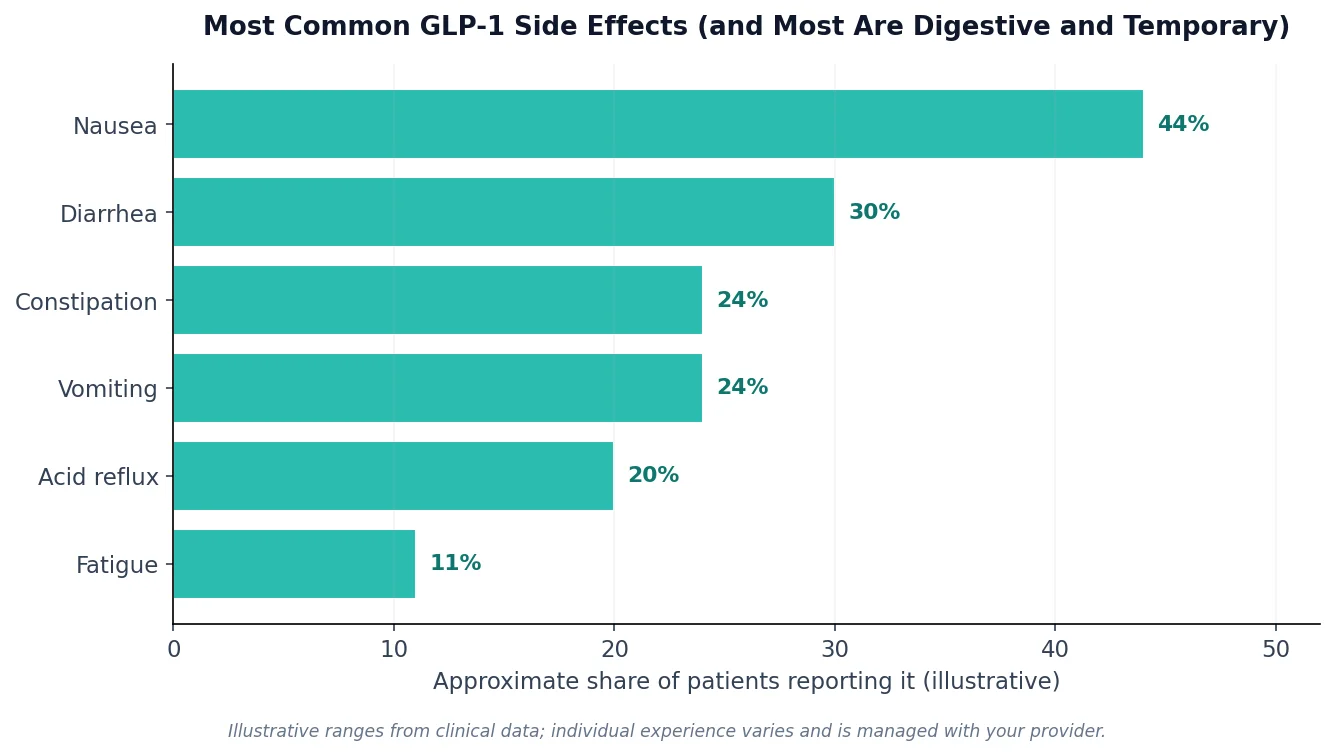
The figures above are illustrative ranges from clinical data, not a promise of what you personally will feel. Some people breeze through with barely a symptom, while others need a slower titration. What matters is that these effects are well understood and, for most patients, very manageable.
Why GLP-1 Medications Cause These Side Effects
Almost all of the common side effects trace back to one mechanism: GLP-1 medications slow down how quickly your stomach empties. That delayed gastric emptying is part of what keeps you feeling full and eating less, but it also means food sits in your stomach longer, which can cause nausea, fullness, reflux, and changes in your bowel habits. It is a predictable effect of how the medication works, not a sign that something is wrong.
Because the effect is dose-dependent, symptoms are strongest when your body is adjusting to a new, higher dose, and they fade as it adapts. This is exactly why the dose is raised slowly rather than started high, and why pushing the dose up too fast is the most common reason people feel miserable on these medications.
How Long Do Side Effects Last?
For most people, side effects are worst in the first days after starting and again for a few days after each dose increase, then they settle. Nausea in particular tends to be front-loaded and improve within a week or two at a given dose as your stomach adapts. By the time you reach a stable maintenance dose, many people have few or no ongoing symptoms.
If side effects are not easing, or they get worse rather than better over time, that is a reason to check in with your provider rather than simply enduring it. Often the fix is as simple as holding at your current dose a little longer before stepping up, which a supervised plan can do easily.
How to Manage Nausea and Digestive Side Effects
Most day-to-day side effects respond well to simple habits, and none of these require stopping a medication that is working. The theme is to work with the slower stomach emptying rather than against it.

- Eat smaller, slower meals: large portions overwhelm a stomach that is already emptying slowly. Stop when you feel full, not stuffed.
- Go easy on greasy, fried, and very rich foods: these are the biggest nausea triggers. Blander, lower-fat meals sit better.
- Stay hydrated: sip water through the day, which also helps with the constipation many people notice.
- Use gentle movement: a short walk after eating can ease fullness and nausea.
- Prioritize fiber and protein: they help with both bowel regularity and holding on to muscle while you lose weight.
- Talk to your provider about timing and pace: adjusting when you inject or slowing the titration often solves stubborn nausea.
Serious Side Effects and Warning Signs
Serious side effects are uncommon, but you should know them so you can act quickly if they happen. These are not the everyday nausea and fullness, they are symptoms that warrant prompt medical attention rather than home management.
- Signs of pancreatitis: severe, persistent abdominal pain, often radiating to the back, sometimes with vomiting. This needs urgent evaluation.
- Gallbladder problems: pain in the upper right abdomen, fever, or yellowing of the skin or eyes.
- Dehydration: from persistent vomiting or diarrhea, which can also affect the kidneys and needs to be addressed.
- Allergic reaction: rash, swelling, or trouble breathing calls for emergency care.
- Persistent vomiting or inability to keep fluids down: a reason to contact your provider rather than pushing through.
These medications also carry a boxed warning about a risk of thyroid tumors seen in animal studies, which is why they are avoided in people with a personal or family history of medullary thyroid carcinoma or MEN 2. A provider screens for this before prescribing, which is one more reason supervision matters.
How Medical Supervision Reduces Side Effects
The single biggest factor in how you tolerate a GLP-1 medication is how the dose is managed, and that is exactly what supervision handles. A provider starts you low, steps you up only when you are ready, and holds or slows the titration if side effects flare. That flexibility is the difference between a smooth adjustment and the rough ride people describe when they push the dose too fast on their own.

Supervision also means someone is watching for the warning signs, screening you before you start, and adjusting the plan around your life. This is a core reason buying these medications from a no-evaluation online seller is risky: you get the drug without the part that actually keeps you comfortable and safe. For the fuller picture of what a supervised plan looks like month to month, see our walkthrough of what your first month on a medically supervised weight management protocol actually involves in Miami.
Side Effects of Semaglutide vs Tirzepatide
Semaglutide, the medication in Ozempic and Wegovy, and tirzepatide, the medication in Mounjaro and Zepbound, share the same general side effect profile because both work on the GLP-1 pathway and both slow gastric emptying. Nausea and digestive symptoms are the common thread for each. Individual tolerance varies, and some people find one easier than the other, which is part of why the choice is personalized.
Beyond digestive effects, some patients ask about hair shedding and facial volume changes during rapid weight loss, which are tied to the speed of weight loss rather than the drug directly. We cover those separately in our guides on why GLP-1 weight loss can cause temporary hair shedding and what actually helps it recover and on choosing between the two medications in our detailed comparison of semaglutide and tirzepatide for medically supervised weight loss in Miami.
Frequently Asked Questions
1. What are the most common side effects of Ozempic?
The most common side effects are digestive: nausea, diarrhea, constipation, vomiting, and acid reflux, with nausea being the most frequent. They are usually mild to moderate, show up more as the dose increases, and tend to ease as your body adjusts. Reduced appetite is expected and is part of how the medication works.
2. Why does Ozempic make you feel nauseous?
Because it slows how quickly your stomach empties. Food stays in your stomach longer, which helps you feel full and eat less but can also cause nausea, fullness, and reflux. Since the effect is dose-dependent, nausea is strongest when adjusting to a higher dose and usually improves within a week or two at that dose.
3. How long do GLP-1 side effects last?
They are usually worst in the first days after starting and after each dose increase, then settle within days to a couple of weeks at a given dose. By the time you reach a stable maintenance dose, many people have few ongoing symptoms. Side effects that keep worsening are a reason to check in with your provider.
4. How can I stop nausea from Ozempic?
Eat smaller, slower meals, avoid greasy and heavy foods, stay hydrated, and try a gentle walk after eating. Stopping when you feel full rather than stuffed helps a lot. If nausea is stubborn, your provider can adjust the timing or slow the dose increase, which is usually the most effective fix.
5. When are GLP-1 side effects a medical emergency?
Seek prompt care for severe, persistent abdominal pain that may radiate to the back, signs of a gallbladder problem, dehydration from ongoing vomiting or diarrhea, or an allergic reaction with swelling or trouble breathing. These are uncommon but need medical attention rather than home management.
6. Do semaglutide and tirzepatide have different side effects?
They share a very similar profile because both act on the GLP-1 pathway and slow gastric emptying, so digestive symptoms are common to both. Individual tolerance varies, and some people find one easier than the other. That personal response is one of the reasons the choice of medication is made with a provider.
7. Will side effects go away if I lower the dose?
Often yes. Because side effects are dose-dependent, holding at your current dose longer or stepping back to a lower one usually reduces them, then you increase again more slowly. This is a common, effective adjustment, but it should be done with your provider rather than on your own so your plan stays on track.
8. Is it safe to manage side effects on my own from an online prescription?
The medication is only part of the picture. The screening, the gradual titration, and a provider who adjusts your plan and watches for warning signs are what keep side effects manageable and safe. A no-evaluation online source skips exactly those safeguards, which is why supervised care is the safer route.
Manage GLP-1 Side Effects With a Supervised Plan in Doral
Side effects should not be the reason a weight loss medication fails you. With a careful, gradual, supervised plan and a few simple habits, most people move through the adjustment period comfortably and stay on track toward their goals. The key is having a provider who paces your dose and manages symptoms with you.
If you want a weight management plan designed to keep side effects to a minimum, the providers at Perfect B in Doral will evaluate you, start you safely, and adjust your plan as your body responds.
- 📍 Visit us at Perfect B, 3905 NW 107th Ave, Suite 104, Doral FL 33178
- 📞 Call or message us at (786) 502-2260
- 💳 Financing available through Cherry, Klarna, Afterpay, and CareCredit