
Perfect B, Doral Fl. | 06.02.26 | 8 min read.
This content is for educational purposes only and is not a substitute for professional medical advice. Consult a licensed provider before beginning any injectable treatment. For more on this, see our guide to Tech Neck and Neck Lines: How PDRN Treats the Skin, and how it is evaluated and treated at Perfect B in Doral.
Why the Perioral Zone Ages Faster Than the Rest of Your Face
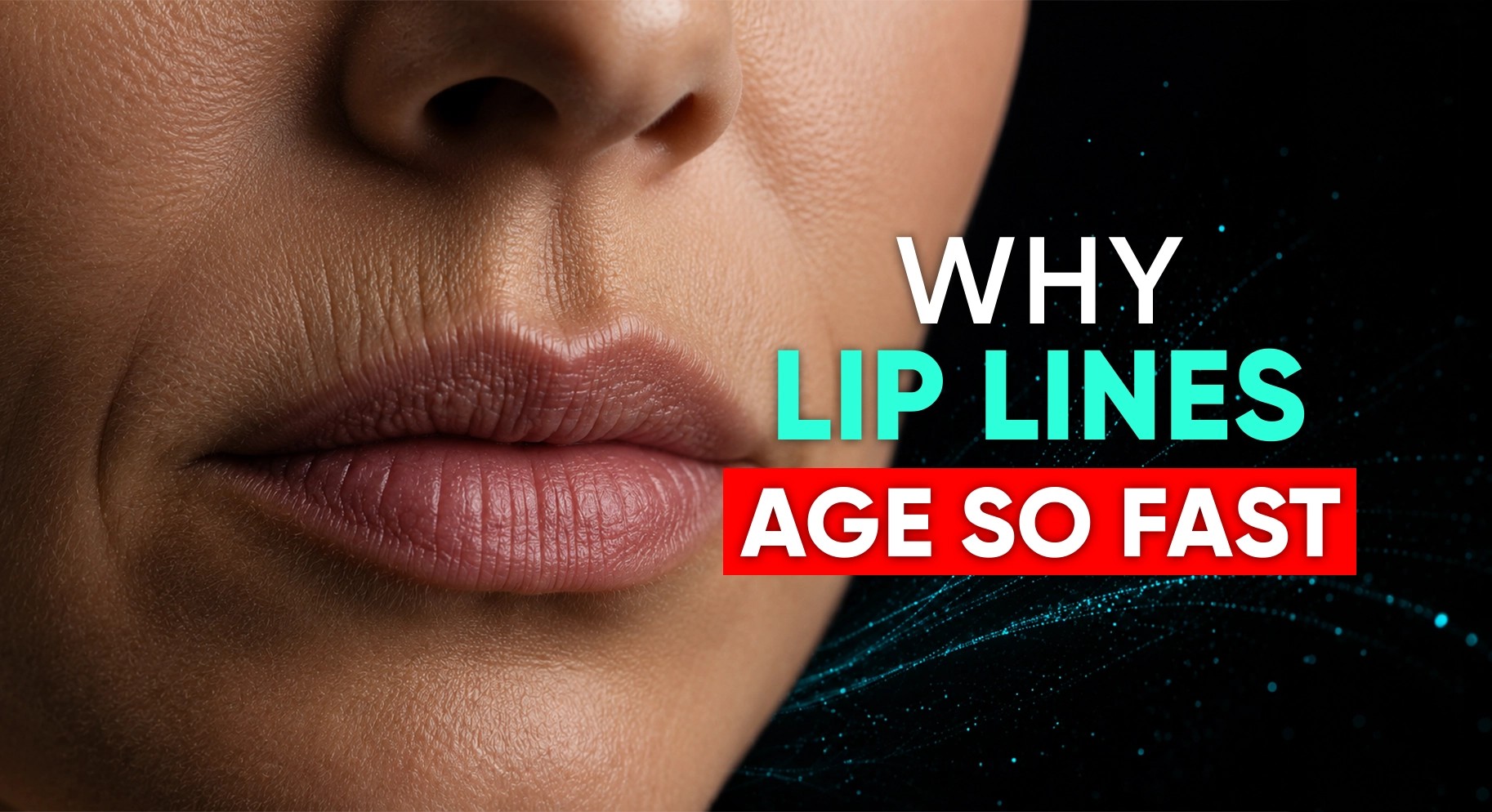
Most facial muscles attach to bone on one end and skin on the other. The orbicularis oris, the circular muscle that surrounds your mouth, is different: it attaches directly to the skin itself, without a bone anchor. Every time you speak, smile, eat, pucker, or sip through a straw, this muscle contracts and pulls on the overlying skin. Across a lifetime of millions of contractions, this repeated mechanical tension gradually weakens the collagen and elastin fibers in the dermis, creating the vertical lines above the upper lip that patients call lip lines, smoker’s lines, or barcode lines. If you are exploring this, it helps to see how PDRN therapy supports skin quality and healing at Perfect B in Doral within a broader regenerative plan.
Compounding this mechanical wear, the perioral skin is thin and has less subcutaneous fat padding than the cheeks or forehead. Lines that would stay hidden elsewhere become visible here earlier. In South Florida, where ultraviolet exposure is year-round, the process accelerates: UV radiation degrades collagen through a separate pathway entirely, piling extrinsic damage on top of the intrinsic muscle-driven breakdown. The result is that most patients in Doral and Miami see perioral changes a decade before they expected them.
Key Takeaways
- Lip lines form where the orbicularis oris attaches directly to skin, creating constant mechanical tension that breaks down the perioral dermal matrix over time.
- PDRN addresses the structural cause of perioral lines by stimulating fibroblasts to produce new collagen and elastin via the adenosine A2A receptor pathway.
- Botox relaxes the muscle, filler adds volume, but neither rebuilds the dermal scaffold the way PDRN does. All three target different aspects of the same problem.
- Most patients see visible improvement in perioral skin texture and fine line reduction after 2 to 3 sessions, with optimal results by session 4 to 6 spaced 4 weeks apart.
- PDRN can be combined with Botox or filler for patients with both dynamic muscle activity and structural collagen loss in the perioral zone.
Lip Lines, Smoker’s Lines, and Perioral Wrinkles: Clarifying the Terminology
These terms are often used interchangeably, and they refer to the same anatomical feature: vertical wrinkles that run perpendicular to the lip border, extending upward from the upper lip toward the nose or downward from the lower lip toward the chin. Healthcare providers use the clinical term perioral rhytids or perioral wrinkles. Patients and practitioners colloquially call them smoker’s lines, lip lines, or barcode lines.
The smoker’s lines label is misleading because non-smokers develop them too, and sometimes more severely than light smokers. The underlying driver is the repetitive orbicularis oris movement, not smoking specifically. Smoking accelerates the process through nicotine-induced vasoconstriction and direct oxidative damage from tobacco smoke, but the lines will develop regardless.
Lip lines are not the same as nasolabial folds, which run from the nose to the corners of the mouth, or marionette lines, which run from the mouth corners toward the chin. Each of these wrinkle types has a distinct anatomical cause and responds differently to treatment. The approaches in this guide address specifically the perioral zone: the skin directly above and below the lips.
How PDRN Works on Perioral Skin: The Biostimulation Mechanism
PDRN stands for polydeoxyribonucleotides, long-chain DNA fragments derived from salmon sperm cells. When injected into the dermis, PDRN is broken down by tissue nucleases into nucleotides. Those nucleotides bind to adenosine A2A receptors on dermal fibroblasts, the cells responsible for producing collagen and elastin. Activating this receptor pathway triggers a cascade of regenerative events: reduced inflammatory cytokines, increased fibroblast proliferation, upregulated collagen type I and III synthesis, elastin production, and angiogenesis.
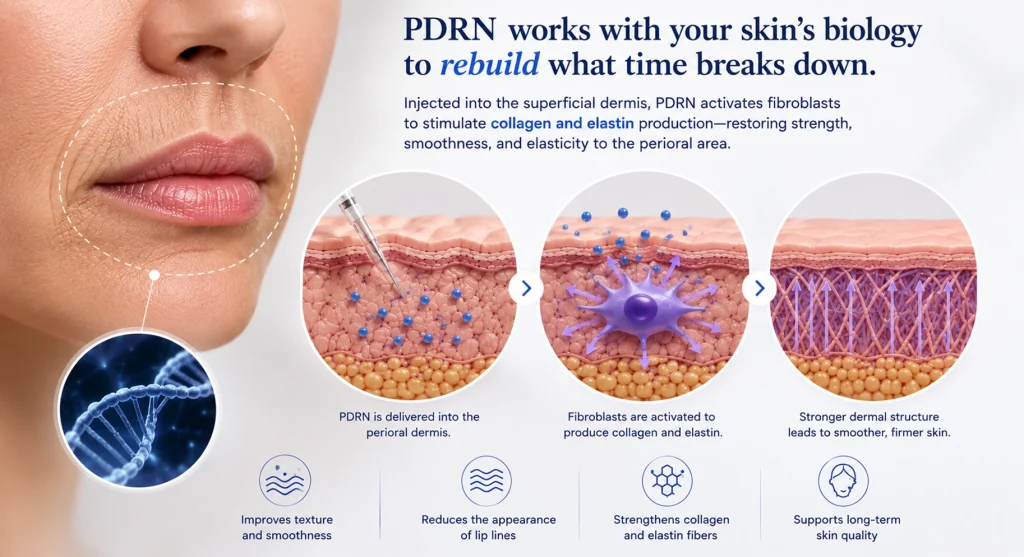
A 2025 peer-reviewed review bridging PDRN and polynucleotide science documents that nucleotides released during PDRN degradation bind A2A fibroblast receptors, stimulating collagen, elastin, and fibronectin production through both the ECM maturation pathway and the cellular salvage pathway. This dual mechanism explains why PDRN produces results that accumulate over sessions: the structural improvements are built by the body’s own cells, not by an external material.
The critical distinction from Botox and filler is that PDRN adds no foreign material to the tissue in a volumizing sense, and it does not interrupt any nerve or muscle signal. It works entirely by giving fibroblasts the molecular signals they need to rebuild what has been lost. For the perioral zone, where the problem is structural dermal thinning rather than excess muscle activity or volume deficit, this mechanism is directly relevant.
→ See how Perfect B uses PDRN for skin rejuvenation and what the full treatment plan involves.
PDRN vs. Botox for Lip Lines: Two Different Mechanisms, Two Different Outcomes
Botox and PDRN are not competitors for the same problem. They address different layers of what causes lip lines, which is why they are often most effective when used together rather than chosen between.
Botox works by blocking acetylcholine release at the neuromuscular junction, temporarily preventing the orbicularis oris from contracting fully. The result is a reduction in the muscle-generated creasing that creates dynamic wrinkles: lines visible when the face is in motion. In skilled hands, a few units of Botox placed with precision around the upper lip softens active lip lines without affecting normal speech or eating. The effect lasts approximately 3 to 4 months before the nerve signals recover.
Botox’s limitation for perioral wrinkles is that it treats the muscular component, not the structural one. If the dermal collagen matrix has already thinned and the lines are present even at rest, relaxing the muscle reduces new crease formation but does not repair the existing structural deficit. This is where PDRN becomes relevant: it rebuilds the dermal scaffold that years of mechanical tension have depleted.
For patients whose lip lines are primarily dynamic (visible mainly when speaking or pursing), Botox alone may be sufficient. For patients with static lines visible even at rest, or those who notice thinning of the perioral skin as a whole, PDRN addresses the structural element that Botox cannot. Our post on Botox lip flip and how neurotoxin placement around the mouth affects the upper lip border covers the Botox approach in detail.
PDRN vs. Filler for Perioral Wrinkles: Volume vs. Structural Repair
Hyaluronic acid fillers add volume that lifts the skin and softens the shadow created by a line. For perioral wrinkles, filler can be effective but requires precise placement: the perioral area is technically demanding because filler migration or overplacement creates an unnatural result.
Filler adds immediate, visible volume. PDRN adds no volume but improves the quality, thickness, and elasticity of the skin itself. For patients whose primary concern is deep, volume-depleted creases, filler often produces faster visible correction. For patients whose primary concern is skin thinning, texture, and fine lines rather than deep creases, PDRN is frequently the better option because it targets skin quality directly without any risk of unnatural volume.
At Perfect B, we see patients who have had perioral filler placed elsewhere and experienced migration or puffiness, and who are now looking for improvement without more volume. PDRN is often the appropriate choice in those cases. For patients interested in both volume and structural improvement, our lip enhancement treatment plan outlines how PDRN can be staged alongside lip filler to address both the structural and volumetric components of perioral aging.
What the PDRN Treatment Around the Lips Actually Involves
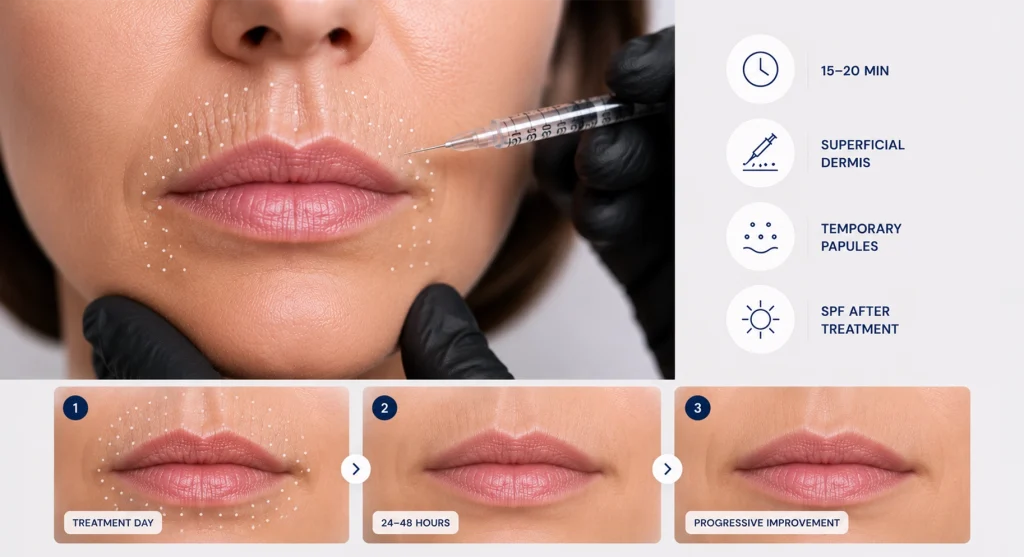
A PDRN session for the perioral zone at Perfect B begins with topical anesthetic applied approximately 30 minutes before injection. The treatment takes 15 to 20 minutes. Using a fine needle, the provider places multiple small injections at points along the upper lip border, the philtrum and upper perioral skin, and if needed the lower perioral zone. The injection depth is superficial, targeting the dermis directly rather than deeper fat layers.
Immediately after the session, patients typically see small papules at each injection point. These are normal and resolve within 24 to 48 hours. The area may be slightly pink or tender for the first day. We advise patients to avoid strenuous exercise, alcohol, and excessive sun exposure for 24 hours, and to use SPF 30 or higher in the treated area starting the morning after treatment.
Because the perioral skin is the most visible zone of the face and any swelling or marking will be noticeable, most patients at our Doral clinic prefer to schedule sessions on a Thursday or Friday to allow the weekend for the papules to resolve before returning to work or social engagements.
How Many Sessions and What Results Can You Expect
PDRN results are cumulative. The biostimulation cascade triggered by each session builds on the previous one, with the most significant collagen remodeling occurring in the weeks following the injection rather than immediately after.
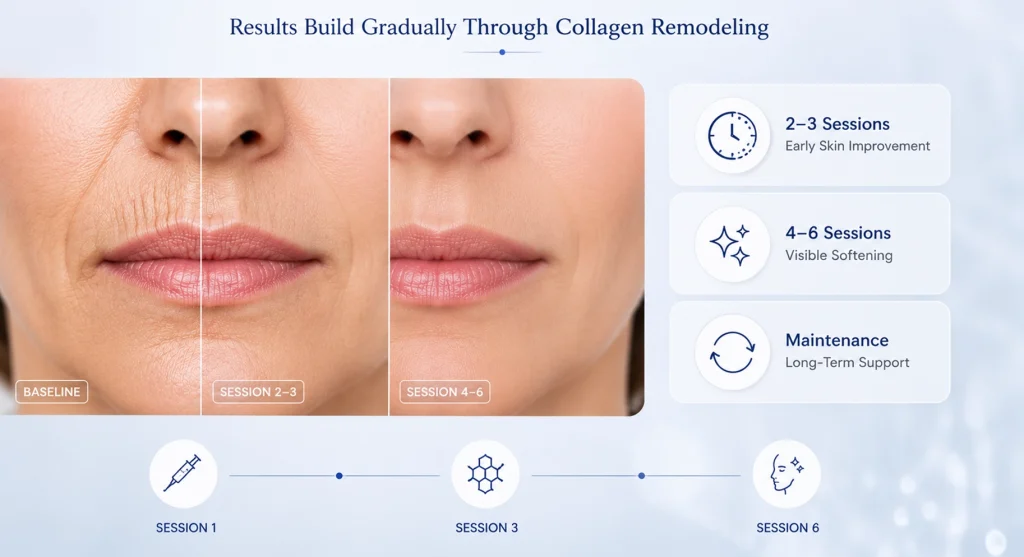
- Sessions 1 and 2: Patients typically notice improved skin hydration and a subtle softening of fine lines. The skin around the mouth looks fresher and more uniform in texture.
- Sessions 3 and 4: Visible reduction in fine lines above the lip. Skin feels firmer. The perioral zone has improved density compared to the start of treatment.
- Maintenance (sessions 5 and beyond): One to two sessions per year after the initial series sustains the structural improvement. Results fade more gradually than Botox and do not abruptly disappear.
A 2023 open-access study on PDRN’s effects on skin keratinocytes and fibroblasts confirms that PDRN promotes skin regeneration by modulating the ERK signaling pathway, supporting collagen accumulation and reducing inflammatory cytokines in dermal fibroblasts. This cellular mechanism supports the clinical observation of gradual, cumulative improvement across multiple sessions.
What Patients at Our Doral Clinic See After Perioral PDRN Treatment
At Perfect B, the patients who see the most satisfying results from PDRN for lip lines tend to share a few common characteristics: they have fine to moderate perioral lines, their primary concern is skin quality rather than volume, and they are committed to the full initial series of sessions rather than expecting a single-treatment result.
The improvement we see most consistently is in the overall quality and texture of the perioral skin. The fine vertical lines above the upper lip become less etched. The skin feels less thin and crepey. The philtrum area regains some of the density it loses with age. Patients who wear lipstick report that feathering into the lip lines is noticeably reduced after the third session.
Patients who smoke respond more slowly and tend to need additional sessions. Nicotine vasoconstriction partially offsets the angiogenesis that PDRN relies on. Reducing or eliminating tobacco use during the treatment series produces markedly better outcomes. We also emphasize mineral-based SPF 30 or higher every morning, as the South Florida sun continues to break down collagen between sessions if the skin is not protected.
Who Is a Good Candidate for PDRN Around the Lips
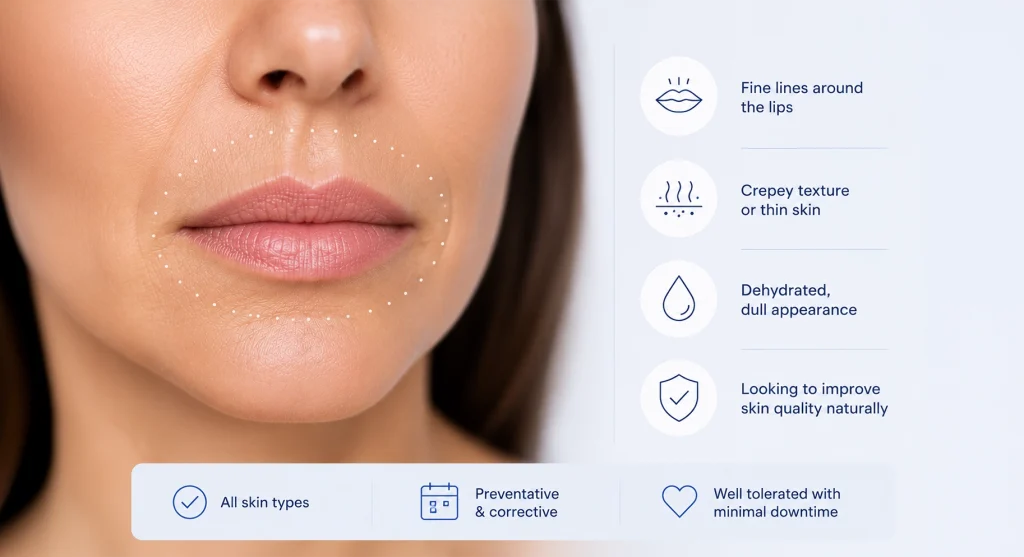
- Fine to moderate static lip lines visible at rest that have not responded to topical skincare alone.
- Patients wanting structural skin improvement without volume addition, particularly those who have previously experienced filler migration in the perioral area.
- Patients in their 40s to 60s noticing loss of skin quality around the mouth: thinning, dullness, or increased texture.
- Patients already doing Botox for the lip area who want to address the underlying structural component that Botox alone does not resolve.
- Fitzpatrick III-VI patients, common in the South Florida Hispanic and Latin American population, seeking collagen stimulation with minimal pigmentation risk.
PDRN is not the ideal first approach for deep creases with significant structural depth that have been present for decades. Those cases benefit more from filler for immediate structural support, often combined with PDRN as a skin-quality complement. The best approach is determined at consultation, where we review the full range of PDRN applications at Perfect B and how the treatment is adapted for different facial zones and patient profiles.
Frequently Asked Questions
1. What exactly are PDRN injections for lip lines?
PDRN injections deliver polydeoxyribonucleotide fragments into the dermis around the mouth. These fragments activate A2A receptors on fibroblasts, triggering the cell’s own collagen and elastin production. The treatment rebuilds the structural matrix of the perioral skin from within, rather than adding a foreign substance for volume.
2. Does PDRN hurt more around the lips than on other areas of the face?
The perioral zone has more nerve density than areas like the cheeks, so patients describe more sensitivity here. Topical anesthetic is applied beforehand and reduces discomfort significantly. Most patients tolerate the session without issue; a small number prefer a dental nerve block for the upper lip area, which we can arrange.
3. How soon do PDRN results appear for perioral wrinkles?
Initial improvement in skin hydration and texture is often noticeable by session 2, at the 4 to 6 week mark. More visible reduction in fine lines above the lip generally appears after session 3. Full cumulative results are seen at the end of the initial series, around the 3 to 4 month mark.
4. Can PDRN be combined with Botox for lip lines?
Yes, and the combination is often more effective than either alone. Botox addresses the muscular component by reducing dynamic creasing. PDRN addresses the structural component by rebuilding the dermal collagen matrix. The two mechanisms complement each other without interference. We typically sequence them 2 weeks apart in the same treatment cycle.
5. Is PDRN safe around the mouth?
PDRN has a well-established safety profile in dermatology. Because no cross-linked or volumizing materials are used, the risk of migration or prolonged distortion is minimal. The most common reactions are localized redness, small papules at injection sites, and mild tenderness, all resolving within 24 to 72 hours when the procedure is performed by a trained provider.
6. What is the difference between PDRN and hyaluronic acid fillers for perioral lines?
Hyaluronic acid fillers add immediate volume that physically fills the line from below. PDRN adds no volume but improves the quality, thickness, and elasticity of the skin itself over a series of sessions. Filler works faster but carries a risk of migration in the perioral zone. PDRN works more gradually but builds structural improvement without volumizing.
7. How long do PDRN results last for lip lines?
After completing the initial series of 4 to 6 sessions, the structural improvement in perioral skin quality lasts approximately 9 to 12 months before a maintenance session is recommended. Unlike Botox, which reverts sharply when the neurotoxin wears off, PDRN results fade more gradually because the collagen and elastin rebuilt are real tissue structures.
8. Do smoker’s lines respond differently to PDRN than other lip lines?
They respond, but more slowly. Nicotine vasoconstriction reduces the local blood flow that PDRN’s angiogenesis pathway relies on, and ongoing tobacco use continues to break down collagen between sessions. Patients who smoke during treatment tend to need 2 to 3 additional sessions for equivalent results. Reducing tobacco use during the treatment series is the most effective way to improve outcomes for this group.
The Clinical Bottom Line on Perioral PDRN Treatment
Lip lines form where the perioral muscle meets the skin and where collagen has been worn down by years of movement and sun exposure. Topical creams address the surface. Botox addresses the muscle. Filler addresses the volume. PDRN addresses the structural deficit that underlies all of it: the thinning of the dermal matrix itself. For many patients in Doral and across South Florida, it fills the gap between what they can accomplish at home and what they want to achieve clinically, without the volumizing risks or the quarterly maintenance cycle of other injectable options.
If you are dealing with fine lip lines, upper lip skin thinning, or perioral wrinkles that have not responded to other approaches, the next step is a consultation. Call or text us at (786) 502-2260 or use the link below to see the full treatment plan and pricing at Perfect B.
- 📍 Visit us at Perfect B, Doral FL, serving Miami and South Florida patients seeking perioral skin rejuvenation.
- 📞 Call or message us at (786) 502-2260 to schedule your PDRN lip lines consultation with a licensed medical provider.
→ See the full PDRN skin rejuvenation treatment plan and what to expect at Perfect B in Doral, FL.