Perfect B, Doral Fl. | 06.11.26 | 11 min read.
This article is for educational purposes only and is not a substitute for medical advice, diagnosis, or treatment. BPC-157 and TB-500 must be prescribed and supervised by a licensed medical provider after a clinical evaluation.
Peptides for Joint Pain: What Actually Helps and What Is Hype
If you are researching peptides for joint pain, you have probably run into two extremes: forums treating BPC-157 like a miracle cure, and skeptics who dismiss the whole category. The honest answer sits in between. A small group of peptides has a genuinely interesting mechanism for supporting joint, tendon, and ligament recovery, but the result you get depends far less on the molecule and far more on the source, the dose, and the provider behind it. At our clinic in Doral, we treat peptides for joint pain as prescribed, supervised protocols, not products you buy off a website.
This guide explains what peptides for joint pain actually involve when the work is done correctly inside a medical clinic: which peptides matter, how they work, who is a candidate, how long they take, what we monitor, whether they are legal, and what they cost in Miami. Everything here reflects how we run these protocols at Perfect B.
Key Takeaways
- Two peptides do the heavy lifting: BPC-157 works locally at an injured tendon or ligament, and TB-500 works systemically across the body. Together they form our most requested recovery protocol.
- It is a repair assist, not a cure for arthritis: peptides for joint pain reduce local inflammation and support tissue maintenance, but they work best alongside a broader plan, not as a standalone fix for advanced osteoarthritis.
- The provider matters more than the molecule: verified concentration, sterility, correct dosing, and lab monitoring are what separate a clinical result from an online gamble.
- Timelines vary by tissue: diffuse inflammation can ease in the first 1 to 2 weeks, while tendon and ligament repair usually becomes noticeable around weeks 3 to 4 and consolidates over 8 to 12 weeks.
- Legality depends on sourcing: these peptides are legally obtained through a licensed US compounding pharmacy after an evaluation, not from research-grade powders sold online.
How Do Peptides for Joint Pain Actually Work?
Peptides are short chains of amino acids that act as signals in the body. The ones used for joint pain do not mask symptoms the way an anti-inflammatory pill does. Instead they work at the cellular level to support the repair process itself, which is why interest in peptides for inflammation and recovery has climbed so quickly among active patients in South Florida.
BPC-157: The Local Repair Signal
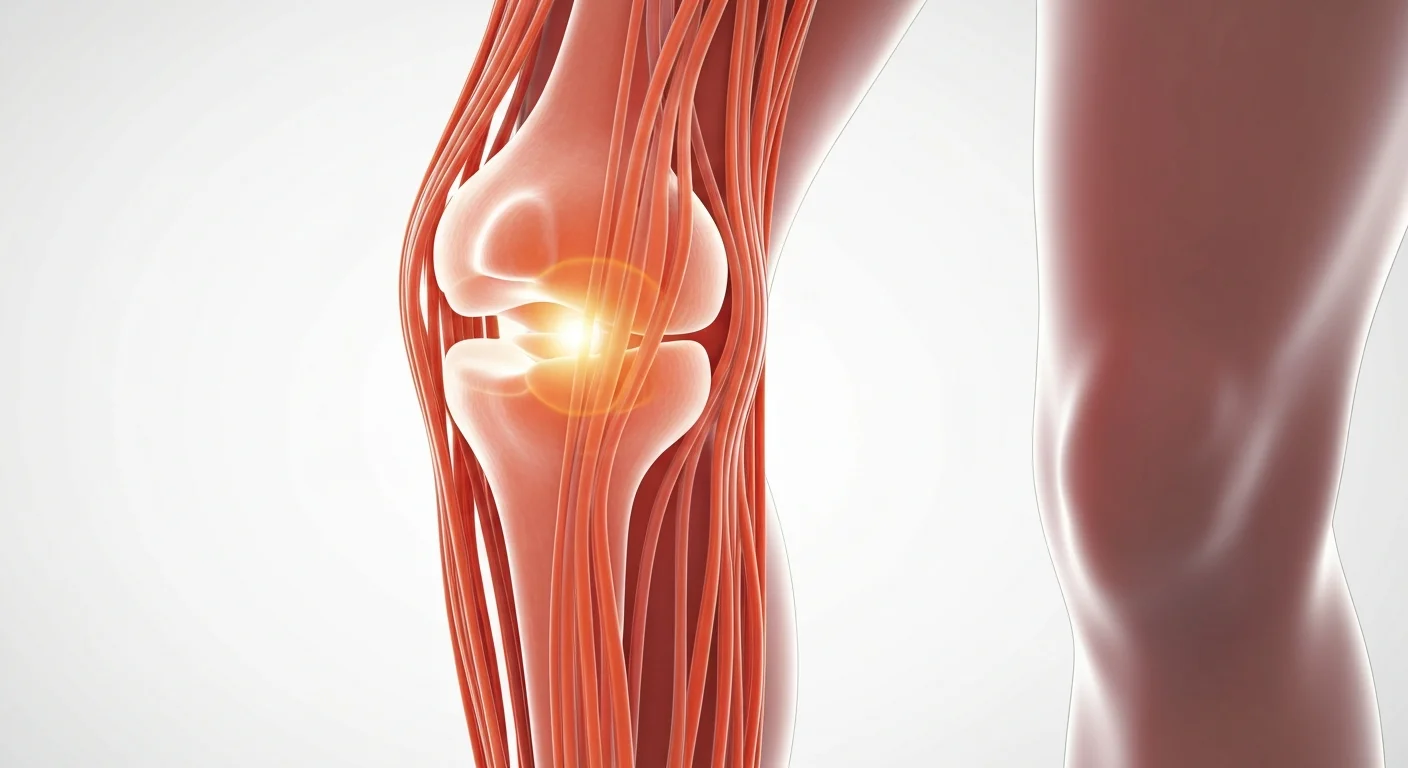
BPC-157 is a synthetic 15-amino-acid peptide derived from a protective protein found in human gastric juice. Its primary mechanism is angiogenesis: it helps trigger new blood vessel growth in injured tissue. Better blood supply to a stalled injury means more oxygen, more nutrients, and a restarted healing signal in tendons, ligaments, and the joint capsule. It also appears to influence the way tendon cells respond to growth signals, which is part of why it is one of the most studied peptides for tendon repair, supporting connective tissue that heals slowly on its own. For joints specifically, the honest framing we give patients is that it is a repair assist, not a cure for arthritis.
TB-500: The Systemic Counterpart
TB-500 is a synthetic fragment of Thymosin Beta-4, a protein found in nearly every cell and concentrated in platelets and wound fluid. It works on actin, a protein that drives cell movement, helping repair cells migrate to where they are needed. Unlike BPC-157, TB-500 is systemic: it circulates and finds damaged tissue wherever it is, which makes it useful for diffuse or multi-site stiffness rather than one isolated spot. The combination of these two mechanisms is why the pairing keeps showing up in any serious discussion of bpc 157 tb 500 for recovery.
Which Peptides Actually Target Joint Pain at a Medical Clinic?
The internet lists a long menu of peptides for joint pain. In a clinical setting the list is much shorter, because we only prescribe what fits the injury pattern in front of us. At our Doral clinic the two that do the real work for musculoskeletal recovery are BPC-157 and TB-500, used alone or together depending on whether the problem is local or diffuse. As peptides for tendon repair and peptides for inflammation, this pairing covers both the structural and the inflammatory side of a joint problem. Patients often ask which one is right for their case, and the answer starts with the injury, not with what they saw on YouTube. We break that decision down in detail in our guide to how BPC-157 and TB-500 differ, when to use each, and why most recovery protocols combine them.
A quick note on collagen: oral collagen peptides are a separate, supplement-grade category sometimes marketed as peptides for arthritis that may modestly help mild osteoarthritis over months of daily use. They are not the same as the prescribed injectable peptides we use for a stalled tendon injury, and we keep that distinction clear with patients so expectations stay realistic. The breadth of this field, from collagen to BPC-157 to Thymosin Beta-4, is summarized well in a 2024 review in the Yale Journal of Biology and Medicine examining how local and systemic peptide therapies support soft tissue and joint repair.
Why the Wolverine Stack Is Our Most Requested Recovery Protocol
When patients need both local repair and a systemic anti-inflammatory reset, we combine BPC-157 and TB-500 into what we call the Wolverine Stack. The rationale is complementary mechanisms: BPC-157 concentrates repair at the injury site, while TB-500 recruits cells and calms inflammation throughout the body. Mapped onto the natural healing cascade, the bpc 157 tb 500 pairing tends to speed the transition from the inflammation phase to the proliferation and remodeling phases, which matters most in poorly vascularized tissue like tendon, ligament, and cartilage.
The injury patterns we see respond best are familiar to anyone with an active South Florida lifestyle: Achilles and patellar tendinopathy, tennis elbow, partial ACL or MCL strains, chronic ankle instability, and post-surgical recovery, the classic cases where patients search for peptides for tendon repair and peptides for arthritis relief. One clinical detail patients rarely hear elsewhere: BPC-157 and TB-500 are kept in separate vials and injected separately, never mixed, because combining them degrades stability. You can see the full breakdown on our guide to how we combine BPC-157 and TB-500 in the Wolverine Stack for chronic musculoskeletal recovery.
How Long Until Peptides Help Joint Pain? A Timeline by Tissue
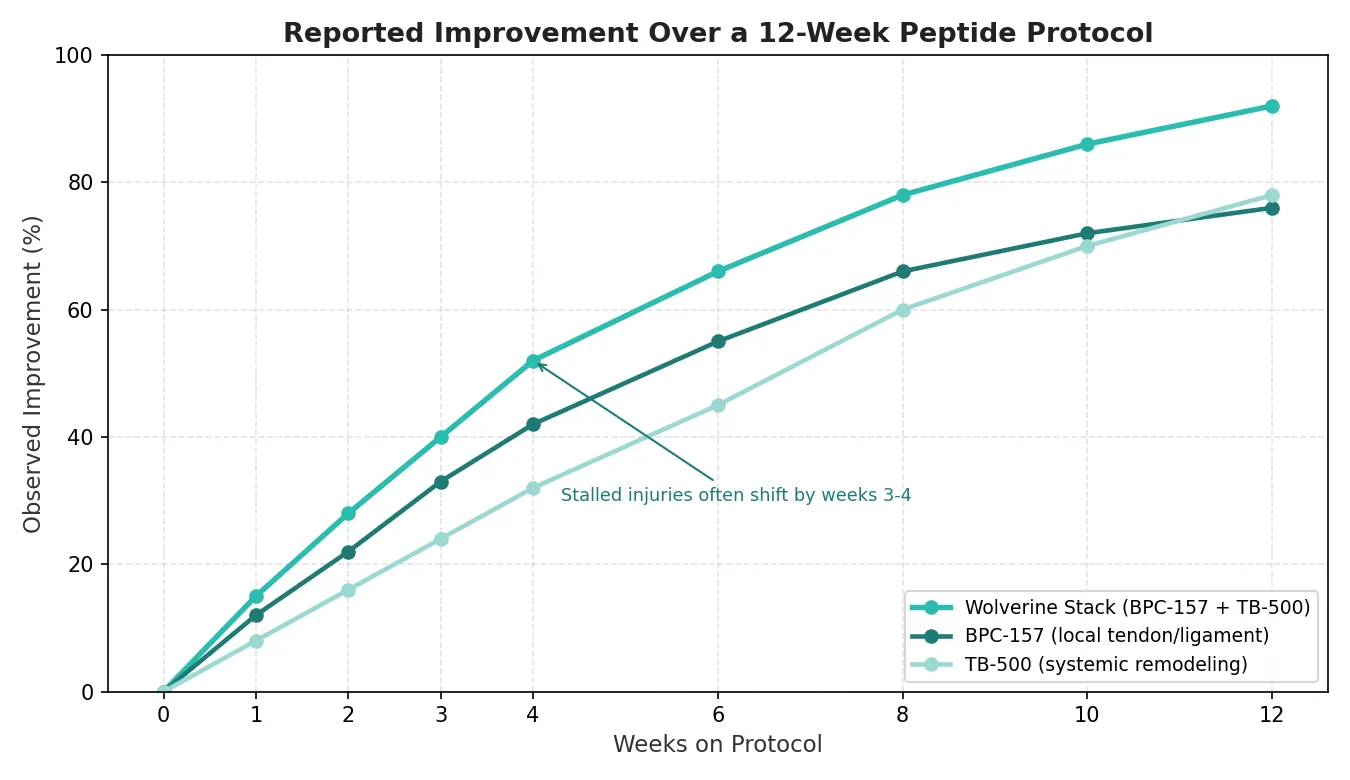
This is where most online content goes vague. The truth is that the timeline depends on the tissue being repaired, because different tissues heal at different speeds. What patients report at our Doral clinic follows a fairly consistent pattern across a 12-week protocol.
- Weeks 1 to 2: Diffuse inflammation and swelling start to settle first, usually the earliest sign the protocol is working, driven largely by the TB-500 side of the stack.
- Weeks 3 to 4: Tendon and ligament pain eases and range of motion improves. A subacute tendinopathy that stalled at 8 to 12 weeks of physical therapy often shifts noticeably in this window.
- Weeks 5 to 8: Load tolerance and strength climb as repair tissue matures. This is when patients start trusting the joint under real activity again.
- Weeks 8 to 12: Structural remodeling consolidates. The gains feel durable rather than fragile, which is the point of running the full cycle instead of stopping early.
Who Is a Good Candidate, and Who Should Avoid Them?
Peptides for joint pain are not a first-line treatment for everyone. As peptides for tendon repair and ligament support, they are most useful when a conventional path has been followed and has plateaued. The candidates who benefit most at our clinic tend to share a profile.
- A soft-tissue injury that stalled: physical therapy is complete, there is no surgical indication, but pain and limited motion persist past 8 to 12 weeks.
- Active adults and athletes: tennis, golf, and gym-goers across Miami who want to support recovery between training blocks under supervision rather than guesswork.
- Adults 45 and up: people with cumulative, multi-site wear who want to exhaust conservative options before considering surgery.
Screening also rules people out. Used as peptides for arthritis and stalled-injury support, we do not prescribe these peptides during pregnancy or breastfeeding, with an active malignancy or cancer history, or in certain vascular conditions, because the same angiogenesis that helps an injury is a concern in those settings. If a peptide is not appropriate for you, your provider will tell you directly, not sell you something that does not fit your case. That candor is part of why peptides for arthritis and joint pain should begin with an evaluation rather than an online order.
Not sure which peptide protocol fits your joint pain?
Perfect B’s peptide protocol tool is built on real clinical data from 2,000+ patients treated in South Florida.
Answer 6 questions and see what patients with similar goals are running: which peptides they use, typical dosing, injection schedule, reconstitution steps, cycle length, and when they pause.
Dosing, Monitoring, and Why We Track hs-CRP
The route is subcutaneous injection with a small insulin-size needle, usually into the abdomen or thigh, with daily site rotation. The exact dose, cycle length, and on-off schedule are individualized and part of the prescribed protocol, which is why we do not publish a one-size-fits-all number that someone could copy from a forum.
What truly separates a clinic from a website is measurement. There is no standard peptide deficiency test, so lab work is not required to start, but for recovery protocols and peptides for inflammation we often review hs-CRP, a marker of systemic inflammation, and use InBody body composition scans where high extracellular water can hint at inflammation. For patients who want the full picture, an optimization panel can track hs-CRP alongside other markers so the protocol is adjusted with data, not guesswork. An online vial gives you a powder and a guess. A supervised protocol gives you verified product, an individualized dose, and someone watching whether your inflammation is actually trending down.
Are These Peptides Legal, and Where Should You Get Them?
This is where the market gets murky. BPC-157 and TB-500 are not FDA-approved drugs, which means they are not sold as retail prescriptions the way a branded pharmaceutical is. They are legally obtainable in the United States through licensed compounding pharmacies when prescribed by a medical provider for a specific patient after a clinical evaluation. That is the route we use at Perfect B: peptides sourced from FDA-registered US compounding pharmacies, tested for sterility and verified potency, with a documented chain of custody.
What is sold online as research-grade powder is a different and riskier category, typically labeled not for human use, with unverified concentration and purity. Two patients running the same online product can be injecting wildly different actual doses, which is exactly why online results are so inconsistent. The emerging science here is moving fast, as shown in a 2026 review in npj Biomedical Innovations on peptide-based strategies that target cartilage and joint tissue in osteoarthritis, but emerging science is not a reason to self-source an unregulated injectable. For a closer look at the local picture, our team covers what BPC-157 therapy in Miami actually costs, how it is legally sourced, and why the provider matters more than the peptide.
What Does Peptide Therapy for Joint Pain Cost in Miami?
Cost depends on how many peptides are in the protocol and how many cycles you run. At Perfect B, a single-peptide BPC-157 protocol starts at 445 dollars per cycle, and the two-peptide Wolverine Stack starts at 795 dollars per cycle, with multi-cycle pricing for longer recovery cases, whether you run BPC-157 alone or the full bpc 157 tb 500 protocol. Every protocol is priced inside supervised care that includes the provider evaluation, the complete kit, and follow-up. We also offer Buy Now Pay Later through Cherry, with monthly installments, so cost is not the reason a patient delays a stalled-injury protocol.
The framing we give patients is simple: the cheapest peptide online is almost always the most expensive mistake, because what you save on price you lose in verified concentration, sterility, and someone tracking your response. You can compare the full structure, including the assessment, protocol design, and monitoring, on the supervised peptide therapy program we run for every recovery patient at Perfect B in Doral.

Frequently Asked Questions
1. Do peptides really work for joint pain?
For the right candidate, yes, but as a repair assist rather than a cure. BPC-157 and TB-500 support the body’s own healing of tendons, ligaments, and inflamed tissue. They work best on stalled soft-tissue injuries and alongside a broader plan, not as a standalone fix for advanced arthritis.
2. What is the best peptide for joints?
There is no single best one. For a localized tendon or ligament injury, BPC-157 is the workhorse. For diffuse or multi-site stiffness, TB-500 adds systemic support. Most recovery cases at our Doral clinic use the two together in the Wolverine Stack, matched to the injury pattern.
3. How long do peptides take to work for joint pain?
Diffuse inflammation often eases within 1 to 2 weeks. Tendon and ligament pain and range of motion usually improve around weeks 3 to 4, with structural remodeling consolidating over 8 to 12 weeks. These are the ranges we observe in our Doral consultations.
4. Are peptides for joint pain legal in Miami?
BPC-157 and TB-500 are not FDA-approved retail drugs, but they are legally obtainable through a licensed US compounding pharmacy when prescribed by a provider after an evaluation. That is the route Perfect B uses. Research-grade powder sold online as not for human use is a different and riskier category.
5. How much does peptide therapy for joint pain cost?
At Perfect B, a single-peptide BPC-157 protocol starts at 445 dollars per cycle and the two-peptide Wolverine Stack starts at 795 dollars per cycle, priced inside supervised care. Buy Now Pay Later through Cherry is available, so most patients can start without paying the full amount upfront.
6. Can peptides replace surgery for a joint injury?
Not when there is a clear surgical indication, such as a full tendon rupture or unstable tear. Where they help is the large middle ground: stalled injuries with no surgical indication that have not responded to rest and physical therapy. For many of those patients, a supervised peptide protocol is a reasonable step to try before considering surgery.
Closing: The Clinical Bottom Line on Peptides for Joint Pain
Peptides for joint pain are a legitimately useful tool, but not a product you should buy off a website and guess your way through. Their value shows up when the right peptide meets the right patient: a stalled tendon, ligament, or joint injury, delivered as a verified, correctly dosed, supervised protocol, with peptides for inflammation chosen deliberately and tracked over time. Everything that makes them work or fail comes down to the source and the provider.
If you are in Miami or Doral and dealing with joint pain that rest and physical therapy have not resolved, the safe path is the same one we use with every recovery patient: a consultation, a clinical evaluation, a protocol built around your injury, and monitoring across the cycle. That is what turns peptides for joint pain from an online gamble into medicine.
See what recovery patients like you are running at Perfect B.
Perfect B’s peptide protocol tool is built on real clinical data from 2,000+ patients treated in South Florida.
Answer 6 questions and see what patients with similar goals are running: which peptides they use, typical dosing, injection schedule, reconstitution steps, cycle length, and when they pause.
- 📍 Visit us at Perfect B, Doral FL, serving Miami and South Florida patients seeking supervised recovery and joint pain peptide therapy.
- 📞 Call or message us at (786) 502-2260 to schedule your consultation with a licensed medical provider.
- 💳 Buy Now Pay Later: Cherry, Klarna, Afterpay, CareCredit