
Perfect B, Doral Fl. | 05.07.26 | 10 min read.
This post is for educational purposes only and does not constitute medical advice. Skin rejuvenation treatments require licensed clinical assessment to match the right modality to your skin type, photodamage level, and downtime tolerance. Consult a qualified provider before starting any protocol. For more on this, see our guide to Top 10 Methods of Regen Therapy and Biohacking for Skin Renewal and Recovery, and how it is evaluated and treated at Perfect B in Doral. For the bigger picture, see how NAD+ vs Peptides: Differences, Combining and Cost, and how it is approached at Perfect B in Doral.
What Is Skin Rejuvenation in a Clinical Setting?
Skin rejuvenation is the clinical practice of restoring the structural, textural, and visible quality of skin that has been changed by aging, sun exposure, scarring, or hormonal shifts. In a Miami clinic that takes the medical side seriously, that means a sequenced plan that pairs proven procedures with realistic recovery windows and skin-type-specific calibration. The goal is not to stack every available treatment in one visit. It is to match the right treatment to the right concern, in the right order, for the patient in front of us.
At Perfect B in Doral, FL, we organize skin rejuvenation around 10 non surgical skin rejuvenation treatments that have repeatable clinical evidence and predictable outcomes. Each treatment in the list below addresses a specific structural or surface concern, and most patients use two or three of them as a sequenced plan rather than picking one in isolation. The decision about which treatments to include and in what order is what makes the work clinical rather than transactional.
→ See our full regenerative and aesthetic services overview at Perfect B in Doral, FL.
Key Takeaways
- Skin rejuvenation is sequenced, not stacked. The right plan matches treatments to your skin type, photodamage level, and downtime tolerance rather than offering a same-day bundle.
- The 10 treatments below cover the main clinical concerns: texture, pigmentation, scars, density, sagging, photodamage, and recovery support.
- Most patients use two or three treatments, not all ten. Choosing the right combination matters more than choosing the most aggressive option.
- Recovery timing is part of the plan. A treatment that requires seven days of downtime and a treatment that requires two days can be sequenced if scheduling is built in advance.
- Skin type and pigment safety drive selection. Patients with deeper skin tones need different parameters and different sequencing than patients with lighter skin to avoid post-procedure pigment changes.
The 10 Skin Rejuvenation Treatments at Perfect B
The list below moves from the most foundational treatments toward the more specialized ones. Most consultations land on a combination of two or three of these, sequenced over weeks or months. The order in the list is not the order of priority for a given patient. It is the order in which we usually explain the menu in clinic.

1. Microneedling for Texture and Pores
Microneedling uses controlled micro-injuries to trigger collagen remodeling. It is one of the most reliable foundational treatments for skin texture, pore appearance, and early fine lines. Downtime is short, around 24 to 48 hours of redness for most patients. We often pair it with topical actives applied during or after the session, and for some patients we layer it with a regenerative booster from the next several treatments on this list.
2. PRP for Density and Healing
Platelet-rich plasma uses your own blood-derived growth factors to support tissue density and accelerate healing after other procedures. Applied topically after microneedling or injected for facial rejuvenation, PRP improves outcomes for patients whose primary concern is overall skin density rather than surface texture alone. The protocol typically involves three sessions spaced four to six weeks apart, with maintenance every six to twelve months.
3. Exosome Therapy for Scar Remodeling and Recovery
Exosomes are vesicles that carry signaling molecules between cells. In aesthetic practice, vetted exosome preparations applied after micro-injury procedures support remodeling of scars (acne, surgical, or post-inflammatory) and accelerate recovery from more aggressive resurfacing. Source quality matters here more than in any other category on this list. We use specific suppliers and decline product lines we have not vetted.
4. Laser Resurfacing for Photodamage
Laser resurfacing uses targeted wavelengths to remove or remodel layers of skin damaged by sun exposure. The choice between ablative, non-ablative, and fractional approaches depends on photodamage severity, skin type, and how much downtime the patient can plan for. For darker skin tones, we adjust device choice and parameters carefully, and we often defer the procedure to seasons with less sun exposure to protect outcomes.
5. Chemical Peels for Pigmentation and Surface Renewal
Chemical peels remove specific layers of skin to address pigmentation, dullness, mild scarring, and surface texture. The depth of the peel (superficial, medium, or deep) determines both the result and the recovery time. For patients in Miami with melasma or post-inflammatory hyperpigmentation, peel selection and seasonal timing are part of the plan from day one. The wrong peel for the wrong skin type can worsen pigment, so the assessment is not optional.
6. Radiofrequency for Skin Tightening
Radiofrequency devices deliver controlled heating to deeper layers of skin to stimulate collagen contraction and remodeling. The result is incremental tightening over a series of sessions, useful for patients whose primary concern is mild laxity rather than texture or pigmentation. Microneedling combined with radiofrequency (often called RF microneedling) is a single session that addresses both texture and tightening, popular for patients who want one treatment doing two things.
7. NAD+ Support for Cellular Recovery
For patients whose skin recovery has been blunted by stress, age, or repeated procedures, supervised NAD+ protocols can support cellular energy and repair. We treat this as a foundation that improves response to other treatments rather than a standalone aesthetic intervention. Screening and dosing are individualized.
8. PDRN (Salmon DNA) for Repair
PDRN, a polynucleotide derived from salmon DNA, supports tissue repair and is used in dedicated injectable protocols and as an adjunct to other procedures. Patients with thin skin, post-procedure compromise, or specific recovery needs are the most common candidates. Like exosomes, source quality and supervision are non-negotiable.
9. Stem Cell-Derived Treatments for Specific Cases
Stem cell-derived treatments occupy a more specialized place on this list. We use them in carefully selected cases where the clinical evidence supports the application and the source is verified. They are not a first-line treatment, and we are honest with patients about which categories of stem cell-derived products are clinically established versus marketing-driven.
10. Maintenance and Recovery Protocols
The tenth item on this list is not a procedure. It is the maintenance plan. Sun protection, peri-procedure skincare, sleep regularity, and follow-up sessions at the right intervals are what determine whether the results from the first nine treatments hold over time. A patient who completes a series of microneedling and skips maintenance loses ground; a patient who maintains the basics holds the result for years.
How We Match Treatments to Skin Types and Goals
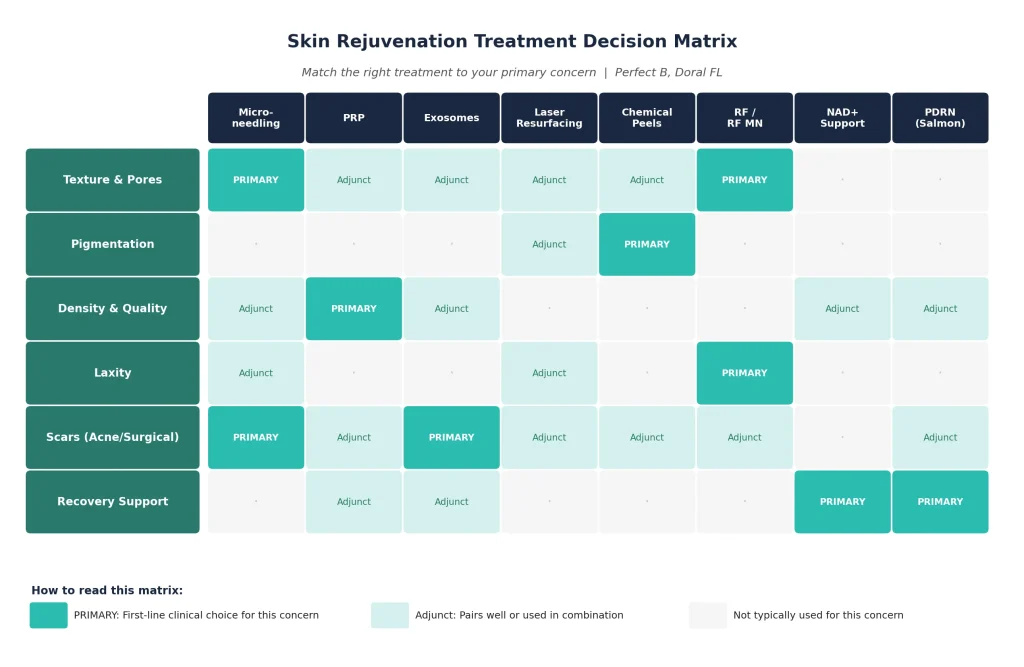
The honest answer to “which treatment should I do?” is that the consultation answers it. The five variables that drive selection at Perfect B are: the primary concern (texture, pigmentation, density, laxity, scars, recovery), the skin type and Fitzpatrick scale, the photodamage level, the patient’s downtime tolerance, and any history of pigment-sensitive responses. The sequencing decision then depends on which treatments combine well and which need separation, plus the season we are in (sun exposure and post-procedure care vary across the year in Miami).
- Texture and pores usually start with microneedling, sometimes with PRP or exosome support depending on the goal.
- Pigmentation typically combines a peel approach matched to skin type with a topical regimen and sun protection. Laser may enter later if the response is incomplete.
- Density and overall quality often respond best to PRP series, sometimes layered with microneedling.
- Laxity usually leads to radiofrequency or RF microneedling protocols.
- Scars (acne, surgical, post-inflammatory) respond best to combinations: microneedling plus exosome therapy, or fractional laser plus PRP.
- Recovery support uses NAD+ and PDRN as adjuncts that improve outcomes from the procedural treatments.

What to Expect: Recovery Timelines and Sequencing
Recovery time is one of the most underestimated variables in skin rejuvenation planning. A patient who books a deep peel a week before a wedding will have a different experience than one who plans the same peel four weeks before. The realistic recovery windows for the treatments above range from one day (light peel, gentle microneedling) to two weeks (deeper laser resurfacing, deeper peels). Most treatments fall between two and seven days of visible recovery.
Sequencing across multiple treatments is where clinical planning earns its place. Two examples: microneedling and PRP can be done in the same session because they support each other. Microneedling and a medium peel should be separated by at least two weeks because the skin needs time to recover from one before the other begins. Laser resurfacing and exosome therapy follow a specific order, with exosomes applied after the laser within a defined window. These are not arbitrary spacing rules; they reflect how skin actually heals.
For patients whose schedule does not allow visible downtime, we tend to start with PRP, gentle microneedling, and topical-supported maintenance, then escalate to higher-impact treatments during seasons or weeks when downtime is feasible. The plan adjusts to the life, not the other way around.
The Bigger Picture: Where Skin Rejuvenation Fits
Skin rejuvenation is one part of the broader aesthetic and regenerative practice at Perfect B. For patients whose goals extend beyond skin into energy, recovery, or overall aesthetic outcomes, the conversation usually expands into a multi-pillar plan that includes cellular optimization protocols and integrated treatments. The skin treatments above are often the entry point into that broader plan, especially for patients whose primary concern was visible skin quality but who recognize, mid-conversation, that the underlying recovery and metabolic baseline are also worth addressing.
Frequently Asked Questions
1. Which skin rejuvenation treatment should I start with?
The answer depends on your primary concern. For texture, microneedling is the usual starting point. For pigmentation, a peel matched to your skin type. For density, PRP. For laxity, radiofrequency. The consultation is designed to translate your goal into the right starting treatment, then sequence the next steps from there. There is no universal “best” treatment because skin rejuvenation is matched to the person, not selected from a menu in advance.
2. How long does each treatment’s downtime last?
Light treatments like superficial peels and gentle microneedling typically have one to two days of mild redness. PRP-supported sessions usually resolve in two to three days. Medium peels, RF microneedling, and laser sessions range from three to seven days. Deeper resurfacing or deeper peels can require ten to fourteen days of visible recovery. The specific number depends on the parameters used, your skin type, and how careful the post-procedure care is.
3. Are skin rejuvenation treatments safe for darker skin tones?
Yes, when the device choice, parameters, and timing are matched correctly. The risks for patients with deeper skin tones are post-inflammatory hyperpigmentation and rebound pigmentation, both of which can be largely prevented with the right protocol. We adjust laser wavelengths, peel depth, microneedling parameters, and post-procedure care for each skin type. Patients with melasma require even more careful planning, including seasonal timing and pre-treatment preparation.
4. How many treatments do most patients actually do?
Most patients work with two or three treatments from the list above, sequenced over several months. The patients who try to do all ten in a short timeframe usually get worse outcomes, not better. Skin needs time to remodel between interventions, and stacking too many procedures without recovery windows can compromise the final result. The clinical plan we write is almost always shorter and slower than what patients initially imagine.
5. How long do skin rejuvenation results last?
Results vary by treatment and by maintenance. Texture and quality improvements from microneedling and PRP series typically hold for nine to twelve months with maintenance, less without it. Pigmentation correction depends heavily on sun protection going forward; without it, results regress quickly. Laser resurfacing results can last several years for the structural component, though the skin continues to age. The maintenance plan is what determines longevity, not the initial procedures alone.
6. How is Perfect B different from a wellness chain or medspa for skin rejuvenation?
The clearest differences are clinical assessment, source quality, sequencing discipline, and licensed clinicians writing the plan. We screen patients before recommending interventions and decline candidates when something is not appropriate. We use vetted suppliers for biologics rather than whatever is in stock. We sequence treatments across weeks or months instead of stacking them in same-day bundles. None of this makes wellness chains bad; it just means they are a different category of service. Patients looking for clinical skin rejuvenation should know which one they are buying.
Closing: Build a Plan You Can Repeat
The 10 treatments above are the menu. The plan is what makes them work. Skin rejuvenation done well is a sequenced project with realistic timelines, honest expectations about downtime, and maintenance built in from the first session. The clinic that gives you that conversation before any procedure is scheduled is the clinic that produces results you can hold over years rather than months.
If you have been looking at the menu trying to figure out what to start with, the right next step is rarely to pick a treatment from a list. It is to sit down for an assessment, understand which two or three of these match your skin and your goals, and write the sequenced plan from there. The result is specific, ordered, and yours.
📍 Visit us at Perfect B, Doral FL
📞 Call or message us at (786) 502-2260