
Perfect B, Doral Fl. | 06.02.26 | 8 min read.
This content is for educational purposes only and does not constitute medical advice. Consult a licensed provider before beginning any laser treatment.
Why Tattoo Removal on the Face and Neck Is Not the Same as Anywhere Else
The skin on your face and neck is not like the skin on your bicep or your back. It is thinner, it sits over different anatomical structures, and the areas most visible in daily life are also the areas where ink removal carries the most technical complexity. When a patient comes to us for face tattoo removal, the conversation is different from the first appointment for a forearm piece. The laser settings, the session spacing, the aftercare, and the expected timeline all shift based on exactly where the ink sits and what type of pigment it contains.
At our clinic in Doral, we see a wide range of cases: from traditional face tattoo regret in patients who got inked young, to permanent makeup applied years ago that has shifted in color or placement. Each of these requires a different approach. This guide breaks down what makes the face and neck distinct as removal sites, what patients should realistically expect, and how the PiQo4 laser handles the complexity that these zones demand.
Key Takeaways
- Face tattoo removal is achievable on all skin tones using picosecond and nanosecond laser technology, including on Fitzpatrick III-VI skin types common in South Florida.
- The neck consistently requires more sessions than most facial zones because lower vascular density slows how the body flushes fragmented ink particles.
- Permanent makeup and cosmetic tattoos use iron oxide-based pigments that can temporarily darken before they begin to clear, a phenomenon known as paradoxical darkening.
- Tattoo removal near the eyes requires specialized intraocular protectors, not standard goggles, to prevent laser energy from reaching the retina through thin eyelid skin.
- Year-round sun exposure in South Florida makes strict UV protection between sessions a clinical requirement, not just a precaution, particularly for patients with darker skin tones.
The Anatomy Behind the Difference: Face vs. Neck vs. Body
Laser tattoo removal works by breaking ink particles into fragments small enough for the lymphatic system to carry away. How quickly that happens depends largely on local blood flow: areas with rich vascularity flush ink faster. The face ranks high for vascular supply, fed by dense branches of the external carotid artery. This is why a face tattoo, when treated correctly, tends to show progressive clearing more reliably between sessions than a tattoo placed on a lower-circulation area like the ankle or the finger.
The neck tells a different story. Vascular density in the neck skin is lower than in the facial tissue, which means ink fragments linger in the dermis longer after each session. Patients with neck tattoos should expect a longer overall timeline than a comparable tattoo on the cheeks, even when using the same laser at the same settings.

Skin thickness is the other variable. Facial skin, particularly around the forehead, eyelids, and upper lip, is among the thinnest on the body. Laser energy reaches the dermis with less scattering, which can be an advantage for ink clearance but also means settings must be calibrated carefully to avoid post-treatment changes in pigmentation. For this reason, face tattoo removal performed by an inexperienced provider carries higher risk than the same procedure on thicker-skinned body sites. Operator experience and device selection matter more here than anywhere else.
Zone-by-Zone: What Changes Based on Where the Tattoo Sits
Forehead
Forehead skin is thin and sits over bone with minimal subcutaneous fat. Laser reflection off the periosteum can increase the effective energy delivered to the treatment zone. Experienced providers reduce fluence accordingly. Forehead tattoos are among the most technically demanding because the bone proximity changes how the photoacoustic wave dissipates. Patients typically see 5 to 9 sessions for traditional black ink placed here.
Near the Eyes
The periorbital zone is where laser tattoo removal requires the most specific safety precautions. Standard protective goggles are not adequate near the eyelid because 1064nm laser energy penetrates thin eyelid skin and can reach the retina. For tattoos near the upper eyelid, the procedure requires metal intraocular protectors, shields placed directly under the lids against the globe, similar to a contact lens. This is non-negotiable. Any provider offering laser removal near the eye without intraocular shields is not following the required safety protocol.
Cheeks and Lower Face
The cheeks benefit from good vascular supply and moderate skin thickness. Traditional tattoo ink in this zone generally responds well. At our clinic, patients with facial tattoo removal goals in the cheek or jawline area typically clear in 6 to 10 sessions for black ink, with multi-color designs adding 2 to 4 sessions depending on ink composition.
Lips and Perioral Area
Lip and perioral tattoos are among the most common permanent makeup applications and among the most nuanced to remove. The skin is thin, highly innervated, and the pigments used for lip liner and lip blush are almost always iron oxide-based rather than carbon-based tattoo ink. Iron oxide pigments behave differently under laser energy. See the permanent makeup section below for a full explanation. Patients pursuing facial tattoo removal in the lip area should plan for 3 to 8 sessions depending on whether they are removing a cosmetic application or a traditional tattoo.
Neck Tattoo Removal: Why It Typically Takes More Sessions
Patients frequently ask why their neck tattoo seems to fade more slowly than a friend who started removal at the same time on a different body site. The answer is physiological. Neck skin has lower vascular density than facial tissue, which reduces the rate at which the lymphatic system can clear ink fragments after each session. The body does not directly eliminate ink. The laser shatters pigment particles into pieces small enough that macrophages can engulf them and the lymphatic system can carry them away. In areas with strong blood flow, this process is relatively efficient. In the neck, it is slower. The result is that each session delivers the same fragmentation, but the body takes longer to complete the clearance between appointments.
There is a secondary mechanical factor specific to the neck that applies to South Florida patients. The neck is a high-motion area: it moves with every swallowing, speaking, and head-turn cycle. Patients who cannot avoid compression from collars or tight necklines during healing add friction to an area that needs undisturbed skin regeneration. Average neck tattoo removal ranges from 8 to 15 sessions for black ink, with colored designs sitting at the higher end of that range. Spacing between sessions must be respected, typically 6 to 8 weeks minimum, to allow full immune clearance before the next fragmentation cycle begins.
What Happens When You Try to Remove Permanent Makeup on the Face
Removing traditional tattoo ink and removing permanent makeup are two different clinical processes, even when the laser is the same device. The distinction comes down to pigment chemistry.
Traditional tattoo inks are typically carbon-based. They absorb laser energy predictably and break down in a linear process. Permanent makeup, lip liner, powder brows, and many cosmetic tattoo formulations use iron oxide pigments: compounds like Fe3O4 (magnetite). When iron oxide is exposed to laser energy, it can undergo a chemical reduction reaction. Fe3+ converts to Fe2+, producing ferrous oxide, which is darker than the original pigment. This is paradoxical darkening, and it can cause a patient’s eyebrows or lip liner to appear significantly darker and sometimes orange or brown after the first one or two sessions.
This does not mean the treatment is not working. It means the chemistry of the pigment responded in a predictable way, and continued treatment will continue to break down the compound. Most patients see paradoxical darkening normalize by session 3 to 5. Providers who do not explain this risk in advance leave patients panicked after their second appointment.
A spot test before full treatment is standard protocol for permanent makeup removal. Our team at Perfect B performs this assessment at the consultation to evaluate how the specific pigment responds before beginning a full series.
For patients specifically focused on eyebrow tattoo removal, we have a dedicated clinical guide: our complete breakdown of eyebrow tattoo and microblading removal at Perfect B covers session counts, paradoxical darkening in detail, and what to expect at each stage of the process.
How Many Sessions Does Face or Neck Tattoo Removal Actually Take?
There is no universal answer, but the ranges below reflect what we observe clinically for different tattoo types in the face and neck zones. The chart shows average clearance sessions by zone for context.
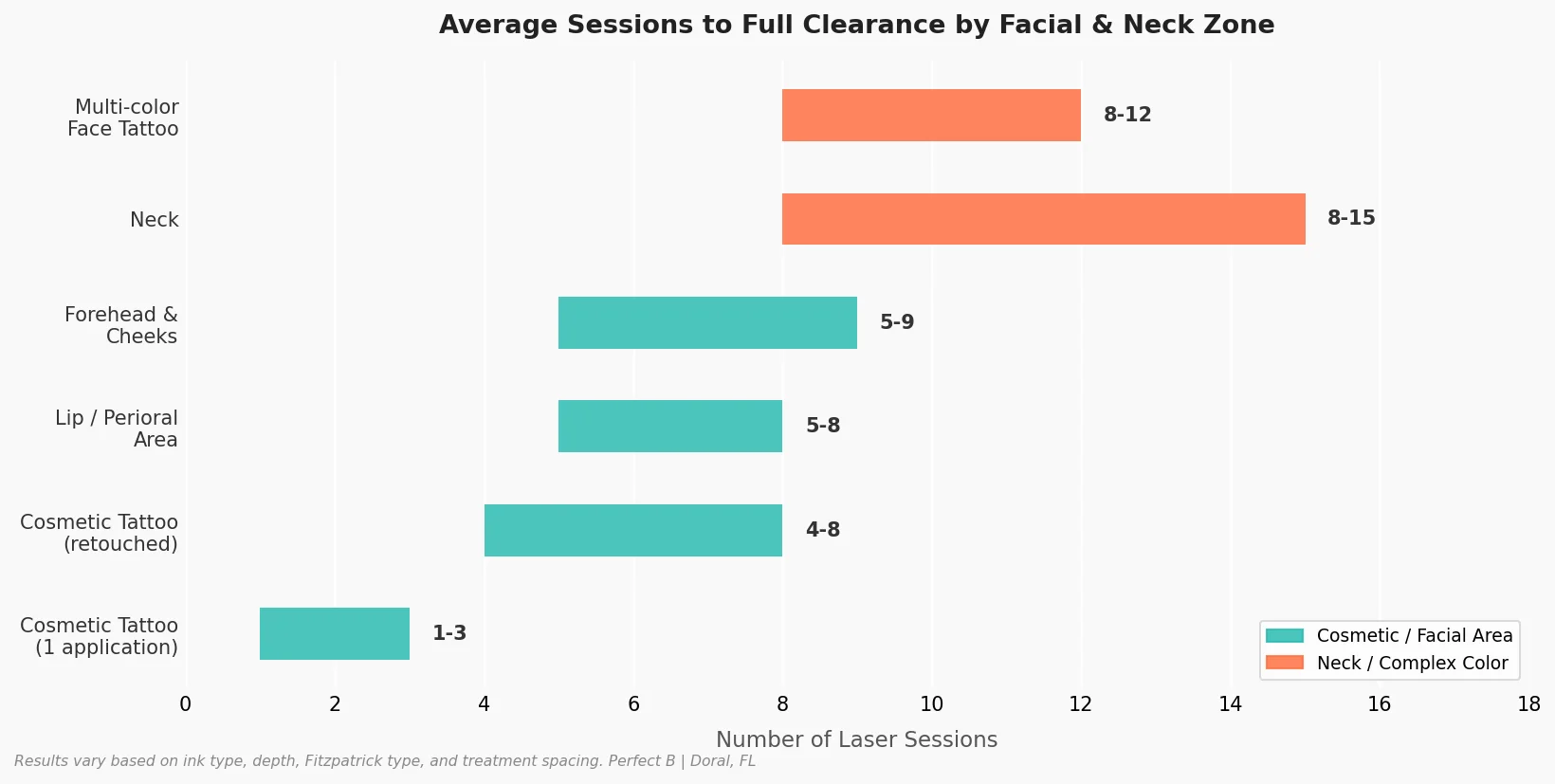
- Cosmetic tattoo (single application, no retouching): 1 to 3 sessions. These are the fastest to clear because the pigment was applied shallowly and once.
- Cosmetic tattoo (retouched multiple times): 4 to 8 sessions. Each retouch adds depth and pigment density.
- Traditional face tattoo, black ink: 6 to 10 sessions on cheeks and forehead, 5 to 9 on forehead specifically.
- Traditional face tattoo, multi-color: 8 to 12 sessions. Lighter colors like yellow and green require more passes.
- Neck tattoo, black ink: 8 to 15 sessions, depending on depth and patient immune response.
These are clinical estimates, not guarantees. The American Society of Plastic Surgeons notes that complete tattoo removal is not always guaranteed and that multiple factors influence the outcome, including pigment depth, the patient’s immune response, and the technology used. For patients who want a personalized session and price estimate before committing, the free calculator on our treatment plan page provides that breakdown in under two minutes.
→ Use our free calculator to see exactly how many sessions your face or neck tattoo will require.
Sun Exposure, Fitzpatrick Type, and Why Miami Patients Need Extra Session Spacing
South Florida is one of the highest UV-exposure markets in the United States. Patients in Miami and Doral live in a climate where year-round sun means the skin is almost never in a low-UV phase. This matters for facial tattoo removal because laser-treated skin is photosensitive for weeks after each session, and UV exposure during that window dramatically increases the risk of post-inflammatory hyperpigmentation.
Post-inflammatory hyperpigmentation occurs when the skin produces excess melanin in response to trauma, including laser energy. A 2015 clinical review on laser tattoo removal in the Journal of Cutaneous and Aesthetic Surgery documents that patients with darker Fitzpatrick types carry higher risk of post-inflammatory hyperpigmentation after laser treatment, particularly when UV protection and session spacing protocols are not followed. For Fitzpatrick III-VI patients, who make up a significant portion of our population in South Florida, this risk is higher than for lighter skin tones. Our standard protocol for darker skin types includes longer spacing between sessions (minimum 8 weeks rather than 6), lower fluence settings calibrated to the Fitzpatrick classification, and strict SPF 30+ application every morning starting three days after treatment.
If you have a darker complexion and are researching facial tattoo removal, the post we published specifically on laser tattoo removal on dark skin in Miami and how we manage Fitzpatrick III-VI cases at our Doral clinic covers the exact protocol in detail.
Why PiQo4 Is Built for the Complexity of Facial Ink
Most tattoo removal providers in Miami use either PicoWay or PicoSure. Both are effective devices. The PiQo4, which is the laser at Perfect B, was designed with a different architecture: four wavelengths (1064nm, 532nm, 585nm, and 650nm) in a single device, combining picosecond and nanosecond pulse durations in the same treatment session.
This matters for face and neck cases specifically because the ink found in these zones is rarely uniform. A patient who had a traditional face tattoo placed alongside permanent makeup on the same area of skin has at least two chemically distinct pigment types requiring different wavelengths. The 1064nm wavelength handles black and dark blue ink. The 532nm handles red and orange. The 585nm and 650nm wavelengths address the green and blue shades most resistant to removal. A device limited to two wavelengths forces compromises that a four-wavelength system does not.
The picosecond mode is particularly relevant for thin facial skin. Ultra-short pulses in the picosecond range create a predominantly photoacoustic effect rather than a photothermal one. This means ink shatters through mechanical pressure rather than heat, reducing the thermal load on surrounding tissue. For a zone like the forehead or the upper lip, where the skin is thin and thermal spread has less margin, this distinction is clinically meaningful.
For a full technical breakdown of the device, our detailed guide to what the PiQo4 laser is, how its four-wavelength architecture differs from standard picosecond devices, and which ink colors each wavelength targets explains the technology in plain terms.
What Recovery Looks Like After a Face or Neck Tattoo Removal Session
Recovery after a face or neck session is more visible than after a body session simply because the treated area is not covered by clothing. Patients should plan their social schedule around this, particularly for the first 48 to 72 hours after treatment.
- Immediate frosting: A white, chalky appearance appears on the skin within seconds of treatment. This is carbon dioxide release from the ink fragmentation process and resolves within 15 to 20 minutes. It is normal and expected.
- Redness and swelling (24 to 72 hours): The face responds more visibly than body sites because of its vascular density. Swelling around the eye area is common after periorbital work. Cold compresses (not ice directly on skin) help manage the first 24 hours.
- No makeup for 72 hours: Applying product to treated skin introduces bacteria to a compromised barrier and can cause infection or pigment changes. This applies to all areas treated, including lip and eyebrow zones.
- SPF 30 or higher, starting day 3: Non-negotiable in South Florida. A mineral sunscreen with zinc oxide is preferred because it does not require rubbing into sensitive skin.
- No Botox, fillers, or chemical peels within two weeks: Any additional procedural trauma to treated tissue during the healing window increases risk of adverse pigment response.
Patients who undergo face tattoo removal at Perfect B receive a written aftercare card at the time of treatment. Recovery from facial sessions is manageable with the right preparation, and most patients return to work or normal activities within two to three days when following the protocol correctly.

Frequently Asked Questions
1. Can you completely remove a face tattoo?
In most cases, yes. The extent of clearance depends on the ink type, depth, colors present, the patient’s Fitzpatrick type, and consistency with the treatment plan. Black ink on the face responds most predictably. Multi-color tattoos and permanent makeup require more sessions but are removable with the right laser. Partial clearance or significant fading is achievable in cases where full removal is not the goal.
2. Does face tattoo removal hurt more than removal on other body sites?
Sensitivity varies by zone. The forehead and neck tend to be less sensitive than the lip and perioral area, which has high nerve density. Most patients describe the sensation as comparable to a rubber band snap. Because face sessions are shorter than full-back or sleeve treatments, the total discomfort duration is lower even when sensitivity per pulse is higher. Topical numbing agents can be applied 30 to 45 minutes before treatment for sensitive zones.
3. How long do I need to wait between face tattoo removal sessions?
A minimum of 6 weeks between sessions is the baseline. For patients with Fitzpatrick III-VI skin tones, 8 weeks is standard protocol. For the neck zone, 6 to 8 weeks allows sufficient lymphatic clearance time. Rushing sessions does not accelerate the outcome and increases the risk of skin complications.
4. Can laser tattoo removal damage my eyesight?
Not when performed with correct safety equipment. Tattoos near the upper eyelid or orbital area require metal intraocular protectors placed directly under the eyelid. Standard opaque goggles are not sufficient because 1064nm laser energy can penetrate thin eyelid skin. A provider who offers eye-area tattoo removal without intraocular shields is not following safety protocol. Our team at Perfect B uses the appropriate protectors for any periorbital work.
5. What is paradoxical darkening and will it happen to my permanent makeup removal?
Paradoxical darkening is a temporary color shift that occurs with iron oxide-based pigments during laser removal. Under laser energy, the iron compounds in some cosmetic tattoo pigments convert to a darker form before continuing to break down with additional sessions. It appears as a brownish or orange darkening of the treated area, most commonly with eyebrow tattoos or lip liner. It is not permanent in the majority of cases. A pre-treatment spot test is the best way to evaluate whether your specific pigment has this risk.
6. Why does my neck tattoo need more sessions than the same design on my arm?
The neck has lower vascular density than the arm, which means the lymphatic system clears fragmented ink particles more slowly between sessions. Each laser session breaks the pigment into smaller pieces, but the body’s immune cells still need to carry those pieces away through the lymph nodes. In lower-circulation zones like the neck, that process takes longer, which is why clearance progresses more gradually even with equivalent laser settings.
7. Can I wear makeup after a face tattoo removal session?
No makeup on the treated area for 72 hours after treatment. The laser creates micro-channels in the skin barrier, and applying cosmetic products to this disrupted surface introduces bacteria and potential irritants. After 72 hours, you may resume normal skincare but should continue to avoid anything with active acids (AHAs, BHAs, retinol) for at least two weeks.
8. How does skin tone affect face tattoo removal results?
Skin tone affects both laser settings and session spacing. Darker skin tones (Fitzpatrick III-VI) contain more melanin in the epidermis, which competes with ink pigment for laser energy absorption. This requires lower fluence settings to avoid damaging the epidermis, which in turn means more sessions may be needed for equivalent clearance. It also increases the risk of post-inflammatory hyperpigmentation, making sun protection between sessions especially critical for patients with darker complexions in South Florida.
The Clinical Bottom Line on Face and Neck Tattoo Removal
Face and neck tattoo removal is achievable, but it is not a simple extension of body removal. The anatomy varies by zone, the ink types differ from those found on body tattoos, and the South Florida climate creates conditions that require adjusted protocols. Whether you are dealing with a traditional face tattoo, permanent makeup that no longer reflects how you want to look, or a neck piece with a complicated ink history, the path forward starts with an honest clinical assessment of the specific variables in your case.
At Perfect B in Doral, FL, we use PiQo4 technology and a one-price-for-the-full-treatment model specifically because face tattoo removal cases rarely fit a simple session formula. Call or text us at (786) 502-2260 or use the button below to see your personal treatment estimate before committing to anything.
- 📍 Visit us at Perfect B, Doral FL, serving Miami and South Florida patients seeking laser tattoo removal.
- 📞 Call or message us at (786) 502-2260 to schedule your tattoo removal consultation with a licensed medical provider.
→ See your personalized face or neck tattoo removal plan and exact price at Perfect B.