
Perfect B, Doral Fl. | 05.14.26 | 12 min read.
This article is for educational purposes only and is not a substitute for professional medical advice, diagnosis, or treatment. Always consult a qualified medical provider before undergoing any laser treatment.
Laser Tattoo Removal on Dark Skin: What Is Actually True in 2026
The answer is yes: laser tattoo removal works on dark skin. What determines the outcome is not your skin tone. It is whether the clinic you choose has the right technology and understands how to calibrate it for your specific Fitzpatrick type. At Perfect B in Doral, the majority of our tattoo removal patients have Fitzpatrick III through V skin. It is not a niche case for us. It is the demographic reality of South Florida, and our entire protocol is built around it.
Key Takeaways
- Laser tattoo removal is safe and effective for Fitzpatrick III-VI: the key is the right technology and a provider who understands how to adjust protocol for melanin-rich skin. At Perfect B in Doral, this is our standard practice.
- The PiQo4 changes the equation: with four wavelengths (532nm, 585nm, 650nm, 1064nm) in both picosecond and nanosecond modes, it can safely treat all ink colors on darker skin types, including colored tattoos that most clinics decline for Fitzpatrick IV and above.
- Post-inflammatory hyperpigmentation is the main risk: it is manageable with conservative fluence settings, extended session intervals, and strict sun protection, all of which are standard in our protocol for darker skin patients.
- Session count is higher for Fitzpatrick IV-VI: black ink on darker skin typically requires 8 to 10 sessions with picosecond technology. Multicolored tattoos on Fitzpatrick IV-V typically require 10 to 14 sessions.
- Miami’s climate requires specific post-treatment protocol: year-round UV intensity, heat, and humidity create a higher risk of post-inflammatory hyperpigmentation after laser treatment, requiring additional precautions for South Florida patients.
Why Darker Skin Requires a Different Laser Protocol
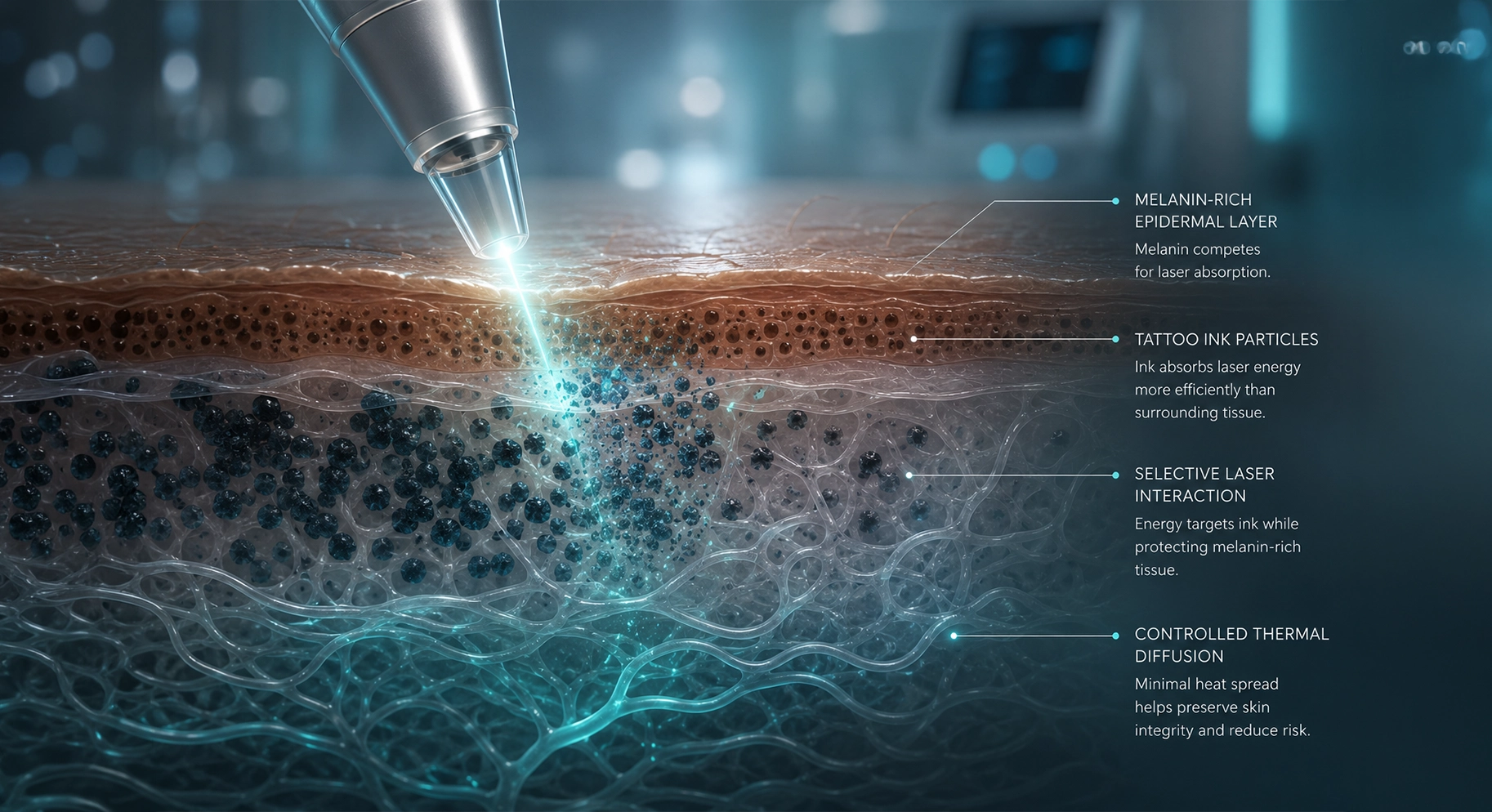
How Melanin Competes with Tattoo Ink for Laser Energy
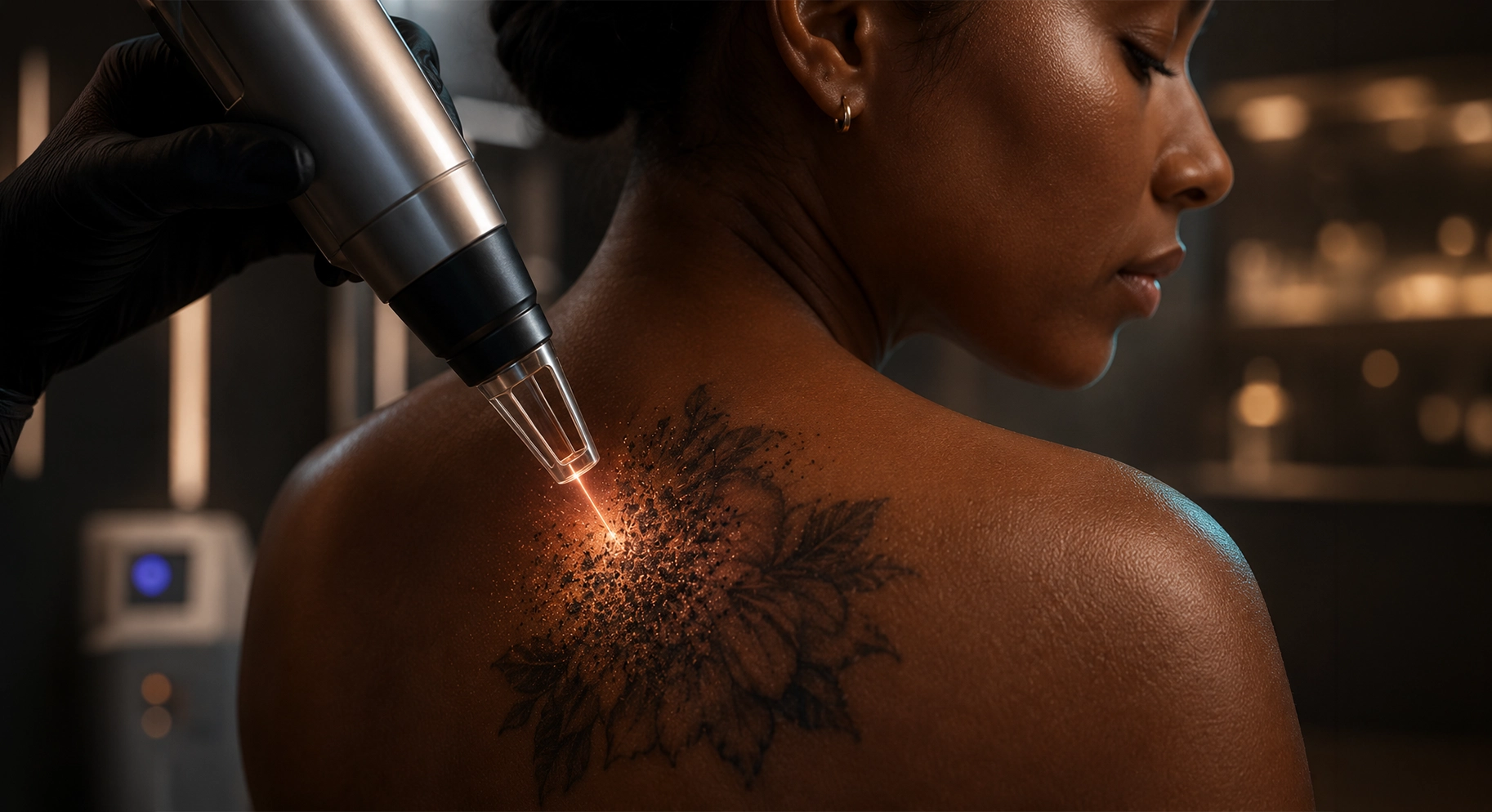
Laser tattoo removal works through a principle called selective photothermolysis: the laser delivers energy at a specific wavelength that is absorbed by the tattoo ink while passing through the surrounding skin tissue. On lighter skin types, the contrast between pale skin and dark ink makes this targeting straightforward. On darker skin types, melanin, the pigment that gives skin its natural color, is also present throughout the dermis. Melanin competes with the tattoo ink for laser energy absorption.
When a laser setting calibrated for a Fitzpatrick I or II patient is applied to a Fitzpatrick IV or V patient, that same energy level can cause excess absorption by melanin rather than ink, producing collateral tissue damage. The result is not that tattoo removal is impossible on dark skin. It is that the protocol must be adjusted: lower fluence settings, longer pulse durations or shorter picosecond pulses depending on the mechanism, and extended intervals between sessions to allow full healing. This is the foundation of how we approach every darker skin patient at our Doral clinic.
The Two Risks Every Dark Skin Patient Needs to Understand
The two adverse outcomes specific to darker skin laser treatment are hyperpigmentation and hypopigmentation. Post-inflammatory hyperpigmentation is a darkening of the treated area caused by melanocytes responding to heat or inflammation by producing excess pigment. It is the most common risk in Fitzpatrick III-V patients and is largely preventable with conservative settings and proper aftercare. Post-inflammatory hypopigmentation is a lightening of the treated area caused by damage to melanocytes. It is less common with modern picosecond technology but more difficult to reverse than hyperpigmentation, which is why preventing it is prioritized over speed of clearance in our protocol.
Why Most Horror Stories Come from the Wrong Technology or Wrong Provider
The majority of adverse outcomes from tattoo removal on dark skin trace back to two sources: older Q-switched nanosecond lasers applied at standard settings without Fitzpatrick adjustment, and non-medical providers who skip the skin type assessment entirely and use the same protocol for every patient. Q-switched lasers deliver energy in nanosecond pulses that produce significantly more residual heat in the surrounding tissue. On Fitzpatrick III-V skin, that thermal load raises the risk of post-inflammatory hyperpigmentation substantially. This is not a problem inherent to darker skin. It is a problem inherent to the wrong tool or the wrong operator.
Why the PiQo4 Is Different from Standard Nd:YAG for Fitzpatrick III-VI
Four Wavelengths Instead of One
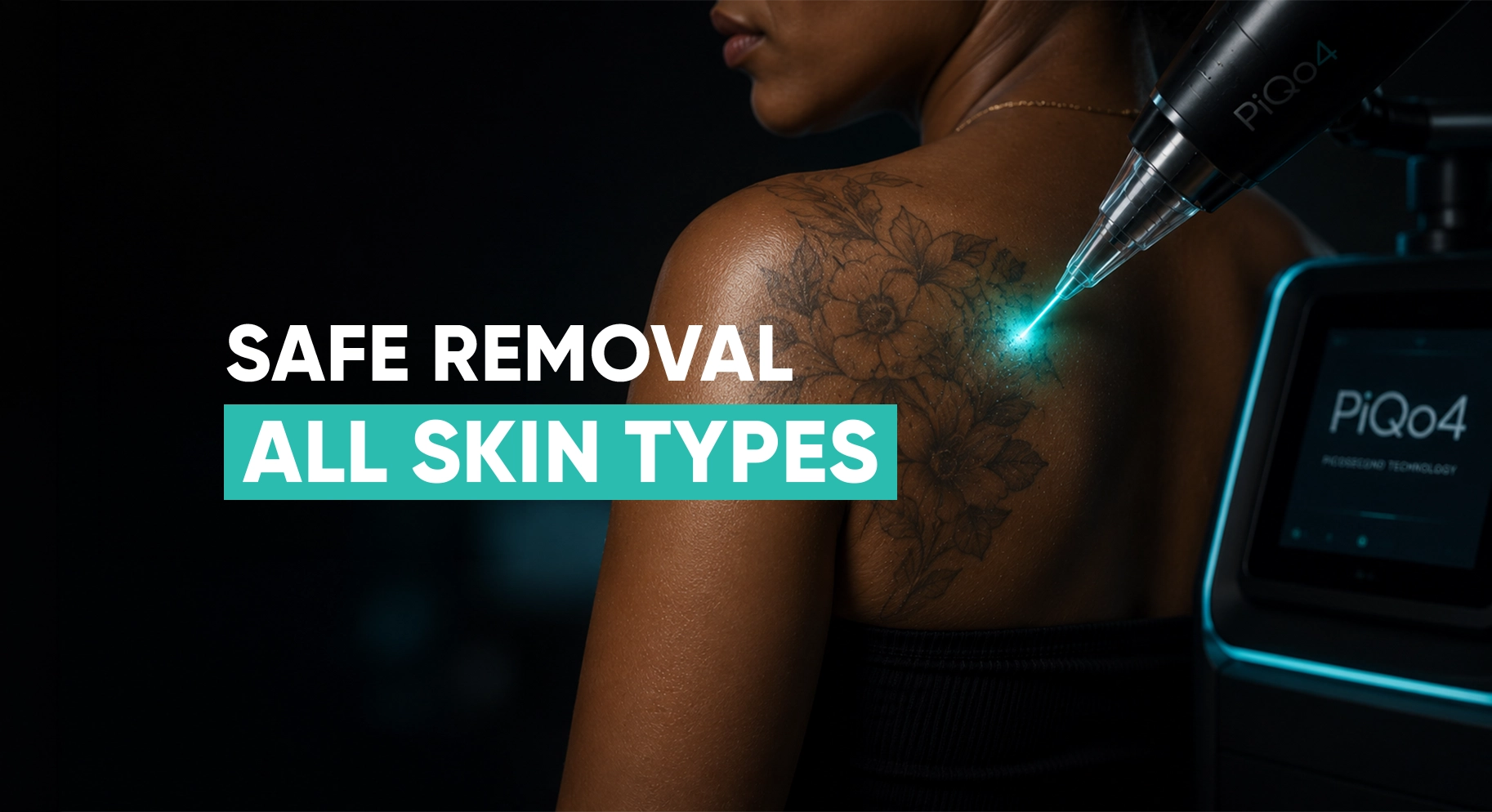
At Perfect B, we use the PiQo4 laser from Lumenis for all tattoo removal treatments at our Doral clinic. Unlike standard Nd:YAG systems that operate at a single wavelength, the PiQo4 delivers four distinct wavelengths: 532nm, 585nm, 650nm, and 1064nm. Each wavelength targets different ink pigments and behaves differently in relation to melanin. The 1064nm wavelength, which is the deepest penetrating and the least absorbed by melanin, is the primary wavelength used on darker skin types and the reason picosecond technology at this wavelength is considered the safest option for Fitzpatrick IV through VI. A clinical review in StatPearls confirming the photomechanical advantages of picosecond technology over Q-switched systems across multiple ink types and skin tones, including Fitzpatrick IV-VI classifications, supports this approach as the current standard of care for melanin-rich skin.
Picosecond Pulses and Why They Protect Darker Skin Better
The fundamental difference between picosecond and nanosecond laser technology is the pulse duration. Picosecond pulses are approximately 100 times shorter than nanosecond pulses. Shorter pulse duration means the energy is delivered so rapidly that ink particles are shattered by photomechanical pressure, the acoustic shockwave created by the ultra-fast energy delivery, rather than by heat. The photomechanical mechanism produces significantly less residual thermal energy in the surrounding dermis compared to older Q-switch systems.
For darker skin patients, less heat in the dermis means lower risk of triggering the melanocyte response that causes post-inflammatory hyperpigmentation. The PiQo4 picosecond pulses also fragment ink into smaller particles than Q-switch lasers, which allows the lymphatic system to clear ink more efficiently between sessions. This means fewer sessions overall, even when conservative fluence settings are required for patient safety on darker skin.
What Perfect B’s Protocol Looks Like for Fitzpatrick IV and V Patients
For Fitzpatrick IV and V patients at our Doral clinic, we make three standard adjustments from our baseline protocol: we select the 1064nm wavelength as the primary treatment channel, we reduce fluence settings to deliver therapeutic energy to the ink while minimizing thermal load on the surrounding dermis, and we extend the interval between sessions to allow conservative healing and prevent cumulative inflammation. We also evaluate any tan on the treatment area before each session. Treating tanned skin significantly increases the risk of hypopigmentation and blistering, and we postpone sessions when a patient has had recent UV exposure in the treatment area. You can learn more about how the PiQo4 and Fitzpatrick classification determine the full protocol at Perfect B in Doral in our complete clinical guide.
What About Colored Tattoos on Dark Skin?
Why Most Clinics Stop at Black Ink for Darker Skin Types
One of the most significant limitations of standard single-wavelength laser systems is that treating colored ink on darker skin types requires wavelengths that carry higher melanin absorption risk. NAAMA Studios, a well-regarded tattoo removal clinic in the UK, states directly on their website that colored tattoo removal can only be performed on Fitzpatrick I through III skin types because the laser settings required for color removals put darker skin at high risk of melanin damage. This limitation is real for clinics using systems designed around a single or dual wavelength that is primarily optimized for lighter skin.
How the PiQo4’s Multi-Wavelength Capability Changes the Answer
The PiQo4’s four-wavelength platform allows us to match the specific wavelength to both the ink color and the patient’s skin type simultaneously. For a Fitzpatrick IV patient with a multicolor tattoo, we approach each color in the tattoo differently: black and dark blue ink at 1064nm, which has minimal melanin absorption at depth; certain color ranges at 585nm and 650nm with adjusted fluence settings specific to the patient’s melanin concentration; and for the most challenging colors, we evaluate whether the pigment absorption spectrum creates a safe margin at the available wavelengths on that patient’s specific skin type.
The result is that at Perfect B, we treat multicolor tattoos on Fitzpatrick III and IV patients regularly. Fitzpatrick V patients with colored tattoos are evaluated case by case based on specific ink colors and their absorption spectra. This is a direct clinical capability advantage created by the PiQo4 platform that single-wavelength systems cannot match. A peer-reviewed review in Lasers in Medical Science confirming the clinical safety and efficacy of picosecond Nd:YAG lasers for tattoo removal across Fitzpatrick III-VI skin types with reduced risk of hyperpigmentation compared to nanosecond systems provides the evidence base for why we favor this approach.
What Realistic Results Look Like for Fitzpatrick III-VI Patients
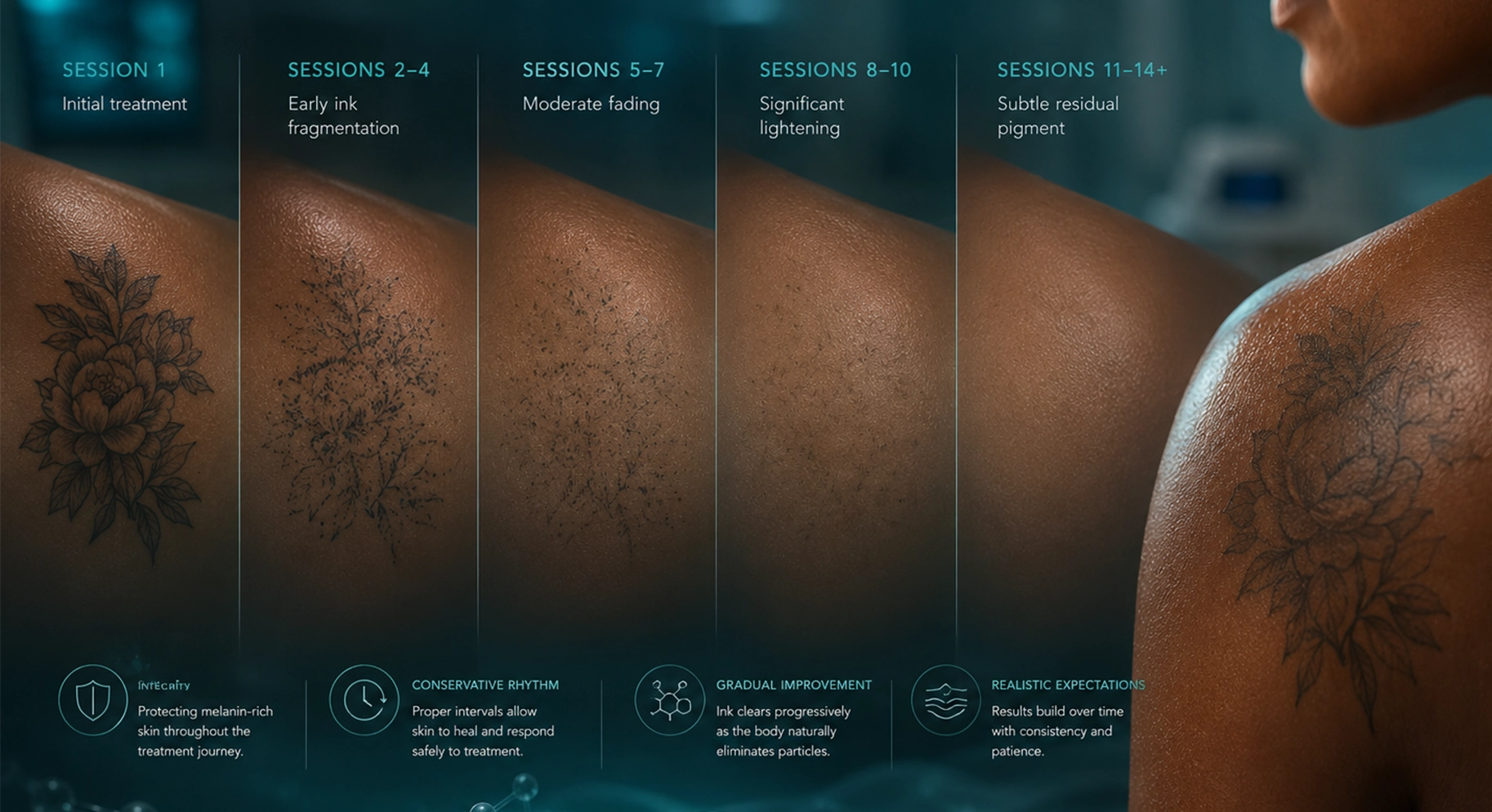
Session Count: What to Expect vs Lighter Skin
The honest answer is that Fitzpatrick IV-VI patients require more sessions than lighter skin types for the same tattoo. This is not a failure of the technology. It is the clinical reality of treating darker skin conservatively and correctly. Conservative fluence settings mean less energy per session, which means less ink fragmented per session, which means more sessions to achieve the same clearance. The alternative, using higher fluence to match lighter-skin session counts, increases the risk of adverse pigmentation outcomes and is not how we practice.
At Perfect B, black ink tattoos on Fitzpatrick III skin typically require 6 to 8 sessions with PiQo4 picosecond technology. The same tattoo on Fitzpatrick IV to V skin typically requires 8 to 12 sessions. Multicolored tattoos on darker skin types generally require 10 to 14 sessions or more, depending on the ink colors present and how they respond to the available wavelengths. Complete clearance is achievable for most patients on all Fitzpatrick types. It requires realistic expectations and a protocol that prioritizes skin safety over speed.
Ink Colors and Which Respond Fastest
Black and dark blue inks respond best and fastest on all skin types because the 1064nm wavelength has high absorption in those pigments and low absorption in melanin at depth. For darker skin patients, this means black ink removal is the most predictable and manageable indication. Green, blue, and bright colors require additional wavelengths and respond more slowly. Yellow ink is the most challenging across all skin types because its absorption peak sits at very short wavelengths that require careful application on darker skin to avoid collateral damage. We evaluate every tattoo’s ink composition at consultation and provide a realistic color-by-color clearance expectation before treatment begins.
The Miami Factor: Why South Florida Patients Need Extra Protocol Attention

Doral and greater Miami present a specific set of environmental variables that add clinical complexity to tattoo removal on darker skin beyond what patients in other regions face. South Florida has year-round UV intensity, ambient temperatures that stay above 80 degrees for most of the year, and high humidity. These factors create a higher baseline risk of post-inflammatory hyperpigmentation for treated skin.
A treated tattoo area has compromised barrier function and significantly reduced melanin protection in the days and weeks following a session. UV exposure during this window is one of the most reliable ways to trigger persistent hyperpigmentation that can outlast the tattoo itself. For a patient in Chicago or Seattle, avoiding sun exposure after treatment is easier because sun intensity is lower and seasonal. For a patient in Doral or Brickell, avoiding meaningful UV exposure requires deliberate daily effort regardless of season.
Our aftercare protocol for all tattoo removal patients at Perfect B includes specific South Florida guidance: zinc-based broad-spectrum SPF applied to the treatment area every morning without exception, avoidance of direct UV exposure on treated skin for a minimum of 4 to 6 weeks post-session, and immediate notification if any unexpected pigmentation change appears between sessions. For Fitzpatrick III through V patients, we also monitor the treatment area at the start of each session before proceeding, and we delay treatment if there is evidence of tan or active inflammation in the area. You can review our complete post-session aftercare and healing protocol for laser tattoo removal at Perfect B in Doral, FL for the full guidance we provide every patient.
What Your First Consultation at Perfect B Looks Like
Every tattoo removal consultation at Perfect B in Doral begins with a structured clinical evaluation before any treatment is discussed. We assess your Fitzpatrick skin type under consistent lighting, evaluate recent sun exposure history for the treatment area, review any prior tattoo removal attempts and their outcomes, and confirm that the skin in the treatment area is not actively tan or inflamed. We then evaluate the tattoo itself: size, age, ink density, colors present, and estimated depth based on the tattoo’s age and visual characteristics.
From that evaluation, we build a personalized protocol: wavelength selection for each ink color in your tattoo, starting fluence settings calibrated to your Fitzpatrick type, session interval, and a realistic clearance estimate based on your specific ink and skin combination. We do not use standardized treatment cards applied uniformly to all patients. The demographic reality of our clinic, where the majority of patients are Fitzpatrick III through V from across Miami-Dade, Brickell, Hialeah, and Kendall, means this individualized approach is not the exception. It is how every patient is treated. Read our full session-by-session healing guide for laser tattoo removal at Perfect B in Doral, FL to understand what to expect at each stage of the process.
Frequently Asked Questions
1. Can people with dark skin get tattoos removed?
Yes. Laser tattoo removal is safe and effective for all Fitzpatrick skin types when performed by a provider using appropriate technology and protocol adjustments. At Perfect B in Doral, the majority of our tattoo removal patients are Fitzpatrick III through V, and we treat them using the PiQo4, a multi-wavelength picosecond platform that allows precise wavelength selection and conservative fluence calibration for melanin-rich skin.
2. What laser is safest for tattoo removal on dark skin?
Picosecond lasers at 1064nm are the safest option for Fitzpatrick IV through VI skin because the photomechanical mechanism minimizes thermal energy deposited in the surrounding dermis, significantly reducing the risk of post-inflammatory hyperpigmentation compared to Q-switched nanosecond systems. At Perfect B, we use the PiQo4 from Lumenis, which delivers four wavelengths in both picosecond and nanosecond modes, allowing precise ink-specific targeting with skin-type-appropriate settings.
3. How many sessions does tattoo removal take on dark skin?
More than on lighter skin, because conservative fluence settings are required. At Perfect B, black ink on Fitzpatrick III skin typically requires 6 to 8 sessions with PiQo4 picosecond technology. Fitzpatrick IV to V patients typically require 8 to 12 sessions for black ink, and 10 to 14 or more for multicolored tattoos. Complete clearance is achievable for most patients. The exact count depends on ink depth, color composition, tattoo age, and how the skin responds over time.
4. Can colored tattoos be removed from dark skin?
Yes, with the right technology. Standard single-wavelength systems often cannot safely treat colored ink on darker skin because the required wavelengths carry higher melanin absorption risk. The PiQo4’s four-wavelength platform allows us to match each ink color to an appropriate wavelength while calibrating fluence for the patient’s Fitzpatrick type. At Perfect B, we regularly treat multicolored tattoos on Fitzpatrick III and IV patients. Fitzpatrick V with colored ink is evaluated case by case based on specific pigment colors.
5. What is the main risk of tattoo removal on dark skin?
Post-inflammatory hyperpigmentation, a temporary darkening of the treated area driven by melanocyte response to heat or inflammation. It is largely preventable with conservative fluence settings, extended healing intervals between sessions, and strict sun protection during recovery. At Perfect B, we also monitor the treatment area at the start of each session and delay treatment if there is evidence of active tan or inflammation, which is a particularly important precaution for South Florida patients with year-round UV exposure.
6. Does Perfect B treat tattoo removal patients with darker skin in Doral?
Yes. Fitzpatrick III through V patients represent the majority of our tattoo removal practice. Our protocol is calibrated for this population, our technology is selected for it, and our aftercare guidance reflects the specific demands of recovering from laser treatment in South Florida’s climate. Patients come to our Doral clinic from across Miami-Dade, including Coral Gables, Hialeah, Brickell, Kendall, and Homestead.
Closing: The Right Technology and the Right Protocol Make All the Difference
Tattoo removal on dark skin is not more dangerous than on lighter skin. It is more demanding, and it requires a provider who has the right equipment and the clinical knowledge to use it correctly. The PiQo4’s multi-wavelength picosecond platform, combined with Fitzpatrick-specific protocol adjustments, makes safe and effective tattoo removal achievable for Fitzpatrick III through VI patients, including those with multicolored tattoos that many clinics decline to treat. At Perfect B in Doral, this is not a specialty service. It is our standard of care for the South Florida community we serve.
If you have been told your skin type makes tattoo removal too risky, or if you have had a disappointing result elsewhere, the starting point is a consultation that actually evaluates your Fitzpatrick type, your specific tattoo, and builds a protocol from there rather than applying a generic template.
- 📍 Visit us at Perfect B, 8200 NW 41st St Suite 200, Doral, FL 33166
- 📞 Call or message us at (786) 502-2260