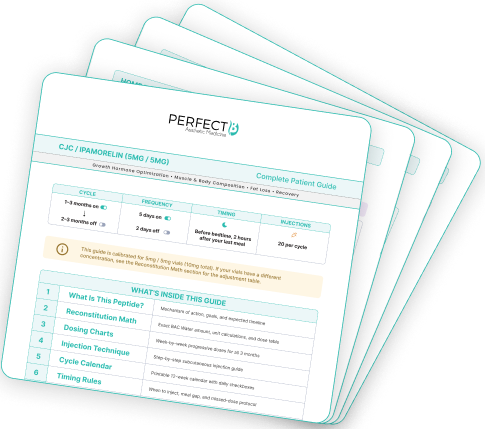
Curious What a Real Peptide Protocol Looks Like?
Perfect B’s peptide protocol tool is built on real clinical data from supervised patients in South Florida.
Perfect B, Doral Fl. | 07.27.26 | 10 min read.
This article is for general education and is not medical advice. Peptide therapy is prescription medicine that must be evaluated, prescribed, and monitored by a licensed provider after an in-person assessment and appropriate labs. Whether any peptide is right for you is a clinical decision. If you are comparing clinics, start with how to tell a legitimate peptide clinic from a risky online seller in Miami.
What Is Peptide Therapy? The Short Answer
Peptide therapy is the medical use of peptides, short chains of amino acids that act as signals in the body, to support a specific health or wellness goal. Your body already makes thousands of peptides that tell cells what to do: repair this tissue, release that hormone, regulate appetite. Peptide therapy uses select, well studied peptides, prescribed and monitored by a provider, to support those same processes. Done right, it is real medicine with a real plan, not a vial bought off a website. This guide explains what peptides are, what people use them for, how supervised therapy actually works, whether they are safe, and how to start the right way.

Key Takeaways
- Peptides are short chains of amino acids that act as natural signals in the body.
- Peptide therapy uses select, studied peptides, prescribed and monitored by a licensed provider.
- People explore it for recovery, metabolic and weight goals, skin and hair, and energy and longevity.
- Peptides are not anabolic steroids, and they are not a magic shortcut; results come with a plan.
- Supervision is the whole point: labs, the right peptide and dose, a reputable source, and follow-up.
- They are prescription medicine, so avoid any seller offering them with no exam and no provider.
- Cost depends on your protocol, so it is confirmed at your consultation, with financing available.
What Peptides Actually Are
A peptide is simply a short chain of amino acids, the same building blocks that make up proteins, just smaller. In the body they work as messengers, binding to receptors and telling cells to carry out a task. That is why a peptide can be so targeted: rather than flooding your system, it nudges one specific pathway. Peptides are also one of the fastest growing classes of modern medicine, with an expanding pipeline of therapeutic uses (a 2026 review of peptides in modern drug discovery and their therapeutic directions). Importantly, therapeutic peptides are not anabolic steroids and not the same as taking a hormone; they are their own category.
What People Use Peptide Therapy For
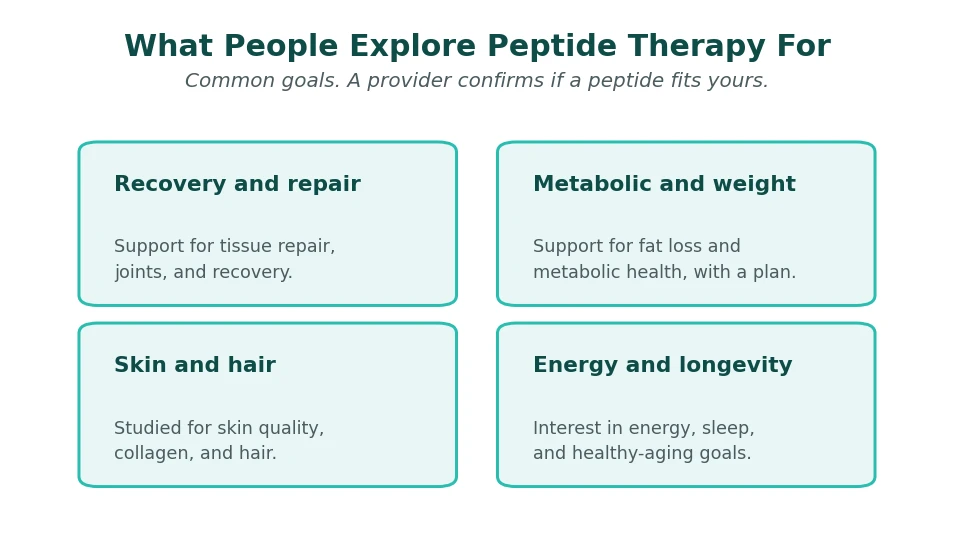
Different peptides do different jobs, so people come to peptide therapy with different goals. The most common fall into four buckets: recovery and tissue repair, metabolic and weight support, skin and hair quality, and energy and healthy aging. What matters is matching the right peptide to a goal that is realistic for you, which is exactly what a provider is for.
A note on realistic expectations
Peptides are a tool, not a miracle. They work best alongside the basics: sleep, protein, training, and a plan you actually follow. A good provider will tell you when a peptide is likely to help and when it is not worth your money, which is the opposite of what an online seller does. For weight goals specifically, it helps to understand how peptides for weight loss compare with Ozempic and where each fits in a plan.
How Supervised Peptide Therapy Works
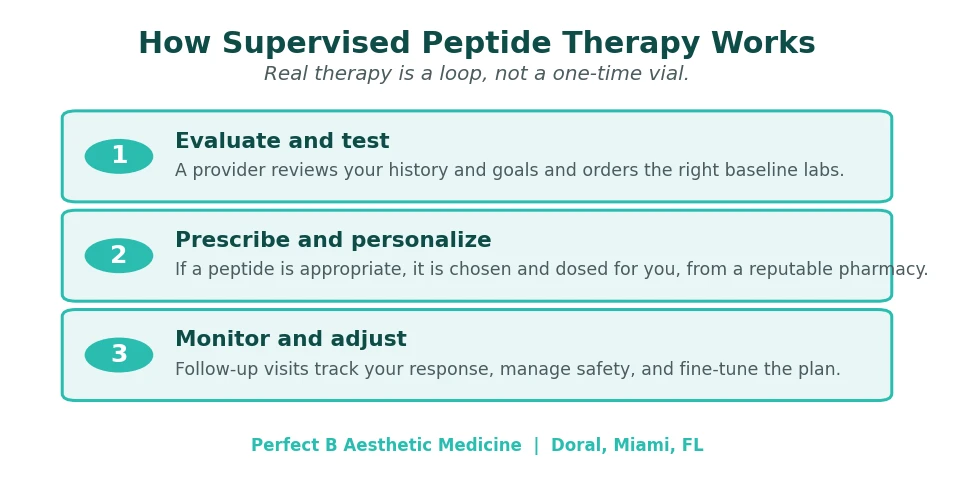
Real peptide therapy is a loop, not a one-time purchase. It starts with an evaluation and the right baseline labs, moves to a personalized prescription from a reputable pharmacy if a peptide is appropriate, and continues with follow-up so your provider can track your response and keep you safe. Clinicians now publish practical guidance on how injectable peptide therapy is used and monitored, a sign of how mainstream and structured it has become (a 2026 physician primer on how injectable peptide therapy is used and monitored).
Why “supervised” is the whole point
Across thousands of supervised peptide protocols in South Florida, the pattern is consistent with the literature: the people who do well treat peptides as medicine, with labs, a real plan, and follow-up. The evaluation catches what is not safe for you, the pharmacy sourcing protects quality, and the monitoring is where a provider adjusts the plan. If you have wondered whether peptides are self-administered, many are given by a simple injection, and here is how peptides are reconstituted and injected safely under provider guidance.
Peptides for Skin and Hair
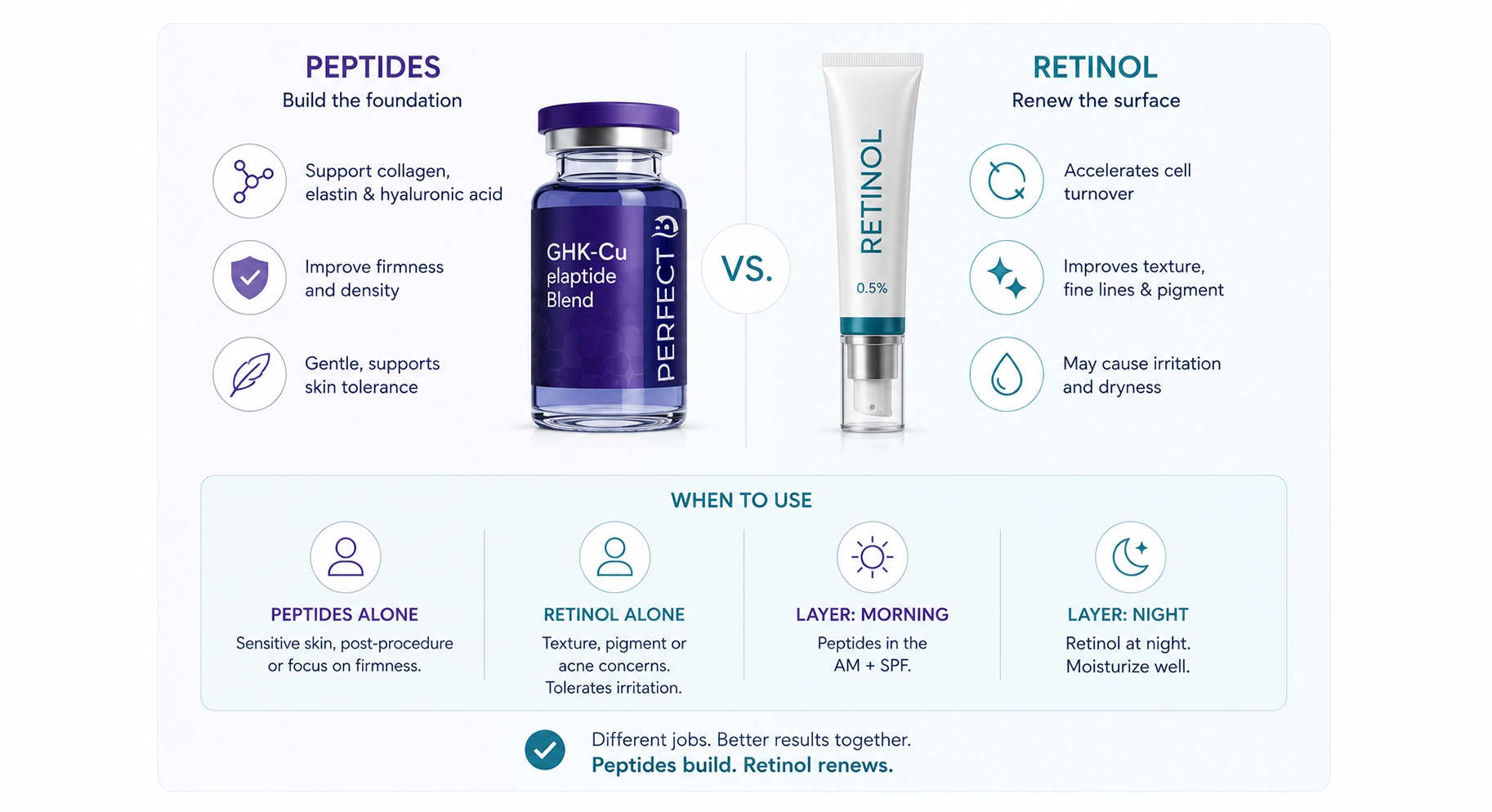
One of the most popular entry points is skin. Certain peptides support collagen and skin quality, and they are often used alongside, not instead of, proven topicals. The difference in jobs is worth understanding: peptides help build the foundation while a retinol renews the surface, and they can complement each other in a plan.
Are Peptides Safe?
When a peptide is appropriate for you, sourced from a reputable pharmacy, dosed correctly, and monitored, the safety picture is reassuring, which is why physicians are publishing clinical guidance on their use. The real risks come from the other path: unregulated product bought online, no exam, no labs, and no one accountable for your plan. A legitimate clinic screens your history and conditions, uses pharmacy-grade product, and follows up. That oversight is not red tape, it is the safety.
Peptides vs Steroids, HGH, and GLP-1s
Peptides are often confused with other categories, so a quick map helps. They are not anabolic steroids, which are synthetic hormones with a very different risk profile. They are not the same as growth hormone itself, though some peptides interact with that axis. And GLP-1 medications for weight loss are technically peptides too, which is why the lines can blur. The practical point is that each tool has its place, and a provider helps you choose based on your goal rather than the label. For a high-performance mindset on this, see how a high performer should approach peptides as supervised medicine, not a shortcut.
What Does Peptide Therapy Cost?
Cost depends on which peptide you are prescribed, your protocol, and how long you are on it, so we confirm your price at your consultation rather than posting one number that would not fit everyone. To keep it manageable, Perfect B offers financing through Cherry, Klarna, Afterpay, and CareCredit. For a fuller breakdown of what drives the price, see our guide on what peptide therapy typically costs and what actually drives the price.
Getting Started with Peptide Therapy in Doral
If peptide therapy sounds like a fit, the right first step is a consultation so a provider can review your goals and labs and tell you honestly whether a peptide makes sense for you. Perfect B is a provider-led clinic in Doral serving greater Miami, and our plans are built and monitored in person, backed by hundreds of local reviews. Call us at +1 786 502 2260 or book online to start.
Frequently Asked Questions
What is peptide therapy in simple terms?
It is the medical use of peptides, short chains of amino acids that act as signals in the body, prescribed and monitored by a provider to support a specific goal like recovery, metabolic health, skin, or energy.
Are peptides safe?
When appropriate for you, sourced from a reputable pharmacy, dosed correctly, and monitored, the safety picture is reassuring. The risk comes from unregulated product bought with no exam, no labs, and no provider.
Are peptides legal, and do I need a prescription?
Therapeutic peptide therapy is prescription medicine and should be provided by a licensed clinic. Products sold as “research use only” with no provider are a red flag, not a legal shortcut.
Do peptides actually work?
For the right person and goal, peptides can help, and clinicians increasingly use them in structured, monitored protocols. They work best with the basics in place, and a provider will be honest about what is realistic for you.
How are peptides taken?
Many peptides are given as a small subcutaneous injection, and some come in other forms. Your provider shows you how, and you can read how peptides are reconstituted and injected safely in our dedicated guide.
Are peptides the same as steroids?
No. Therapeutic peptides are short amino acid signals, not anabolic steroids, and they are their own category of medicine with a different purpose and risk profile.
Where should I start with peptide therapy near me?
Start with a consultation at a legitimate, provider-led clinic that requires an exam and labs. If you are in Doral or greater Miami, Perfect B can evaluate whether a peptide is right for you and build a monitored plan.
→ Ready to explore it the right way? Call +1 786 502 2260 or book online to schedule your peptide therapy consultation at Perfect B in Doral.