Perfect B, Doral Fl. | 05.04.26 | 10 min read.
This content is for educational purposes only and does not constitute medical advice. Consult a qualified medical provider before beginning any peptide therapy protocol. All peptide medications referenced on this page require a clinical evaluation and prescription from a licensed provider. Results vary by patient.
Do Sermorelin Pills and Tablets Actually Work? The Short Answer Is No
Sermorelin is one of the most searched growth hormone peptides on the internet, and the demand for a convenient oral version is real. The problem is biological, not commercial. A peptide composed of 29 amino acids cannot survive the gastrointestinal tract intact. By the time an oral sermorelin tablet has passed through your stomach, the compound that could have signaled your pituitary gland to release growth hormone no longer exists in a form capable of doing that. Whether you are asking do sermorelin tablets work or do sermorelin pills work, the clinical answer is the same: not in the way the people selling them suggest. If your IGF-1 is the number you are trying to move, oral sermorelin will not move it.
Key Takeaways
- Do sermorelin tablets work? No, and the reason is irreversible: Gastric enzymes and hydrochloric acid hydrolyze the 29-amino-acid chain before it reaches the bloodstream, leaving free amino acids with no pituitary signaling capacity.
- IGF-1 does not rise with oral or sublingual sermorelin: IGF-1 is the measurable marker of growth hormone activity. Patients who use oral formulations consistently show no meaningful change in IGF-1 levels after weeks or months of use.
- Sublingual delivery faces the same absorption barrier: At 29 amino acids, sermorelin is too large for reliable mucosal absorption. Sublingual works for small molecules like nitroglycerin, not for peptides of this molecular weight.
- Unregulated sermorelin products are a recognized consumer risk: Any sermorelin product sold without a prescription, through online marketplaces, or without a licensed compounding pharmacy is operating outside FDA oversight guidelines for compounded medications.
- CJC-1295 with Ipamorelin outperforms sermorelin in any delivery form: This combination stimulates growth hormone through dual receptor activation, produces longer-lasting pulses than sermorelin’s short half-life allows, and does not increase cortisol or appetite.

What Is Sermorelin and Why Is There a Market for Sermorelin Peptide Pills?
Sermorelin is a synthetic 29-amino-acid peptide that mimics growth hormone-releasing hormone (GHRH), the signal the hypothalamus sends to the pituitary gland to trigger growth hormone release. It was FDA-approved in 1997 under the brand name Geref for growth hormone deficiency in children, administered exclusively as a subcutaneous injection. That product was discontinued by the manufacturer and is no longer available. What circulates in the market today is compounded sermorelin, produced by licensed 503A compounding pharmacies under prescriber supervision, in injectable form.
The demand for sermorelin peptide pills and oral tablets grew as the compound became more widely searched in adult anti-aging and wellness contexts. Injecting a medication daily creates friction for some patients, and marketers recognized that. The result is a category of sermorelin peptide pills, capsules, and sublingual tablets that carry the sermorelin name, sometimes combined with other peptide fragments or amino acids, and sells without a prescription requirement. The clinical question, which most of those product pages avoid answering directly, is whether any version of oral sermorelin can actually reach the pituitary intact and stimulate growth hormone release. The answer, based on the molecular biology of the compound and the consistent IGF-1 data we see in clinical practice, is no.
Why the Digestive System Destroys Sermorelin Before It Can Reach the Pituitary
Physiologically, sermorelin is a peptide composed of 29 amino acids, which means the digestive system simply recognizes it as just another protein, similar to a piece of meat. Once ingested, gastric enzymes and hydrochloric acid hydrolyze the peptide before it can reach the bloodstream intact, eliminating its ability to stimulate the pituitary gland. For a peptide to be orally bioavailable, it would require complex encapsulation technology to survive the gastric pH, something that is not feasible given sermorelin’s chemical structure. For this reason, the subcutaneous route remains the only clinically validated method of administration. Any marketing of sermorelin tablet forms is typically a red flag for an unregulated product or a basic amino acid supplement disguised as hormone therapy.
This is not a failure of formulation quality or dosage. A 500 mcg oral sermorelin tablet does not fail because the dose is wrong. It fails because the active molecule is dismantled by the digestive process before it can bind to GHRH receptors in the pituitary. The free amino acids that arrive in the bloodstream after digestion have no signaling specificity. They are building blocks with no destination address. The question of whether do sermorelin pills work is not a matter of finding the right brand or the right dose. It is a matter of chemistry that does not favor oral delivery for this class of peptide. The sermorelin pills vs injections comparison is not a consumer preference question. It is a biological one.

Why Encapsulation Technology Does Not Solve This for Sermorelin
Some manufacturers attempt to address oral bioavailability through lipid nanoparticles, enteric coatings, or cyclodextrin complexes. These strategies have succeeded for small-molecule drugs and a limited number of short peptide fragments. Sermorelin’s size and structural complexity make it a poor candidate for any of these approaches at commercially viable concentrations. The peptide needs to arrive at pituitary GHRH receptors intact and in sufficient concentration to produce a measurable GH pulse. No oral delivery system currently meets that threshold for a 29-amino-acid GHRH analog. Research published in the Journal of Clinical Endocrinology and Metabolism confirming that growth hormone secretagogues require parenteral administration to produce measurable IGF-1 elevation and pituitary GH response makes this point clearly at the endocrine level.
What About Sublingual Sermorelin? Why Under-the-Tongue Delivery Still Falls Short
Sublingual delivery bypasses the stomach entirely, which is why it works well for small molecules like nitroglycerin, certain hormones, and B12. The sublingual mucosa allows direct absorption into systemic circulation without gastric acid exposure. This is a legitimate pharmacological route for the right compounds. Sermorelin is not one of them, and understanding why requires looking at molecular weight rather than just route of administration.
At 29 amino acids, sermorelin is significantly larger than the molecules that absorb reliably through sublingual mucosa. Molecular size directly limits mucosal permeability, and peptides above a certain threshold do not cross the sublingual epithelium in clinically predictable amounts. The fraction of intact sermorelin that reaches systemic circulation through this route is not consistent across patients, is not validated in controlled clinical trials for adult GH optimization, and is not comparable to what subcutaneous injection achieves in terms of IGF-1 response. We have seen patients at our clinic in Doral who used sublingual sermorelin formulations for several months with no measurable change in IGF-1 levels. That is the objective test that matters, and sublingual delivery does not pass it reliably. Compounding pharmacies that produce sermorelin rapid-dissolve tablets are selling a legal compounded product with a valid prescription, but most of those product pages do not tell patients the critical distinction between dissolving quickly and absorbing clinically.
Not sure which peptide protocol fits your goals?
Perfect B’s peptide protocol tool is built on real clinical data from 2,000+ patients treated in South Florida.
Answer 6 questions and see what patients with similar goals are running: which peptides they use, typical dosing, injection schedule, reconstitution steps, cycle length, and when they pause.
The IGF-1 Test: The Only Honest Answer to Whether Sermorelin Pills Work
IGF-1, insulin-like growth factor 1, is the downstream marker of growth hormone activity. When the pituitary releases GH in response to GHRH stimulation, the liver produces IGF-1. Measuring IGF-1 before starting a peptide protocol and again at weeks four and eight is how a medical provider confirms that the therapy is working at the biological level it is supposed to work. Patients who ask do sermorelin tablets work deserve a lab-based answer: injectable sermorelin patients see IGF-1 begin to rise within weeks three to four. Patients using oral or sublingual sermorelin formulations consistently show no meaningful change in those same labs.
In clinical practice, it is common to see frustrated patients who tried oral or sublingual versions without noticing any changes in body composition, energy levels, or sleep quality. Results are usually nonexistent because IGF-1 levels do not increase with these formulations. When patients transition to injectable therapy, they often experience noticeable improvements in muscle recovery and lipid metabolism within a matter of weeks. The difference lies in direct bioavailability, allowing the chemical signal to reach the appropriate receptors without digestive interference. The sermorelin pills vs injections question resolves itself when you have both sets of lab results side by side.

How to Identify an Unregulated Sermorelin Product Before You Spend Money on It
Not every product that carries the sermorelin name is the same, and not all of them are operating under the same regulatory framework. Patients who ask do sermorelin tablets work are often surprised to find that even legitimate compounded sermorelin tablets from licensed pharmacies cannot produce the IGF-1 response that injectable protocols deliver. Understanding what legitimate compounded sermorelin looks like makes it easier to identify what it does not look like.
- No prescription required: Sermorelin in any compounded form is a prescription medication. A website that sells it without a clinical consultation and an active prescription from a licensed provider is not operating within the legal framework for compounded medications. This applies to oral and injectable formulations equally.
- Sold through Amazon, eBay, or general retail platforms: Legitimate compounded sermorelin is dispensed by licensed pharmacies directly to patients with valid prescriptions. It is not available on general retail marketplaces. If you can add it to a cart without speaking to a provider, it is not the same product.
- No verifiable pharmacy accreditation: Licensed compounding pharmacies carry accreditation through organizations like PCAB or display LegitScript certification. If a product page provides no verifiable pharmacy information or state licensing details, treat that as a material warning sign.
- Claims of “FDA approved” on a compounded product: Compounded sermorelin is not FDA-approved. It is prepared under FDA oversight guidelines for 503A facilities, which is a different standard. Any product claiming FDA approval for a compounded sermorelin formulation is making a factually incorrect claim.
- Price significantly below market rate: A legitimate single-peptide sermorelin protocol from a licensed compounding pharmacy costs several hundred dollars per cycle. Products priced at 30 to 50 dollars per month are not the same compound or the same pharmaceutical grade.
- No requirement for baseline labs or provider follow-up: A responsible prescriber orders IGF-1 and other baseline markers before starting any GH-pathway peptide and monitors them during treatment. A platform that offers sermorelin without lab requirements is not practicing supervised medicine. It is processing orders.
The FDA’s published guidance on human drug compounding, which outlines the oversight standards, testing requirements, and dispensing rules that compounding pharmacies must meet to legally produce peptide medications for patient use, is publicly available and worth reviewing before purchasing any compounded peptide from an unfamiliar source.
What We See at Our Clinic: Patients Who Switched From Oral to Injectable Therapy
The patients who come to Perfect B in Doral having already tried oral or sublingual sermorelin share a consistent clinical picture. They followed the protocol as instructed, took the product for months, and experienced no change they could attribute to the treatment. No shift in body composition. No improvement in sleep architecture. No change in recovery. When we run IGF-1 on these patients at intake, the labs confirm what they reported: no meaningful elevation from baseline, no evidence the pituitary responded to the therapy at all.
When those same patients transition to a properly formulated injectable protocol, the clinical picture changes within weeks. Improved sleep depth is typically the first signal, appearing in the first three to four weeks of a first cycle. Recovery between training sessions improves. The persistent afternoon energy drop that many of these patients described as their baseline begins to stabilize. By weeks six to eight, body composition starts shifting in ways that are visible and measurable. The sermorelin pills vs injections question resolves itself when a patient has IGF-1 labs from both periods in front of them.
This pattern is not unique to South Florida, but it is particularly relevant here because the Miami wellness market is dense and patients in our area are regularly exposed to products and claims that the clinical evidence does not support. At our clinic in Doral, we see patients from across Miami, Hialeah, Kendall, and Westchester who made the same journey from supplement to supervised protocol. The biology does not change by geography, but having a licensed provider who can order your labs, review your response, and adjust your protocol makes a material difference in what actually happens in your body. → Read our complete clinical guide to what sermorelin is, why Perfect B prescribes CJC-1295 with Ipamorelin instead, and what modern growth hormone peptide therapy looks like at a licensed medical clinic in Doral, FL.
Not sure which peptide protocol fits your goals?
Perfect B’s peptide protocol tool is built on real clinical data from 2,000+ patients treated in South Florida.
Answer 6 questions and see what patients with similar goals are running: which peptides they use, typical dosing, injection schedule, reconstitution steps, cycle length, and when they pause.
Why CJC-1295 With Ipamorelin Outperforms Sermorelin in Any Delivery Form
Even patients who move from oral sermorelin to injectable sermorelin are not necessarily on the strongest available protocol for their goals. The growth hormone peptide field has evolved significantly since sermorelin’s approval in the late 1990s, and the combination of CJC-1295 with Ipamorelin represents a clinically superior option for most adults pursuing growth hormone optimization in 2026.
For those seeking more robust results, the combination of CJC-1295 and Ipamorelin represents a stronger alternative than sermorelin alone. While sermorelin has a very short half-life, CJC-1295 provides more sustained stimulation, and Ipamorelin acts selectively without increasing hunger or cortisol levels. The ideal clinical candidate is an adult experiencing symptoms of hormonal decline, such as fatigue, loss of muscle mass, and persistent abdominal fat, who is seeking deeper metabolic optimization through high-purity compounding pharmacy protocols rather than relying on the ineffective quick fixes commonly marketed online.

How the CJC-1295 and Ipamorelin Stack Works at the Receptor Level
CJC-1295 is a modified GHRH analog with a significantly longer half-life than sermorelin, achieved through a drug affinity complex that binds it to albumin in the bloodstream. This extends the GH-stimulating signal from minutes to days. Ipamorelin works through the ghrelin receptor pathway, a separate and complementary mechanism to CJC-1295’s GHRH action. The result of combining both is a larger, more sustained GH pulse that neither compound produces alone, without the cortisol elevation or appetite stimulation associated with older secretagogues like GHRP-2 or GHRP-6.
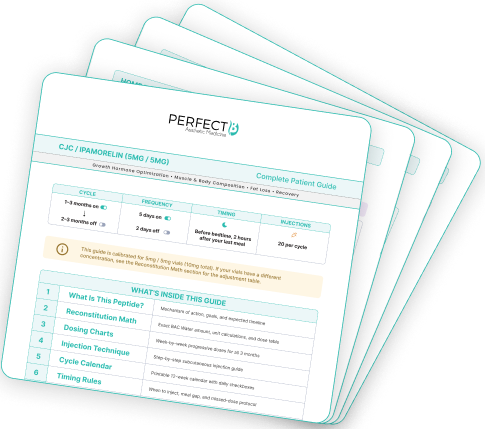
At Perfect B, every patient who qualifies for a CJC-1295 with Ipamorelin protocol starts with a clinical intake, body composition assessment, and baseline IGF-1 measurement. Your provider builds the protocol around what we are actually trying to move clinically, not a default dose. Follow-up check-ins at weeks four and eight allow us to assess your response and adjust if needed. For patients whose primary concern is visceral fat reduction specifically, our clinical comparison of Tesamorelin versus Sermorelin, which covers the FDA-approval data behind Tesamorelin’s fat loss indication and why it outperforms sermorelin for that specific goal, covers that decision in detail. → Read our complete clinical guide to CJC-1295 with Ipamorelin, including how the dual-receptor mechanism works, what IGF-1 results look like at 3 and 6 months, and how it compares to sermorelin.
Frequently Asked Questions
1. Can sermorelin be taken as a pill or tablet?
Sermorelin is not clinically effective in pill or tablet form. The only validated route of administration is subcutaneous injection. Compounding pharmacies do produce rapid-dissolve sublingual tablets and they are sold with a prescription, but the clinical evidence for meaningful IGF-1 elevation through this route is not comparable to injectable therapy. When patients at our Doral clinic ask about this, we explain that the injection is not optional. It is the mechanism by which the therapy works at all.
2. Why do peptides like sermorelin get destroyed in the stomach?
Sermorelin is a chain of 29 amino acids. The digestive system does not recognize it as a hormone. It recognizes it as a protein and processes it exactly the way it would process any dietary protein. Gastric acid and proteolytic enzymes break the peptide bonds before the molecule can cross the intestinal wall intact. By the time anything reaches the bloodstream, the original peptide structure is gone. What remains are free amino acids with no signaling capacity and nothing that can bind to GHRH receptors in the pituitary to trigger growth hormone release.
3. Are there any oral growth hormone supplements that actually work?
Nothing available over the counter produces a clinically meaningful increase in growth hormone or IGF-1. Products marketed as oral GH secretagogues, growth hormone releasers, or peptide supplements generally contain amino acid precursors like arginine, lysine, and ornithine, which have modest effects on GH in very specific fasted conditions but nothing close to what a prescribed injectable peptide protocol achieves. If a product does not require a prescription and does not come from a licensed compounding pharmacy, it is not the same category of treatment.
4. What is the difference between sermorelin injections and sermorelin pills?
The difference is bioavailability. Injectable sermorelin is delivered subcutaneously, bypasses the digestive system entirely, enters the bloodstream intact, and reaches the pituitary gland where it binds to GHRH receptors and triggers a growth hormone pulse. This produces a measurable rise in IGF-1 within weeks. Oral sermorelin is destroyed before it gets anywhere near the pituitary. When patients ask us do sermorelin pills work, the honest clinical answer is that the sermorelin pills vs injections comparison is not between two formulations of the same treatment. One works through a validated biological mechanism. The other does not clear the first obstacle, which is surviving the stomach.
5. Is sublingual sermorelin any more effective than oral tablets?
Sublingual delivery does bypass gastric digestion, which is why it works well for small molecules like nitroglycerin or certain hormones. The problem with sermorelin is its size. At 29 amino acids, it is too large for reliable mucosal absorption under the tongue. Some fraction may cross the sublingual mucosa, but the amount that reaches systemic circulation intact is not clinically predictable or consistent across patients. We have seen patients who used sublingual sermorelin for several months with no measurable change in IGF-1. That is the test that matters, and sublingual does not pass it reliably.
6. What do patients at Perfect B use instead of sermorelin pills, and why?
At our clinic in Doral, we prescribe CJC-1295 with Ipamorelin for patients who want growth hormone optimization. This combination works through two complementary receptors, produces sustained GH pulses that last longer than sermorelin’s short half-life allows, and does not raise cortisol or appetite the way some older secretagogues do. For patients whose primary goal is visceral fat reduction, we use Tesamorelin, which is FDA-approved for that specific indication and has stronger clinical data for fat metabolism than sermorelin. Neither is available over the counter. Both require a consultation, a clinical evaluation, and a protocol built around the patient’s actual goals and body composition data.
7. How quickly do patients see results with injectable alternatives like CJC-1295 with Ipamorelin?
The first changes most patients notice are in sleep quality and workout recovery, usually within weeks three to four of a first cycle. Sleep becomes deeper and more restorative, and patients who train report less soreness and faster turnaround between sessions. Visible body composition changes, reduced abdominal fat and improved muscle tone, typically become apparent between weeks six and twelve. Skin quality changes including improved firmness and texture develop more gradually and are usually noticeable by month three. The results are cumulative, and each cycle builds on the previous one, which is why we structure protocols across multiple cycles rather than expecting full transformation in 30 days.
8. Are sermorelin pills legal or FDA-approved?
Sermorelin in its original branded form, Geref, was FDA-approved as an injectable for growth hormone deficiency in children. That product has been discontinued by the manufacturer and is no longer available. What exists today is compounded sermorelin, produced by licensed compounding pharmacies under FDA oversight guidelines for 503A facilities. Compounded sermorelin injections are legal when prescribed by a licensed provider and dispensed by an accredited pharmacy. Sermorelin tablets or pills sold without a prescription, through online retailers, or without a required clinical consultation are operating outside that regulatory framework. There is no FDA-approved oral sermorelin product and no standardized safety or efficacy data supporting those formulations.
Not sure which peptide protocol fits your goals?
Perfect B’s peptide protocol tool is built on real clinical data from 2,000+ patients treated in South Florida.
Answer 6 questions and see what patients with similar goals are running: which peptides they use, typical dosing, injection schedule, reconstitution steps, cycle length, and when they pause.
Closing: The Clinical Bottom Line on Sermorelin Pills and What Actually Works
The answer to whether do sermorelin tablets work is settled at the molecular level: they do not produce the IGF-1 elevation that defines a functioning growth hormone protocol. This is not a matter of dosage, brand, or formulation. It is a function of how 29-amino-acid peptides interact with the gastrointestinal tract. Sermorelin in oral form arrives at the bloodstream as free amino acids, not as a growth hormone secretagogue. The difference between a product that carries the sermorelin name and a supervised injectable protocol from a licensed compounding pharmacy is not a preference. It is whether anything measurable happens in your body at all.
At Perfect B in Doral, FL, every peptide protocol starts with a clinical intake, baseline IGF-1 labs, and a provider review of your goals, symptoms, and body composition data. We prescribe CJC-1295 with Ipamorelin and Tesamorelin because the injectable evidence is strong and the results in our South Florida patient population are consistent and measurable. If you have already tried oral sermorelin and nothing changed, the answer is in your IGF-1 labs. If you have not started a protocol yet and want to understand what medically supervised growth hormone peptide therapy looks like from consultation to first injection, that conversation starts with one appointment.
📍 Visit us at Perfect B, 8200 NW 41st St Suite 100, Doral, FL 33166
📞 Call or message us at (786) 502-2260