Perfect B, Doral Fl. | 06.19.26 | 12 min read.
This article is for general educational purposes and does not replace a medical evaluation. Laser tattoo removal involves clinical decisions about wavelength selection, fluence, and skin protection that should only be made by a licensed clinician after an in person consultation.
Key Takeaways
- Amateur tattoos often clear faster than professional tattoos. Shallower placement, lower ink density, and non standardized inks usually mean fewer laser sessions for stick and poke, homemade, and prison tattoos.
- The Kirby-Desai Scale formalizes this difference. The amateur versus professional origin of the tattoo is one of the six predictive factors used to estimate how many laser sessions a tattoo will need.
- DIY tattoo removal methods do not work and damage the skin. Salt scrubs, TCA peels, removal pens, and homemade pastes cause burns and scarring without clearing dermal pigment.
- The four wavelength picosecond approach handles non standardized inks better. Prison soot, India ink, pen ink, and improvised pigments respond more predictably when the clinician has multiple wavelengths available.
- Set realistic expectations on residual ghosting. Very shallow stick and poke work can leave faint pigment shadows or temporary hypopigmentation that take additional time to resolve, especially in Fitzpatrick IV to VI skin.
Why Amateur and Professional Tattoos Behave Differently Under the Laser
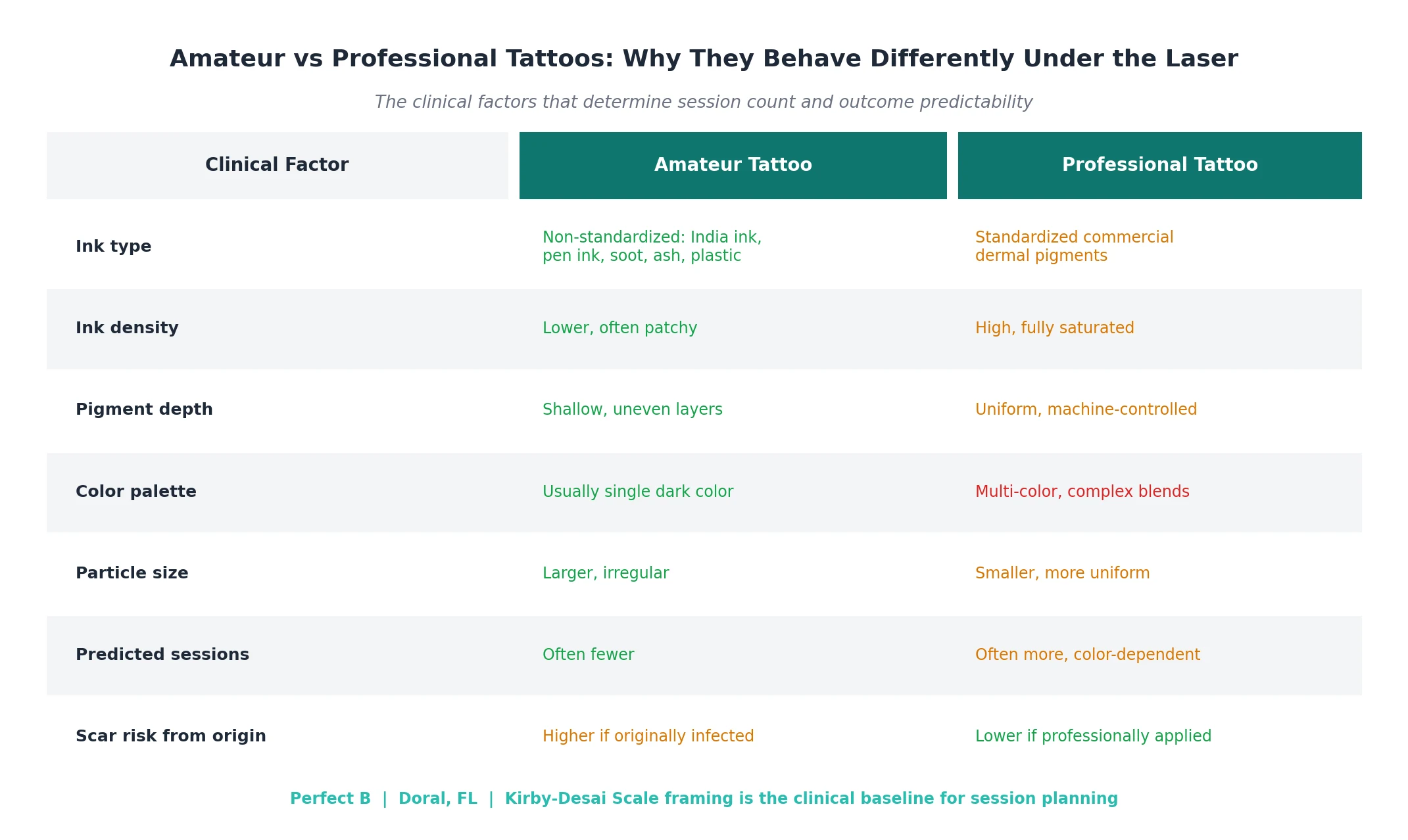
Two patients can walk into the same Doral clinic on the same day, both wanting a small dark tattoo on the forearm removed, and leave with very different treatment plans. One came in with a stick and poke they got at a friend’s apartment in college. The other came in with a professional piece done at a Wynwood studio with a tattoo machine and standardized commercial ink. The clinical reality is that amateur and professional tattoo removal is a different problem in three ways: ink composition, depth of placement, and density of pigment inside the dermis. Each of those differences changes how the picosecond laser interacts with the tattoo, how many sessions are likely, and what the patient should expect to see along the way.
This guide walks through that difference honestly. It covers what each amateur tattoo type is made of (stick and poke, hand poke, homemade, prison ink, and DIY-machine), why amateur tattoos often clear faster than professional pieces, how the Kirby-Desai Scale uses the amateur versus professional distinction as a clinical input, why every DIY tattoo removal method that promises results at home is wrong, and how a real laser tattoo removal plan looks in our Doral, FL medical clinic.
The Kirby-Desai Scale: How Clinicians Estimate Sessions Before You Start
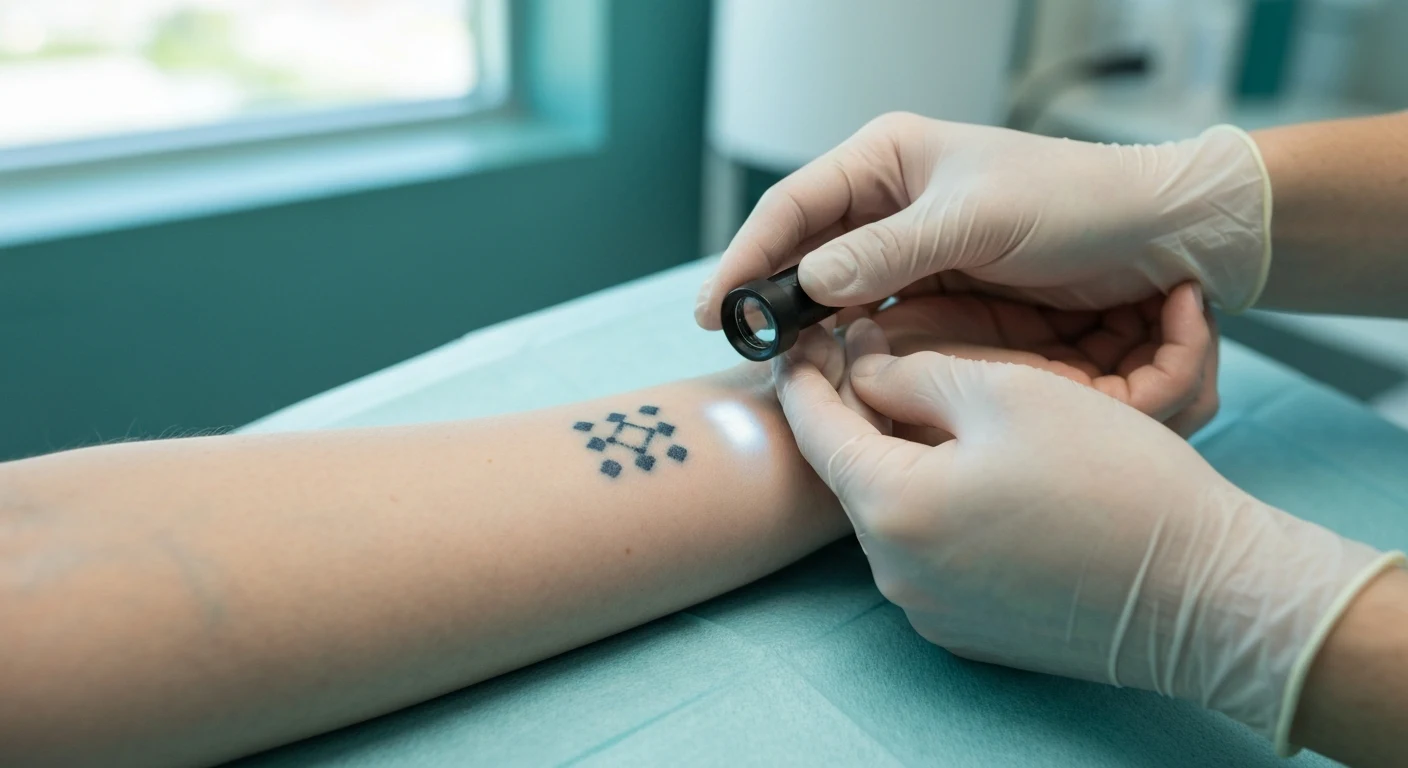
The Kirby-Desai Scale was the first widely adopted clinical tool for predicting how many laser sessions a tattoo will need. A peer-reviewed scoring system published in the Journal of Clinical and Aesthetic Dermatology that uses skin type, location, color, ink amount, scarring, and whether the tattoo is amateur or professional to estimate the number of laser sessions needed turned a long running clinical impression into an actual scoring framework. Each of the six factors gets a numeric score, the scores are added, and the total estimates a session count range for the patient. The amateur versus professional axis sits at the heart of the scale because the original Kirby-Desai authors recognized that homemade and unprofessional tattoos behaved differently from machine-applied commercial work.
What the scale captures, and what a careful clinic uses during the consultation, is that amateur tattoos usually score lower on the ink amount and the depth axes, which means fewer expected sessions. The score is an estimate, not a guarantee. A poorly placed stick and poke that went deep into the dermis behaves more like a professional tattoo than like a typical amateur piece. A light professional piece with sparse pigment can score closer to an amateur range. The scale forces the clinician to look at the actual tattoo in front of them, not at the patient’s story of how it was made.
Stick-and-Poke and Hand-Poke Tattoos: Shallow, Uneven, and Often India Ink
Stick and poke and hand poke tattoos are made one dot at a time with a needle dipped in ink, usually by a friend, a partner, or the patient themselves. The technique creates a tattoo that is almost always shallower than professional work, uneven in depth across the design, and lower in total ink density. The ink most commonly used is India ink (a carbon black suspension) or repurposed pen ink, both of which respond well to laser wavelengths that target dark pigment. For most stick and poke tattoo removal cases, the patient sees meaningful clearance in fewer sessions than a comparable professional tattoo of the same size and location.
The catch with stick and poke removal is the unevenness itself. Because the dots were placed at variable depths, some pigment particles sit very superficially while others sit deeper. The shallow particles can clear quickly and leave the deeper ones visible as a faint shadow, which sometimes requires additional sessions targeted at the residual deeper deposits. Patients should expect their stick and poke tattoo removal plan to look more like a sequence than a single appointment, even if the total session count is lower than for a professional tattoo.
Prison and Homemade Tattoos: Soot, Pen Ink, and Why Composition Matters
Prison tattoos and homemade tattoos add another layer of complexity. The ink is rarely commercial. Common sources in homemade tattoo removal cases include burnt baby oil or melted plastic collected as soot, pen ink from disassembled ballpoint pens, ash mixed with water or shampoo, and improvised pigments made from whatever was available. None of these are standardized, none come in known particle sizes, and none were formulated for dermal deposition. From a laser physics perspective, that lack of standardization is actually helpful for removal, because the irregular ink particles fragment under laser energy without the consistency that makes commercial inks somewhat predictable to remove.
The flip side is that improvised ink composition is unpredictable. The clinician cannot tell in advance whether the pigment in a prison tattoo removal case will fragment cleanly under the standard wavelength or whether it will need multiple wavelengths across the sequence. This is one reason a four-wavelength picosecond device matters for homemade tattoo removal more than for clean professional pieces with known commercial inks.
DIY Tattoo Removal Methods and Why They Fail
The internet sells diy tattoo removal kits, fading creams, salt and lemon scrubs, TCA peels, removal pens, and homemade pastes. None of these clear dermal pigment, because the ink particles in any tattoo, amateur or professional, sit below the epidermis and outside the reach of topical chemistry. What these methods actually do is damage the surface skin while leaving the tattoo intact. Cleveland Clinic’s clinical overview of tattoo removal, which lists whether a tattoo was applied by an amateur or professional as one of the questions providers ask before planning treatment, also clearly states that the only safe and effective methods for clearing dermal pigment are laser, surgical excision, and dermabrasion performed by a clinician. The home-aisle alternatives are not on the list because they do not work.
The real cost of trying diy tattoo removal first is what it does to the skin around the tattoo. Salt and abrasive scrubs cause friction burns and post inflammatory hyperpigmentation. TCA peels at home are unpredictable and can create deeper chemical burns than expected. Removal pens are essentially uncontrolled DIY plasma devices that can scar permanently. Once that damage is done, a clinical removal plan becomes harder, because the laser now has to navigate not only the original tattoo but also the iatrogenic scar tissue and discoloration the home method created. The honest sequence is to start at the clinic, not after.
Professional Tattoos: Standardized Inks, Deeper Placement, More Sessions
Professional tattoos are placed with a tattoo machine that drives ink to a consistent depth, usually about one to two millimeters into the dermis, and that depth is what makes the work lasting and crisp. The inks themselves are commercially manufactured, formulated for dermal use, and standardized in particle size and pigment density. All of those features make a professional tattoo look better on day one and harder to remove on day one of a removal sequence. For most professional tattoo removal cases, the patient is looking at more sessions than a comparable amateur piece, especially when the design uses multiple colors. Our deep dive on why black ink is the most predictable color to remove with a picosecond laser and what to expect when the rest of the design contains color covers the wavelength-by-color logic in detail.
The other variable that matters for professional tattoo removal is ink quality across studios. A high end studio using premium commercial inks produces tattoos that respond predictably to laser. A lower end studio using cheaper bulk inks sometimes produces pieces that contain trace contaminants, unknown filler pigments, or color blends that behave unpredictably under the laser. The clinical reality is that the patient does not always know what was in the ink the artist used, which is why the test spot conversation matters for professional work as much as it does for amateur and cosmetic tattoo cases.
How the PiQo4 Picosecond Laser Handles Both Tattoo Types in Doral
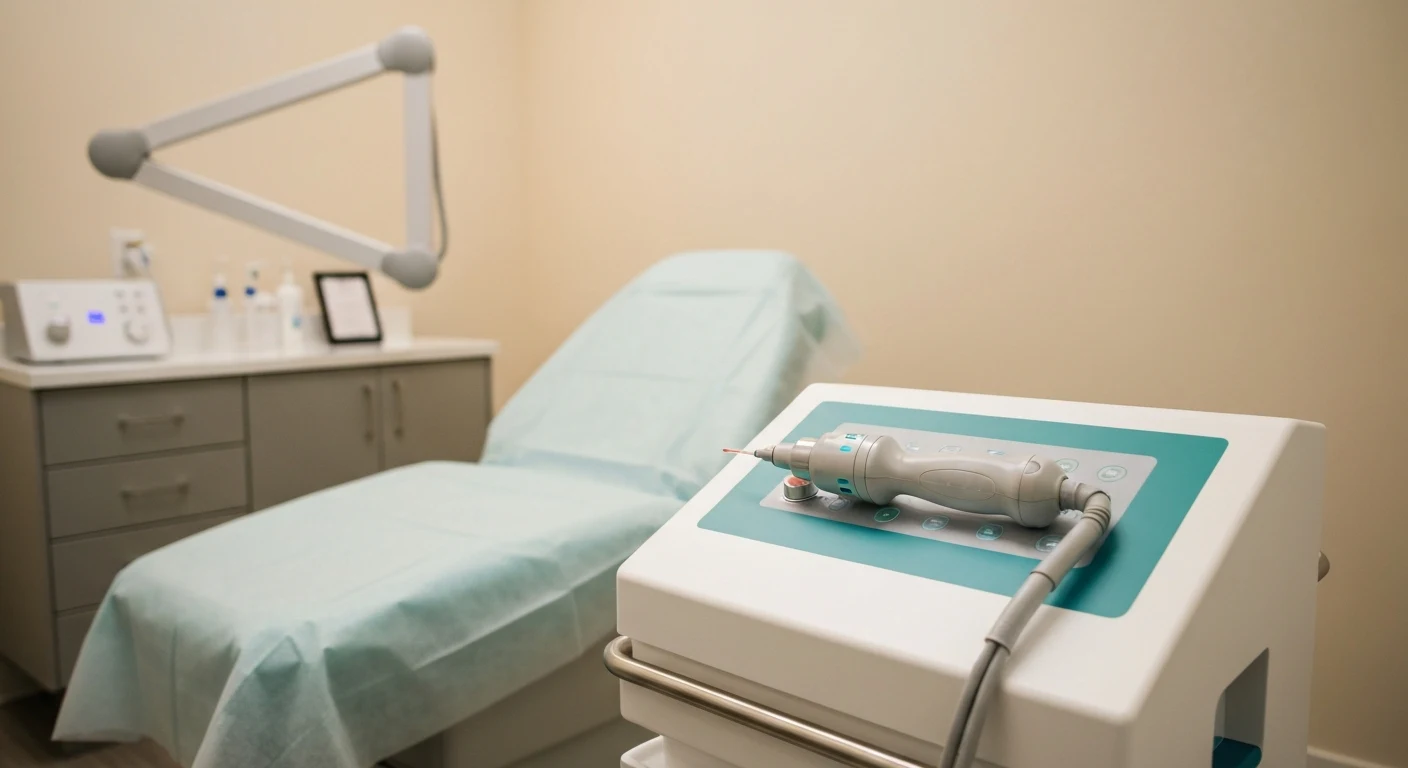
The reason a four wavelength picosecond platform matters across amateur vs professional tattoo removal is the variety of ink chemistry the clinician has to address across both tattoo types. A single wavelength Q-switched device handles black dominant amateur tattoos reasonably well but struggles with the residual reds, blues, and greens that often emerge during a professional tattoo removal sequence. For a stick and poke or prison tattoo removal case, the same device often suffices because the ink is monochrome black or near black. For a colored professional piece, multiple wavelengths matter for the orange, yellow, and sky blue residuals that nearly always appear once the dark base pigment has been broken up. That is why our deep dive on the four wavelength PiQo4 picosecond platform we use at Perfect B in Doral is relevant whether the tattoo on the patient is amateur or professional.
The PiQo4 advantage is real but bounded. The device does not eliminate session count, it does not change ink depth, and it does not turn a four month protocol into a single visit. What it does is give the clinician more tools when the ink in front of them is unusual, which is exactly the case in amateur, homemade, and prison tattoo removal work where the original ink chemistry is unknown.
Setting Realistic Expectations: Ghosting, Hypopigmentation, and Scar Risk on Amateur Ink
The honest part of an amateur vs professional tattoo removal conversation is the part most clinics gloss over. Amateur tattoos, especially old stick and poke or homemade tattoos placed with poor sterile technique, sometimes scar from the original tattoo itself, not from the removal. When that pre existing scar is in the way, the laser has to navigate it. Hypopigmentation, where the treated skin becomes lighter than the surrounding tissue, can occur on darker Fitzpatrick skin types regardless of whether the original tattoo was amateur or professional, and it is usually temporary but can take months to resolve. Ghosting, where a faint outline of the original tattoo remains visible after most pigment has cleared, is more common with very shallow stick and poke work than with professional pieces, because the residual pigment sits at the edges of the original deposit.
None of these outcomes are reasons to skip removal. They are reasons to plan the sequence properly and to commit to follow up visits. Our companion guide on what causes scarring from laser tattoo removal, how to prevent it, and how to manage it when it happens covers the protective measures across both amateur and professional cases.

Finding a Doral Clinic That Treats Amateur and Professional Tattoos as Different Cases
A clinic that lumps every tattoo into a single price list and a single session protocol is not running a real clinical tattoo removal program. A clinic that scores the Kirby-Desai factors during the consultation, tests a small area before committing to the full sequence, and explains why the patient’s particular tattoo will or will not follow the typical amateur or professional pattern is running a real clinical workflow. The difference is most visible during the first visit. For a broader view of how to evaluate any laser tattoo removal clinic in our market, our full overview on what to look for in a laser tattoo removal clinic near me across Doral and South Florida covers the seven structural standards that separate a clinical program from a generic service.
At Perfect B in Doral, FL the amateur vs professional distinction is one of the first things the provider documents during the consultation, because it changes the rest of the plan: the expected session count, the wavelength sequence, the test spot strategy, and the realistic expectations conversation with the patient about ghosting and pigment shift.
Frequently Asked Questions
1. Is amateur tattoo removal really faster than professional tattoo removal?
For most cases yes. Stick and poke, hand poke, homemade, and prison tattoos typically clear in fewer sessions because the ink is placed shallower, the pigment density is lower, and the ink itself often responds to the standard wavelength. The Kirby-Desai Scale formalizes this difference and reduces the score for amateur work, which translates to a lower expected session count.
2. Can I remove a stick and poke tattoo at home with creams or salt scrubs?
No. Topical creams cannot reach dermal pigment. Salt and abrasive scrubs damage the epidermis and leave the tattoo intact. TCA peels and removal pens cause chemical or thermal burns and frequently scar. The diy tattoo removal market is built on methods that do not work and that often make later clinical removal harder by adding scar tissue and pigment damage to the area.
3. How many laser sessions does a typical stick and poke tattoo removal take?
Most stick and poke tattoo removal cases clear in fewer sessions than a comparable professional tattoo of similar size and location, but the exact number depends on ink depth, density, color, and the Kirby-Desai factors. Cleveland Clinic’s overview notes that tattoo removal in general takes between six and twelve visits. Amateur work usually sits at the lower end of that range when other factors are favorable, but a small number of stick and poke tattoos placed at unusual depths require more sessions than expected.
4. What if my prison tattoo or homemade ink contains unknown substances?
Unknown ink chemistry in homemade tattoo removal cases is exactly why the test spot exists. The clinician treats a small area with the wavelength believed to be appropriate, watches the response across a few weeks, and uses the result to decide on the full sequence. Prison tattoo removal and homemade tattoo removal cases benefit most from a multiple wavelength picosecond platform because the clinician can switch wavelengths as residual pigment behavior shows up.
5. Will my amateur tattoo leave a scar or a faint outline after removal?
Some amateur tattoos already have a scar from the original application, especially older stick and poke work done without sterile technique. The laser does not create new scars when used at clinical settings on healthy skin, but it cannot remove the original scar tissue. Ghosting, a faint outline of the original tattoo after most pigment has cleared, is more common with very shallow stick and poke work and usually fades with time and additional targeted sessions.
6. Do colored professional tattoos take longer than black professional tattoos?
Yes. Black absorbs all laser wavelengths well, which is why black ink tattoo removal is the most predictable category. Colors like red, orange, sky blue, and green require specific wavelengths and often more sessions than a comparable black piece. This is part of the reason a four wavelength picosecond device is useful for professional tattoo removal cases that contain mixed colors.
7. Can a clinic predict exactly how many sessions my tattoo will need?
Not exactly, but the Kirby-Desai Scale gives a useful range during the consultation. The estimate is based on skin type, location, color, ink amount, scarring, and the amateur versus professional axis. A test spot result refines the estimate after the first visit. A clinic that quotes a specific number of sessions before evaluating the tattoo is making a marketing claim, not a clinical one.
8. What does amateur vs professional tattoo removal cost at Perfect B in Doral?
Cost depends on the size of the tattoo, the location, the expected number of sessions from the Kirby-Desai scoring, and whether the original ink chemistry is known. Amateur work usually costs less in total because the session count is lower. Perfect B prices per session after the consultation and offers financing through Cherry, Klarna, Afterpay, and CareCredit so the protocol can be paid over time.
Closing: The Clinical Bottom Line on Amateur vs Professional Tattoo Removal
Two tattoos that look similar on the surface can have very different removal stories under the laser. Amateur tattoos, stick and poke, homemade, prison, and DIY-machine work, usually clear faster because of shallower placement, lower ink density, and ink that the laser handles predictably. Professional tattoos take more sessions because of deeper placement, denser ink, and color complexity. The Kirby-Desai Scale captures that difference, the test spot confirms it, and the consultation translates it into a real plan for the patient sitting in the chair.
At Perfect B in Doral, FL the alternative to a generic tattoo removal package is a structured consultation, an honest Kirby-Desai conversation, a test spot before the full sequence, four wavelength picosecond tools for non standardized inks, and a realistic expectations conversation about ghosting and pigment shift before the protocol begins. If you are weighing options for laser tattoo removal of either an amateur or a professional piece in the Miami area, that workflow is what to ask any clinic about, including ours.
- 📍 Perfect B | 3905 NW 107th Ave, Suite 104, Doral FL 33178
- 📞 Call or message us at (786) 502-2260
- 💳 Buy Now Pay Later: Cherry, Klarna, Afterpay, CareCredit