Perfect B, Doral Fl. | 06.19.26 | 12 min read.
This article is for general educational purposes and does not replace a medical evaluation. Laser permanent makeup removal involves a real risk of paradoxical pigment darkening, particularly with iron oxide and titanium dioxide pigments, and should only be considered after an in person test spot evaluation by a licensed clinician.
Key Takeaways
- Permanent makeup removal is not the same as body tattoo removal. Cosmetic pigments are formulated differently, sit in delicate skin, and behave differently under laser light.
- Paradoxical darkening is a real risk. Iron oxide and titanium dioxide, the two pigment classes most common in microblading and lip blush, can darken or shift color under standard laser exposure.
- Test spot first is the ethical baseline. Any reputable clinic will perform a small laser test spot, wait for the response, and reassess before committing to full treatment.
- PiQo4 four wavelengths help, but they do not eliminate the risk. A picosecond device with multiple wavelengths gives the clinician more tools to address mixed pigments, but pigment chemistry still rules the outcome.
- At home microblading removal does not work and can damage the skin. Topical fading creams, scrubs, and DIY saline kits are either ineffective or carry their own complications.
Why Permanent Makeup Removal Is Different from Body Tattoo Removal
Cosmetic tattoos look like body tattoos but they are not built the same way. Body tattoo inks tend to be carbon-based blacks and synthetic organic pigments engineered for deep dermal placement and slow fade. Microblading, eyeliner tattoos, lip blush, and areola tattoos use very different pigment chemistry: iron oxide blends for flesh-toned brow strokes, titanium dioxide for the light backgrounds of lip blush, and carbon black for eyeliner. These pigments are usually placed shallower than body tattoos, in skin that is thin, vascular, and near critical structures like the eye margin or the lip vermillion. Cosmetic tattoo removal lives at the intersection of those two problems, and the right approach is genuinely different from removing a forearm tattoo.
This guide is about that difference. It covers the pigment chemistry that decides whether a laser is the right first step, the paradoxical darkening risk that every honest clinic discusses up front, why PiQo4’s four wavelengths matter for mixed PMU pigments, what changes by PMU type, what the test spot protocol looks like, and what a real cosmetic tattoo removal program at a medical clinic in Doral, FL involves. There is no marketing here. The point is to help you ask better questions before any laser touches your skin.

The Pigments Inside Microblading, Eyeliner, Lip Blush, and Areola Tattoos
The single most important variable in any cosmetic tattoo removal case is what pigment is actually in your skin. Microblading and powder brow procedures rely heavily on iron oxide pigments, often blended with synthetic browns to achieve the natural hair color the patient wanted. Lip blush almost universally contains titanium dioxide as the lightener that gives flesh, peach, or coral tones their visible color. Eyeliner tattoos are most often carbon black, which is the same pigment class as a body tattoo and the easiest to remove. Areola tattoos used in post-mastectomy reconstruction commonly mix iron oxide with skin-tone modifiers to match the surrounding tissue.
Why does this matter for laser removal? Because iron oxide and titanium dioxide both undergo chemical reduction when a Q-switched or picosecond laser delivers energy to them. Iron oxide can reduce from its red-brown ferric state to a dark ferrous state. Titanium dioxide can reduce to lower titanium oxides that are visibly gray or black. A landmark report by Anderson, Geronemus, and colleagues in Archives of Dermatology documented cosmetic tattoo ink darkening as a complication of Q-switched laser treatment in patients with light flesh-toned pigments and put the paradoxical darkening problem on the dermatology map. Three decades later, the chemistry has not changed; only the laser tools have improved.
Paradoxical Darkening: What It Is and Why Cosmetic Pigments Are Vulnerable
Paradoxical darkening is exactly what it sounds like. The patient comes in for PMU removal expecting the pigment to fade, and instead the treated area becomes darker or shifts to an unwanted color. The mechanism is reduction chemistry: laser pulses deliver heat that reduces oxidized metallic pigments to a more reduced, darker state. White or flesh-toned PMU containing titanium dioxide is particularly vulnerable because the original color is light, so even a small color shift toward gray or black is visually dramatic. Iron oxide microblading can shift from warm brown to cool gray, which is often more noticeable than the original color.
A follow-up Ross et al. analysis in Archives of Dermatology characterizing the role of titanium dioxide in tattoo darkening and nonresponse after laser treatment refined the clinical advice across the cosmetic pigment landscape. The honest summary is that paradoxical darkening is not rare in cosmetic pigments, it is the default expectation that the clinician must actively design around. That is why our companion piece on how a medical clinic prevents scarring and pigment complications during laser tattoo removal dedicates a section to test spot protocols and color shift management before any full treatment begins. A clinic that does not raise this topic during a PMU removal consultation is either uninformed or hoping you will not notice.
How PiQo4’s Four Wavelengths Address Mixed PMU Pigments
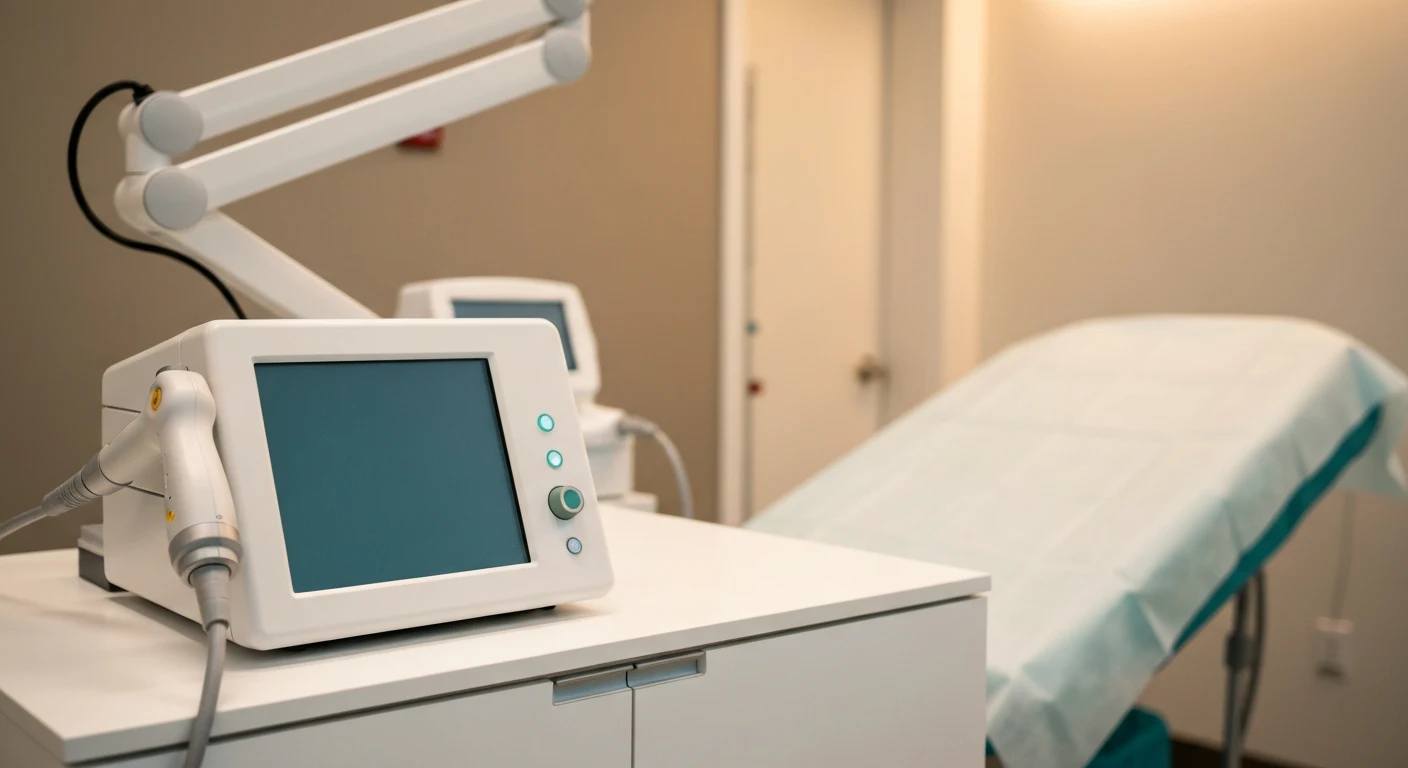
The reason single-device tattoo clinics struggle with permanent makeup removal is pigment diversity. A brow that looks like a single warm brown to the eye is almost always a blend of iron oxide and organic warm pigments, and once a few sessions of laser have started reducing the iron oxide, residual pigment can shift into red, orange, or yellow ranges. A Q-switched 1064/532 nm laser is designed for body tattoos and does not have the wavelengths to address those residuals well. That is why our deep dive on the four wavelength PiQo4 picosecond laser platform we use at Perfect B in Doral matters for cosmetic tattoo removal: the same device covers 1064 nm for deep dark pigment, 532 nm for warm reds and oranges, and dedicated 585 nm and 650 nm wavelengths for residual sky blues, greens, and yellows that almost always emerge during a cosmetic tattoo removal sequence.
Device alone does not solve the problem. PiQo4 gives the clinician more tools, but the pigment chemistry under the skin still rules whether laser is the right first step. For some titanium dioxide heavy lip blush cases, the right first move is not laser at all. For most microblading and eyeliner tattoo removal cases, laser is appropriate but the test spot is mandatory before the full sequence begins.
PMU Type by Type: Microblading, Eyeliner, Lip Blush, and Areola Tattoos
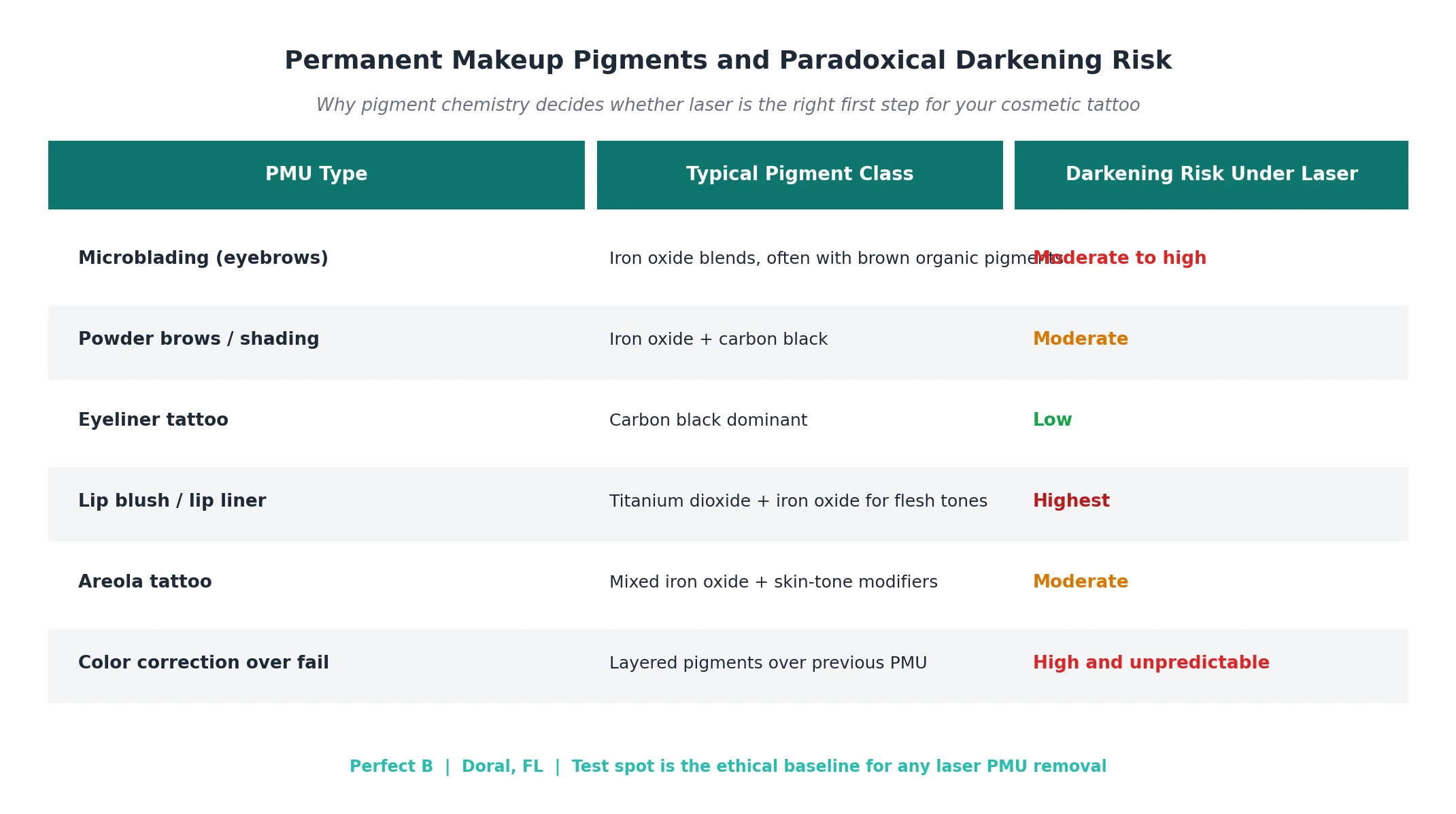
Different cosmetic tattoo types carry different paradoxical darkening risk and different removal expectations. The pattern below is the practical decision framework most experienced clinicians use.
- Microblading removal: iron oxide dominant, moderate to high paradoxical darkening risk for warm flesh-toned blends. Microblading removal almost always requires multiple sessions and careful wavelength selection across the sequence as residuals emerge.
- Eyeliner tattoo removal: carbon black dominant, low paradoxical darkening risk. Laser eyeliner tattoo removal is among the most predictable cosmetic tattoo removal cases, but eye safety protocols are non-negotiable given the proximity to the globe.
- Lip blush removal: titanium dioxide and iron oxide blends, the highest paradoxical darkening risk in the cosmetic tattoo removal universe. For some lip blush cases, a saline-first hybrid approach is more appropriate than going straight to laser.
- Areola tattoo removal: mixed iron oxide with skin-tone modifiers, moderate risk. Many patients in this category had areola tattoos after breast reconstruction and want revision rather than full removal, which changes the protocol design.
- Color correction over a previous failed PMU: layered pigments over older PMU produce unpredictable behavior under any laser. These cases benefit most from a test spot and the slowest, most conservative protocol.
The Honest Test Spot Protocol Before Full Treatment
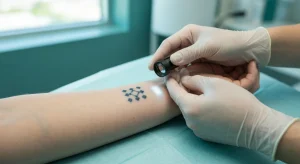
The test spot is the single piece of the PMU removal workflow that separates a responsible clinic from a careless one. A test spot is exactly what it sounds like: a very small area of the cosmetic tattoo is treated with the wavelength and fluence the clinician believes is appropriate, then the patient is sent home and reassessed at the next visit. If the pigment lightens cleanly, the protocol is built around that result. If the pigment darkens or shifts color, the clinician adjusts the wavelength, the fluence, or the modality entirely before any additional area is treated.
The reason this matters is that paradoxical darkening on a small test spot is reversible or maskable. Paradoxical darkening on a full brow, a full eyeliner line, or a full lip is a much bigger problem, sometimes requiring different lasers, multiple correction sessions, or in worst cases a tattoo over the darkened area to mask it. Skipping the test spot to save a visit is the most common reason cosmetic tattoo removal cases go wrong. At Perfect B in Doral we treat the test spot as non-negotiable.

What to Expect During and Between Sessions at Perfect B in Doral
A full PMU removal visit at our Doral clinic opens with a mapping consultation, the test spot, and a written plan for the sequence. Subsequent visits cluster around the cosmetic tattoo with conservative wavelength selection and small spot-size treatment to protect surrounding skin. Because cosmetic tattoos sit on the most delicate facial skin, our protocol shares a lot with the broader approach in our companion piece on how a medical clinic approaches tattoo removal on the face and neck where iron oxide pigments and paradoxical darkening are common. Most patients require six to ten visits across several months for full clearance, with longer intervals between sessions on cosmetic areas than on body tattoos to allow the immune system to clear fragmented pigment.
Downtime is usually mild: redness, small frosting at the treated area, occasional pinpoint bleeding, and a few days of crusting. Strict sun protection on the treated area is mandatory throughout the sequence, both to protect against post inflammatory hyperpigmentation and to avoid driving pigment shifts in the residual cosmetic tattoo material.
When Laser Is Not the Right First Step
Not every cosmetic tattoo is a laser first case. Three scenarios deserve a slower conversation:
- Titanium dioxide heavy lip blush: the paradoxical darkening risk is high enough that an experienced clinician may recommend saline removal sessions before, or instead of, laser. A hybrid sequence often produces a better cosmetic result than pure laser.
- Very recent PMU within a few weeks: waiting for the cosmetic tattoo to settle into its final color and depth before any removal attempt usually saves visits and improves outcomes.
- Pregnancy, breastfeeding, active facial infection, or untreated facial dermatologic disease: these are standard deferral periods. The cosmetic tattoo will still be there in three to six months; the right window to treat it is a healthy skin window.
Microblading removal at home using fading creams, scrubs, or DIY saline kits is in a different category. These options are sold heavily online and almost always cause more problems than they solve, including chemical burns, infections, and scarring of the brow tissue that makes future correction harder. A clinic visit is genuinely the safer route.
Finding Provider Led Laser PMU Removal in Doral and Greater Miami
Many Miami area clinics offer laser eyebrow tattoo removal, microblading removal, and other cosmetic tattoo removal services. What separates a clinical program from a generic spa service is usually three things: the device class, the test spot protocol, and who is supervising the case. A picosecond multi wavelength platform handles mixed PMU pigments and laser eyebrow tattoo removal cases better than a single wavelength Q-switched device. A mandatory test spot before full treatment is the ethical baseline. APRN or physician supervision turns the case from a service into a medical workflow with a chart and follow up.
For a broader view of how to evaluate any laser tattoo removal clinic in our market, our full overview on what to look for in a laser tattoo removal clinic near me across Doral and South Florida covers the same checklist for general body tattoo work. The cosmetic tattoo subset adds the paradoxical darkening conversation as the central question, and a consultation that does not include that conversation is incomplete.
Frequently Asked Questions
1. Can permanent makeup be removed completely?
In most cases yes, with a multi session sequence and the right wavelength selection. Cosmetic tattoos with predominantly carbon black pigment, like most eyeliner tattoo work, clear most predictably. Iron oxide and titanium dioxide pigments require more care to avoid paradoxical darkening and may take more sessions, but full clearance is achievable in the majority of cases when the clinician follows the test spot protocol.
2. How many laser eyebrow tattoo removal sessions will I need?
Most microblading removal and laser eyebrow tattoo removal cases require six to ten sessions across several months, with longer intervals between sessions than typical body tattoo work. The exact number depends on pigment depth, pigment chemistry, how saturated the original cosmetic tattoo was, and how the patient responds to the test spot.
3. Is paradoxical darkening permanent if it happens?
Not always, but it can be persistent. The point of the test spot protocol is to detect paradoxical darkening on a small area before it happens across a full brow or lip. When darkening occurs, the clinician adjusts the protocol, sometimes switches modalities, and continues treating with the new approach. In some cases the darkened pigment can be cleared in subsequent sessions; in others it requires correction or masking strategies.
4. Will saline tattoo removal work for my microblading?
Saline removal can be appropriate for certain PMU cases, particularly titanium dioxide heavy lip blush where laser carries higher darkening risk. For most iron oxide microblading, laser is faster and more predictable. The decision belongs in a consultation, not in a generic recommendation.
5. Can I cover up bad PMU with new PMU instead of removing it?
Color correction PMU over a previous failed cosmetic tattoo is possible for some cases, but layering more pigment over compromised pigment usually worsens the long term color stability. Removal first, then re tattooing if desired, almost always produces a better aesthetic result than coverup tattoos.
6. Is laser eyeliner tattoo removal safe for the eye?
Yes, when the clinician uses appropriate corneal protection. Stainless steel or specially designed laser-rated intraocular eye shields are mandatory for any eyeliner tattoo removal session. A consultation that does not discuss eye protection should raise concern.
7. Can I remove microblading at home with creams or saline kits?
No. Topical creams sold for at home cosmetic tattoo removal lack the mechanism to clear dermal pigment and often contain irritants that damage surrounding skin. DIY saline kits applied without sterile technique can cause infection, scarring, and uneven results that make professional removal harder. The cost of correcting a botched home removal usually exceeds the cost of doing it correctly the first time.
8. What does permanent makeup removal cost?
Cost depends on the cosmetic tattoo type, the area, and the number of sessions required. PMU removal at our Doral clinic is priced per session after the consultation and test spot, so the patient sees the full plan before committing. Financing through Cherry, Klarna, Afterpay, and CareCredit is available to spread the protocol cost over time.
Closing: The Clinical Bottom Line on Permanent Makeup Removal
Cosmetic tattoo removal is a clinical decision that lives in pigment chemistry, device selection, and clinician judgment. The wrong combination of any of those three produces darker brows, gray lips, or color shifts that are harder to fix than the original cosmetic tattoo. The right combination produces a quiet, predictable fade across the sequence with the patient leaving the clinic looking like themselves again. The difference is the consultation, the test spot, and the wavelength tools the clinician has available.
At Perfect B in Doral, FL the alternative to a generic laser appointment for cosmetic tattoo removal is a structured consultation, an honest pigment assessment, a mandatory test spot, a written sequence plan, and PiQo4 four wavelength tools for the residuals that almost always emerge during cosmetic tattoo removal. If you are weighing options for microblading removal, eyeliner tattoo removal, lip blush removal, or areola tattoo removal in the Miami area, that workflow is what to ask any clinic about, including ours.
- 📍 Perfect B | 3905 NW 107th Ave, Suite 104, Doral FL 33178
- 📞 Call or message us at (786) 502-2260
- 💳 Buy Now Pay Later: Cherry, Klarna, Afterpay, CareCredit