Perfect B, Doral Fl. | 06.19.26 | 11 min read.
This article is for general educational purposes and does not replace a medical evaluation. Peptide therapy involves prescription compounds that should only be considered after an in person clinical assessment by a licensed provider. The information below does not constitute a diagnosis, prescription, or treatment plan.
Key Takeaways
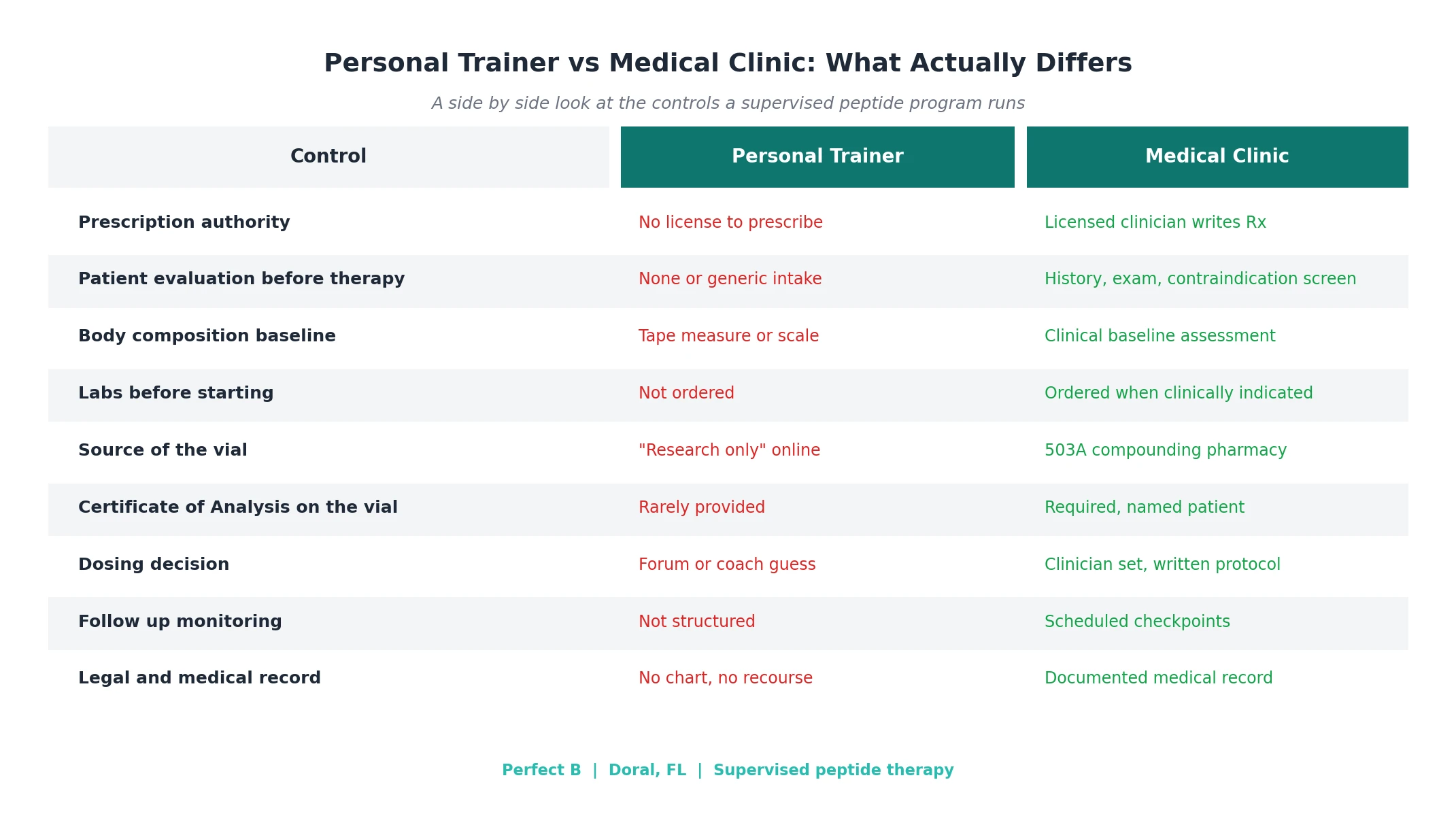
- Personal trainers are not licensed to prescribe, dose, or inject peptides. Getting peptides from personal trainers means accepting a prescription decision from someone whose certification explicitly excludes that role.
- “Research only” is not a legal workaround. The label means the vial was never tested or released for human use. It is a warning, not a loophole.
- A compounded peptide from a 503A pharmacy is patient named and traceable. A vial bought from a coach is anonymous, with no Certificate of Analysis and no chain of custody.
- A medical clinic evaluates you before recommending a peptide. That includes intake history, contraindication screen, body composition baseline, and indication specific labs when needed.
- Are peptides legal for fitness use? Only when prescribed by a licensed Florida provider and dispensed by a regulated compounding pharmacy to the named patient. Anything else falls outside that legal lane.
Why Getting Peptides from Personal Trainers Suddenly Sounds Normal
Walk into almost any commercial gym in Miami in 2026 and you will hear the same conversation. A trainer mentions BPC-157 for a sore shoulder, or hands a client a vial of something with a long acronym, or quotes a price for a “stack” that is supposed to drop fifteen pounds in eight weeks. The pitch is casual, the supply is fast, and the framing makes it sound like a supplement. It is not. Getting peptides from personal trainers is a clinical decision being routed through a fitness channel, and the consequences land on the patient, not on the trainer.
The conversation also exists for a reason. National news coverage of peptides in 2026, including the PBS NewsHour reporting on the FDA reconsideration of restrictions on compounded peptides, has put these compounds in front of millions of people who never heard of them before. That mainstream attention has filtered straight into gyms, fitness influencer feeds, and trainer certification courses. What is missing from the gym version of the conversation is the part that protects the patient: licensing, clinical evaluation, regulated sourcing, and follow up. This post is about why those four pieces exist, what happens when they are absent, and what a supervised alternative looks like at a peptide therapy clinic near me in Doral, FL.
The Legal Line a Personal Trainer Cannot Cross in Florida
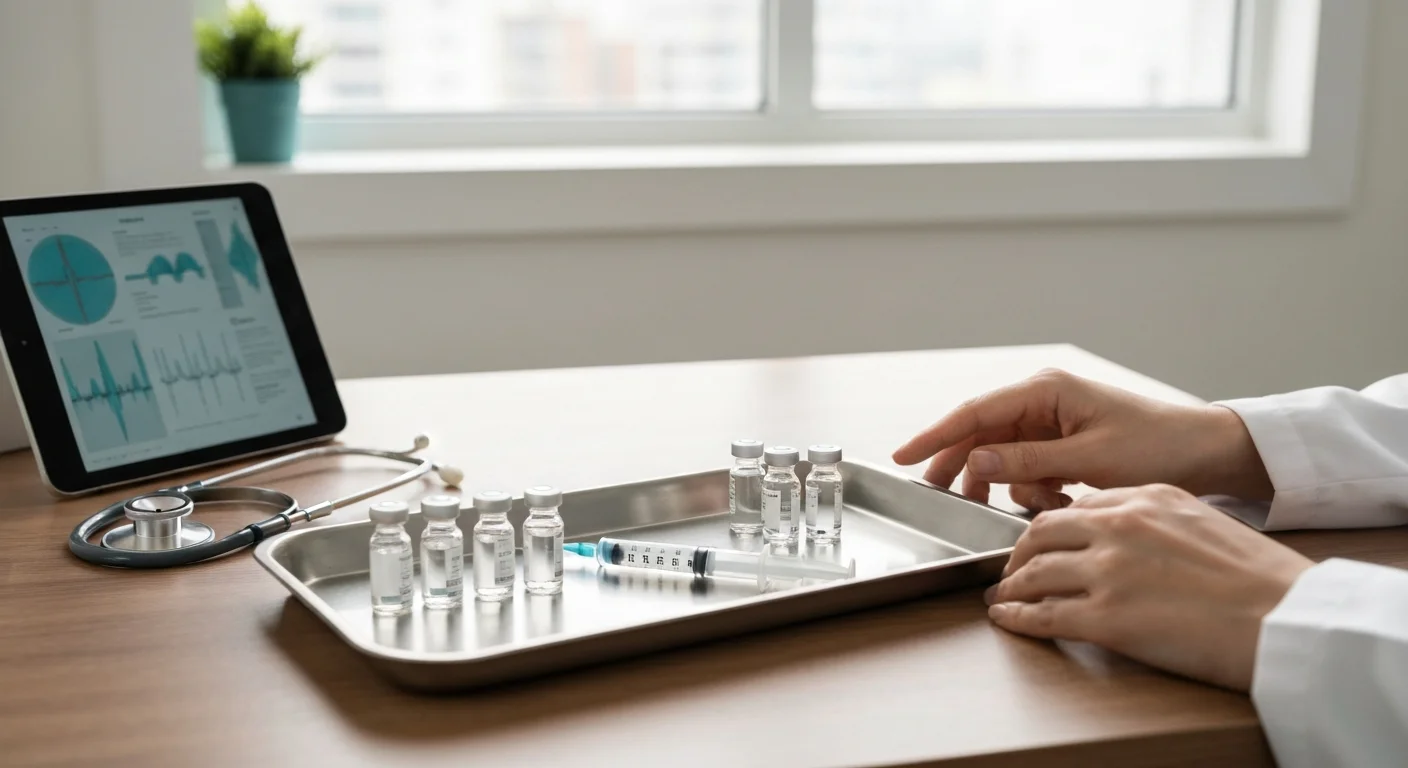
A certified personal trainer in Florida holds a credential that authorizes them to assess fitness, design exercise programs, and coach clients through movement. That credential does not authorize them to prescribe a controlled or prescription only substance, to determine the dose of an injectable compound, to teach injection technique as a clinical service, or to manage adverse reactions. Even the largest trainer certification bodies say this in writing. The American Council on Exercise has stated publicly that “many injectable peptide products being promoted in the fitness world are not approved by the U.S. Food and Drug Administration.” Fitness Mentors, a major trainer education platform, states bluntly that “recommending peptides, sourcing them, working out doses, coaching someone through using them, all of that falls outside a personal trainer’s scope of practice.”
That language matters because scope of practice is not a suggestion. It is a regulatory boundary. When a trainer crosses it, the trainer is exposed, but the patient is exposed more. There is no medical record of the recommendation. There is no licensed provider to call if something goes wrong. There is no insurance pathway for an adverse event. Asking whether are peptides legal for fitness use under Florida law collapses into a different question: who is allowed to write a prescription in this state. The answer is a Florida licensed physician, advanced practice registered nurse with prescribing authority, or physician assistant. A personal trainer is not on that list. This is the first and clearest line where getting peptides from personal trainers stops being a fitness decision and becomes an unsupervised medical one.
What Peptides Actually Are and What They Are Not
Peptides are short chains of amino acids that act as signaling molecules in the body. They tell tissues to repair, to release growth hormone, to mobilize fat, to modulate inflammation, or to support neurological function. Different peptides do different things, and a serious clinical conversation always starts with the indication, not the molecule. A peptide is not a steroid, not a supplement, and not a “natural” version of either. It is a pharmaceutical signaling agent, and that is exactly why dosing, route, and timing belong to a clinician who has reviewed the patient’s history.
For a deeper look at how a medical clinic frames peptide categories, risks, and patient selection, see our companion guide on how a medical clinic reviews safety before prescribing a peptide. The short version is that peptide therapy is not unsafe by category. It becomes unsafe when the wrong compound is given to the wrong patient at the wrong dose with no follow up, which is exactly what tends to happen when peptides personal trainer safe assumptions take the place of a real clinical review.
The “Research Only” Vial Is Not a Loophole, It Is a Warning Label
The most common way peptides reach gyms is through online vendors that label vials “for research use only” or “not for human consumption.” That language is not marketing. It is a legal disclaimer that means the product was never manufactured, tested, or released under the standards required for human use. The vial was meant for a laboratory bench, not for an injection site. When a trainer or a coach buys those vials in bulk and resells them or hands them to clients, the “research only” disclaimer does not transfer protection to the patient. It transfers risk to the patient.
That distinction is also why the question of are peptides legal for fitness use cannot be answered with a yes or a no. Peptides as a class are not banned. Specific peptides prescribed for specific indications and dispensed by a licensed compounding pharmacy are legal for that named patient. The same peptide bought from an unregulated vendor and used in a person without a prescription falls outside that legal frame, regardless of who hands the vial across the counter at the gym. A peptide bought through an unregulated gym channel almost always means the vial in question is on the second side of that line. The “research only” sticker is the manufacturer telling you so in advance.

What Can Actually Go Wrong When Peptides Come from a Gym
The risks of an unregulated peptide vial fall into four categories. Contamination is the first. A laboratory grade compound is not synthesized, filled, or sealed under the sterile conditions required for an injectable drug, and contamination can range from endotoxin to bacterial growth that the patient cannot see or smell. Mislabeling is the second. Investigative work cited in clinical commentary from Columbia University sports medicine reviewing peptide benefits and safety concerns has found that vials sold to consumers often do not contain the compound or the concentration printed on the label. Dose variability is the third. Without standardized fill, the dose drawn into the syringe varies between vials and even within the same vial. No recourse is the fourth. If the patient develops an injection site reaction, a sterile abscess, an allergic response, or a longer term endocrine effect, there is no medical chart, no prescribing clinician, and no insurance pathway. Getting peptides from personal trainers means accepting all four of those risks without the protections that would normally absorb them.
This is the practical reason peptides personal trainer safe is a phrase that does not survive scrutiny. The trainer can be perfectly well intentioned and still cannot fix any of the four risks listed above, because none of them are within a trainer’s scope to control.
What a Real Peptide Evaluation Looks Like at Perfect B in Doral
A supervised peptide program at Perfect B in Doral, FL starts with an in person evaluation, not with a vial. The first visit covers a focused medical history, a review of current medications and supplements, a contraindication screen specific to the peptide class being discussed, and a body composition baseline. The provider documents what the patient is trying to accomplish, whether that is recovery from a soft tissue injury, lean mass and recomposition, skin or hair quality, or longevity oriented goals. Indication specific labs are ordered when a clinical question requires them, for example IGF-1 before a growth hormone secretagogue, a metabolic panel before a fat loss peptide, or thyroid markers when symptoms suggest it.
Only after that workup does the provider decide whether a peptide is appropriate, which one, at what dose, and for how long. If a peptide is not the right tool, the visit ends with a different plan. That sequence is what defines a peptide therapy clinic near me as a clinical environment rather than a retail one. For a fuller breakdown of what a supervised program includes from the patient perspective, our reference page on what defines a supervised peptide therapy clinic near me and what to ask before you start walks through the entire intake to follow up arc.

Where Compounded Peptides Come from When It Is Done Right
Compounded peptides used in a real medical program are not bought online and resold. They are prescribed by the patient’s clinician and prepared by a 503A compounding pharmacy that is licensed and inspected. Each vial is dispensed to the named patient, with a Certificate of Analysis that documents the identity, purity, and concentration of the compound. The chain of custody runs from the licensed pharmacy to the patient, through the prescribing provider, on a documented prescription. Compounded peptides handled this way are traceable in both directions: the patient knows what is in the vial, and the pharmacy knows who received it.
This is the structural opposite of a vial passed across a gym floor. A trainer cannot generate a prescription, cannot select the pharmacy, and cannot produce a Certificate of Analysis for their patient. For a side by side look at how clinically sourced compounded peptides differ from the online research market, see our reference on compounded peptides from a 503A pharmacy versus online research peptides and how to source them safely and legally. Compounded peptides done the right way are a regulated medical product. Compounded peptides done the gym way are a label on a vial of unknown content.
Questions to Ask Before Anyone Injects Anything Into Your Body
If a peptide is being recommended to you, the answers to the following questions tell you whether the conversation is clinical or commercial. A clinician will answer them without hesitation. A trainer almost never can.
- Who is the prescribing clinician for this peptide and what is their Florida license number? If the answer is a name that is not a licensed physician, APRN, or PA, the prescription does not exist.
- Which compounding pharmacy dispenses the vial? A 503A pharmacy name should be available. A peer to peer source is not an answer.
- Is there a Certificate of Analysis for this batch? A real compounded peptide vial is traceable. A research vial usually is not.
- What did the clinical evaluation cover before the peptide was recommended? History, contraindication screen, and indication specific labs are the baseline.
- What is the follow up plan if there is a side effect? A supervised program has a written discontinuation and adjustment plan, not a text message.
- Will this be in my medical record? If the answer is no, there is no record to protect you.
A peptide therapy clinic near me in Doral, FL should answer all six of those questions in writing. If you have already started talking to a trainer about a peptide, this is the moment to compare answers side by side. For a broader Miami area view of how supervised programs are structured locally, our reference on what a medical peptide therapy clinic offers in Miami that a spa or a gym cannot covers the same checklist for the regional market.
Not sure which peptide protocol fits your recovery or performance goal?
Perfect B’s peptide protocol tool is built on real clinical data from 2,000+ patients treated in South Florida.
Answer 6 questions and see what patients with similar goals are running: which peptides they use, typical dosing, injection schedule, reconstitution steps, cycle length, and when they pause.
Frequently Asked Questions
1. Is getting peptides from personal trainers illegal in Florida?
A personal trainer is not authorized to prescribe, dose, or dispense a prescription compound in Florida. When a trainer hands over a peptide vial outside of a licensed prescriber and a regulated compounding pharmacy, the transaction is outside the legal medical channel. The trainer’s exposure is one issue. The patient’s lack of a prescription, a medical record, and a regulated source is the bigger one.
2. Are peptides legal for fitness use at all?
Peptides prescribed by a licensed Florida clinician for a specific indication and dispensed by a 503A or 503B compounding pharmacy to the named patient are legal for that patient. Peptides sold online with a “research only” label are not legally available for human therapeutic use, regardless of how they reach the consumer. The legal status follows the path of the prescription, not the molecule.
3. My trainer says peptides personal trainer safe because everyone in the gym uses them. Is that true?
Frequency of use is not a measure of safety. Whether a given peptide is appropriate for a given patient depends on medical history, current medications, body composition, and the indication. None of that is assessed at a gym, so the framing peptides personal trainer safe cannot be evaluated against the relevant clinical criteria. Safety belongs to the patient, not to the gym.
4. What is the difference between compounded peptides from a clinic and a vial bought online?
Compounded peptides from a 503A pharmacy are dispensed against a prescription, named to the patient, and accompanied by a Certificate of Analysis documenting identity and purity. A vial labeled “research only” is sold for laboratory use, has no prescription tied to it, no traceability to a patient, and no enforceable quality standard for human use.
5. How do I find a peptide therapy clinic near me that operates this way?
A real peptide therapy clinic near me will name the prescribing clinician, the compounding pharmacy partner, and the evaluation steps before any peptide is recommended. The intake should include in person history, contraindication screen, body composition baseline, and indication specific labs when needed. Programs that skip those steps are not running a clinical pathway, regardless of how the marketing reads.
6. I already started a peptide my trainer gave me. What should I do?
Stop using a vial whose source and content you cannot verify and schedule a clinical evaluation. Bring the vial, the labeling, and any information you have about how it was prepared. A licensed clinician can review what you have been exposed to, order labs if indicated, and discuss a supervised plan if a peptide is genuinely appropriate for your goals. A program that starts with a clean evaluation is the inverse of an unsupervised gym handoff, and it is the only version that keeps the patient in a documented care path.
Closing: The Clinical Bottom Line on Peptides and Personal Trainers
The reason peptides keep showing up in gyms is that the products are accessible and the conversation is loud. The reason supervised therapy exists is that signaling molecules belong in a clinical workflow, with a licensed prescriber, a regulated pharmacy, a documented evaluation, and a follow up plan. None of those four components is optional, and none of them lives inside a personal trainer’s certification.
At Perfect B in Doral, FL, the alternative to getting peptides from personal trainers is a structured first visit, an honest answer about whether a peptide is the right tool for the goal, a prescription written only when it is appropriate, a 503A compounded peptide dispensed to your name, and a follow up plan in writing. If you are weighing a vial from your trainer against a clinical program, the comparison is not close.
- 📍 Perfect B | 3905 NW 107th Ave, Suite 104, Doral FL 33178
- 📞 Call or message us at (786) 502-2260
- 💳 Buy Now Pay Later: Cherry, Klarna, Afterpay, CareCredit