
Perfect B, Doral Fl. | 05.22.26 | 13 min read.
This article is for educational purposes only and does not substitute professional medical advice. TB-500 is a 503A compounded peptide administered under licensed medical supervision at Perfect B. All protocols are individualized at APRN intake. Results vary by patient, indication, and protocol adherence. For the bigger picture, read how peptide therapy is delivered under medical supervision at our Doral clinic as part of a complete, individualized plan.
Skip Ahead to the Perfect B Peptide Protocol Tool. See Reconstitution, Daily Units, and Cycle Structure.
Perfect B’s peptide protocol tool is built on real clinical data from 2,000+ patients treated in South Florida.
Answer 6 questions and see what patients with similar goals are running: which peptides they use, typical dosing, injection schedule, reconstitution steps, cycle length, and when they pause.
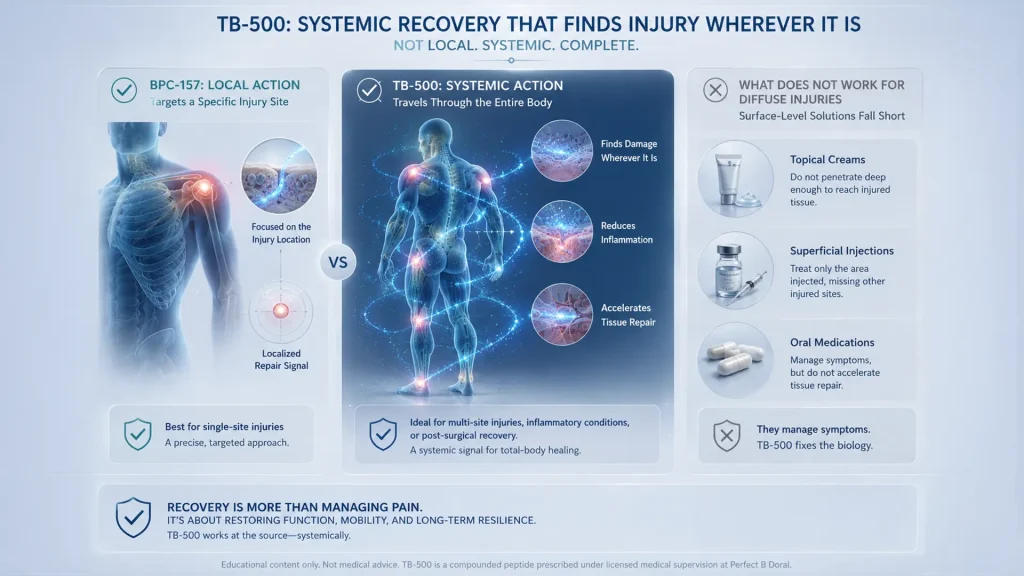
The TB-500 benefits patients ask about most at Perfect B in Doral come down to one core difference: this is the systemic recovery peptide we prescribe when a patient’s injury picture is too diffuse for a single-site approach. Where BPC-157 targets a specific injury location, TB-500 travels through the entire body and finds damaged tissue wherever it is, reducing inflammation and accelerating repair across multiple areas simultaneously. For patients dealing with more than one injury at a time, post-surgical recovery, or chronic inflammation that has not responded to standard approaches, the TB-500 benefits we see at our South Florida clinic are consistent and clinically meaningful.
Search interest in TB-500 has grown over 800 percent in the past year, and the interest reflects something real. Conventional approaches to soft tissue injury and chronic inflammation manage symptoms. TB-500 works differently: as a synthetic fragment of Thymosin Beta-4, it accelerates the biology that actually repairs the tissue, rather than masking what is happening inside it. This guide covers what those benefits are, how they work, who the right candidate is at Perfect B, and what the protocol structure looks like in practice.
Key Takeaways on TB-500 Benefits
- Systemic distribution sets it apart: Unlike BPC-157, which acts locally near the injection site, TB-500 distributes throughout the body after administration and travels to injured or inflamed tissue wherever it is. This makes it the peptide of choice at Perfect B for patients with multi-site injuries, diffuse inflammation, or post-surgical recovery needs that involve more than one area.
- Four core benefits at a clinical level: Soft tissue and musculoskeletal repair, improved flexibility and range of motion, systemic inflammation reduction, and hair growth support. These are the TB-500 benefits that have the most consistent support from preclinical research and that align with what we see in our Doral patients.
- It works by accelerating the biology of repair: TB-500 binds to G-actin, regulates cell migration to injury sites, upregulates VEGF for new blood vessel formation, and reduces pro-inflammatory cytokines including TNF-alpha and IL-1beta. The result is faster delivery of repair resources to damaged tissue and a more efficient healing environment.
- The protocol at Perfect B runs in 3-month cycles: A loading phase followed by a maintenance phase and a rest period, then a 2-month break before repeating. Every cycle is individualized at APRN intake based on the patient’s injury history, current tissue condition, and treatment goals.
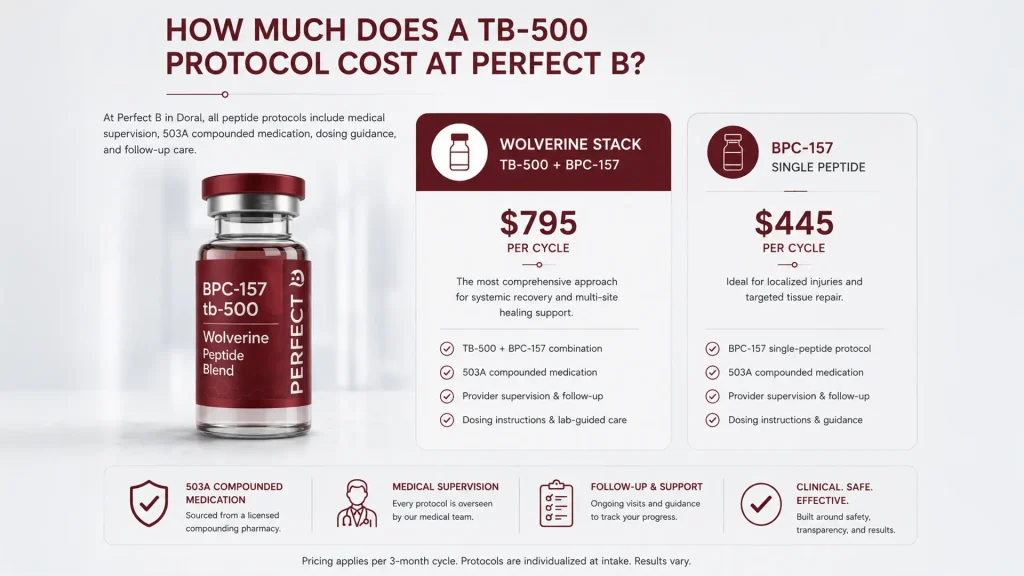
- The Wolverine Stack amplifies both peptides: When TB-500 is combined with BPC-157 in Perfect B’s Wolverine protocol, the two peptides address overlapping but distinct healing pathways: BPC-157 targets local tissue repair and angiogenesis, TB-500 adds systemic distribution and cellular migration. The combination produces results neither achieves alone. The Wolverine Stack is $795 per cycle at Perfect B.
- 503A source matters for consistent results: TB-500 at Perfect B comes from a licensed 503A compounding pharmacy with verified concentration and documented sterility. The consistency of the source is what makes the protocol’s results predictable over a 3-month cycle.
What TB-500 Is and Why It Works Differently From BPC-157
TB-500 is a synthetic fragment of Thymosin Beta-4, a protein found in virtually every human cell that plays a central role in how the body responds to injury. Thymosin Beta-4 is one of the most abundant intracellular proteins in mammalian tissue. The TB-500 peptide isolates the active repair sequence of that protein and concentrates its tissue repair and anti-inflammatory signaling in a format that can be administered as an injectable protocol.
The functional difference between TB-500 and BPC-157 is the single most important thing patients at Perfect B need to understand before choosing one or the other. BPC-157 is a localized peptide: it works best when injected near a specific injury site, where it promotes angiogenesis and growth hormone receptor activation in that targeted tissue. TB-500 is systemic. After subcutaneous injection, it distributes widely through the body and concentrates where metabolic activity and injury signals are highest. It does not need to be injected near the problem. It finds the problem.
This systemic distribution is why TB-500 is the primary choice at our Doral clinic for patients with multi-site injuries, diffuse joint inflammation, or post-surgical recovery that involves tissue disruption across multiple areas. A patient recovering from ACL surgery who also has a rotator cuff issue and chronic lower back inflammation is a classic TB-500 candidate. BPC-157 would address one of those targets. TB-500 addresses all of them. For a complete comparison of how the two peptides differ mechanistically and when to use each, see our full guide to the Wolverine Stack combining BPC-157 and TB-500 for synergistic tissue repair.
The Core TB-500 Benefits at a Clinical Level
TB-500 produces its benefits through multiple interconnected cellular mechanisms. Understanding what those mechanisms are helps explain why the peptide works for such a wide range of indications and why some patients see faster or more pronounced results than others depending on the specific biology of their condition.
- Actin regulation and cellular migration: TB-500’s primary mechanism is binding to G-actin monomers, which enhances the ability of cells to migrate to injury sites. Immune cells, endothelial cells, and repair cells reach damaged tissue faster and remain active there longer. This is the foundation of TB-500’s accelerated healing effect across all tissue types.
- Angiogenesis and vascular development: TB-500 upregulates VEGF, the vascular endothelial growth factor that signals the formation of new capillary networks. New blood vessels deliver more oxygen and nutrients to the injury site, which is the rate-limiting step in soft tissue repair. Without adequate blood supply, collagen synthesis slows regardless of other interventions.
- Anti-inflammatory modulation: TB-500 reduces pro-inflammatory cytokines including TNF-alpha, IL-1beta, and IL-6. It also suppresses NF-kB activation, which is the master regulator of the inflammatory cascade. The result is a controlled reduction of chronic inflammation without blunting the acute inflammatory response that is necessary for initial healing.
- Growth factor activation: TB-500 activates the Akt/PI3K survival pathway, upregulates hepatocyte growth factor expression, and promotes stem cell mobilization toward injury sites. These pathways support cell survival and proliferation in the repair environment.
TB-500 Benefits for Soft Tissue and Musculoskeletal Recovery
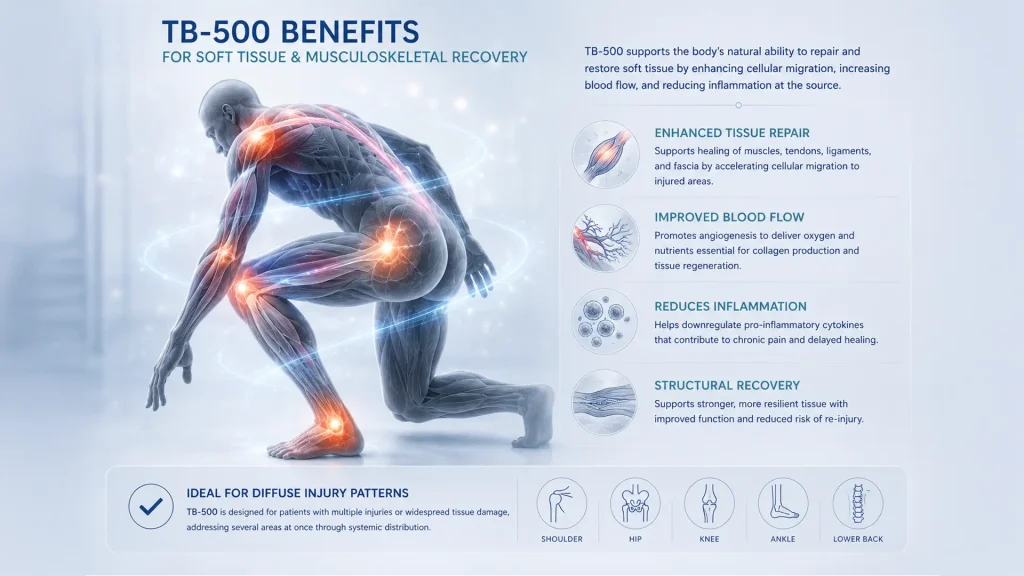
Soft tissue repair is the most common indication for TB-500 at Perfect B. Patients arrive with muscle strains that have been managed for months without structural progress, tendon injuries that physical therapy has helped but not resolved, ligament damage from sports injuries, and post-surgical recovery where the healing process has stalled before full tissue integrity is restored.
The TB-500 benefits in soft tissue repair are primarily driven by the combination of enhanced cellular migration and accelerated angiogenesis. Repair cells reach the injury site faster. The new capillary network that TB-500 promotes delivers the raw materials for collagen synthesis. The anti-inflammatory effect prevents the chronic low-grade inflammation that keeps injured soft tissue in a partial-repair state, cycling between managed pain and flare rather than progressing toward structural restoration.
At Perfect B in Doral, the soft tissue patients who respond best to TB-500 are those with diffuse injury patterns, meaning damage that is not confined to a single structure. A single-site tendon injury often responds well to BPC-157 alone. A patient with bilateral knee issues, hip flexor tightness, and recurring shoulder pain is a much stronger TB-500 candidate, because the systemic distribution of the peptide addresses all of those injury environments in a single protocol.
TB-500 Benefits for Flexibility and Range of Motion
One of the TB-500 benefits that patients at our Doral clinic report earliest in the protocol is improved flexibility and range of motion, often within the first 3 to 4 weeks of the loading phase. This improvement comes primarily from the actin regulation mechanism: as TB-500 reduces the fibrous adhesions that form in chronically inflamed tissue and promotes more organized tissue remodeling, joint and muscle mobility increases.
Patients who have been dealing with restricted range of motion from an old injury, post-surgical scar tissue, or chronic joint inflammation often notice this as one of the first objective improvements on the protocol. The stiffness that accompanies chronic inflammation begins to reduce as TB-500’s anti-inflammatory signaling takes effect, and the improved cellular migration accelerates the removal of disorganized scar tissue that contributes to movement restriction.
For patients whose primary complaint is flexibility rather than acute pain, TB-500 at Perfect B is prescribed with specific return-to-activity guidance. Improved range of motion earlier in the protocol can lead patients to increase activity too aggressively before the structural repair is complete. The APRN follow-up visits in the Perfect B protocol are specifically designed to track these functional improvements and align activity progression with the underlying tissue healing timeline.
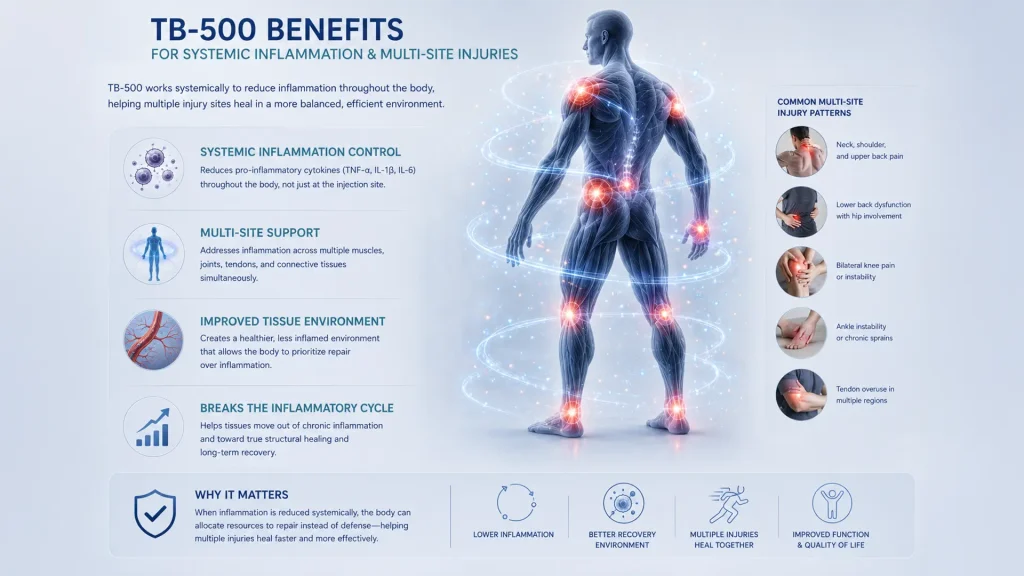
TB-500 Benefits for Systemic Inflammation and Multi-Site Injuries
Systemic inflammation is one of the most undertreated conditions in recovery medicine. Patients who have multiple active injury sites, chronic inflammatory conditions that affect more than one tissue type, or a history of repeated injuries that have created a background state of persistent low-grade inflammation are exactly the patients for whom TB-500’s systemic distribution mechanism is most clinically relevant.
The anti-inflammatory benefits of TB-500 operate at the cytokine level, reducing TNF-alpha, IL-1beta, and IL-6 systemically rather than only at the site of injection. For a patient who is managing inflammation at multiple locations simultaneously, this systemic reduction changes the tissue environment throughout the body, not just in one targeted area. The practical result is that multiple injury sites begin progressing toward repair rather than remaining static in a chronic inflammatory state.
At Perfect B, we see this most clearly in patients who have been managing multiple injuries with conventional approaches and report that they have reached a plateau: pain is manageable but healing is not progressing. These patients are often the most dramatic TB-500 responders because the systemic inflammatory suppression allows the body to direct repair resources to tissue that was previously stuck in an inflammatory holding pattern. For a detailed overview of the TB-500 protocol structure and how cycle timing is calibrated for these patients, see our guide to the TB-500 dosage protocol including cycle structure, loading phase, and individualization at Perfect B.
TB-500 Benefits for Hair Growth: What the Research Shows
Hair growth is among the TB-500 benefits with the longest documented research history. Thymosin Beta-4, the protein from which TB-500 is derived, was first identified as a hair follicle activator in research dating back to 2003. A foundational study published in the Journal of Investigative Dermatology demonstrated that Thymosin Beta-4 activates hair follicle stem cells and promotes hair growth through its actin-regulatory mechanism, showing that the same cellular migration pathway responsible for tissue repair also drives follicle activation.
At Perfect B, hair growth is a secondary benefit that patients on TB-500 protocols for musculoskeletal indications often report, rather than a primary indication we prescribe for in isolation. The mechanism is consistent with what the research describes: TB-500’s actin regulation promotes dermal papilla cell migration and follicle cycling, which can improve hair density and reduce shedding in patients with diffuse thinning. The effect is most noticeable in patients who are also seeing systemic inflammation reduction, suggesting that the anti-inflammatory mechanism contributes to follicle recovery alongside the direct actin pathway.
Patients in South Florida who come to Perfect B specifically for hair loss concerns are evaluated at intake to determine whether TB-500 is the appropriate approach for their presentation. If the hair loss pattern suggests a hormonal or nutritional driver rather than inflammatory and follicle-migration-related causes, TB-500 may not be the right primary intervention. The APRN intake identifies the driver before prescribing.
Who Is the Right Candidate for TB-500 at Perfect B?
TB-500 at Perfect B is prescribed for patients who match a specific clinical profile. Understanding who the protocol is designed for helps prospective patients assess whether their presentation aligns before booking an intake appointment.
- Multi-site or diffuse injuries: Patients with two or more active injury sites, or with a diffuse pattern of soft tissue damage that is not localized to a single structure. The systemic distribution of TB-500 is its primary advantage for these patients.
- Post-surgical recovery: Patients in the post-operative phase of any procedure involving soft tissue disruption, joint repair, or connective tissue work. TB-500’s angiogenic and anti-inflammatory benefits support the tissue repair cascade that follows surgery and can reduce the timeline for returning to full function.
- Chronic inflammatory conditions: Patients who have been managing persistent inflammation that affects multiple joints or tissue regions, where conventional anti-inflammatory approaches have provided symptomatic relief without structural progress.
- Stalled recovery: Patients who have made initial progress with physical therapy, rest, or other interventions but have plateaued before achieving full tissue restoration. The cellular migration mechanism of TB-500 can restart the repair cascade in tissue that has settled into a chronic partial-repair state.
- Wolverine Stack candidates: Patients who have both a specific local injury and a broader pattern of diffuse inflammation or multi-site damage often benefit most from the combined BPC-157 plus TB-500 protocol. The local repair targeted by BPC-157 and the systemic coverage of TB-500 address the full picture simultaneously.
Is TB-500 Safe Under Medical Supervision?
TB-500 does not have FDA approval for human use, which means there is no regulatory-defined safety profile from human clinical trials. The safety data that exists comes from preclinical animal studies and from clinical observation in supervised medical settings. At Perfect B, every TB-500 protocol begins with a full APRN intake that reviews the patient’s health history, current medications, and any conditions that would affect the appropriateness of the protocol before any prescription is written.
The side effects reported with TB-500 in clinical use are generally mild and transient. Injection site reactions, temporary fatigue in the early loading phase, and occasional mild nausea in the first week are the most commonly noted effects. These typically resolve within the first two weeks of the protocol as the loading phase progresses.
The most important safety consideration is source quality. TB-500 administered from an unverified research-grade source carries real risks: unknown concentration, unverified sterility, and no quality control documentation. At Perfect B, all TB-500 is sourced from licensed 503A compounding pharmacies with documented pharmaceutical standards. This is not a regulatory formality. It is the practical difference between knowing what you are administering and not knowing. A patient who self-administers research-grade TB-500 and reports inconsistent results or unexpected reactions is, in most cases, experiencing the consequence of a non-pharmaceutical source rather than a property of the peptide itself.
TB-500 Benefits vs BPC-157: When to Stack and When to Use One Alone
The decision at Perfect B between TB-500 alone, BPC-157 alone, or the Wolverine Stack comes down to the injury pattern and the scope of what needs to be addressed.
- BPC-157 alone: A single well-defined injury in one location. A tendon, a specific gut issue, a localized joint. The targeted local action of BPC-157 is sufficient and more precisely directed at the problem.
- TB-500 alone: Diffuse or multi-site injuries where systemic coverage is the priority and there is no single acute local injury requiring targeted intervention. Post-surgical recovery that involves broad tissue disruption rather than one site is also a strong TB-500 solo indication.
- Wolverine Stack (BPC-157 + TB-500): When the patient has a specific acute or chronic injury that benefits from BPC-157’s localized mechanism AND a broader pattern of inflammation or additional injury sites that TB-500’s systemic distribution addresses. The stack is $795 per cycle at Perfect B and represents the most comprehensive tissue repair protocol available.
Not sure which peptide protocol fits your recovery goal?
Perfect B’s peptide protocol tool is built on real clinical data from 2,000+ patients treated in South Florida. Answer 6 questions and see which protocol patients with similar goals chose: single peptide at $445, Wolverine Stack at $795, or a custom multi-peptide cycle.
How Much Does a TB-500 Protocol Cost at Perfect B?
A TB-500 protocol at Perfect B in Doral is available as part of the Wolverine Stack, which combines TB-500 with BPC-157 for $795 per cycle. This includes provider supervision, 503A compounded medication from a licensed pharmacy, dosing instructions, and follow-up visits. Patients who need BPC-157 as a single-peptide protocol for a localized indication can access that at $445 per cycle. For a complete breakdown of what each pricing tier includes and what distinguishes supervised clinical protocols from research-grade alternatives, see our guide to how much BPC-157 costs in 2026 and what the pricing range actually reflects.
Frequently Asked Questions About TB-500 Benefits
1. What are the main benefits of TB-500?
The primary TB-500 benefits are soft tissue and musculoskeletal repair, improved flexibility and range of motion, systemic inflammation reduction, and hair growth support. What distinguishes TB-500 from other recovery peptides is its systemic distribution: it travels through the entire body after administration and addresses damaged tissue wherever it is, making it effective for multi-site injuries and diffuse inflammatory conditions that a locally administered peptide cannot fully address.
2. How is TB-500 different from BPC-157?
BPC-157 acts locally near the injection site, targeting a specific injury location through localized angiogenesis and growth hormone receptor activation. TB-500 acts systemically, distributing throughout the body to find and address damaged tissue wherever it is. BPC-157 is the choice for a single well-defined injury. TB-500 is the choice for multi-site injuries, post-surgical recovery across multiple tissue areas, or diffuse inflammation. The Wolverine Stack combines both for patients who need both local and systemic coverage simultaneously.
3. Does TB-500 help with hair growth?
Yes. Thymosin Beta-4, the protein from which TB-500 is derived, activates hair follicle stem cells through its actin-regulatory mechanism. Patients on TB-500 protocols at Perfect B for musculoskeletal indications often report improved hair density as a secondary benefit. Whether TB-500 is the appropriate primary intervention for a specific hair loss pattern depends on the underlying driver, which the APRN intake at Perfect B evaluates before prescribing.
4. What are the side effects of TB-500?
The most commonly reported side effects in clinical use are mild and transient: injection site reactions, temporary fatigue in the early loading phase, and occasional mild nausea in the first week. These typically resolve within the first two weeks. Serious adverse effects have not been consistently reported in supervised clinical settings using pharmaceutical-grade 503A compounded TB-500. Source quality is the most important variable: unverified research-grade TB-500 introduces risks that pharmaceutical-grade compounded medication does not.
5. Can TB-500 and BPC-157 be used together?
Yes, and at Perfect B this combination is called the Wolverine Stack. The two peptides address complementary pathways: BPC-157 drives local tissue repair, angiogenesis, and growth hormone receptor activation at the injury site. TB-500 adds systemic cellular migration, broader angiogenesis, and systemic anti-inflammatory signaling. The combination produces results neither achieves alone. The Wolverine Stack is $795 per cycle and is the most comprehensive tissue repair protocol offered at Perfect B in Doral.
6. How long does it take for TB-500 to work?
Flexibility and range of motion improvements are often among the first changes patients notice, typically in weeks 3 to 4 of the loading phase. Systemic inflammation reduction becomes more apparent in weeks 4 to 6. Structural soft tissue repair progresses over the full 3-month cycle, with peak results assessed at the end of the first cycle before determining whether to proceed with a second cycle or transition to a different protocol.
7. Is TB-500 safe?
Under medical supervision with a pharmaceutical-grade 503A compounded source, the clinical safety profile of TB-500 is favorable based on preclinical data and supervised clinical observation. At Perfect B, every patient undergoes APRN intake before any TB-500 protocol is prescribed, with health history review, indication confirmation, and baseline assessment. The safety of TB-500 is inseparable from the context in which it is administered: supervised clinical protocols with pharmaceutical-grade sources produce a fundamentally different risk profile than unsupervised self-administration with research chemicals.
8. Who should consider TB-500 at Perfect B?
Patients with multi-site injuries, post-surgical recovery involving broad tissue disruption, chronic inflammatory conditions affecting multiple areas, or stalled recovery from conventional approaches are the strongest TB-500 candidates at Perfect B. Patients with a single localized injury often do better with BPC-157 alone. Patients with both a specific acute injury and a broader inflammatory picture are often the best candidates for the Wolverine Stack.
Closing: The TB-500 Benefits Are Real When the Protocol Is Right
TB-500’s benefits for soft tissue repair, flexibility, systemic inflammation, and hair growth are consistent and well-supported by the preclinical research and by what we see at Perfect B in Doral. What makes the benefits consistent is not the peptide alone. It is the match between the peptide’s mechanism and the patient’s specific clinical presentation, the quality of the 503A compounded source, and the structure of the protocol: loading, maintenance, rest, and follow-up built around the patient’s actual injury pattern and treatment goals.
The patients who see the most significant results are those who arrive at the intake having already tried conventional approaches and found them insufficient for their diffuse or multi-site injury picture. TB-500 gives the body the systemic repair signal it needs to get unstuck and start healing the way it is designed to.
📍 Perfect B | 8200 NW 41st St, Suite 100, Doral, FL 33166
📞 (786) 502-2260
Not sure which peptide protocol fits your recovery goal?
Perfect B’s peptide protocol tool is built on real clinical data from 2,000+ patients treated in South Florida. Answer 6 questions and see which protocol patients with similar goals chose: single peptide at $445, Wolverine Stack at $795, or a custom multi-peptide cycle.