

Perfect B, Doral Fl. | 06.02.26 | 8 min read.
This content is for educational purposes only and is not a substitute for professional medical advice. Consult a licensed provider before beginning any injectable treatment.
What Is Tech Neck and Why It Ages the Skin of Your Neck Faster
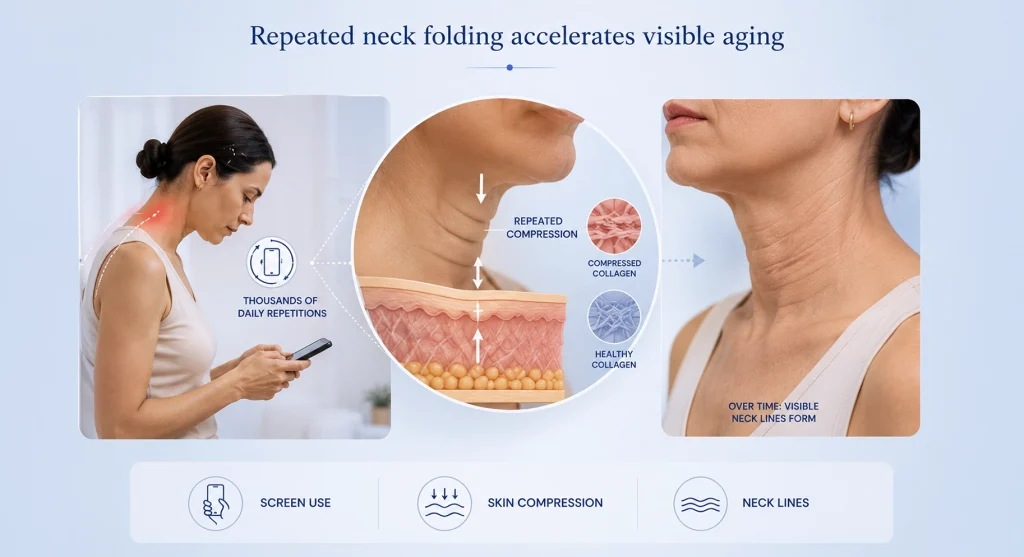
Tech neck, also called text neck, refers to the strain on the cervical spine that results from holding the head in a forward, downward position while using a smartphone, tablet, or laptop. The average adult head weighs 10 to 12 pounds in a neutral position. According to UT Southwestern Medical Center, tilting the head forward to just 45 degrees increases the effective load on the cervical spine to approximately 49 pounds. Across thousands of daily repetitions, that mechanical load strains muscles, compresses discs, and flattens the natural cervical curve. If you are exploring this, it helps to see how PDRN and polynucleotide regenerative therapy works at Perfect B in Doral and where it fits among our skin treatments.
But the musculoskeletal damage is only half the story. The skin of the anterior neck is simultaneously being folded, compressed, and creased in the same forward-tilted position thousands of times every day. Over years, this repeated mechanical folding deepens the horizontal lines across the neck that are increasingly visible in patients in their 30s and 40s who have never had significant neck aging before. In South Florida, where UV exposure is year-round and smartphone use is as constant as anywhere, the skin consequences of tech neck arrive earlier and progress faster than in lower-sun climates.
Key Takeaways
- Tech neck causes both musculoskeletal damage and accelerated neck skin aging through the repeated mechanical compression of the anterior neck skin into the same fold thousands of times daily.
- Neck skin is thinner than facial skin and has fewer hair follicles, making it more susceptible to UV damage, collagen loss, and visible aging often before the face shows equivalent change.
- PDRN rebuilds the collagen and elastin matrix of neck skin via the A2A receptor pathway, addressing the structural deficit that exercises and posture correction cannot reverse.
- Two distinct types of neck lines require different treatment emphasis: horizontal bands from forward-head posture, and diffuse vertical crepiness from collagen loss.
- PDRN for the neck requires 4 to 6 initial sessions spaced 4 weeks apart, with maintenance every 6 to 12 months depending on UV exposure and lifestyle factors.
Tech Neck vs. Natural Aging: Why Your Neck Shows Lines Before Your Face Does
Most patients are surprised to find that their neck looks older than their face. The explanation is anatomical. Neck skin has fewer hair follicles and sebaceous glands per square centimeter than facial skin, making it thinner and less equipped to retain moisture and resist environmental damage. A dermatologist at Cleveland Clinic has noted that this structural difference makes neck skin “more prone to showing signs of aging and sun damage” than the thicker facial skin most people focus on protecting.
Beyond skin thickness, the neck lacks the bony scaffold that facial anatomy provides. The orbital rim, zygomatic arch, and mandible give facial skin structural support points that limit how much gravitational and mechanical force acts directly on the dermis. The anterior neck has no such architecture. Every hour of looking down at a phone applies compressive force directly to a stretch of thin, collagen-depleted skin with no bony reinforcement beneath it.
Add in the chronic sun exposure that most South Florida patients accumulate on their neck and décolleté, and the result is a zone that collapses earlier and more visibly than the face. Most patients who ask us about neck lines treatment are not neglecting their skincare routine. They are simply applying it only to their face and ignoring the three inches of skin directly below it.
The Two Types of Neck Lines: Horizontal Bands vs. Vertical Crepiness
Not all neck lines are the same, and understanding the distinction matters for treatment planning.
Horizontal Necklace Lines
These are the parallel horizontal bands that circle the neck like rings, sometimes called necklace lines. They are present to some degree in most people from early adulthood because the skin of the neck naturally folds along these lines during movement. Tech neck accelerates and deepens them: hours of downward head tilt compress the skin into the same fold repeatedly, etching these lines progressively deeper into the dermis. They are often most visible in patients in their 30s and 40s who have spent years with their head angled toward a screen.
Vertical Crepiness and Laxity
This pattern appears later, typically in the 40s and 50s, and is driven by collagen and elastin loss from both intrinsic aging and UV-induced photoaging. The skin becomes thin, loose, and texturally rough. Fine vertical lines and a crepe-paper surface replace the firm, elastic skin of younger years. It affects the full anterior neck and often extends into the décolleté.
Most patients who come to Perfect B for neck lines treatment have both patterns simultaneously. PDRN addresses both: the structural collagen rebuilding reduces the crepiness, and the increased dermal thickness softens the depth of the horizontal necklace lines over the treatment series.
How PDRN Works on Neck Skin: The Biostimulation Approach
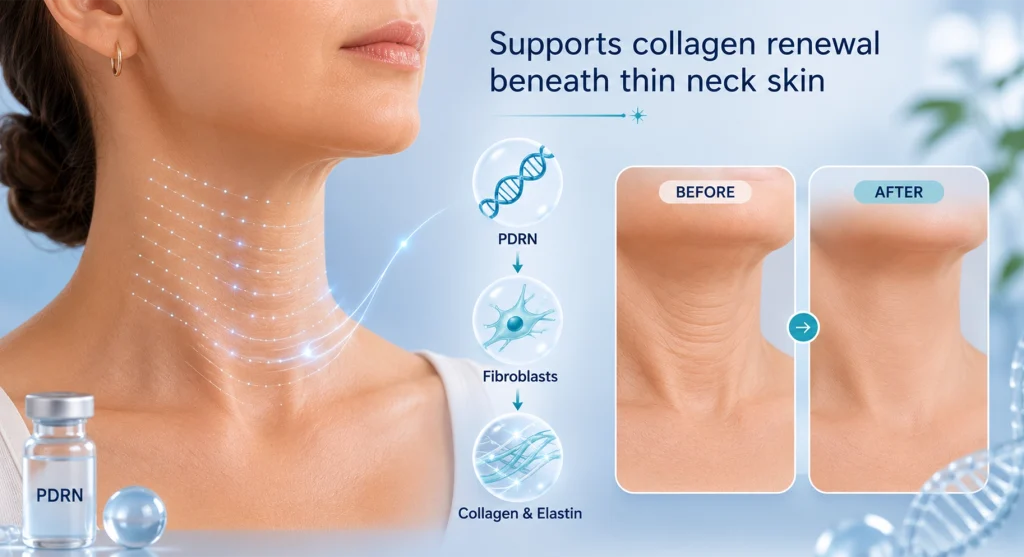
PDRN (polydeoxyribonucleotides) are long-chain DNA fragments derived from salmon sperm cells. When injected intradermally, they are broken down by tissue nucleases into nucleotides that bind to adenosine A2A receptors on dermal fibroblasts. This receptor activation triggers a regenerative cascade: upregulated collagen type I and III synthesis, elastin production, reduced inflammatory cytokines, and increased angiogenesis.
A 2025 study published in PLOS ONE examining PDRN’s role in cellular senescence found that PDRN attenuates autophagy-mediated SIRT1 degradation during skin aging, supporting its function as a structural protector of dermal architecture in aging tissue. For neck skin, which has already lost significant collagen density by the time patients seek treatment, this mechanism is directly relevant: PDRN stimulates the cells that should be producing collagen to begin doing so again.
The neck responds more gradually than the face, for structural reasons. Thinner skin with fewer supporting follicular structures means slower initial response, but also means the cumulative sessions have a more pronounced visible effect on overall skin quality as the new collagen accumulates. Patients who have treated their face with PDRN and then extend treatment to the neck consistently report that the neck reaches parity with facial improvement by session 4 to 6 of the neck series.
PDRN for Neck Lines: What the Treatment Protocol Involves
A PDRN session for the neck at Perfect B follows the same structure as our other PDRN treatments, with adjustments for the larger surface area and thinner skin of the anterior neck.
Topical anesthetic is applied to the treatment area 30 minutes before the session. The treatment takes 20 to 30 minutes, longer than the perioral area because the neck covers more surface. Using a fine-gauge needle, the provider places multiple small intradermal injections in a grid pattern across the anterior neck, from the jawline to the clavicle, and into the décolleté when included. Injection depth is superficial, targeting the dermis rather than subcutaneous tissue.
Small papules at each injection point are normal and typically resolve within 24 to 48 hours. The neck may feel slightly tight or tender for the first day. We advise patients to apply SPF 30 or higher to the treated area from the morning after treatment and to avoid strenuous exercise, direct heat, and alcohol for 24 hours. Because the neck is visible in most professional and social settings, patients generally prefer Thursday or Friday sessions to allow the papules to resolve over the weekend.
Tech Neck Treatment: What Exercises and Posture Can and Cannot Fix
Chin tucks, cervical retraction exercises, and posture correction protocols are legitimate, evidence-based interventions for the musculoskeletal component of tech neck. Strengthening the deep cervical flexors and cervical extensors reduces the forward head posture angle, which in turn reduces the compressive load on the spine and slows the rate of new crease formation in the neck skin.
What exercises cannot do is reverse the structural changes already present in the dermis. Once collagen has been lost from years of UV exposure and mechanical compression, no amount of chin tucks will rebuild the extracellular matrix. The necklace lines already etched into the skin are not muscular in origin: they are dermal. They will not respond to strengthening the muscles beneath them.
The practical clinical approach is to combine both. Posture exercises and ergonomic adjustments reduce the rate of new damage and prevent reaccumulation of the same mechanical forces that PDRN is working to repair. PDRN addresses the accumulated structural deficit that posture alone cannot reach. Patients who use both consistently get better results than those who use either in isolation.
→ See how the same PDRN biostimulation approach treats perioral wrinkles and lip lines at Perfect B.
How Many Sessions and What Results Can You Expect on the Neck
PDRN results on the neck are cumulative and build progressively across the treatment series.
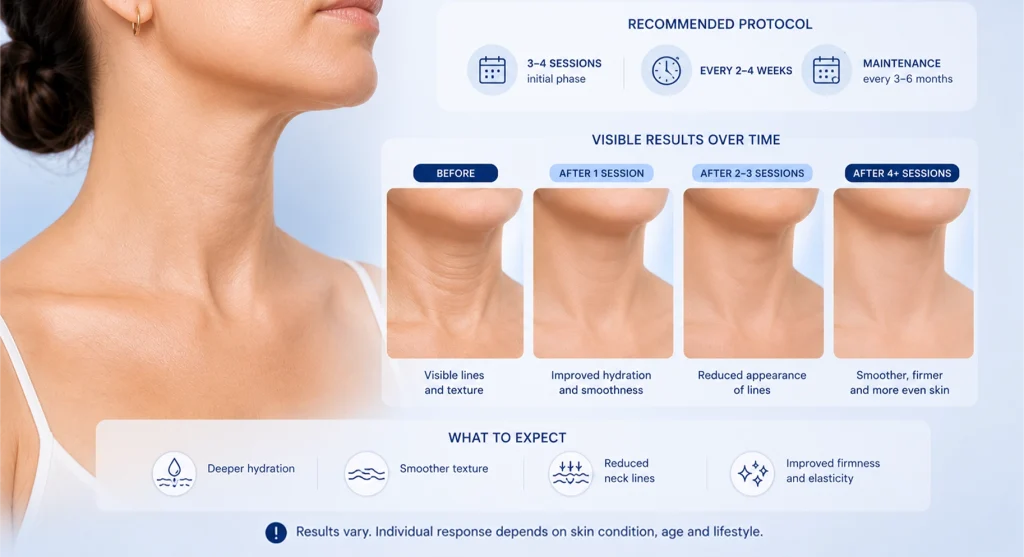
- Sessions 1 and 2: Improved skin hydration and texture. The neck skin looks more rested and uniform. Necklace lines are less pronounced at rest.
- Sessions 3 and 4: Visible reduction in neck crepiness. The skin has improved density and firmness. Patients report that the neck looks closer in quality to the face.
- Sessions 5 and 6: Optimal structural improvement. Horizontal necklace lines are softer and less etched. The décolleté shows improved skin quality where included in treatment.
- Maintenance: In South Florida, we recommend 2 maintenance sessions per year rather than 1, because UV exposure continues to break down the rebuilt collagen between sessions more aggressively than in lower-sun climates.
Patients who have already had neck PDRN elsewhere and come to Perfect B for continuation typically need fewer sessions to reach their target, as the foundation of collagen already rebuilt by prior treatment accelerates the response to subsequent sessions.
What Patients at Our Doral Clinic See After Neck PDRN Treatment
The patients who respond most consistently to PDRN for tech neck and neck lines at Perfect B share a few common characteristics: they have early to moderate horizontal necklace lines and some degree of neck crepiness, their concern is skin quality and line reduction rather than surgical recontouring, and they commit to the full initial series rather than stopping after two sessions when the improvement is just beginning.
A pattern we see frequently at our Doral clinic: patients of Hispanic and Latin American descent, common in our patient population, often have excellent facial skin well into their 50s because of the photoprotective advantage of higher Fitzpatrick skin types. But they skip the neck in their skincare routine, assuming the same protection applies. It does not: the neck skin is equally thin regardless of Fitzpatrick type, and UV exposure accumulates there without the same sebaceous gland density to support barrier function. These patients see meaningful improvement in neck quality relatively quickly once they begin a PDRN series, because the baseline is better than they assume.
Patients who combine PDRN for the neck skin with Botox placed along the platysmal bands (the Nefertiti approach) for band reduction see improvement in both the muscular and structural dimensions simultaneously. The two treatments work on different tissues and do not interfere with each other when sequenced correctly, typically 2 weeks apart.
Who Is a Good Candidate for PDRN on the Neck
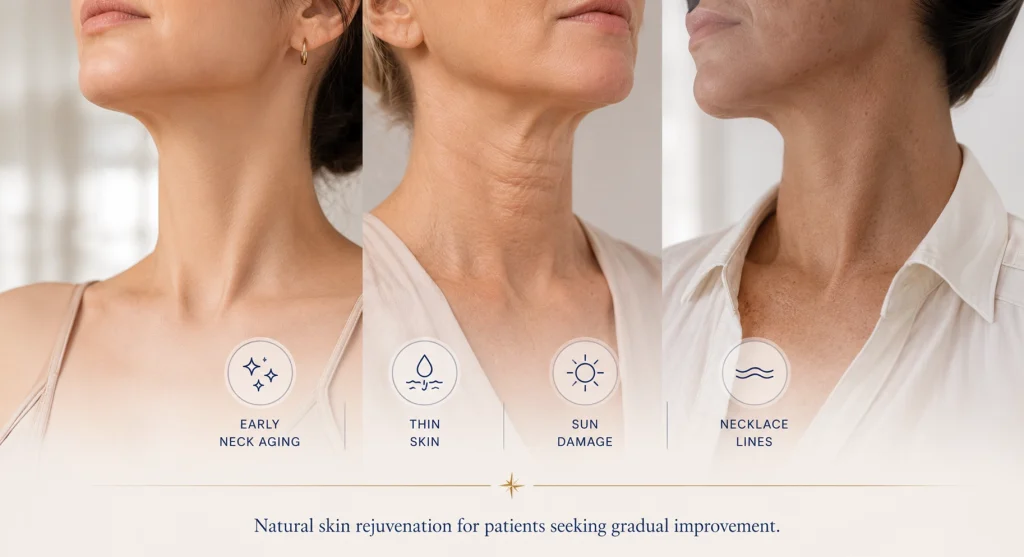
- Patients with early to moderate horizontal necklace lines deepened by tech neck posture, who want to reduce their appearance without surgical intervention.
- Patients with neck crepiness and skin thinning from collagen loss and UV exposure, seeking improved skin quality and density.
- Patients in their 30s to 60s who have begun to notice the neck aging faster than the face and want to address the structural deficit before it progresses further.
- Patients combining PDRN with a posture correction program who want a clinical complement to what exercises can achieve.
- Fitzpatrick III-VI patients in the South Florida population who may have underestimated their neck sun damage and want to restore skin quality without laser risk.
PDRN is not the first-line approach for patients with significant neck laxity involving loose, hanging skin (the condition sometimes called turkey neck) or prominent platysmal bands that stand up visibly at rest. Those presentations often require energy-based devices or surgical consultation before or alongside biostimulation. The full range of what PDRN can and cannot address across different facial and body zones is covered in our patient consultations; our PDRN for under-eye circles post also explains how treatment depth and response time vary by anatomical zone.
Frequently Asked Questions
1. What is the difference between tech neck pain treatment and tech neck skin treatment?
Tech neck pain treatment focuses on the cervical spine and musculoskeletal system: physical therapy, posture correction, ergonomic adjustments, and in some cases pain management injections. Tech neck skin treatment addresses the aesthetic consequence of forward-head posture on the skin of the anterior neck: the horizontal necklace lines and crepiness that the repeated compression creates. PDRN is a skin treatment, not a pain treatment. Both types of care address the same underlying posture habit from different clinical angles.
2. Can PDRN fix horizontal necklace lines from tech neck?
PDRN can significantly reduce the appearance of fine to moderate necklace lines by rebuilding the collagen and elastin matrix of the neck skin, making it thicker and more resilient. Deep, entrenched necklace lines that have been present for decades may see partial improvement. The treatment works best on lines that are still in the early to moderate stage of development, before the structural deficit has become severe.
3. How many PDRN sessions does the neck need compared to the face?
The neck typically requires 4 to 6 sessions for the initial series, compared to 3 to 4 for the perioral area. The neck’s thinner skin and lower density of supporting follicular structures means the biostimulation response builds more gradually. The visual improvement is equivalent by the end of the series, but it takes longer to get there.
4. Is PDRN safe for the neck and décolleté?
PDRN has a well-established safety profile in dermatology. No cross-linked or volumizing material is used, so there is no risk of migration or structural distortion. The most common reactions are localized redness, small papules at injection sites, and mild tenderness, all of which resolve within 24 to 72 hours. The neck and décolleté are commonly treated with PDRN in aesthetic medicine.
5. Can PDRN be combined with Botox for neck lines?
Yes. Botox placed along the platysmal bands (the Nefertiti technique) addresses the muscular component of visible neck lines and bands. PDRN addresses the structural skin component. The two treatments work on different tissues and are fully compatible when sequenced 2 weeks apart. Patients who combine both typically see improvement in both the muscular and dermal dimensions of neck aging.
6. How long do PDRN neck results last?
After completing the initial series of 4 to 6 sessions, structural improvement in neck skin quality lasts approximately 9 to 12 months before a maintenance session is recommended. In South Florida, where UV exposure is year-round, we suggest 2 maintenance sessions per year rather than 1, as photodamage degrades the rebuilt collagen more quickly in high-sun environments.
7. My neck looks older than my face. Is PDRN the right first step?
For most patients with this complaint, particularly those with early to moderate necklace lines and skin thinning without major laxity, PDRN is an excellent first clinical step. It addresses the structural deficit without surgery, without devices, and without downtime beyond 48 hours. Patients with more significant structural laxity may benefit from an energy-based device or surgical consultation alongside PDRN. A consultation at Perfect B will determine which approach fits your specific presentation.
8. Do tech neck exercises help or hurt PDRN results?
They help. Exercises that strengthen the cervical extensors and reduce forward head posture angle decrease the rate of new neck skin compression and crease formation. Combined with PDRN, which repairs the accumulated structural damage, posture work and biostimulation are complementary. Patients who address both the behavioral cause and the structural consequence consistently see better outcomes than those who address only one.
The Clinical Bottom Line: Tech Neck Is a Skin Problem, Not Just a Spine Problem
The same hours of downward screen use that strain the cervical spine also compress, fold, and age the skin of the anterior neck at an accelerating rate. Exercises and posture correction address the musculoskeletal component. PDRN addresses the dermal one. Neither fully substitutes for the other.
For patients in Doral and across South Florida who are noticing that their neck looks older than their face, or that horizontal lines are appearing earlier than expected, PDRN offers a biostimulation approach that rebuilds the structural collagen the neck skin has lost. No surgery, no energy devices, no extended downtime.
The next step is a consultation. Call or text Perfect B at (786) 502-2260 or see the full treatment plan and protocol details at the link below.
- 📍 Visit us at Perfect B, Doral FL, serving Miami and South Florida patients seeking neck rejuvenation and tech neck skin treatment.
- 📞 Call or message us at (786) 502-2260 to schedule your PDRN neck treatment consultation with a licensed medical provider.
→ See the full PDRN skin rejuvenation treatment plan and what to expect at Perfect B in Doral, FL.