Perfect B, Doral Fl. | 07.10.26 | 10 min read.
This article is for general educational purposes and is not a substitute for personalized medical or nutritional advice. Supplements are not regulated the way medications are, and individual needs vary with age, health, and goals. Always confirm what is right for you with a licensed provider before starting any new supplement or in-office treatment.
Best Collagen Supplement: How to Choose One That Actually Works
Searching for the best collagen supplement can feel like standing in an endless aisle of powders, capsules, and liquid shots that all promise firmer skin, stronger nails, and healthier joints. The honest truth is that there is no single best collagen supplement for everyone, only the one that is best matched to your goal, your budget, and how your body actually uses it. This buyer’s guide walks you through what genuinely separates a quality collagen product from clever packaging, so your money goes toward something that works rather than toward a pretty label.
At Perfect B in Doral, patients often ask which collagen supplement to buy before or after an in-clinic skin treatment. Rather than name one brand, we think it is far more useful to teach you how to read the science, the label, and your own expectations. Once you understand the type of collagen, the dose, the source, and the co-factors that help it work, a confusing purchase becomes a confident one.

Key Takeaways
- Best is personal: the best collagen supplement is the one matched to your goal, whether that is skin, nails, or joints, not a single universal winner.
- Hydrolyzed absorbs better: hydrolyzed collagen, also called collagen peptides, is broken into small fragments your body takes up more easily than gelatin or intact collagen.
- Dose and consistency matter: research typically uses a steady daily amount for at least eight to twelve weeks, so a supplement only pays off if you take it consistently.
- The label tells the truth: third-party testing, a clearly stated collagen type, and useful co-factors like vitamin C matter far more than bold front-of-package claims.
- Supplements support, they do not replace: for visible firming, pairing a supplement with in-clinic collagen stimulation gives the most reliable results.
What Makes a Collagen Supplement Worth Buying?
A collagen supplement is worth buying when three things line up: the form is absorbable, the dose is meaningful, and the source is clean and tested. Everything else on the label is either a helpful bonus or marketing noise. Collagen is the most abundant protein in your body and it forms the scaffolding of your skin, so the idea behind supplementing is simple, you provide the raw building blocks and the amino acid signals that support your own collagen production. The catch is that quality varies enormously between products, and price alone does not tell you which is which.
The best way to shop is to ignore the front of the jar and turn it around. A product that clearly states the collagen type, the exact amount per serving, the animal or marine source, and any third-party testing is telling you it has nothing to hide. A jar covered in adjectives like premium and clinical but vague on the actual numbers is asking you to trust the branding instead of the facts. The rest of this guide gives you the specific things to check.
Collagen Peptides, Hydrolyzed Collagen, and Types I, II, and III Explained
The words on collagen labels can be confusing because several of them mean almost the same thing. Hydrolyzed collagen and collagen peptides are effectively the same product, collagen that has been broken down into small, easily absorbed fragments. Gelatin is collagen that is only partly broken down, which is why it gels when cold and is harder to mix into a cold drink. For a supplement you plan to take daily, hydrolyzed collagen peptides are usually the most practical and best absorbed choice. If you want the deeper science on this specific distinction, read our in-depth comparison of collagen peptides versus collagen hydrolysate and which form is genuinely best for your skin over time.
The type number matters too, because different types target different tissues. Type I is the main collagen in skin, hair, nails, and bone, which makes it the priority for anti-aging and skin firmness. Type II is concentrated in cartilage, so it is the one people choose for joint comfort. Type III often appears alongside Type I and supports skin elasticity. Many skin-focused products combine Types I and III, while joint products lean on Type II. The table below sorts out which is which.
| Collagen type | Main role in the body | Best for | Common source |
|---|---|---|---|
| Type I | Skin, hair, nails, and bone structure | Skin firmness and anti-aging | Marine or bovine |
| Type II | Cartilage and joint cushioning | Joint comfort and mobility | Chicken |
| Type III | Skin and blood vessel elasticity | Skin elasticity, usually paired with Type I | Bovine |
| Hydrolyzed peptides | Any type, cut into small fragments | Easy daily absorption and mixing | Marine or bovine |
Marine, Bovine, Chicken, or Vegan: Which Collagen Source Is Best?
The source of a collagen supplement affects its type, its absorption, and whether it fits your diet. Marine collagen comes from fish skin and scales, is rich in Type I, and is often praised for smaller peptide size and good absorption, which makes it popular for skin goals. Bovine collagen comes from cattle and delivers Types I and III together, a natural fit for both skin and general structural support. Chicken collagen is a common source of Type II for joints. Each is a real animal protein, so none of them are suitable for a strict plant-based diet.
This is where so-called vegan collagen needs an honest note. There is no true plant collagen, because collagen is an animal protein. Products labeled vegan collagen are usually collagen boosters, meaning blends of vitamin C, amino acids, and botanicals meant to support your own collagen production rather than supply collagen itself. They can be worthwhile, but you should buy them understanding that they are not the same thing as a collagen supplement. Choosing between marine, bovine, and chicken mostly comes down to your primary goal and any dietary or allergy considerations.
How Much Collagen Per Day, and What the Research Actually Shows
Dose is where many products quietly fall short. Studies on collagen and skin generally use a steady daily amount of hydrolyzed collagen peptides, commonly in the range of 2.5 to 15 grams, taken for a sustained period rather than in a single burst. A capsule product that provides only a fraction of a gram per serving may technically contain collagen while never reaching an amount that research associates with visible benefits. This is why powders, which make it easy to hit a full dose, are often better value than low-dose capsules for skin goals.
Consistency matters as much as quantity. The skin renews slowly, so collagen is a daily habit, not a quick fix, and stopping after two weeks tells you very little. For a balanced, independent look at the evidence before you buy, browse the independent, evidence-based summary of collagen supplement research compiled by the science team at Examine. Reading the research first protects you from paying premium prices for claims that studies do not support.
How to Read a Collagen Supplement Label Like a Pro
Once you know what to look for, a label reveals a product’s real quality in about thirty seconds. Start with the amount of collagen per serving in grams, then check the collagen type and source, and confirm the product lists a third-party testing seal such as NSF or Informed Choice. Look for helpful co-factors, especially vitamin C, which your body needs to actually build collagen, and sometimes hyaluronic acid for hydration. Finally, scan the other ingredients for unnecessary sugars, artificial colors, or a vague proprietary blend that hides how much of anything you are really getting.
A quality product is transparent about all of these details, while a weaker one relies on impressive language and a photogenic jar. If you cannot find the grams per serving or the collagen type, treat that as a reason to keep looking. The best collagen supplement for you is one whose label you can fully understand, because that is the only way to compare two products fairly on the things that actually change results.
Powder, Capsule, or Liquid: Does the Format Change Results?
Format is mostly about practicality and dose, not magic. Powder is usually the best value and the easiest way to reach a full daily amount, since you can stir a scoop into coffee, water, or a smoothie. Capsules are convenient and travel well, but they often deliver a small fraction of a research-level dose, so you would need to swallow many of them to match a single scoop of powder. Liquid collagen shots are convenient and pleasant, though you are frequently paying a premium for water and flavoring rather than for more collagen.
The right format is the one you will genuinely take every day at a meaningful dose. A powder you enjoy stirring into your morning drink beats a capsule you forget on the shelf. When comparing cost, calculate the price per gram of collagen rather than the price per jar, because that is the number that reflects what you are actually paying for and prevents an attractive package from disguising a weak dose.
How Long Before a Collagen Supplement Shows Results?
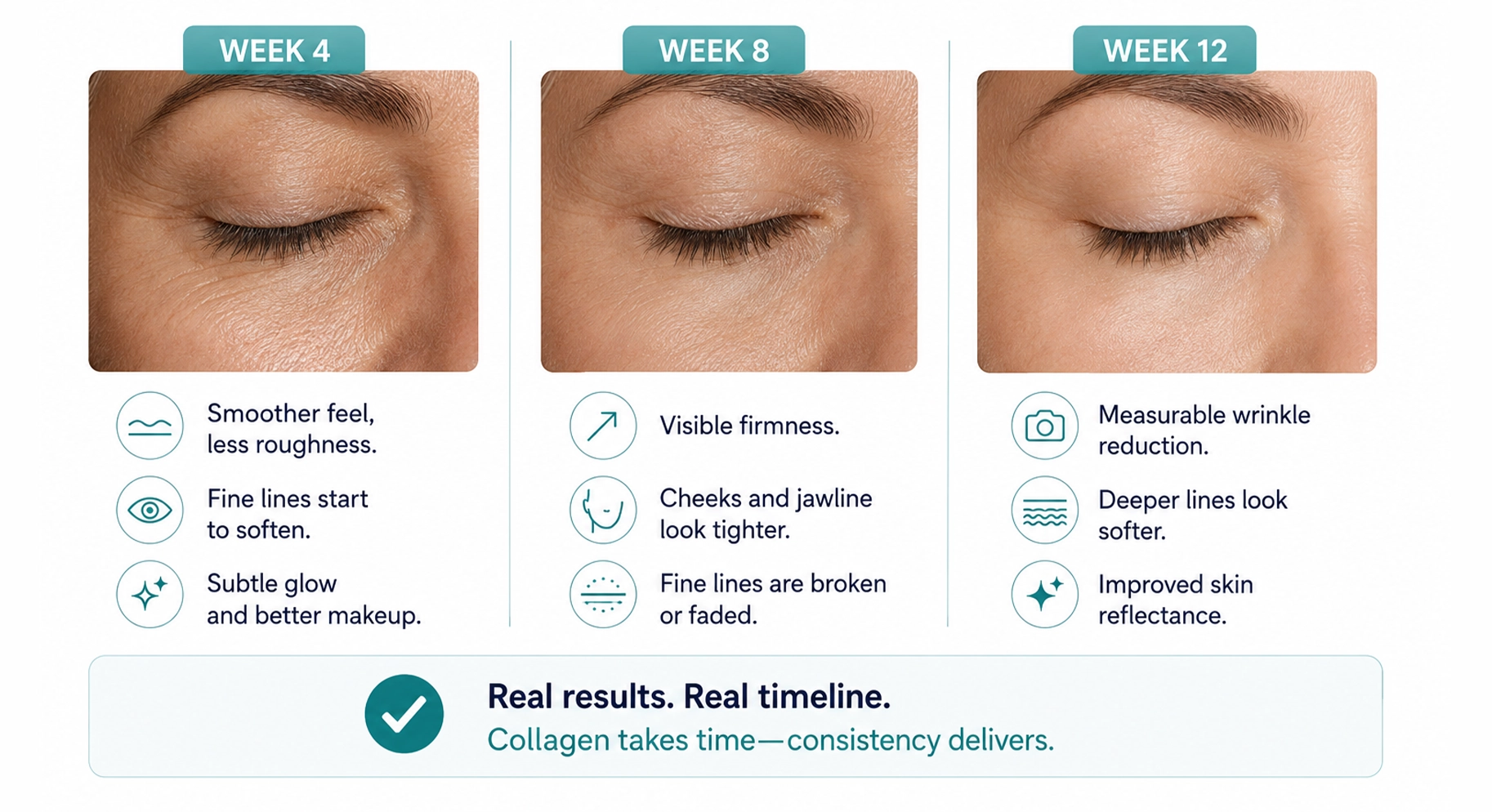
Patience is part of the plan. Because skin turns over gradually, most people who notice a difference report it after roughly eight to twelve weeks of consistent daily use, not days. Early changes are often subtle, such as skin that feels a little smoother or nails that seem sturdier, before any firmness becomes visible. Setting this expectation up front is the single best way to avoid the common mistake of quitting a good product too soon and assuming it failed.
For a reliable, plain-language explanation of how collagen behaves in the body and why it declines with age, read the Cleveland Clinic overview of what collagen is, what causes it to decline as we age, and how supplements are studied. Grounding your expectations in that kind of source keeps a supplement in its proper place as one helpful part of a bigger skin plan.
When a Collagen Supplement Is Not Enough: In-Clinic Support
A supplement supplies building blocks, but it cannot direct your skin to rebuild a specific area, and that is where professional treatments come in. If your goal is visible firmness or smoother texture rather than general wellness, the most reliable results come from pairing a good supplement with a treatment that actively stimulates your own collagen. One well established option is microneedling in Miami, a staged in-office treatment that uses controlled micro-channels to prompt your skin to build fresh new collagen, planned as a short series for gradual, natural-looking improvement.

Two more options work naturally alongside a supplement. You can explore collagen induction therapy and what a full course typically involves and costs at our Doral clinic for firmer, healthier skin, and you can learn about the GHK-Cu copper peptide and how it is applied with microneedling to support your skin’s own collagen production and repair. Combining an internal supplement with a professional treatment usually outperforms either one on its own.
If you are not sure where to begin, a provider can map the right mix for you as part of our step by step skin rejuvenation treatment plan that sequences in-clinic collagen treatments with the right at-home support for your skin.
Collagen Supplement Mistakes That Waste Your Money
The most common mistake is buying on price or packaging instead of on dose and testing, which is how people end up with a jar that contains too little collagen to matter. A close second is quitting after two weeks, long before the skin has had time to respond, and then concluding that collagen does not work. Others buy the wrong type for their goal, such as a joint-focused Type II product when they wanted skin benefits, or they choose a low-dose capsule when a powder would have delivered far more for the money.
You can sidestep all of these by shopping the way this guide describes: match the type to your goal, confirm a meaningful dose, check for third-party testing and vitamin C, commit for at least a couple of months, and treat the supplement as one part of a plan rather than a miracle in a jar. Do that, and you will spend less over time while getting results that actually show up.
Frequently Asked Questions
1. What is the best collagen supplement for skin?
For skin, the best collagen supplement is a hydrolyzed product rich in Type I, and often Type III, at a meaningful daily dose with vitamin C included. Marine collagen is a popular Type I source. The best choice is the one you will take consistently for at least two to three months.
2. Is hydrolyzed collagen better than regular collagen?
For a daily supplement, yes. Hydrolyzed collagen, also called collagen peptides, is broken into small fragments that are easier to absorb and mix into cold drinks than gelatin or intact collagen. That is why most quality skin and joint products use the hydrolyzed form.
3. How much collagen should I take per day?
Research on skin generally uses a steady daily amount of hydrolyzed collagen peptides, commonly in the range of 2.5 to 15 grams. The exact amount that suits you depends on your goal and product, so confirm the grams per serving on the label and take it consistently rather than occasionally.
4. Does vegan collagen really exist?
Not as true collagen, because collagen is an animal protein. Products labeled vegan collagen are collagen boosters, meaning blends of vitamin C, amino acids, and botanicals that support your own collagen production. They can help, but they are not the same as an animal-sourced collagen supplement.
5. How long until a collagen supplement shows results?
Most people who notice a change report it after about eight to twelve weeks of consistent daily use. Early signs are often subtle, such as smoother-feeling skin or sturdier nails, before firmness becomes visible. Collagen is a daily habit, so quitting too early is the most common reason people think it did not work.
6. Powder or capsules: which collagen format is better?
Powder is usually the best value and the easiest way to reach a full daily dose, while capsules are convenient but often provide only a small fraction of a research-level amount. Compare products by the price per gram of collagen rather than the price per jar to see which is truly better value.
7. Can a collagen supplement replace an in-clinic treatment?
No. A supplement supplies building blocks from within, but it cannot target a specific area the way a professional treatment can. For visible firming, pairing a good supplement with a treatment that stimulates your own collagen, such as microneedling, usually gives the most reliable results.
8. What should I look for on a collagen supplement label?
Check the grams of collagen per serving, the collagen type and source, and a third-party testing seal such as NSF or Informed Choice. Look for vitamin C as a co-factor, and avoid vague proprietary blends, added sugars, and products that never state how much collagen you actually get.
Choose the Right Collagen Plan for Your Skin
The smartest thing you can do with the search for the best collagen supplement is stop hunting for a single winning brand and start shopping by the things that matter: the right type for your goal, a meaningful dose, a clean and tested source, and helpful co-factors like vitamin C. Read the label, commit for a couple of months, and treat the supplement as one supporting piece of your skin plan rather than the whole plan. If firmer, healthier skin is the goal, explore the full range of skin rejuvenation treatments we use to firm, smooth, and refresh the skin at Perfect B in Doral.
Our team is happy to help you build a plan that combines the right at-home support with the in-clinic treatments that actually rebuild collagen where you want it. Reach out and turn a confusing supplement aisle into a clear, personalized plan for your skin.
- 📍 Visit us at Perfect B, 3905 NW 107th Ave, Suite 104, Doral FL 33178
- 📞 Call or message us at (786) 502-2260
- 💳 Financing available through Cherry, Klarna, Afterpay, and CareCredit