
Perfect B, Doral FL. | 05.07.26 | 9 min read.
This post is for educational purposes only and does not substitute for personalized medical advice. Laser tattoo removal protocols vary based on ink type, skin tone, tattoo age, and individual healing response. Consult a licensed medical provider before beginning any tattoo removal treatment.
What Actually Happens to Ink When a Laser Hits It?
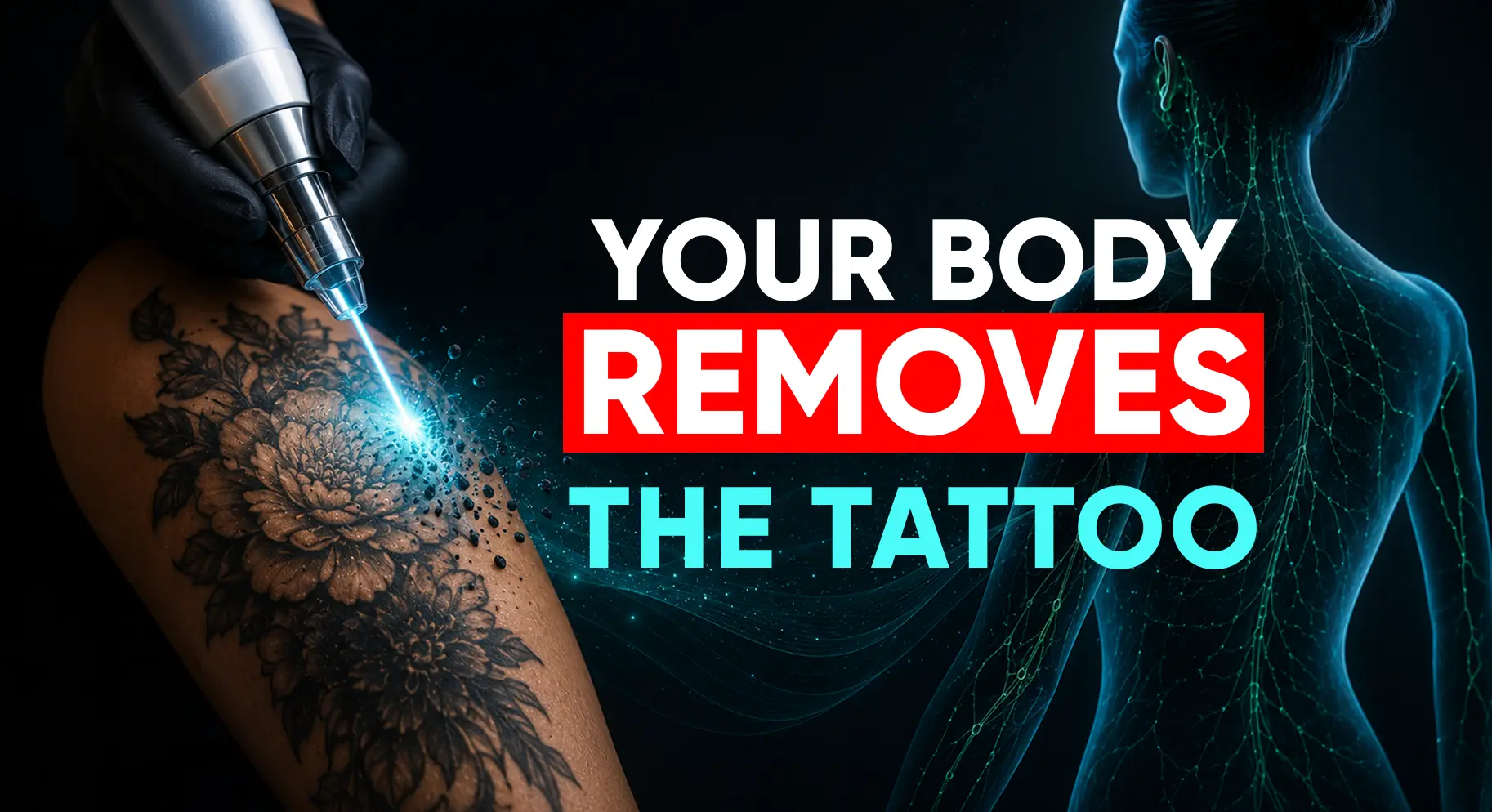
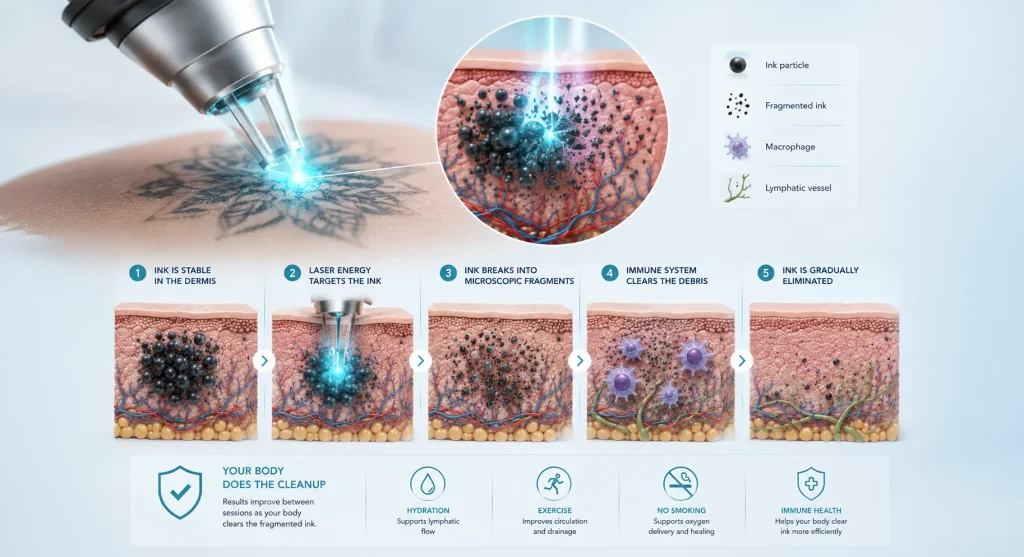
Tattoo ink is permanent because of size. When a tattoo artist injects pigment into the dermis, the ink particles are large enough that your immune system cannot process them. Your macrophages, the cells responsible for clearing foreign particles, attempt to engulf the ink, but the particles are simply too big. So they stay put, and the tattoo remains visible indefinitely.
Laser tattoo removal solves this by doing what your immune system cannot: breaking those large ink particles into fragments small enough for your body to clear naturally. The laser delivers concentrated light energy directly into the ink at the dermis layer. The ink absorbs that energy and the particle fractures. What was one large, immovable particle becomes dozens of microscopic fragments. Your lymphatic system then gradually transports those fragments out of the skin over the weeks that follow each session.
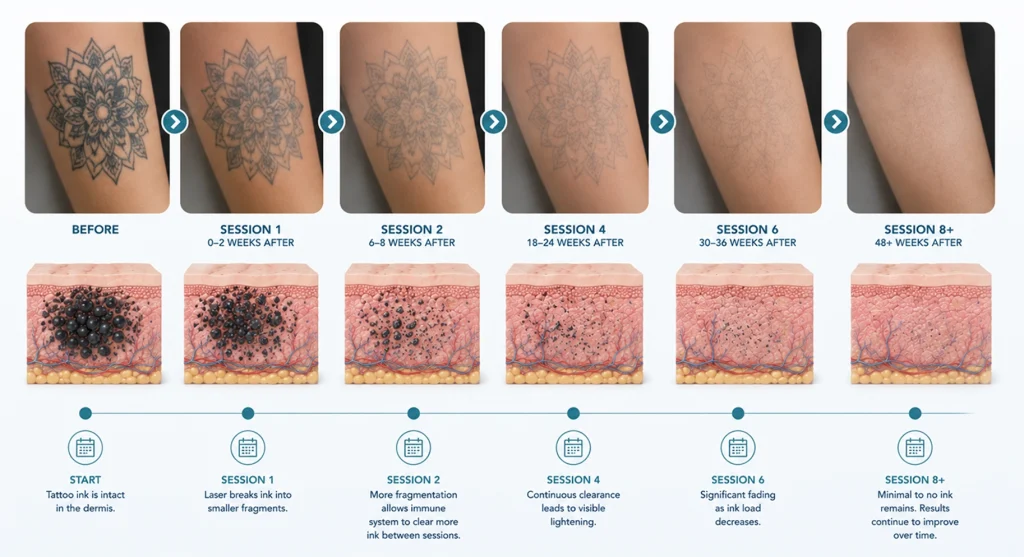
This is why tattoo removal takes multiple sessions and why you see fading between appointments rather than immediate disappearance. The laser does the initial work in the clinic. Your body does the cleanup over the following four to eight weeks.
Why your immune system could not do this alone
The immune system is not passive during the tattoo removal process. It is actively working between every session, and how efficiently it works directly affects how quickly your tattoo fades. Factors that support immune function and lymphatic circulation, including hydration, cardiovascular exercise, and avoiding tobacco, measurably improve the speed of ink clearance between sessions. Patients who smoke or have compromised immune function consistently require more sessions for the same level of clearance. This is not a minor variable. It is one of the most underestimated factors in the entire removal process.
The role of your lymphatic system between sessions
The lymphatic system functions as the drainage network that carries fragmented ink particles away from the treatment site. After a laser session, the treated area undergoes local inflammation, which is a normal part of the process. The lymphatic vessels in that region then work to transport the debris. This is why sessions are spaced six to eight weeks apart rather than back to back. Consecutive weekly sessions would not accelerate results because the lymphatic system requires time to complete each clearance cycle. Attempting to rush the schedule by shortening intervals between sessions reduces total clearance per session and increases the risk of complications.
Key Takeaways
- Laser tattoo removal works by fracturing ink particles into fragments small enough for your lymphatic system to clear. Your immune system cannot do this without the laser because intact ink particles are too large to process.
- Picosecond lasers are the clinical standard in 2026, using photomechanical pressure waves rather than heat to shatter ink more efficiently and with less collateral tissue damage than Q-switched systems.
- Your Fitzpatrick skin type determines which laser and which wavelength is appropriate, not just what setting to use. On darker skin tones, melanin competes with ink for laser energy, which requires conservative protocols to avoid hyperpigmentation.
- Session count depends on five variables: size, ink depth, colors present, Fitzpatrick type, and lymphatic health. Generic claims of 8 to 12 sessions do not account for individual variation in any of these.
- Miami’s UV environment changes the aftercare rules significantly. Post-treatment sun exposure is one of the most reliable ways to cause permanent hyperpigmentation in treated skin. One unprotected afternoon at the beach can undo weeks of progress.
Picosecond vs Q-Switch: Why the Technology Changes Everything
Not all lasers remove tattoos the same way. The difference between a picosecond laser and a Q-switched laser is not a matter of brand preference or marketing. It is a fundamental difference in the physical mechanism used to destroy ink, and that mechanism has direct consequences for how many sessions you need, how your skin responds during healing, and whether darker skin tones can be treated safely.
Q-switched lasers: heat-based fragmentation in nanoseconds
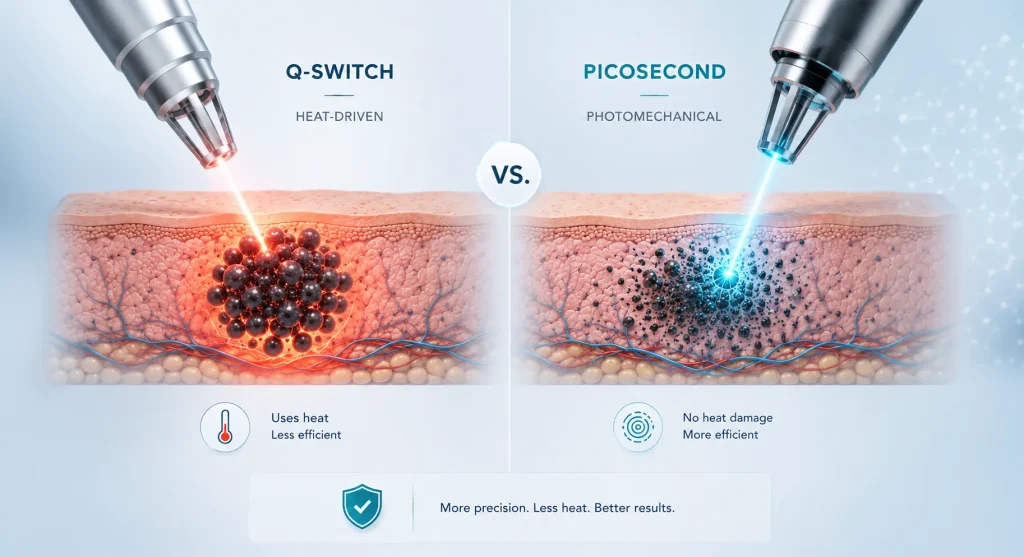
Q-switched lasers deliver pulses of light energy measured in nanoseconds, which are billionths of a second. At that pulse duration, the primary mechanism for breaking ink particles is thermal: the ink absorbs the energy, heats rapidly, and the thermal expansion fractures the particle. Q-switched systems have been used in tattoo removal for decades and have a well-established safety record, particularly for black and dark blue inks at the 1064nm wavelength. They remain effective and FDA-cleared for tattoo removal. The limitation is that the thermal mechanism requires more energy to achieve the same fragmentation effect, which means more residual heat in the surrounding tissue. On Fitzpatrick III to V skin, that residual heat raises the risk of post-inflammatory hyperpigmentation, because melanocytes in the dermis respond to thermal injury by producing excess pigment.
Picosecond lasers: pressure waves in trillionths of a second
Picosecond lasers deliver pulses measured in picoseconds, which are trillionths of a second, approximately 1,000 times faster than nanosecond systems. At that pulse duration, the primary mechanism shifts from thermal to photomechanical. The ultra-fast energy delivery creates a shockwave inside the ink particle rather than heating it. The particle shatters under pressure rather than thermal expansion. This photomechanical fragmentation produces smaller ink fragments per session, which the lymphatic system can clear more efficiently. Clinical studies confirm that picosecond systems achieve higher clearance rates in fewer sessions compared to Q-switched systems, with significantly lower risk of thermal damage to surrounding tissue. A peer-reviewed review published in StatPearls on laser tattoo removal confirming the photomechanical advantages of picosecond technology over Q-switched systems across multiple ink types and skin tones supports this clinical approach.
Which technology Perfect B uses and why
At Perfect B in Doral, FL, we use picosecond laser technology for tattoo removal. The decision is clinical, not cosmetic. Our patient population in South Florida includes a high proportion of Fitzpatrick III to V skin types, which are Latin American, Hispanic, and Caribbean patients for whom the thermal risk of Q-switched systems creates unnecessary complication potential. Picosecond technology reduces that risk substantially while achieving superior clearance results in fewer sessions. For our patients, fewer sessions means less total cost, less cumulative skin stress, and a faster path to the result they came in for. → See how Perfect B structures laser tattoo removal treatment in Doral, FL, including technology, session spacing, and what to expect at each stage.
Why Your Skin Tone Determines the Protocol
Skin tone is not a cosmetic consideration in tattoo removal. It is a clinical one. The Fitzpatrick scale classifies skin from Type I, which is very fair and always burns, to Type VI, which is deeply pigmented and never burns. This classification exists because melanin concentration in the skin affects how laser energy is absorbed. In tattoo removal, the laser needs to target ink pigment selectively, without damaging the surrounding skin. On lighter skin tones, the contrast between pale skin and dark ink makes this targeting straightforward. On darker skin tones, the melanin in the dermis competes with the ink for laser energy absorption.
The Fitzpatrick scale and melanin competing with ink
When a laser is set at a wavelength and fluence appropriate for a Fitzpatrick I or II patient, that same setting applied to a Fitzpatrick IV or V patient can result in excess energy absorption by melanin, leading to thermal injury, blistering, or post-inflammatory hyperpigmentation that can be as visible and persistent as the original tattoo. This is not a theoretical risk. It is one of the most common sources of adverse outcomes from tattoo removal, particularly in non-medical settings where Fitzpatrick assessment is skipped in favor of standardized protocols applied uniformly across all patients.
Why South Florida patients get a different assessment
The demographic reality of Doral and greater Miami means that the majority of our tattoo removal patients fall into Fitzpatrick III to V. This shapes our entire approach before a single pulse is delivered. We assess Fitzpatrick type, evaluate recent sun exposure history, review any prior tattoo removal attempts, and confirm that the skin in the treatment area is not actively tan. For Type IV and V patients, we adjust wavelength selection, reduce fluence settings, and extend session intervals to allow more conservative healing. We also evaluate multicolored tattoos more carefully, since certain pigments, particularly greens, blues, and yellows, require specific wavelengths that must be calibrated differently on darker skin to avoid collateral damage. → See how Fitzpatrick assessment and technology selection affect the total cost and session count for laser tattoo removal in Doral, FL.
How Many Sessions Does Laser Tattoo Removal Actually Take?
The most common question patients ask is how many sessions their tattoo will require. The honest answer is that no provider can give you an accurate number after a single consultation without acknowledging the variables involved. Generic claims of “8 to 12 sessions” are a starting point, not a protocol. The actual session count for any individual tattoo is determined by five specific factors, and each one can add or subtract sessions from the baseline estimate.
The 5 variables that determine your session count
1. Tattoo size and density. Larger tattoos with dense ink coverage require more sessions because there is more total pigment to fragment and clear. A small wrist tattoo and a full sleeve are not comparable in session count, even if both are black ink.
2. Ink depth. Professional tattoos are injected deeper into the dermis than amateur tattoos. Deeper ink requires more sessions because the laser energy must penetrate further to reach and fragment the particles. Amateur tattoos, despite often appearing more irregular, typically fade faster for this reason.
3. Ink colors present. Black and dark blue inks respond best and fastest, because the 1064nm wavelength has high absorption in those pigments. Greens, blues, and yellows require additional wavelengths, specifically 532nm and 785nm, and respond more slowly. Multicolored tattoos almost always require more sessions than single-color tattoos of comparable size.
4. Fitzpatrick skin type. Darker skin tones require more conservative treatment settings, which means less energy per session and therefore more sessions to achieve equivalent clearance. This is a safety-driven protocol adjustment, not a limitation of the technology.
5. Lymphatic health and immune function. Your body’s ability to clear fragmented ink particles between sessions determines how much progress you make between appointments. Patients who hydrate well, exercise regularly, do not smoke, and have healthy immune function consistently clear faster. This is the one variable fully within patient control.
Ink Color and Why Some Colors Are Harder to Remove
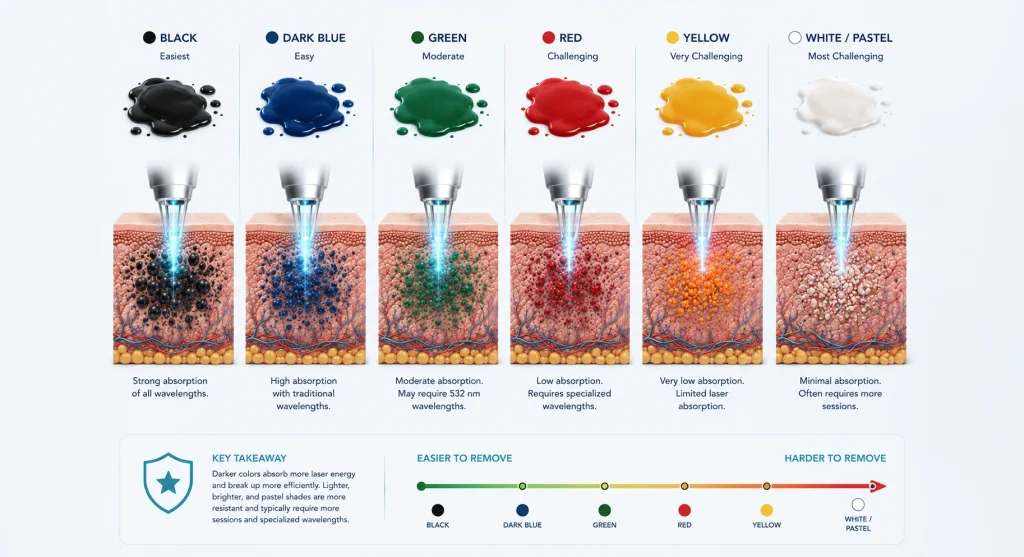
The physics of laser tattoo removal depends on selective absorption: the ink must absorb the laser’s wavelength more efficiently than the surrounding skin tissue. Different ink pigments have different absorption spectra, which is why no single wavelength removes all colors with equal efficiency.
Black and dark blue: the most responsive
Black ink absorbs broadly across the near-infrared spectrum and responds well to the 1064nm wavelength, which is the primary wavelength in both picosecond and Q-switched Nd:YAG systems. This is why black tattoos are generally the easiest and fastest to clear. Dark blue inks behave similarly at 1064nm and typically track alongside black in terms of session count.
Green, blue, and yellow: specific wavelengths required
Bright blue and green inks have absorption peaks at shorter wavelengths, around 694nm and 785nm. Older Q-switched systems without ruby or alexandrite handpieces could not effectively target these colors, which is why green ink developed a reputation for being nearly impossible to remove. Modern picosecond platforms with 785nm handpieces address this limitation significantly. Yellow ink is the most challenging across all systems because its absorption peak sits at very short wavelengths that no commercially available tattoo removal laser targets efficiently. Yellow-containing tattoos require more sessions and typically achieve less complete clearance than black-ink tattoos of comparable size and age. A peer-reviewed reference on wavelength-specific ink targeting and selective photothermolysis is available in the StatPearls clinical review on laser tattoo removal, covering the evidence base for wavelength selection across pigment types.
What Laser Tattoo Removal Feels Like and What to Expect After
Most patients describe the sensation as a sharp snap, similar to a rubber band hitting the skin, repeated rapidly across the treatment area. For smaller tattoos, a session takes five to fifteen minutes. For larger pieces, sessions can run thirty to forty-five minutes. A topical numbing cream is applied before treatment to manage discomfort, and cooling devices are used during the procedure to protect the skin surface.
During the session
After numbing takes effect, the provider passes the laser handpiece over the tattoo in overlapping pulses. Each pulse produces a brief, sharp sensation and you may notice a slight crackling sound, which is the ink fragmenting. The skin will appear frosted or whitened immediately after treatment, which is a normal optical response called whitening that resolves within minutes. Mild swelling and redness are expected in the hours following the session.
The healing timeline: week by week
Days 1 to 3: Redness, mild swelling, and sensitivity at the treatment site. Blistering can occur, particularly on denser ink, and is a normal part of the healing process. Do not pop blisters. Keep the area clean and covered.
Days 4 to 7: Swelling subsides. The treatment area begins to crust or peel. Do not pick or pull at peeling skin. Allow it to shed naturally.
Week 2 to 3: The outer skin heals. The tattoo may appear darker than before treatment at this stage, which is normal. The ink is still in the process of fragmenting.
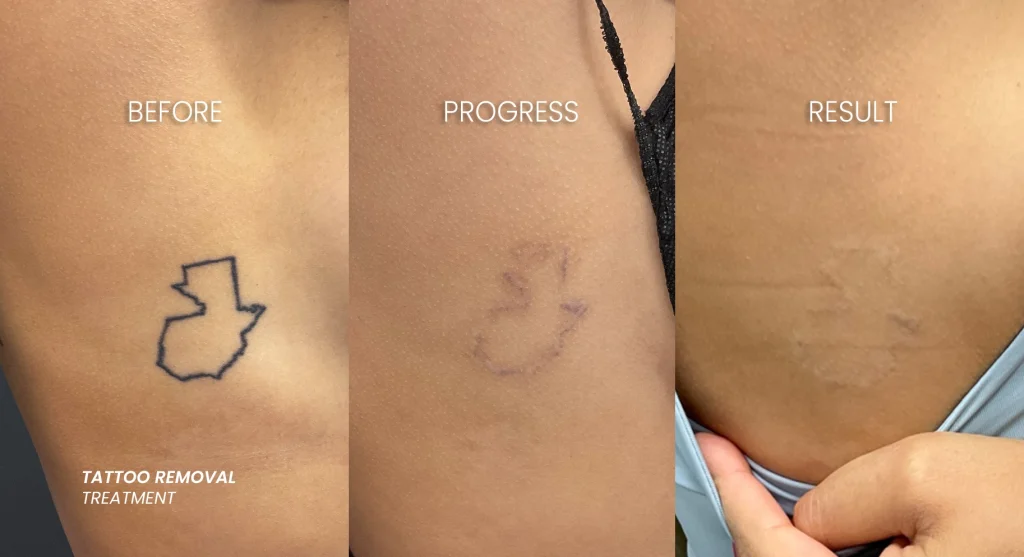
Weeks 4 to 8: Visible fading begins. The fragmented particles are being cleared by the lymphatic system. The tattoo will appear progressively lighter and the next session can be scheduled at the 6-to-8 week mark.
Aftercare in Miami: Why Sun and Heat Change the Rules
Miami’s UV index is consistently among the highest in the continental United States. For patients undergoing laser tattoo removal, this creates a specific aftercare context that does not apply in most other markets. Freshly treated skin has a compromised barrier and significantly reduced melanin protection in the treated area. UV exposure during the healing window is one of the most reliable ways to trigger post-inflammatory hyperpigmentation, producing a dark mark over the treatment area that can be as persistent and visible as the tattoo itself.
Why one afternoon at the beach can undo your progress
The combination of direct sun exposure, salt water, sand, and heat creates multiple simultaneous risks for recently treated skin: UV-induced melanocyte activation, contamination of a healing wound, and thermal aggravation of an already-inflamed dermis. Our standard aftercare instructions for all Doral and Miami patients:
- No sun exposure for a minimum of two weeks post-session, including incidental exposure, not just intentional tanning.
- Mineral sunscreen SPF 50 or higher on the treated area every morning during the entire removal series, even on cloudy days.
- No swimming in pools, ocean, or open water for two weeks post-session. Chlorine and salt water both disrupt healing skin.
- No outdoor workouts or high-sweat activities for one week post-session. Sweat and friction delay healing and increase infection risk.
- No self-tanner or spray tan on the treated area during the active removal series.
Medical Clinic vs Tattoo Removal Franchise: What the Difference Means for You
The tattoo removal market in South Florida includes everything from medical clinics to dedicated removal franchises to esthetician studios. The differences in these settings are not cosmetic. They affect what technology is used, who is operating it, and what happens when something unexpected occurs during treatment.
Franchise tattoo removal chains operate with certified laser technicians who are trained to use specific devices under standardized protocols. Those protocols are designed to be broadly applicable and safe for a wide patient population. They are not designed to manage the clinical complexity of Fitzpatrick IV-V patients with multicolored tattoos, immune considerations, or prior adverse reactions. When a complication occurs in a non-medical setting, the pathway to medical management is not always clear.
At Perfect B, laser tattoo removal is performed under direct medical supervision. Our providers assess each patient before every session, not just at the initial consultation. They adjust settings based on how the skin responded to the previous treatment, not based on a standardized protocol applied uniformly. That per-session clinical judgment is the difference between a procedure that produces consistent progress and one that plateaus or causes complications. → Learn about tattoo removal at Perfect B in Doral, FL, including technology, candidacy, and what sets a medical clinic apart from franchise and spa providers.
Frequently Asked Questions
1. Does laser tattoo removal completely remove a tattoo?
Complete removal is achievable for most tattoos, but not guaranteed for all. Black ink tattoos on lighter Fitzpatrick skin types have the highest complete clearance rates. Multicolored tattoos, particularly those containing yellow or light green ink, typically achieve 80 to 95 percent clearance rather than complete removal. Older, amateur, or partially faded tattoos often clear more completely than fresh professional tattoos. At Perfect B, we evaluate your specific tattoo at consultation and give you a realistic clearance expectation based on ink type, colors, and skin tone.
2. How many sessions does it take to remove a tattoo?
It depends on five variables: tattoo size and density, ink depth, colors present, Fitzpatrick skin type, and lymphatic health. Most black ink tattoos on lighter skin tones require 6 to 8 sessions with picosecond technology. Multicolored tattoos or treatments on Fitzpatrick IV-V skin typically require 8 to 12 sessions, sometimes more. Any estimate given before a thorough clinical assessment should be treated as approximate.
3. Is laser tattoo removal safe for dark skin?
Yes, when performed by a provider who understands Fitzpatrick classification and adjusts the protocol accordingly. Picosecond lasers at 1064nm are the safest option for Fitzpatrick IV to VI skin because the photomechanical mechanism minimizes the thermal energy deposited in the surrounding dermis. Fitzpatrick assessment, conservative fluence settings, and extended healing intervals are standard practice at Perfect B for all patients with melanin-rich skin.
4. Does laser tattoo removal hurt?
Most patients describe it as a sharp snapping sensation, similar to a rubber band repeatedly hitting the skin. Topical numbing cream is applied before every session. Sessions on small tattoos are brief and discomfort is minimal. For larger tattoos or particularly dense ink, the session can be more uncomfortable, and we adjust accordingly. Post-session soreness is normal for 24 to 48 hours.
5. How long do I have to wait between tattoo removal sessions?
Six to eight weeks is the standard interval between sessions. This spacing allows your lymphatic system to complete one full clearance cycle of the fragmented ink from the previous treatment. Shortening the interval does not accelerate results. It reduces the amount of clearance achieved per session and increases the risk of cumulative skin stress.
6. Can I get a tattoo removed if I am currently tan?
No. Active tan on or near the treatment area is a contraindication for laser tattoo removal because melanocytes are in an elevated activity state during and after tanning. Treating tanned skin significantly increases the risk of hypopigmentation, hyperpigmentation, and blistering. We require patients to avoid any tanning, including self-tanner and spray tan, for a minimum of four weeks before each session. In Miami, this means patients need to be consistent about sun protection throughout the entire removal series.
7. What is the difference between a picosecond laser and a Q-switch laser for tattoo removal?
Q-switched lasers operate in nanoseconds and fragment ink primarily through thermal energy: the ink heats and expands until it fractures. Picosecond lasers operate 1,000 times faster and fragment ink through photomechanical shockwaves rather than heat. Picosecond technology produces smaller fragments per session, achieves higher clearance rates in fewer sessions, and generates less residual heat in the surrounding tissue, which makes it significantly safer for darker skin tones. At Perfect B, we use picosecond technology for all tattoo removal procedures.
Closing: What to Know Before Your First Session
Laser tattoo removal is a process, not a procedure. Understanding what actually happens at the biological level, how the technology works, why your skin tone matters, and what your lymphatic system does between sessions gives you a realistic picture of what to expect and how to support the best possible outcome.
The variables that determine your results are partly clinical and partly within your control. Your provider controls the technology, the protocol, and the session-by-session adjustments. You control sun protection, hydration, smoking cessation, and how consistently you follow aftercare instructions. When both sides of that equation are working, the results are real and measurable. At Perfect B in Doral, FL, we assess every tattoo removal patient with a full Fitzpatrick evaluation, a review of ink type and colors, and a frank conversation about realistic clearance expectations before any treatment begins. → Book a laser tattoo removal consultation at Perfect B in Doral, FL and get a personalized session estimate based on your ink, skin type, and goals.
📍 Visit us at Perfect B, Doral FL
📞 Call or message us at (786) 502-2260