
Perfect B, Doral FL. | 05.13.26 | 10 min read.
This content is for educational purposes only and does not substitute professional medical advice. Consult a licensed medical provider before starting any treatment.
Laser Tattoo Removal Healing: A Session-by-Session Guide
Most guides about laser tattoo removal healing describe what happens after a single session. That answers part of the question, but patients who are halfway through a removal protocol know there is more to it. Healing after session one is not the same as healing after session five. The skin responds differently each time, and knowing what to expect at each stage of the process is what separates a well-managed protocol from a frustrating one.
At Perfect B in Doral, FL, we use the PiQo4 laser for tattoo removal. PiQo4 is a multi-wavelength picosecond and nanosecond platform, and its specific mechanism affects how healing unfolds between sessions. This guide covers the complete healing process from the first 24 hours after a session through the weeks of internal recovery that follow, including how that process changes as you progress through your treatment.
Key Takeaways
- Healing after laser tattoo removal happens in two phases: surface healing (visible, 1 to 2 weeks) and internal healing (lymphatic ink clearance, up to 8 weeks between sessions).
- The frosting effect, blistering, and scabbing are all normal responses and indicate the laser worked. None should be manually disrupted.
- Healing intensity decreases with each session. The first session produces the strongest reaction. By sessions 5 and 6, most patients heal significantly faster with less visible inflammation.
- PiQo4 technology fragments ink into smaller particles than older Q-switch lasers, which allows the lymphatic system to clear ink more efficiently between sessions.
- South Florida heat and humidity require specific aftercare adjustments that standard aftercare guides do not address. SPF protection and infection prevention are more critical here than in cooler climates.
What Happens to Your Skin Immediately After a Laser Session (The First 24 Hours)
The frosting effect: what it means and why it happens
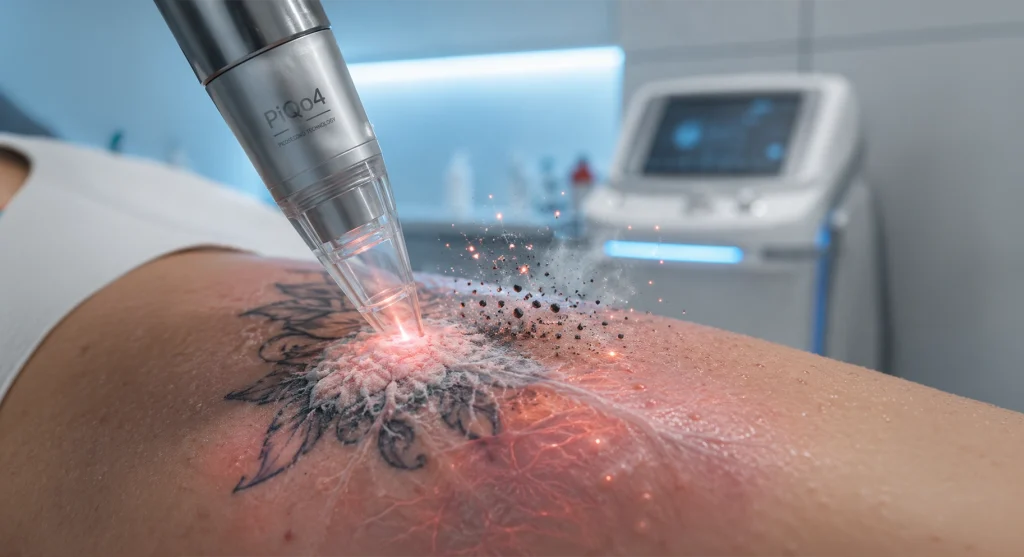
Within seconds of the laser passing over the treatment area, the skin turns white. This is called the frosting effect, and it is the most reliable visual confirmation that the laser has done its job. Frosting occurs because the rapid energy absorption by tattoo ink particles causes the release of carbon dioxide gas, which temporarily whitens the superficial dermis.
The frosting effect resolves within 15 to 30 minutes as the gas disperses. It is not a burn and it is not damage. It is a sign that the laser successfully targeted the ink. At Perfect B, we assess the frosting pattern in real time to evaluate coverage and adjust settings for the next pass.
Redness, swelling, and the sunburn sensation
Within the first hour after a session, the treated area develops redness, swelling, and a sensation similar to a moderate sunburn. This is a normal inflammatory response. The laser energy that fragments ink also creates controlled thermal injury in the surrounding tissue, which triggers the immune response that will eventually carry broken-down ink particles out of the skin.
This phase typically peaks within the first 6 hours and begins to subside by the end of the first day. Applying a cold compress in the first 30 minutes after treatment, keeping the area elevated if possible, and avoiding heat exposure helps moderate the response. Do not apply ice directly to the skin.
Days 1 Through 3: Blistering, Scabbing, and What Is Normal
Why blisters form and what to do (and not do)
Blistering is one of the most common concerns patients bring to us after their first session. It looks alarming, but it is a normal and expected response, particularly after the first one to three sessions when the ink load in the skin is highest. Blisters form as the body sends fluid to the treated area to protect the tissue while the immune system processes the fragmented ink.
The single most important rule with blisters is this: do not pop them. An intact blister is sterile. A popped blister is an open wound. In South Florida, where heat and humidity create conditions that favor bacterial growth, a popped blister after tattoo removal can become infected significantly faster than in a cooler, drier climate. If a blister breaks on its own, keep the area clean with gentle soap and water, apply a thin layer of Aquaphor, and cover it loosely with a non-stick bandage. Contact your provider if you see spreading redness, warmth beyond the immediate treatment zone, or any discharge.
Scabbing as a sign the immune system is working
Scabbing typically begins on days 2 through 4. As blisters flatten and the surface begins to dry, a thin crust forms over the treated area. This is the skin’s natural barrier repair process. Do not pick scabs. Premature removal of scabs disrupts the barrier repair and can cause post-inflammatory hyperpigmentation, which is particularly significant for patients with Fitzpatrick III through VI skin types, which includes the majority of our patients at our Doral clinic.
Scabs from laser tattoo removal are typically thinner and smaller than those from a burn or cut. They fall off on their own within 5 to 14 days. Keeping the area moisturized with a fragrance-free ointment like Aquaphor helps prevent the scab from cracking or pulling prematurely.
Week 1 to 2: Surface Healing and What to Watch For
By the end of week one, most of the visible inflammation has resolved. Blisters have flattened and dried, scabs are beginning to separate, and the skin in the treated area may appear pink or slightly lighter than the surrounding skin. This is normal and temporary.
Week two is when most patients feel they are “healed” and begin to resume normal activity around the treated area. The surface is healed, but the internal process is still in its early stages. The lymphatic system is beginning to clear the fragmented ink particles that the laser broke down, and this process will continue for the next 6 to 8 weeks.
When to contact your provider
Contact Perfect B if you experience any of the following during the first two weeks: spreading redness or warmth beyond the treatment zone (possible infection), fever above 100.4 degrees Fahrenheit, yellow or green discharge from the treatment area, pain that increases rather than decreases after day 2, or signs of allergic reaction including hives or significant swelling away from the treatment site.
Weeks 3 to 8: Internal Healing and How Your Body Flushes Ink
How the lymphatic system removes fragmented ink
This is the phase of healing that no one sees, but it is where the actual fading happens. When the PiQo4 laser fires, it shatters tattoo ink particles into fragments small enough for the body’s immune cells, specifically macrophages, to engulf and transport. Peer-reviewed research on laser-tissue interaction and pigment clearance confirms that macrophage recruitment and lymphatic transport are the primary mechanisms responsible for ink fading between sessions. Those cells carry the ink fragments through the lymphatic system, ultimately depositing them in the liver and other filtration organs where they are processed out of the body.
This process takes weeks, not days. The lymphatic clearance that occurs between sessions 3 and 8 weeks after treatment is what produces the fading you see when you come in for your next session. Staying well hydrated, maintaining moderate cardiovascular exercise after the surface has healed (typically after day 5 to 7), and avoiding alcohol in excess all support lymphatic function and can contribute to faster ink clearance between sessions. The American Academy of Dermatology confirms that laser treatments remain the most effective method for tattoo removal, with outcomes directly influenced by immune health and aftercare compliance.
Why the tattoo may look darker before it looks lighter
Many patients notice that their tattoo appears darker or more defined in the weeks immediately following a session before it begins to fade. This is a normal optical effect. As swelling and surface inflammation resolve, the contrast between the ink and the surrounding skin becomes more visible temporarily. The actual fading begins once lymphatic clearance picks up pace, typically between weeks 3 and 6. By the time you come in for your next session, the full benefit of the previous session is visible.
How Healing Changes Session by Session
This is the gap in almost every guide about tattoo removal healing. Most content describes a single session as if every session is the same. It is not. Here is what actually changes as you progress through your protocol.
Session 1: the most intense reaction
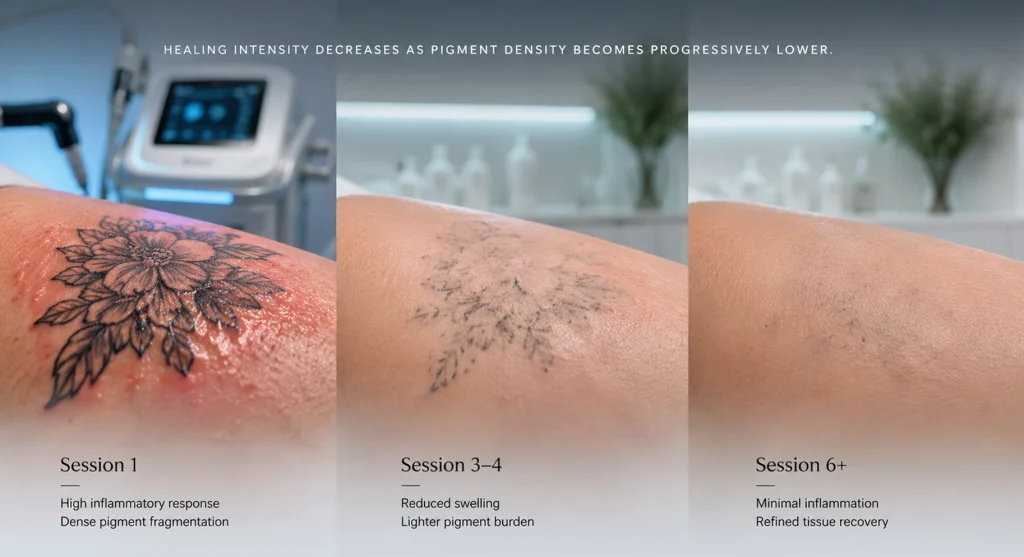
The first session targets the full ink load that has been sitting in your dermis since the tattoo was placed. The immune system has not previously encountered this volume of fragmented ink, macrophage recruitment is at its highest, and the inflammatory response is the most pronounced. Most patients experience blistering, significant redness, and the longest healing window of their entire protocol, typically 3 to 4 weeks before the surface is fully normalized.
Sessions 3 to 4: healing becomes faster
By the third and fourth sessions, several things have changed. The total ink load in the skin has been progressively reduced. The immune system has developed an efficient response pattern to the fragmentation byproducts. And the dermis itself has adapted to the thermal cycling of the treatment. Blistering is less frequent or less extensive, surface healing typically completes within 10 to 14 days, and patients report that sessions feel less intense.
Session 6 and beyond: what changes
In the later sessions of a protocol, healing is often minimal by comparison to session one. Many patients experience only mild redness and slight peeling with no significant blistering. Surface healing may complete within 7 days. This does not mean the laser is being less effective. It means the remaining ink is less dense, the immune response is more efficient, and the tissue has adapted. The fading still continues in the weeks between sessions through the same lymphatic mechanism.
PiQo4 Laser and Healing: Why the Technology Matters
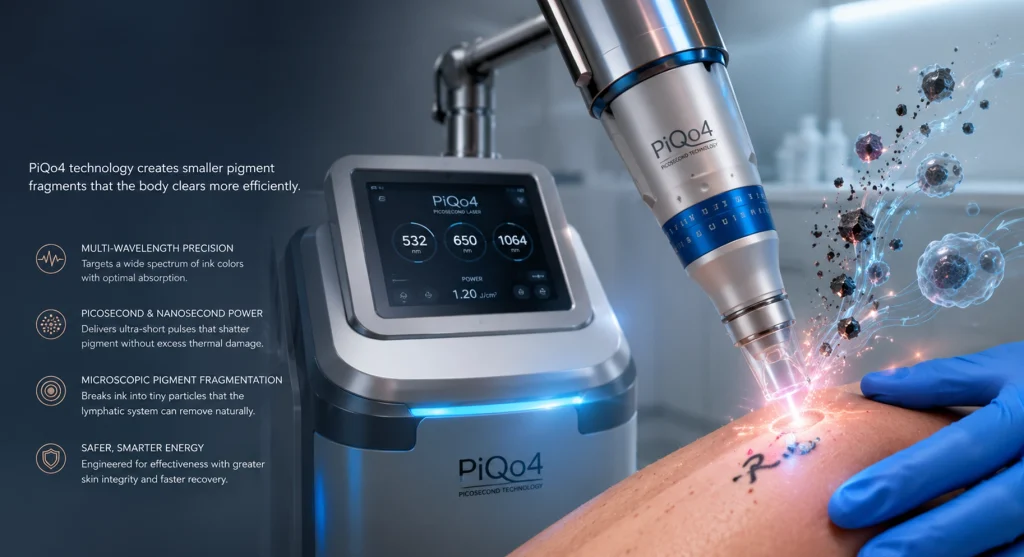
Not all tattoo removal lasers produce the same healing experience. The PiQo4 platform used at Perfect B in Doral operates in both picosecond and nanosecond modes across multiple wavelengths, including 532nm, 650nm, 585nm, and 1064nm. This multi-wavelength capability allows us to target different ink colors in a single session, which reduces the total number of sessions needed for full removal.
The picosecond pulses that PiQo4 delivers shatter ink into significantly smaller particles than older Q-switch nanosecond lasers. Smaller particles are more efficiently cleared by the lymphatic system, which means the fading between sessions is faster and more complete. This has a direct effect on healing: because the immune burden per session is distributed more efficiently, the inflammatory response is often less pronounced than with older technology, particularly in the mid-to-late sessions of a protocol.
At Perfect B, we tailor PiQo4 settings to each patient’s skin type, ink color spectrum, and session number within the protocol. If you want to understand how the technology affects your specific tattoo, our consultation process at our Doral tattoo removal clinic includes a full assessment of your ink composition and skin type before the first session.
Healing in South Florida: What Heat and Humidity Add to the Process
Standard tattoo removal aftercare guides are written for a general audience. They do not account for what it means to be healing laser-treated skin in South Florida, where average temperatures in summer exceed 90 degrees Fahrenheit and humidity regularly exceeds 80 percent.
Heat and humidity affect the healing process in two specific ways. First, sweating in and around the treated area during the first 5 to 7 days can introduce bacteria to the healing tissue, increasing infection risk. We advise patients to avoid activities that produce significant sweating in the treated zone during this window. This includes outdoor exercise, saunas, and pool swimming.
Second, UV exposure in South Florida is significantly more intense than in most of the country. Laser-treated skin is acutely photosensitive for up to 6 weeks after a session. Sun exposure during this window can cause post-inflammatory hyperpigmentation, particularly in patients with Fitzpatrick III through VI skin, and can also delay ink clearance by triggering additional inflammation in the dermis. We recommend SPF 50 applied consistently to the treatment area throughout the entire interval between sessions, not only during the acute healing phase.
For patients with darker skin tones, the healing protocol at Perfect B includes specific guidance on pigmentation monitoring between sessions. Before and after results at our Doral clinic include patients across the full Fitzpatrick spectrum, and our protocol is calibrated for the Miami demographic.
Aftercare Protocol at Perfect B in Doral
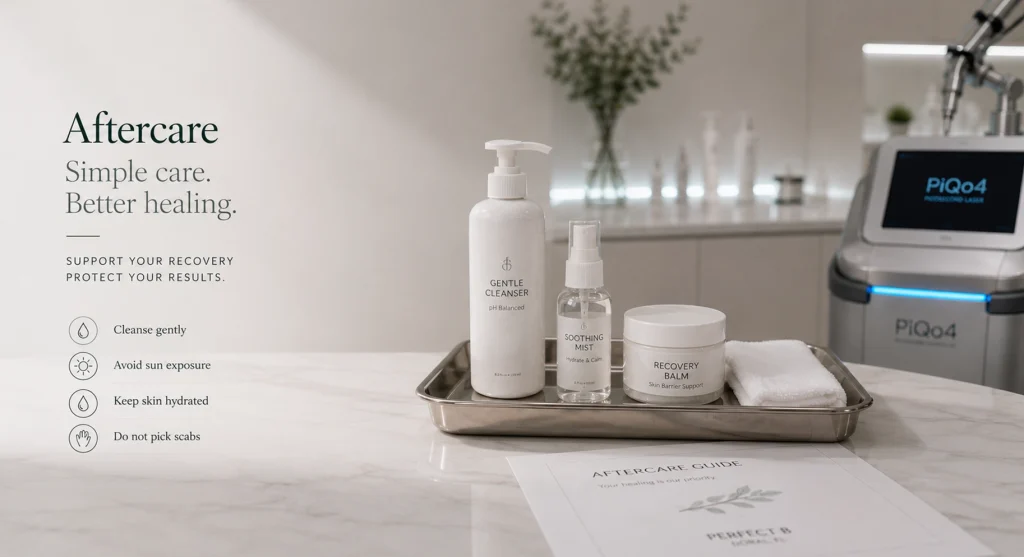
Our standard laser tattoo removal aftercare protocol at Perfect B covers the complete healing window, not just the first 48 hours. Here is what we provide to every patient after each session:
- Immediately after: cold compress application in the clinic, bandage placement, verbal and written aftercare instructions.
- Days 1 to 3: keep the area covered with a non-stick bandage, apply Aquaphor twice daily, avoid water submersion, no picking or popping.
- Days 4 to 14: gentle cleansing once daily, fragrance-free moisturizer, loose clothing over the area, no direct sun exposure.
- Weeks 2 to 8: SPF 50 applied daily to the treatment area, moderate hydration and cardiovascular activity to support lymphatic clearance, avoid tanning beds throughout the protocol.
- Before your next session: the treatment area should be fully healed on the surface. If you have any remaining scabs, active blistering, or signs of infection, contact us before your scheduled appointment to assess whether to proceed.
Questions about your specific healing between sessions? Call us at (786) 502-2260. We review healing progress at every session and adjust the protocol if needed.
Frequently Asked Questions
1. How long does it take to recover from a tattoo removal?
Surface healing after a laser tattoo removal session typically completes within 1 to 2 weeks. Full internal healing, including lymphatic clearance of fragmented ink, takes 4 to 8 weeks. This is why sessions are spaced 6 to 8 weeks apart, not just until the surface looks healed. Rushing sessions shortens the lymphatic clearance window and reduces overall results.
2. What I wish I knew before laser tattoo removal?
The most common thing patients tell us they wish they had known: healing is not linear and it is not the same every session. Session one is the hardest. The tattoo often looks darker before it fades. Blistering is normal and should not be popped. The lymphatic clearance that produces fading is invisible and happens for weeks after the surface heals. And in South Florida, sun protection between sessions is not optional.
3. How long do scabs take to fall off after laser tattoo removal?
Scabs from laser tattoo removal typically fall off on their own within 5 to 14 days. Do not pull them. The timeline depends on the size and density of the treated area, the patient’s individual healing rate, and how consistently the aftercare protocol is followed. Keeping the area moisturized with Aquaphor reduces the risk of the scab cracking or detaching prematurely.
4. Is it normal for the tattoo to look darker after a laser session?
Yes. In the first 1 to 3 weeks after a session, as swelling and redness resolve, the tattoo can appear more defined or darker than it did before the treatment. This is a temporary optical effect caused by reduced tissue edema revealing the underlying ink contrast. The actual fading happens as lymphatic clearance progresses, typically becoming visible from week 3 to 6 post-session.
5. How long between tattoo removal sessions?
At Perfect B, we space sessions 6 to 8 weeks apart. This interval is determined by the healing biology, not by scheduling convenience. The lymphatic system needs the full 6 to 8 week window to clear the ink fragments broken down in the previous session. Shorter intervals reduce clearance efficiency and increase cumulative tissue stress. Longer intervals are fine and do not reduce results.
6. How does PiQo4 affect healing compared to older lasers?
PiQo4 delivers picosecond pulses that shatter ink into smaller fragments than Q-switch nanosecond lasers. Smaller fragments are cleared more efficiently by the lymphatic system, which generally results in faster fading between sessions and, in later sessions, a less pronounced inflammatory response. The multi-wavelength capability also means fewer sessions are needed overall for multi-color tattoos, which reduces the total cumulative healing burden over the protocol.
7. When should I call my provider during healing?
Call Perfect B at (786) 502-2260 if you experience spreading redness beyond the treatment zone, increasing rather than decreasing pain after day 2, yellow or green discharge, fever above 100.4 degrees Fahrenheit, or signs of an allergic reaction. These are not typical healing responses and should be evaluated promptly.
Closing: What Healthy Healing Actually Looks Like
Healthy healing after laser tattoo removal is not comfortable and it is not always pretty. Frosting, blistering, scabbing, and temporary darkening are all part of the process. What changes over the course of a complete protocol is the intensity of those responses, not their nature.
At Perfect B in Doral, Valeria Marulanda guides every tattoo removal patient through a protocol that is calibrated to their skin type, ink profile, and the specific demands of healing in South Florida. If you are in Miami, Doral, or the greater South Florida area and have questions about your healing or want to understand what a complete removal protocol looks like for your specific tattoo, that conversation starts with a consultation.
📍 Perfect B | 8200 NW 41st St, Suite 100, Doral, FL 33166
📞 (786) 502-2260