
Perfect B, Doral FL. | 06.04.26 | 9 min read.
This content is for educational purposes only and does not constitute medical advice. Consult a licensed medical provider before beginning any acne treatment protocol. All treatments referenced on this page require a clinical evaluation from a licensed provider at Perfect B. Results vary by patient.
Why Male Acne Is a Different Clinical Problem
Most acne content online is written for women in their 20s cycling through hormonal fluctuations once a month. That is not who walks into our clinic in Doral asking for help with jawline breakouts that have been there for three years and do not respond to anything they have tried.
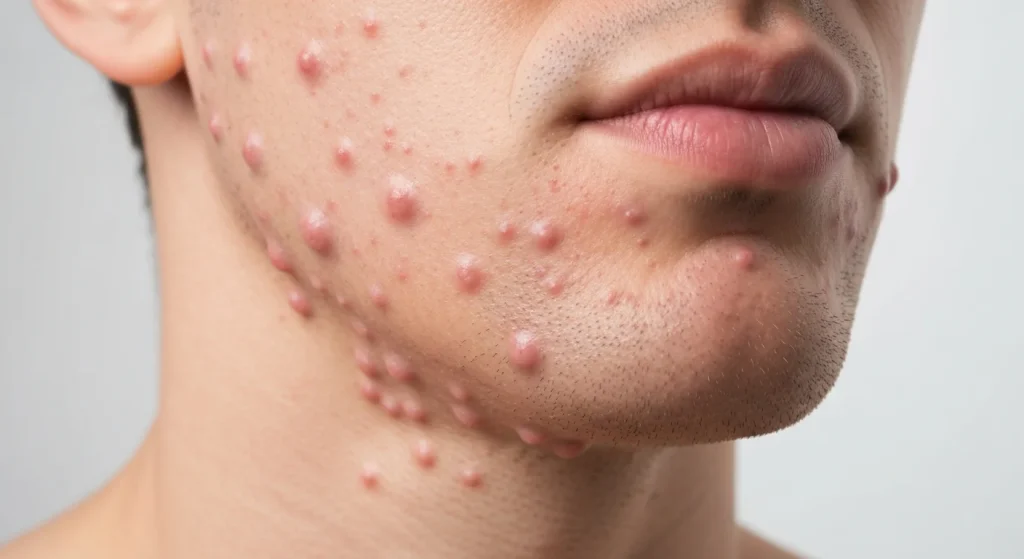
Male acne has a different hormonal driver, a different pattern of presentation, and a different healing behavior. It requires a different clinical response. The men we see at Perfect B in Doral, FL are usually dealing with deep, inflammatory breakouts along the jawline, lower cheeks, and sometimes the back and shoulders. It is rarely surface-level whiteheads. It is papules, pustules, and nodular cysts that leave marks. Understanding why that happens is the first step toward clearing it.

Key Takeaways
- Male acne is not cyclical like female hormonal acne: Testosterone drives sebum production constantly, not in monthly waves, which is why breakouts persist without a clear on/off pattern.
- Whey protein and testosterone supplements are direct triggers: Both spike IGF-1 and androgen activity at the sebaceous gland level. Clearing acne often requires addressing the supplement stack first.
- Gym hygiene timing matters more than most men realize: Sweat left on skin for more than 20 to 30 minutes after training creates the bacterial environment that feeds inflammatory acne.
- Thicker male skin heals differently: Breakouts in men are slower to resolve and leave post-inflammatory hyperpigmentation that can last months, especially in Fitzpatrick IV and V skin types common in South Florida.
- Treating scars over active acne is a clinical mistake: Inflammation must be controlled first. Microneedling or RF microneedling on actively breaking-out skin produces poor results and risks worsening inflammation.
How Adult Male Acne Differs Clinically from Female Acne
The hormonal mechanism is the same at the molecular level: androgens stimulate sebaceous glands, excess oil clogs follicles, bacteria overgrow, inflammation follows. But the pattern plays out differently in men for several reasons.
In women, acne is often cyclical. Estrogen suppresses androgen activity during the first half of the cycle, and breakouts cluster in the week before menstruation when that suppression lifts. There is a rhythm that makes the pattern somewhat predictable. In men, testosterone drives sebum production at a steady, higher baseline with no monthly reset. The breakouts do not have a clear on/off pattern. They are more constant, more inflammatory, and they present deeper in the dermis.
Male skin is also structurally different. It is approximately 25% thicker than female skin, with larger pores and higher sebum output. When a breakout forms, it has more tissue to work through before resolving. That is why the nodular cysts we see in male patients take longer to flatten, leave marks more often, and tend to cluster in the same spots repeatedly rather than moving around.
The location pattern is also distinct. Female hormonal acne often appears on the lower cheeks, jaw, and chin, following the jawline symmetrically. Male acne in adults does the same, but frequently extends further, onto the neck, the upper chest, and the back and shoulders. In the South Florida patient population at Perfect B in Doral, we also see a strong association with gym-related breakouts that appear on the back and chest regardless of whether facial acne is present.
The Triggers Most Men Are Not Connecting to Their Acne
The most common question we hear at consultation is: “I eat clean, I exercise, I wash my face. Why is my skin still breaking out?” The answer is usually one or more of the following triggers that are not part of a standard skincare conversation.
Whey Protein and Dairy-Based Supplements
Whey protein is derived from milk and carries an insulin-like growth factor (IGF-1) load that directly stimulates sebaceous gland activity. A 2024 case-control study published in Dermatology Research and Practice confirming the association between whey protein consumption and acne vulgaris in male adolescents and young adults found a statistically significant correlation between regular whey use and active acne. An earlier study published in Health Promotion Perspectives documenting the link between whey protein supplementation and trunk acne in gym-active men specifically documented the association with chest and back acne in men training regularly.
The practical implication is direct: if you are using a whey-based protein powder and breaking out on your chest, back, or jaw, switching to a plant-based alternative (pea protein, rice protein) for 6 to 8 weeks is a clinically reasonable first intervention before escalating to prescription treatment.
Testosterone Supplements and Anabolic Compounds
This is the conversation that many men delay having with a provider. Exogenous testosterone, whether prescribed TRT or self-administered, raises DHT levels and amplifies androgen signaling at the sebaceous gland. The result is sebum overproduction that no topical or in-clinic treatment can fully counter while the exogenous androgen load remains elevated.
At our clinic, we ask every male acne patient directly about hormonal supplements during the consultation. Not to judge, but because that information changes the entire treatment plan. If TRT is medically supervised, we coordinate with the prescribing provider. If it is self-administered, we have an honest conversation about what clearing the acne actually requires.
Sweat and Gym Hygiene Timing
Sweat does not cause acne by itself. Sweat left on the skin for an extended period creates a warm, moist environment that disrupts the skin microbiome and feeds the bacterial overgrowth that drives inflammatory acne. The practical rule we give patients: wash your face within 20 to 30 minutes of finishing training, not when you get home an hour later. The same applies to the chest and back if you are prone to body acne. A clean workout shirt after each session matters. Wearing the same compression gear for two consecutive training days is a common culprit in patients presenting with chest and shoulder breakouts.
First-Line In-Clinic Treatment: What We Actually Use
The first in-clinic treatment for active inflammatory acne in male patients at Perfect B is typically a HydraFacial with a salicylic acid boost. The vortex extraction component deep-cleans pores without the surface trauma of manual extractions, and the salicylic infusion addresses the bacterial load and sebum buildup in one session. For men who have never had a facial treatment before, this is also the gentlest entry point that produces visible results quickly, which matters for compliance.
If the skin can tolerate it after the first assessment, we follow with a light chemical peel. The approach adjusts significantly based on Fitzpatrick classification. South Florida patients frequently present with Fitzpatrick IV and V skin types, where acid strength needs to be more conservative to prevent post-inflammatory hyperpigmentation. In these cases, we pretreat with a pigment inhibitor to protect against PIH before introducing any resurfacing agent. → Learn how HydraFacial with salicylic acid works for active acne and blackhead extraction at Perfect B in Doral.
The Topical Protocol We Combine with In-Clinic Treatment
In-clinic treatment alone is not enough for active male acne. The home protocol runs in parallel. The combination we use most often for male acne patients with inflammatory breakouts is tretinoin at night with a clindamycin-benzoyl peroxide gel in the morning, paired with a gentle, non-comedogenic cleanser. This addresses the three drivers simultaneously: cell turnover and pore regulation (tretinoin), bacterial load (clindamycin), and sebum control (benzoyl peroxide).
For men with Fitzpatrick IV and V skin who are sensitive to retinoid purging, we buffer the tretinoin with moisturizer for the first several weeks, gradually building tolerance before applying it directly. Niacinamide as a morning serum helps with both inflammation and the early hyperpigmentation that forms before a breakout fully resolves. The goal of the topical protocol is to reduce the volume and severity of breakouts between clinic visits, not to replace them.
How Male Skin Responds Differently to Fitzpatrick Classification
Fitzpatrick skin type is not just a cosmetic classification. It changes what treatments are safe, at what strength, and in what sequence. In Miami and Doral, a significant proportion of the male patient population presents with Fitzpatrick III to V skin, where the risk of post-inflammatory hyperpigmentation is meaningfully higher.
For these patients, the clinical priority is preventing the dark marks that form after a breakout, not just clearing the breakout itself. That means lower acid concentrations on peels, pretreatment with pigment inhibitors before any resurfacing, and a more conservative introduction of tretinoin. It also means that the post-acne dark spots take longer to fade and require their own treatment phase before we can address scarring.
The combination of active acne, post-inflammatory hyperpigmentation, and beginning scar formation is the most common clinical picture we see in male patients who have been breaking out for more than one year without a structured treatment plan. Addressing these in the right order, not simultaneously, is what makes the difference.
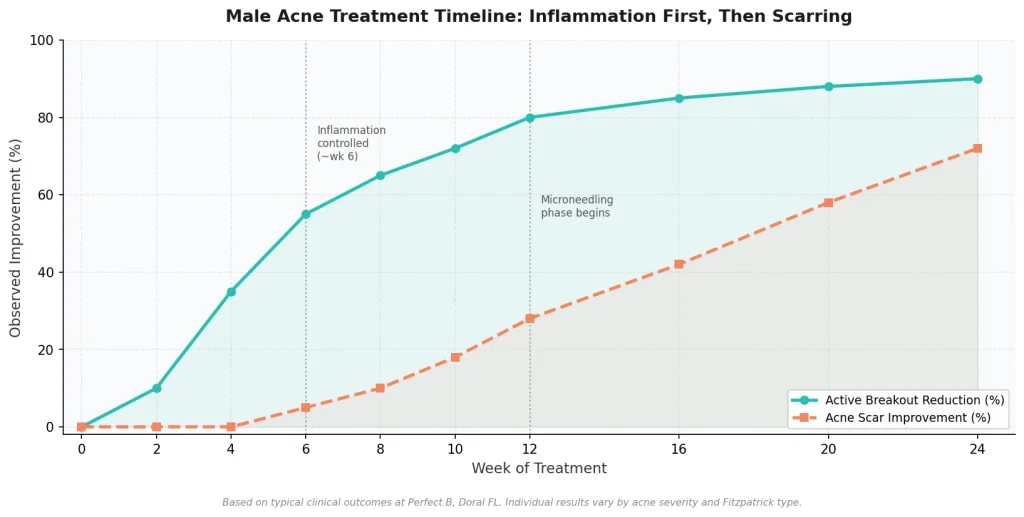
When There Is Both Active Acne and Scarring: The Sequencing Problem
This is one of the most common clinical mistakes made outside of a medical setting. A patient comes in with both active breakouts and visible scarring, and a provider starts microneedling to address the scars. The result is poor scar improvement, extended recovery, and often a worsening of the active acne from the inflammatory response triggered by the treatment.
The correct sequence is fixed and not negotiable. Phase one: control the active inflammation. This means 4 to 6 weeks of combined in-clinic treatment (HydraFacial, chemical peel) and topical protocol until breakouts are significantly reduced. Phase two: address post-inflammatory hyperpigmentation if present, using targeted agents and in some cases light-based treatment. Phase three: scar remodeling with microneedling, RF microneedling, or a combination approach depending on the scar types present as outlined in the full acne scar treatment plan at Perfect B in Miami.
Treating scars over an active flare is a waste of the patient’s time and money. The inflammatory environment prevents the remodeling response that scar treatment is designed to trigger. We tell patients directly: we cannot get you to clear skin if we skip steps, but we can get you there efficiently if we do not.
Realistic Timeline: What to Expect and When
The timeline for male acne treatment depends on severity, but a realistic framework looks like this: new breakouts reduce noticeably within the first 4 to 6 weeks of a consistent in-clinic and topical protocol. Significant reduction in active acne, meaning fewer than 2 to 3 new lesions per week, typically happens by week 8 to 10. If scarring is present, scar improvement with microneedling or RF microneedling takes 3 to 6 months from the point active acne is controlled.
The male patients who see the best results are the ones who also address lifestyle: gym hygiene, protein supplement choices, sleep, and supplement transparency with the provider. The in-clinic work does the heavy lifting, but it cannot fully compensate for ongoing sebum overproduction driven by external factors. → For men with back or chest acne alongside facial breakouts, the full body acne treatment guide at Perfect B covers how the same sequencing principles apply to trunk acne.
Frequently Asked Questions
1. Why do I still have acne in my 30s if I exercise and eat well?
Adult acne in men is predominantly driven by testosterone activity at the sebaceous gland level, not by diet or fitness directly. Exercise and clean eating support overall health but do not lower androgen signaling at the follicle. If you are also using whey protein, testosterone supplements, or training in unwashed gear, those factors can actively sustain the acne cycle regardless of how well you eat.
2. Can whey protein really cause acne?
Yes, it can be a contributing trigger. Whey protein is derived from milk and carries an IGF-1 load that stimulates androgen activity at the sebaceous gland. Two published studies have documented the association, one specifically in men with facial acne and one focused on trunk acne in gym-active men. Switching to a plant-based protein for 6 to 8 weeks is a reasonable diagnostic step if you suspect it is contributing.
3. Does testosterone replacement therapy cause acne?
It can and frequently does. Exogenous testosterone raises DHT levels, which amplifies sebaceous activity. The degree of acne response varies by individual sensitivity and the form of TRT being used. If you are on TRT and experiencing acne, the treatment approach requires coordination between your prescribing provider and a medical aesthetics provider who can manage the skin response without conflicting with your protocol.
4. How is male acne different from female acne clinically?
Male acne is driven by steady testosterone rather than cyclical estrogen fluctuation, so breakouts are more constant rather than monthly. Male skin is thicker and produces more sebum, meaning breakouts form deeper, heal more slowly, and leave post-inflammatory marks that persist longer. The pattern also differs: male acne frequently extends to the neck, chest, and back in ways that female hormonal acne typically does not.
5. Can I start treating acne scars at the same time as active breakouts?
No. Treating scars over active acne produces poor results and can worsen inflammation. The correct sequence is inflammation control first, which takes approximately 4 to 6 weeks with a combined in-clinic and topical protocol, followed by scar treatment once breakouts are significantly reduced. Skipping this sequence extends the total treatment time rather than shortening it.
6. How soon after a workout should I wash my face?
Within 20 to 30 minutes. Sweat left on the skin for longer disrupts the skin microbiome and creates the bacterial environment that feeds inflammatory acne. Waiting until you get home an hour after training is a meaningful delay. If you train during lunch and cannot shower immediately, a gentle face wash without a full skincare routine is enough to break the cycle.
7. What is the typical treatment timeline for male acne at Perfect B?
For most male patients, new breakout frequency reduces noticeably by week 4 to 6. Significant control, meaning fewer than 2 to 3 new lesions per week, typically occurs by week 8 to 10. If scarring is also being treated, scar improvement with microneedling or RF microneedling takes an additional 3 to 6 months from the point active acne is controlled. The full timeline from first consultation to clear skin with minimal scarring is typically 6 to 9 months for moderate-to-severe presentations.
The Clinical Bottom Line on Male Acne Treatment
Adult male acne does not clear on its own once you have had it for more than a year. The testosterone-driven sebum production continues, the bacterial environment stays in place, and the skin builds up a pattern of breakouts that becomes self-reinforcing. Generic skincare routines, OTC face washes, and surface-level treatments do not reach the mechanisms that sustain the cycle.
What works is a structured clinical approach: identify and address the drivers (supplements, gym hygiene, hormonal load), control the active inflammation in-clinic and with prescription topicals, then address the marks and scarring in sequence. Men who come in with a 3-year acne history and a simple supplement change plus 6 weeks of consistent treatment regularly see more improvement than they got from 3 years of trying things on their own. The biology is not complicated once you understand what is actually driving it.
📍 Perfect B | 3905 NW 107th Ave, Suite 104, Doral FL 33178
📞 Call or message us at (786) 502-2260 to schedule your acne consultation with a licensed medical provider.
💳 Buy Now Pay Later: Cherry, Klarna, Afterpay, CareCredit