
Perfect B, Doral FL. | 05.29.26 | 9 min read.
This article is for educational purposes only and is not a substitute for professional medical advice. MOTS-c and NAD injections should be evaluated and prescribed by a licensed medical provider. For medically guided care, read how NAD+ vs Peptides: Differences, Combining and Cost, and how it is approached at Perfect B in Doral.
Skip Ahead to the Perfect B Peptide Protocol Tool. See Reconstitution, Daily Units, and Cycle Structure.
Perfect B’s peptide protocol tool is built on real clinical data from 2,000+ patients treated in South Florida.
Answer 6 questions and see what patients with similar goals are running: which peptides they use, typical dosing, injection schedule, reconstitution steps, cycle length, and when they pause.
MOTS-c vs NAD+: Two Mitochondrial Pathways, Different Jobs
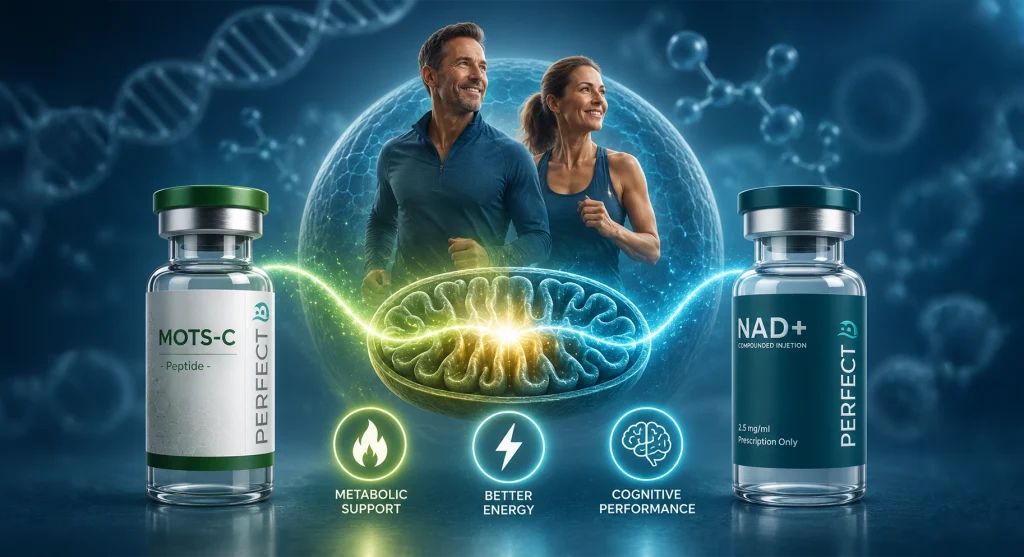
Both MOTS-c and NAD+ target the mitochondria, which is why patients exploring peptide therapy or longevity protocols often ask which one they need. The short answer is that they do different things through different mechanisms, and for many patients at Perfect B in Doral the most useful question is not which one to choose but whether a combined protocol makes sense for their goals. This guide walks through how each compound works, where the evidence is strongest, and how we think about prescribing them at our clinic.
Key Takeaways
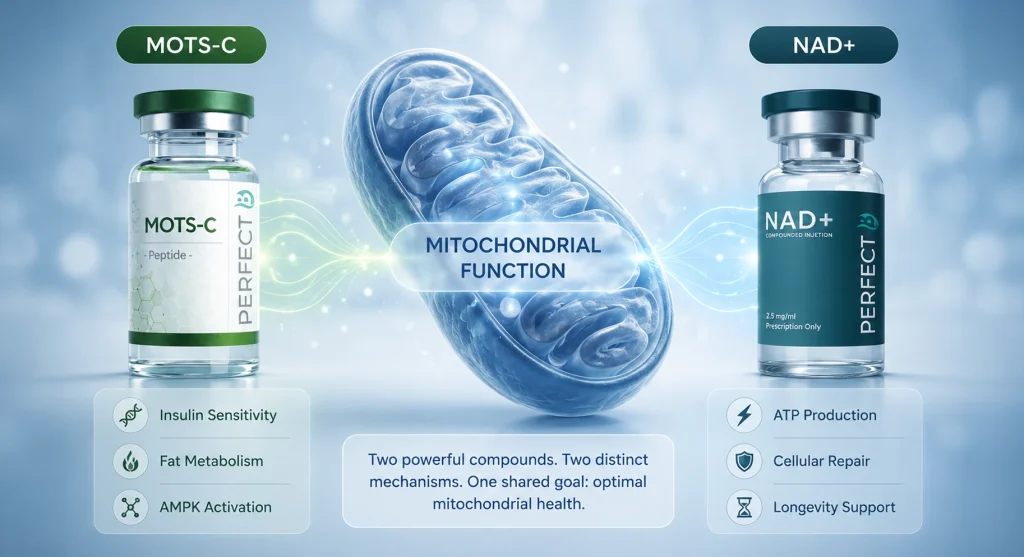
- MOTS-c is a peptide produced inside your mitochondria. It acts as a metabolic regulator, signaling cells to improve insulin sensitivity, reduce visceral fat, and enhance physical performance. It is a molecule your body already makes.
- NAD+ is a coenzyme your cells need to produce energy. It fuels the electron transport chain, activates repair enzymes called sirtuins, and declines sharply with age. Supplementing it restores what the body loses over time.
- MOTS-c and NAD+ work differently but overlap in one key area: MOTS-c increases cellular NAD+ levels as part of its mechanism, which means stacking both compounds can create a synergistic effect rather than a redundant one.
- Who benefits from MOTS-c: patients with metabolic dysfunction, insulin resistance, stubborn visceral fat, or body composition goals.
- Who benefits from NAD+: patients with fatigue, brain fog, accelerated aging markers, or cognitive decline concerns.
- Who benefits from both: patients who present with a mix of metabolic and energy/cognitive symptoms, which is common in patients over 40.
What Is MOTS-c and How Does It Work?
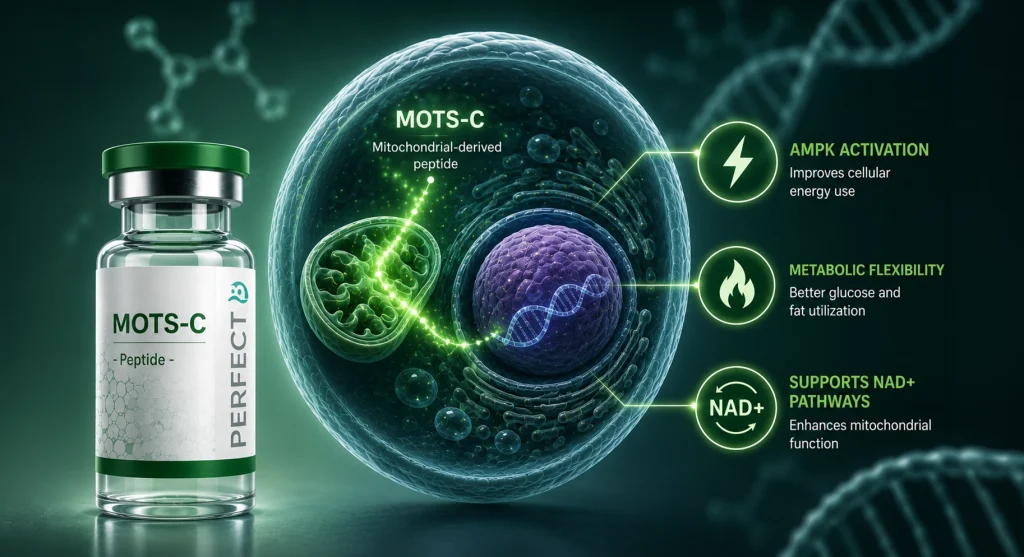
MOTS-c (Mitochondrial ORF of the 12S rRNA type-c) is a peptide encoded not in the cell nucleus but in the mitochondrial genome itself. That makes it unusual among the peptides we prescribe, it is a signal that your own mitochondria generate in response to metabolic stress and exercise. As with many compounds involved in cellular homeostasis, production declines with age.
Its primary mechanism runs through AMPK activation. MOTS-c moves from the mitochondria into the cell nucleus under metabolic stress, where it acts on gene expression to improve how cells use glucose and fatty acids. According to a 2023 PMC study by Gao et al. showing MOTS-c functionally prevents metabolic disorders including insulin resistance and obesity, the main physiological functions include reducing insulin resistance, preventing obesity, improving muscle function, and promoting bone metabolism. The downstream result for patients is improved metabolic flexibility: the body becomes better at switching between fuel sources rather than defaulting to fat storage.
Critically, and this is the connection to NAD+ that matters for stacking, according to the foundational 2016 PMC paper by Lee et al. which first documented that MOTS-c increases cellular NAD+ levels and activates AMPK through SIRT1, MOTS-c also increases cellular NAD+ levels as part of its activation of AMPK through SIRT1. That means MOTS-c does not just compete with NAD+ as a mitochondrial support tool. It upregulates some of the same pathways NAD+ feeds, which is why patients who combine them often report more consistent energy and metabolic improvement than patients on either one alone.
For a full breakdown of the mechanism and how we structure the protocol, see our clinical guide to what MOTS-c is and how it works as a mitochondrial-derived peptide.
What Is NAD+ and How Does It Work?
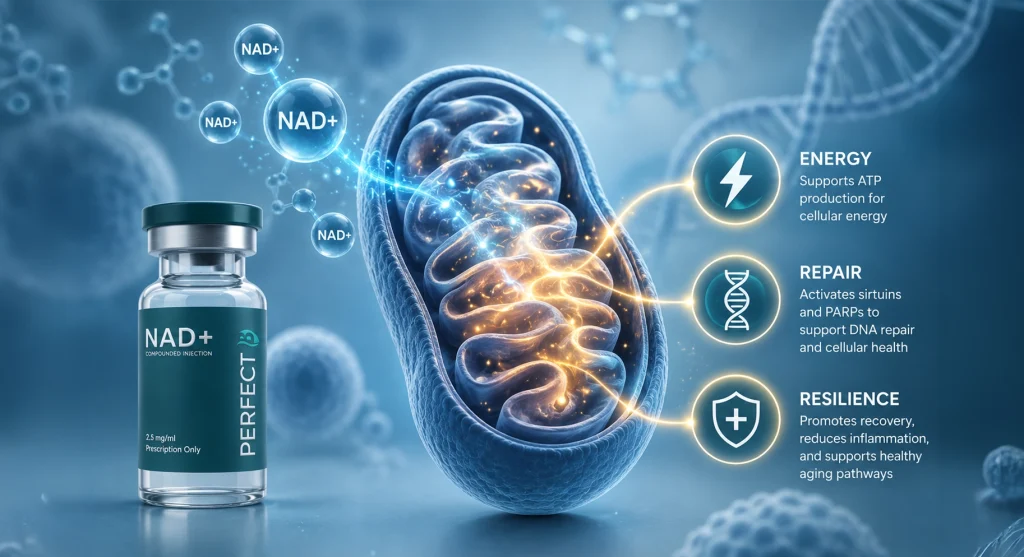
NAD+ (nicotinamide adenine dinucleotide) is a coenzyme found in every cell in the body. Unlike MOTS-c, it is not a peptide and is not a signaling molecule in the traditional sense. It is a substrate: cells need it to run the electron transport chain, generate ATP, and activate a class of repair enzymes called sirtuins and PARPs. Without adequate NAD+, cells lose the ability to repair DNA efficiently, regulate inflammation, and maintain the energy output needed for cognitive and physical performance.
NAD+ levels decline roughly 50 percent between the ages of 40 and 60 in most people, which correlates directly with the fatigue, brain fog, slower recovery, and general reduction in resilience that patients describe as they age. Restoring NAD+ through injectable supplementation bypasses the limited absorption of oral precursors and delivers the coenzyme directly into circulation. At Perfect B, we use NAD injections rather than IV drips for most patients because the subcutaneous delivery is more practical in a protocol context and the bioavailability is reliable. More detail on how we structure this is in our guide to NAD peptide benefits and how NAD injections work at our Doral clinic.
MOTS-c vs NAD+: Where Each One Is Stronger
MOTS-c is stronger for metabolic dysfunction and body composition
If the patient’s primary complaints are insulin resistance, difficulty losing visceral fat despite consistent effort, or body composition that has stopped responding to diet and training, MOTS-c is the more targeted tool. It directly addresses the metabolic signaling dysfunction that drives those symptoms. According to a 2023 peer-reviewed review in PMC by Zheng et al. confirming MOTS-c as a promising mitochondrial-derived peptide with anti-inflammatory and metabolic effects, MOTS-c has been shown to significantly reduce pro-inflammatory markers, improve glucose utilization, and act on fat tissue in ways that make it more directly metabolic than NAD+ in this context.
MOTS-c is also the better starting point for patients who want to support physical performance and recovery, because it acts as what researchers describe as an exercise mimetic, activating some of the same cellular pathways that exercise triggers. This makes it particularly relevant for patients whose training has stalled or who recover poorly between sessions. See our breakdown of MOTS-c for weight loss, including what the research shows and realistic expectations for more on the fat loss angle specifically.
NAD+ is stronger for energy, cognitive function, and aging markers
If the primary complaints are persistent fatigue that is not fully explained by lifestyle factors, brain fog, reduced mental stamina, or a general sense of faster aging, NAD+ is typically the better entry point. Its effects on sirtuin activation and DNA repair are more directly relevant to those symptoms than MOTS-c’s metabolic signaling pathway.
NAD+ also has a broader longevity application because sirtuin activation is one of the most studied anti-aging mechanisms at the cellular level. Patients who come in with a longevity or health-span focus rather than a specific metabolic complaint tend to respond better to NAD+ as a primary intervention.
The overlap: both affect mitochondrial function and inflammation
Both compounds reduce systemic inflammation through mitochondrial mechanisms, and both contribute to the general category of mitochondrial support that anti-aging protocols are built around. The difference is that MOTS-c gets there through metabolic signaling and gene expression while NAD+ gets there through substrate supply and repair enzyme activation. Those are complementary pathways, not competing ones, which is why the stack works.
Not sure whether MOTS-c, NAD+, or both fits your protocol? See what Perfect B patients with similar goals are running.
Perfect B’s peptide protocol tool is built on real clinical data from 2,000+ patients treated in South Florida.
Answer 6 questions and see what patients with similar goals are running: which peptides they use, typical dosing, injection schedule, reconstitution steps, cycle length, and when they pause.
When Perfect B Uses Both Together
The combination becomes the prescription when the patient’s presentation has both a metabolic component and a fatigue or cognitive component, which is more common than not in patients over 40. The classic profile is someone who presents with stubborn visceral fat and body composition that no longer responds to diet and exercise, combined with persistent low energy and brain fog that they attribute to aging. Running MOTS-c and NAD+ together addresses both ends of the problem without asking the patient to choose which symptom matters more.
The other context where we use both is in longevity-focused protocols where the goal is comprehensive mitochondrial support rather than a single symptom target. MOTS-c covers the metabolic and exercise-mimetic angle. NAD+ covers the repair, cognitive, and sirtuin-activation angle. Together they address more of the age-related mitochondrial decline than either one does alone.
The dosing and cycling structure for the combined protocol is built around the individual patient’s labs and response. The protocol detail for MOTS-c is covered in the MOTS-c dosage protocol we use at Perfect B, including cycle length and injection timing, and the broader framework for how we build these plans is in the supervised peptide therapy program at Perfect B, where MOTS-c and NAD are prescribed as part of a full protocol.
Who Is a Candidate for MOTS-c vs NAD+ at Perfect B?
MOTS-c is the primary recommendation for:
- Patients with insulin resistance or pre-diabetes markers where metabolic signaling needs direct support.
- Patients with stubborn visceral fat that has not responded to lifestyle intervention and where metabolic flexibility is the underlying problem.
- Patients with body composition goals who want a peptide that addresses the cellular basis of how the body stores and uses fuel.
- Patients whose primary complaint is physical performance and recovery rather than energy or cognition.
NAD+ is the primary recommendation for:
- Patients with persistent fatigue, brain fog, or cognitive decline that tracks with aging rather than a specific metabolic cause.
- Patients focused on longevity and health-span who want to address sirtuin activation and DNA repair capacity.
- Patients whose GSC labs or functional markers show accelerated cellular aging or mitochondrial dysfunction that is not primarily metabolic.
- Patients who want broader anti-aging support as a foundation before adding more targeted peptides.
Both together for:
- Patients over 40 who present with a combination of metabolic complaints and energy or cognitive symptoms.
- Patients in comprehensive longevity protocols where the goal is full-spectrum mitochondrial support.
- Patients who have completed a cycle of one and want to address the remaining symptom cluster with the other.
Want to see what patients with your goals are running at Perfect B?
Perfect B’s peptide protocol tool is built on real clinical data from 2,000+ patients treated in South Florida.
Answer 6 questions and see what patients with similar goals are running: which peptides they use, typical dosing, injection schedule, reconstitution steps, cycle length, and when they pause.
Frequently Asked Questions
1. What is the difference between MOTS-c and NAD+?
MOTS-c is a peptide your mitochondria produce that acts as a metabolic signaling molecule, improving insulin sensitivity, reducing visceral fat, and activating exercise-related cellular pathways. NAD+ is a coenzyme that cells need to produce energy and run DNA repair enzymes. MOTS-c signals; NAD+ supplies the substrate for those signals to act on.
2. Can you stack MOTS-c and NAD+ together?
Yes, and at Perfect B this is one of the more common combinations for patients over 40. MOTS-c increases cellular NAD+ levels as part of its mechanism, so the two compounds work through complementary pathways rather than redundant ones. The combined protocol addresses metabolic signaling and energy substrate supply simultaneously.
3. Which peptide is better for fat loss?
MOTS-c is the more targeted tool for metabolic fat loss, particularly visceral fat driven by insulin resistance. It improves how cells use glucose and fatty acids and activates AMPK in a way that directly addresses the metabolic dysfunction behind fat storage. NAD+ supports fat metabolism indirectly through energy production but is not the primary tool for a fat loss goal.
4. How long does MOTS-c take to work?
Most patients on a supervised injectable MOTS-c protocol at Perfect B begin noticing changes in energy and body composition at the 3 to 4 week mark, with more meaningful metabolic improvements building over a full 8 to 12 week cycle. Results depend on dosing, baseline metabolic health, and whether MOTS-c is running alongside complementary interventions.
5. Does NAD repair mitochondria?
NAD+ does not repair mitochondria directly in the way a structural repair would, but it activates sirtuins and PARP enzymes that drive DNA repair and mitochondrial biogenesis. By restoring the substrate these repair systems need to function, NAD+ supplementation supports mitochondrial health at a cellular level in a meaningful way.
6. Which peptides are best for mitochondria?
MOTS-c is one of the most studied mitochondrial-specific peptides because it is actually encoded in the mitochondrial genome. For mitochondrial support in a broader sense, NAD+ is the most established intervention. At Perfect B, we combine both for patients whose goal is comprehensive mitochondrial health rather than a single targeted outcome.
7. Is MOTS-c or NAD+ better for anti-aging?
They address different mechanisms of aging. NAD+ has a stronger evidence base specifically for anti-aging through sirtuin activation, telomere maintenance, and DNA repair. MOTS-c addresses the metabolic and inflammatory dimensions of aging. For a longevity protocol, both have a role, and which one leads depends on the patient’s primary aging presentation.
The Clinical Takeaway: It Is Rarely Either/Or
The MOTS-c vs NAD+ question is most useful as a starting point for understanding which mechanism is more relevant to a patient’s current symptoms. For most patients at our clinic in Doral, the answer is not one or the other but a sequenced or combined protocol that addresses the full picture. The goal is always to identify what is actually driving the symptoms and prescribe accordingly, which is why the conversation starts with a consultation and labs rather than a product selection.
- 📍 Visit us at Perfect B, Doral FL, serving Miami and South Florida patients seeking metabolic and longevity peptide therapy.
- 📞 Call or message us at (786) 502-2260 to schedule your MOTS-c or NAD+ consultation with a licensed medical provider.
→ See how Perfect B builds supervised MOTS-c and NAD protocols in Doral, FL.