
Perfect B, Doral Fl. | 05.11.26 | 8 min read.
This post is for educational purposes only and does not substitute for personalized medical advice. Individual results vary based on skin condition, treatment protocol, and aftercare compliance. Consult a licensed provider before beginning any regenerative treatment.
PDRN Before and After: Why the Timeline Matters as Much as the Result
The most common frustration patients bring to Perfect B after their first PDRN session is that the before-and-after photos they saw online did not match what they experienced in the first two weeks. They expected the dramatic glow they saw on social media. What they noticed instead was mild redness, some temporary papules at injection sites, and a subtle brightening that felt underwhelming compared to the transformations circulating on TikTok and Instagram.
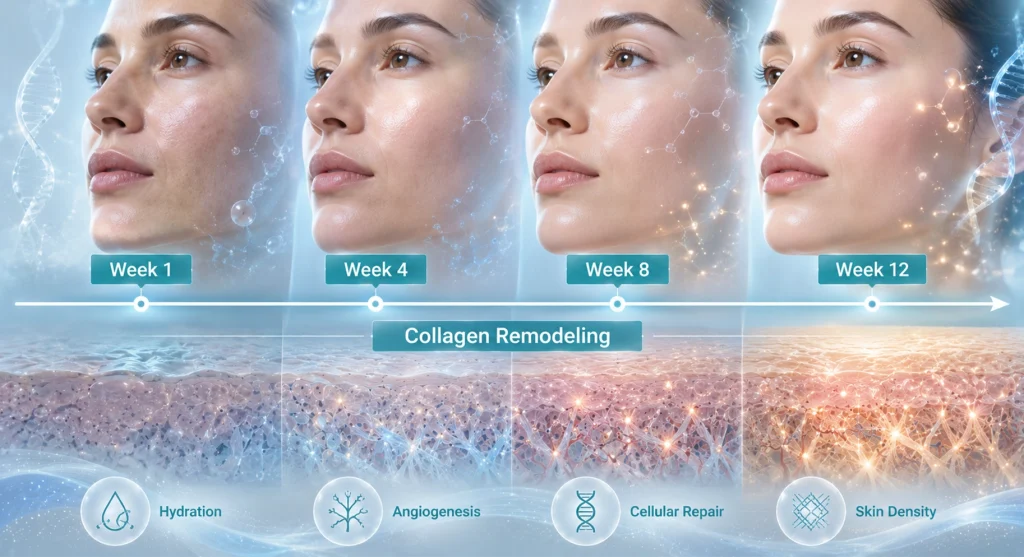
The gap between expectation and experience is not because PDRN does not work. It is because the results from PDRN injections follow a specific biological timeline that most before-and-after content ignores entirely. The early glow is not the real result. The real result is what happens at weeks 6 to 12 as new collagen and elastin are synthesized and deposited. Understanding that timeline is what separates patients who complete a full series and see transformational results from patients who stop after one session believing it did not work.
Key Takeaways
- PDRN results follow a two-phase arc: an early glow phase (weeks 1 to 3) driven by inflammation reduction and improved circulation, and a structural phase (weeks 4 to 12) driven by new collagen and elastin synthesis.
- The early papule effect immediately after injection is normal and resolves within hours. It indicates the PDRN is being deposited intradermally as intended, not that something went wrong.
- Hydration and glow improve fastest, often visible within 7 to 10 days. Skin texture, pore size, and fine line reduction follow, with most patients seeing meaningful structural change between weeks 4 and 8.
- Results compound across sessions. Session 1 establishes the biological foundation. Sessions 2 and 3 build on it. Patients who complete a 3-session series at 4-week intervals see results approximately 2.5 times more significant than after one session alone.
- Fitzpatrick III-V patients in Miami often see more dramatic improvements in skin tone evenness and barrier quality than lighter-skin patients, because the A2A receptor anti-inflammatory mechanism specifically addresses the chronic UV-related inflammation that suppresses normal cellular repair in high-sun environments.
The First 48 Hours: What You Will Notice Immediately After a PDRN Session
The papule effect and why it is expected
Within minutes of a PDRN injection session, the treatment area will show small raised papules at each injection site, resembling mosquito bites. These are a normal and expected consequence of the intradermal microbolus technique, in which 0.2 to 0.3 mL of PDRN is deposited in the mid-dermis at each injection point. The papules indicate that the material has been placed where it needs to be to activate the A2A adenosine receptor and enter the DNA salvage pathway. They are not an allergic reaction or a sign of incorrect technique. At Perfect B, we specifically inform patients before their session that this will happen, because patients who are not warned sometimes mistake the papules for a complication. They flatten within 2 to 4 hours for most patients, and within 24 hours for all patients who follow normal aftercare. → Read Perfect B’s complete clinical guide to PDRN therapy, including how the A2A adenosine receptor pathway works and what distinguishes injectable PDRN from topical products that use the same marketing name.
Redness, warmth, and the inflammatory phase
The treated area will appear red and feel warm for the first 24 to 48 hours. This is the initial inflammatory phase, which is paradoxically a positive sign: the body is mobilizing the repair response that PDRN’s A2A receptor activation is designed to modulate. The redness should be progressively improving by day 2 and largely resolved by day 3. If redness is increasing rather than decreasing after 48 hours, contact your provider. Most patients are comfortable returning to work and normal activity the day after treatment, provided they avoid direct sun exposure, intense physical activity, and any active skincare ingredients at the treatment site for the first 72 hours.
Week 1 to Week 2: The Early Glow Phase
Between day 5 and day 14, most patients notice the first visible changes they associate positively with PDRN. The skin looks brighter and more hydrated. The grayness or dullness that characterized the skin before treatment begins to lift. Puffiness and mild swelling that were present in the first few days resolve, and the skin surface looks smoother and more uniform than it did before the session.
What is actually causing the early glow
The early brightness is primarily the result of two biological processes. First, the A2A adenosine receptor activation reduces local inflammation and triggers angiogenesis, the formation of new small blood vessels in the treatment area. Improved microvascular circulation means more oxygenated blood reaching the surface, which produces the visible luminosity patients describe as a glow. Second, the nucleotide supply from PDRN enables cells that were under metabolic stress to resume more normal function, including more efficient moisture retention. The early result is real, but it is largely the consequence of reduced inflammation and improved circulation, not of new structural proteins. A peer-reviewed analysis in the Journal of Clinical and Aesthetic Dermatology documenting that PDRN’s adenosine A2A receptor pathway simultaneously reduces inflammation, stimulates fibroblast activity, and promotes angiogenesis, with these effects appearing at different timepoints following injection provides the scientific framework for understanding why early and late results look different.
Why this is not the full result yet
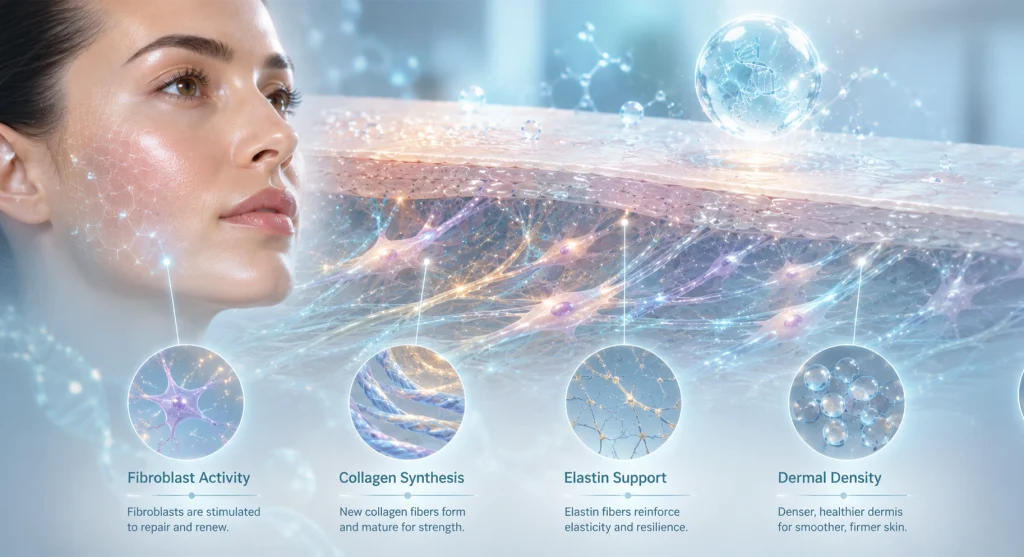
Collagen and elastin synthesis are slower biological processes. Fibroblasts activated by PDRN need 3 to 6 weeks to produce and deposit meaningful new structural matrix. Patients who photograph their skin at day 10 and compare it to a photograph at day 60 using the same lighting and angle consistently report that the day 60 image shows more significant structural improvement, even though the day 10 glow was the more immediately noticeable change. Managing this expectation upfront is something we do at every initial consultation at Perfect B, because patients who understand the timeline stay committed to their series and achieve the best outcomes.
Not sure which peptide protocol fits your goals?
Perfect B’s peptide protocol tool is built on real clinical data from 2,000+ patients treated in South Florida.
Answer 6 questions and see what patients with similar goals are running: which peptides they use, typical dosing, injection schedule, reconstitution steps, cycle length, and when they pause.
Weeks 3 to 6: Where the Clinical Transformation Happens
Collagen and elastin synthesis timeline
Between weeks 3 and 6, the fibroblasts activated by PDRN’s receptor mechanism have had sufficient time to synthesize and deposit new collagen and elastin in the treated zones. This is the phase where patients begin noticing changes that go beyond the early glow: the skin feels firmer to the touch, fine lines look less pronounced in morning photographs, and the overall structural density of the skin appears improved. These changes are slower to appear but are more clinically meaningful than the early hydration and brightness because they represent actual tissue remodeling rather than circulatory and inflammatory changes. The peer-reviewed literature in the Journal of Medical Sciences confirming that PDRN’s nucleotide supply pathway accelerates DNA repair and enables fibroblasts to sustain elevated collagen synthesis over a 4 to 8 week window following treatment reflects what we observe clinically at Perfect B.
What improves first: texture, pore size, fine lines, or dark circles
The order of improvement is consistent across most patients. Skin texture improves earliest, typically noticeable by week 3, because the surface skin cells benefit from both the inflammatory modulation and the early collagen from activated fibroblasts. Pore size reduction follows at weeks 3 to 4, as improved dermal structure supports the follicular openings from beneath. Fine line reduction becomes visible at weeks 4 to 6 as new collagen fills the structural deficit beneath the lines. Dark circles, particularly those with an underlying thin-skin component, often improve meaningfully by week 4 to 5, especially in patients treated with PDRN specifically in the periorbital zone. Patients should always be photographed in consistent lighting and at consistent angles to accurately track these changes, as the improvements are progressive and subtle rather than dramatic and sudden.
After 3 Sessions: What a Complete PDRN Series Looks Like at Perfect B
How results compound across sessions
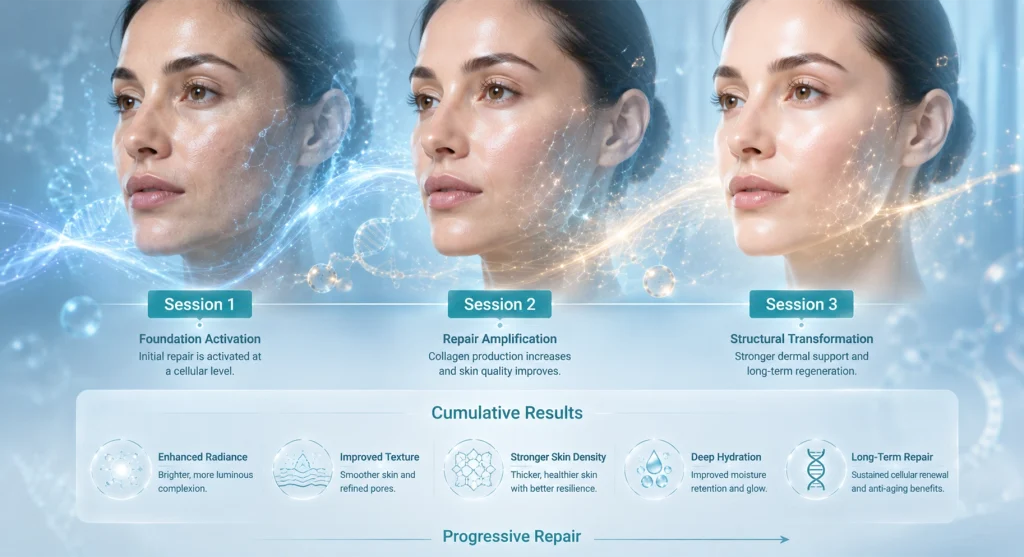
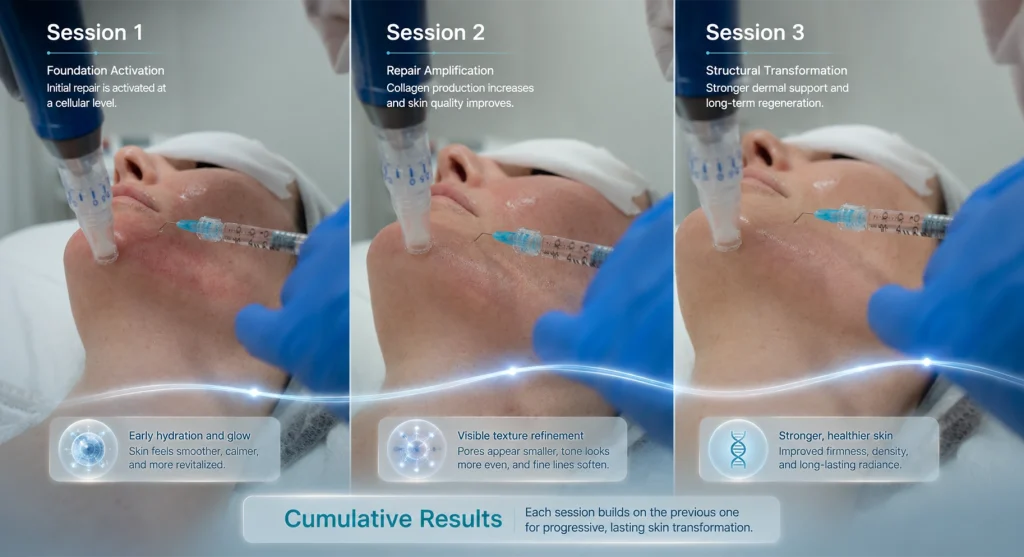
Session 1 activates the repair pathway and establishes the biological foundation. Session 2, administered 3 to 4 weeks after session 1 during the active collagen synthesis window, amplifies the fibroblast response on top of the matrix that session 1 initiated. Session 3 adds a third layer of activation as the session 2 collagen synthesis is still in progress. The result is not linear. Patients who complete 3 sessions spaced appropriately do not see triple the improvement of one session. They see approximately 2 to 2.5 times the improvement, because each subsequent session builds on a skin substrate that is already more receptive and structurally improved than it was before treatment began. → See how PDRN compares to PRP in clinical outcomes, consistency, and which patients achieve better results with each approach at Perfect B in Doral, FL.
What the skin looks like at 12 weeks
At the end of a properly spaced 3-session PDRN series, patients at Perfect B consistently report: visibly firmer skin that feels denser to the touch, significant reduction in fine line depth particularly in the periorbital and nasolabial areas, improved evenness of skin tone, reduction in the grayness associated with chronic UV exposure, noticeably reduced dark circles in patients with a thin-skin periorbital component, and a baseline glow that persists without any treatment-related inflammation. The skin looks like a better version of itself rather than a treated or altered version. This is the differentiator that makes PDRN particularly popular among patients who are not ready for or interested in injectable fillers or neurotoxins but want clinically meaningful improvement.
PDRN Before and After by Skin Concern
PDRN for dark circles and under-eye hollowing
The periorbital area is one of the zones where PDRN consistently delivers some of its most appreciated results, particularly for patients with dark circles that have a structural component, meaning thin skin over the orbital bone rather than purely pigmentation. PDRN injected in the under-eye zone thickens the dermis over time through collagen stimulation, reducing the degree to which the underlying vasculature is visible through the skin. Most periorbital patients notice a difference in dark circle intensity by session 2, with meaningful improvement by the end of session 3. For patients whose dark circles are primarily pigmentary (post-inflammatory hyperpigmentation or melanin deposits), PDRN is a useful adjunct but not a standalone solution.
PDRN for fine lines and skin laxity
Fine lines that have a hydration and early collagen deficit component respond well to PDRN. Deeper structural lines established over years of sun damage and volume loss require complementary treatments. At Perfect B, we are specific with patients about which lines PDRN can meaningfully address and which require neurotoxins, fillers, or RF microneedling. Superficial periorbital lines, nasolabial skin texture, and the fine lines of the mid-cheek are typically well within PDRN’s range of effect. The horizontal lines of the forehead and deep nasolabial folds generally require additional modalities.
Not sure which peptide protocol fits your goals?
Perfect B’s peptide protocol tool is built on real clinical data from 2,000+ patients treated in South Florida.
Answer 6 questions and see what patients with similar goals are running: which peptides they use, typical dosing, injection schedule, reconstitution steps, cycle length, and when they pause.
PDRN for chronic dullness and UV damage in Miami
This is where PDRN’s clinical advantage in Miami is most pronounced. South Florida patients accumulate UV damage year-round at levels that are among the highest in the continental US. Chronic UV stress creates a cellular environment where repair mechanisms are consistently overwhelmed: DNA damage accumulates faster than cells can repair it, fibroblast activity is suppressed, and the baseline inflammatory state of the skin elevates over time. This produces the characteristic gray, dull, textured appearance of chronically sun-damaged skin that no moisturizer or antioxidant serum can address because the deficit is at the cellular level, not the surface level. PDRN’s nucleotide supply directly addresses this by giving damaged cells the raw material to restart their repair processes. Patients with this presentation, which describes a significant proportion of our Doral patient population, often see more dramatic early improvements than patients treating primarily cosmetic concerns on otherwise healthy skin.
Fitzpatrick III-V Results: What Miami Patients See That Generic Before-and-After Photos Don’t Show
The vast majority of before-and-after PDRN content online features Fitzpatrick I and II patients, typically from Korean clinics where PDRN has been used for decades. The dramatic texture improvements visible in those images are real, but they do not fully represent what Fitzpatrick III to V patients should expect, because the baseline skin conditions, the risk profile, and the treatment protocol are different.
For our Latin American, Caribbean, and South American patient population in Doral, the most consistently reported improvements from PDRN are: reduction in the chronic dullness and grayness associated with UV and heat-related cellular stress, improvement in post-inflammatory hyperpigmentation from prior acne or procedures, measurable increase in skin firmness and density that feels more substantial than it looks in photographs, and a reduction in the reactive redness that often accompanies oily or sensitized skin in humid climates. The A2A receptor’s anti-inflammatory mechanism is particularly beneficial for patients with melanin-rich skin because inflammation suppression reduces the risk of new pigment deposition. Patients in this demographic who follow sun protection protocols throughout their series consistently achieve results that are comparable in quality to the before-and-afters from lighter-skin populations, even if the visible contrast in photographs appears less dramatic due to melanin. → See how Perfect B combines PDRN with microneedling for patients in Miami and Doral, including why the combination amplifies results for Fitzpatrick III-V skin beyond what either treatment achieves independently.
PDRN Plus Microneedling vs PDRN Injections Alone: Which Shows Results Faster?
At Perfect B, we offer both delivery methods and use them for different patient presentations. Microneedling with PDRN as a serum creates surface micro-channels that improve penetration of the PDRN into the dermis while simultaneously triggering collagen induction through the physical micro-injury. The combination produces faster surface texture improvement and visible results typically within 10 to 14 days rather than the 14 to 21 days typical of injections alone. Injectable PDRN, by contrast, deposits the material precisely in the mid-dermis where the receptor activation happens most efficiently, making it more appropriate for patients with specific structural concerns such as periorbital thinning, pronounced fine lines, or areas where the skin barrier is compromised and topical delivery is unreliable. For most patients, a combined protocol using injections in targeted zones and microneedling with PDRN for broader surface coverage delivers the best of both mechanisms. → See Perfect B’s full skin rejuvenation treatment plan in Doral, FL, including how PDRN, microneedling, and exosome protocols are combined based on each patient’s clinical profile and skin condition.
Frequently Asked Questions
1. How long does it take to see results from PDRN?
Most patients notice the first visible change, typically improved hydration and a subtle glow, within 7 to 10 days of their first session. Meaningful structural improvements including firmer skin, reduced fine lines, and improved texture emerge between weeks 3 and 6. Maximum results from a single session are visible at 8 to 12 weeks. With a 3-session series spaced 3 to 4 weeks apart, cumulative results are typically most apparent 6 to 8 weeks after the final session.
2. How many PDRN sessions do I need to see results?
One session will produce visible results, particularly in patients with significant UV damage or baseline cellular stress. However, the results from a single session are approximately 35 to 40 percent of what a properly spaced 3-session series achieves. At Perfect B, we recommend 3 sessions as the standard series for patients with moderate skin aging or damage, and assess at session 3 whether a 4th or 5th session would be beneficial before transitioning to maintenance. For patients with mild concerns primarily seeking preventive maintenance, 2 sessions per year may be sufficient.
3. Does PDRN actually work, or is it mostly hype?
PDRN has over 40 years of clinical research behind it, primarily in wound healing and tissue regeneration. The aesthetic application is newer in the US market but reflects the same well-documented biological mechanisms. The relevant distinction is between injectable medical-grade PDRN administered by a trained provider and topical cosmetic products that use the same marketing name but cannot penetrate to the dermal layer where the receptor activation occurs. At Perfect B, we source injectable PDRN from US laboratories with third-party purity verification. The results from properly administered injectable PDRN are clinically real and reproducible. The hype is largely around topical versions whose penetration and efficacy are far more limited than the injectable protocol.
4. What are the downsides of PDRN treatment?
The primary downside is the timeline: patients seeking rapid, dramatic results within days will be disappointed by the progressive nature of PDRN’s mechanism. The treatment requires a series of sessions rather than a single dramatic procedure. Minor temporary side effects include the papules at injection sites, mild redness and swelling for 24 to 48 hours, and occasional mild bruising. Allergic reactions are rare due to PDRN’s high biocompatibility with human cells. PDRN is not a substitute for neurotoxins or fillers in patients whose primary concern is muscle-driven expression lines or significant volume loss.
Not sure which peptide protocol fits your goals?
Perfect B’s peptide protocol tool is built on real clinical data from 2,000+ patients treated in South Florida.
Answer 6 questions and see what patients with similar goals are running: which peptides they use, typical dosing, injection schedule, reconstitution steps, cycle length, and when they pause.
5. How long do PDRN results last?
Results from a properly completed 3-session series typically last 4 to 6 months before the skin begins to return toward its prior baseline. Maintenance sessions every 3 to 6 months sustain the improvement. In Miami’s high-UV environment, patients who maintain consistent sun protection throughout their treatment series and afterward sustain their results longer than patients who return to unprotected sun exposure. Each maintenance session builds on the structural improvements from previous series, so the baseline improves progressively over multiple years of consistent treatment.
6. Is the salmon DNA facial the same as PDRN injections?
The underlying molecule is the same: polydeoxyribonucleotide derived from salmon DNA. The delivery method and resulting efficacy differ significantly. Injectable PDRN places the material precisely in the mid-dermis where the A2A receptor activation and nucleotide salvage pathway operate most effectively. Topical PDRN applied as a serum or facial product is limited by skin barrier penetration and primarily acts on the epidermal layer. At Perfect B, we use injectable PDRN from US laboratories. Patients researching “salmon DNA facial” should ask specifically whether the treatment involves injections or topical application, as the before-and-after results that circulate online typically reflect the injectable protocol rather than topical products. Contact us at (786) 502-2260 to discuss which delivery method is appropriate for your specific concerns and skin type.
Closing: What PDRN Before and After Really Means at Perfect B
The before-and-after transformation from PDRN is not a single dramatic event. It is a biological progression that unfolds over weeks, driven by cellular processes that cannot be accelerated beyond their natural timeline. The early glow is real. The structural improvement is more significant but takes longer to appear. The compounding effect across a properly spaced series is where the most meaningful results live. Patients who understand this timeline and commit to it consistently report outcomes that they describe as more satisfying than treatments that produce immediate but temporary results.
In Miami’s high-UV, high-heat environment, with a patient population where chronic UV damage and Fitzpatrick III-V skin tones are the norm rather than the exception, PDRN’s mechanism is particularly well-matched to what patients actually need: a treatment that works at the cellular level to repair what years of sun exposure have degraded, not a surface-level intervention that temporarily masks it. → Schedule a consultation at Perfect B in Doral, FL to evaluate your skin baseline, discuss your specific before-and-after goals, and design a PDRN protocol that matches your timeline and clinical profile.
📍 Visit us at Perfect B, Doral FL
📞 Call or message us at (786) 502-2260