
Perfect B, Doral Fl. | 05.20.26 | 14 min read.
Medical disclaimer: BPC-157 is a 503A compounded peptide administered under licensed medical supervision. This article is for educational purposes only. Dosage ranges reflect clinical protocols used at our Doral clinic and should not be applied without a medical consultation.
Skip Ahead to the Perfect B Peptide Protocol Tool. See Reconstitution, Daily Units, and Cycle Structure.
Perfect B’s peptide protocol tool is built on real clinical data from 2,000+ patients treated in South Florida.
Answer 6 questions and see what patients with similar goals are running: which peptides they use, typical dosing, injection schedule, reconstitution steps, cycle length, and when they pause.
BPC-157 does not have an FDA-approved dosage because it is not FDA-approved as a drug. There is no universal protocol. The right dose depends on the indication, the patient’s weight and health history, and the prescribing provider’s clinical judgment. At Perfect B in Doral, every BPC-157 protocol is individualized at a licensed APRN intake before any medication is prescribed or dispensed.
This guide breaks down the exact protocol structure we use at our peptide clinic in Doral, FL: dose by administration route, dose by use case, cycle length and rest periods, the mcg-to-units-to-mL math patients ask about every week, and how BPC-157 dosage changes when it is stacked with TB-500 in the Wolverine protocol.
BPC-157 Dosage at a Glance
- Subcutaneous injection: Used for musculoskeletal injuries, administered near the target injury site or in the abdominal fat pad. Dose individualized by your APRN provider.
- Oral or troche: Used for gut, IBS, or systemic applications. Dose and format determined at intake.
- Cycle length: Typically 4 to 8 weeks depending on indication and clinical response.
- Rest period: A recovery window between cycles allows the system to reset before repeating.
- Wolverine Stack: BPC-157 combined with TB-500 at doses individualized to injury severity. $795 per cycle at Perfect B.
- No FDA-approved dose exists: All BPC-157 protocols at Perfect B are individualized at the APRN intake before any medication is prescribed.
What BPC-157 Actually Is: Why Dosage Starts with Source
BPC-157 is a synthetic pentadecapeptide derived from a sequence in human gastric juice, consisting of fifteen amino acids in the chain Gly-Glu-Pro-Pro-Pro-Gly-Lys-Pro-Ala-Asp-Asp-Ala-Gly-Leu-Val. The molecule was first identified and studied by the Sikiric research group in Croatia starting in the early 1990s, and the bulk of the preclinical evidence base comes from more than three decades of rat and rodent studies showing consistent tissue-repair, anti-inflammatory, and gastroprotective effects. Its primary mechanism is VEGF upregulation, the growth of new blood vessels that supply oxygen and nutrients to injured tissue, alongside nitric oxide pathway modulation and fibroblast stimulation in tendon and ligament tissue.
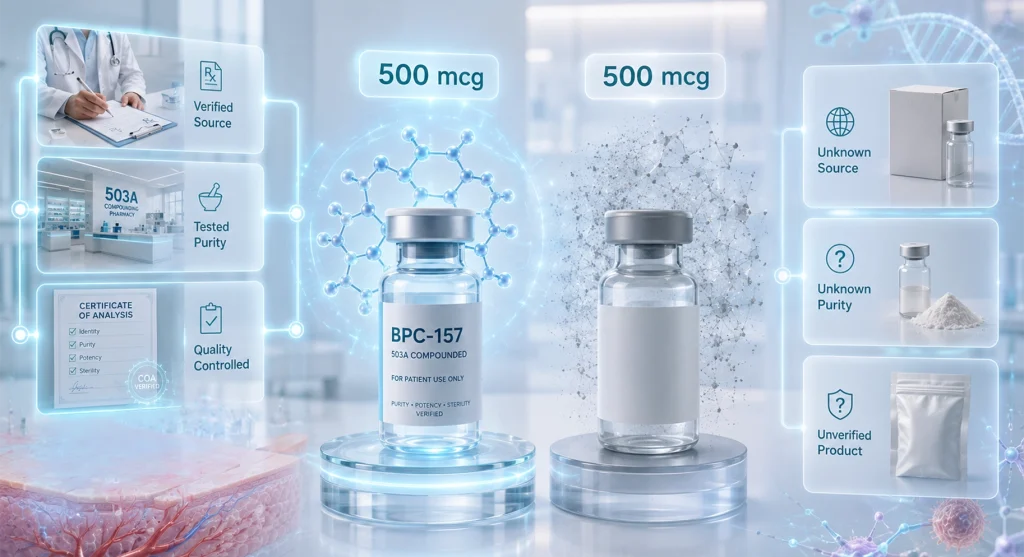
In the United States, BPC-157 is available only through licensed 503A compounding pharmacies that prepare it to patient-specific prescriptions. This is not the same product as the gray-market “research-grade” BPC-157 sold online in powder form for self-injection. The purity, sterility, and potency of compounded BPC-157 from an FDA-registered pharmacy is verified and tested. The research-grade alternative is not.
Why this matters for dosage: the same mcg number means something different depending on purity. A 500 mcg dose from a verified 503A pharmacy delivers 500 mcg of active peptide. A 500 mcg dose from an untested online source delivers an unknown quantity of an unknown substance. The protocols in this guide apply to compounded, pharmacy-grade BPC-157 only.
How BPC-157 Dosage Is Determined: The Clinical Approach
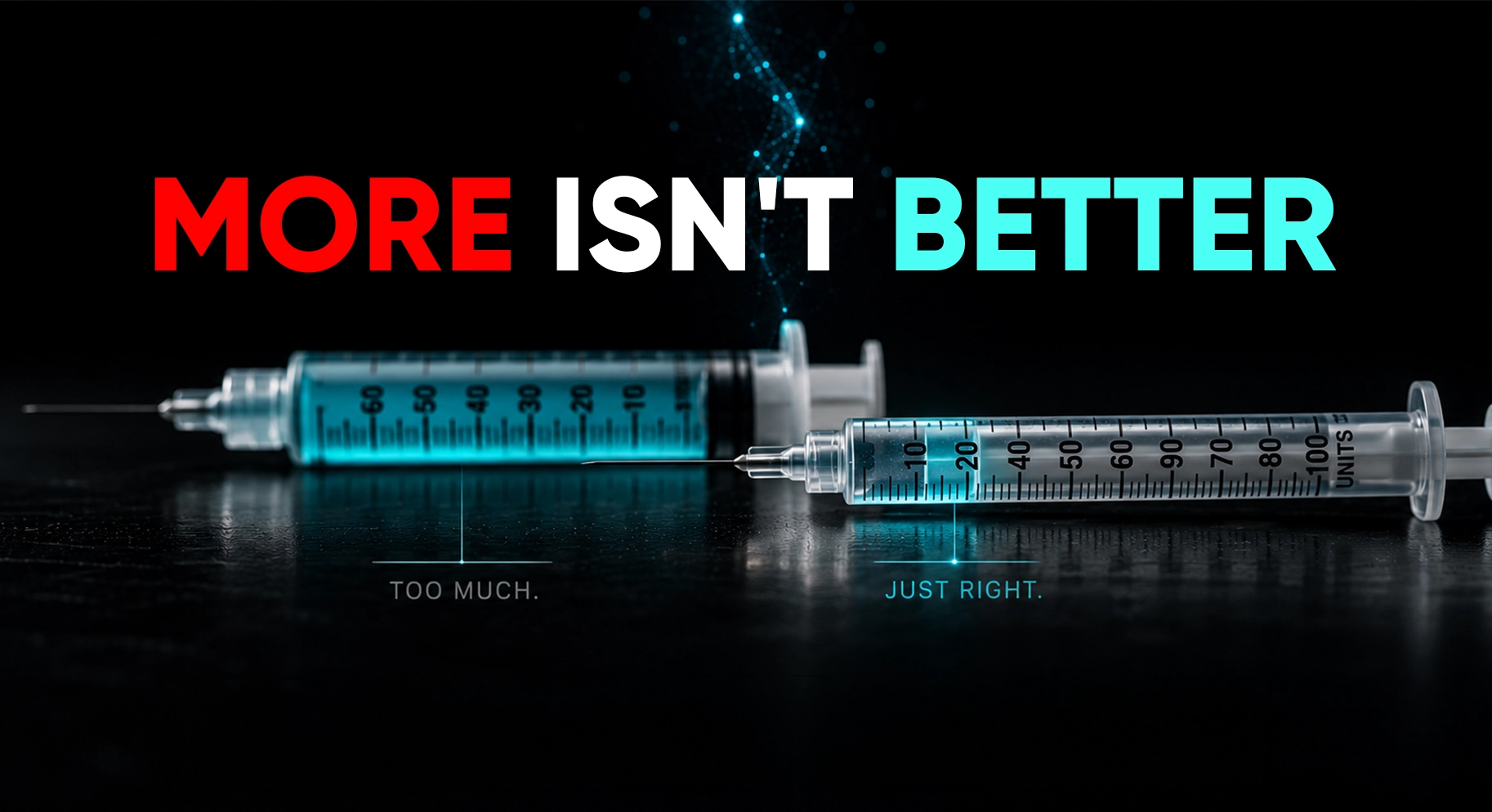
Because BPC-157 has no FDA-approved dosage, every clinical protocol is built from preclinical data, provider experience, and individualized patient assessment. There is no single number that applies to every patient. At Perfect B in Doral, the exact dose is determined at your APRN intake based on your specific indication, body weight, injury profile, and treatment goal.
Independent clinical literature notes that BPC-157 injection dosing varies by indication and provider protocol. At Perfect B, every BPC-157 protocol starts with a licensed APRN intake. Your provider reviews your full health history and treatment goals before prescribing any dose or route. For a summary of the published research, Rupa Health’s clinical review of BPC-157 covers the available data.
- Injection route: Subcutaneous, near the injury site or abdominal fat pad depending on indication
- Dose and frequency: Set at your APRN intake based on indication, body weight, and injury severity
- Cycle length: 4 to 8 weeks, with a rest period between cycles
- All Perfect B protocols start with a full medical intake, not a vial and a pamphlet
BPC-157 Injection Dosage: Subcutaneous Protocol Step by Step
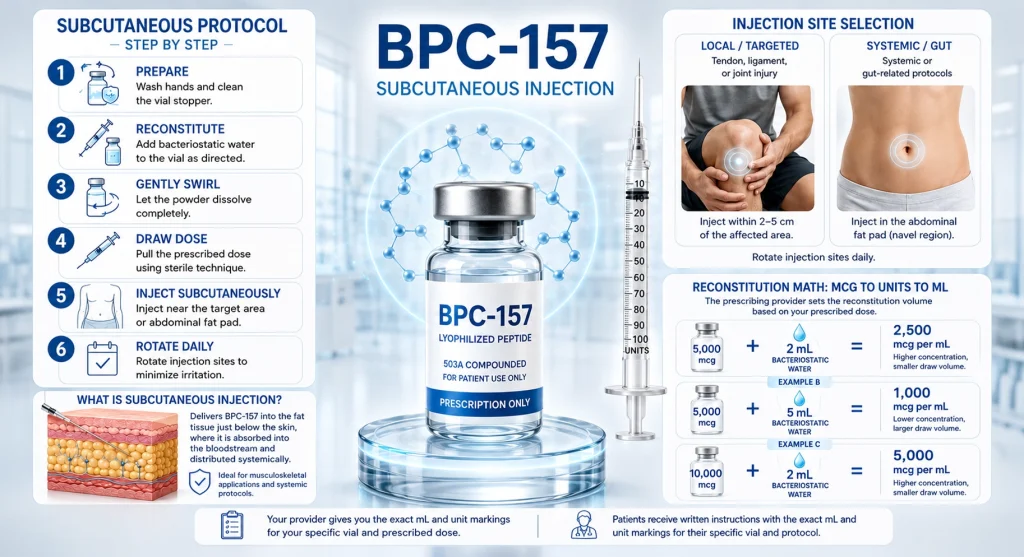
Subcutaneous injection delivers BPC-157 directly into the fat tissue just below the skin, where it is absorbed into the bloodstream and distributed systemically. It is the most common route for musculoskeletal applications because it allows proximal injection near the injury site, which appears to improve local tissue concentration based on animal study findings.
Injection site selection
The preferred injection site depends on the treatment goal. For tendon, ligament, or joint injury, injection within two to five centimeters of the affected area is the standard approach. For systemic or gut-related protocols, the abdominal fat pad at the navel region is used. Patients rotate injection sites daily to avoid localized tissue irritation.
Reconstitution math: mcg to units to mL
This is the calculation patients ask about most often. BPC-157 arrives from the 503A compounding pharmacy as a lyophilized powder in a vial marked by total mcg content. Bacteriostatic water is used to reconstitute it. Your prescribing provider gives you the exact mL and unit markings for your specific vial and prescribed dose. The general math works as follows:
- Example A: 5,000 mcg vial + 2 mL bacteriostatic water: Yields 2,500 mcg per mL. Each dose drawing is calculated from your prescribed amount.
- Example B: 5,000 mcg vial + 5 mL bacteriostatic water: Yields 1,000 mcg per mL. Lower concentration, larger draw volume per dose.
- Example C: 10,000 mcg vial + 2 mL bacteriostatic water: Yields 5,000 mcg per mL. Higher concentration, smaller draw volume per dose.
The reconstitution volume is set by the prescribing provider based on the prescribed dose. Patients receive written instructions with the exact mL and unit markings for their specific vial and protocol.
BPC-157 Oral Dosage: When Troches or Capsules Make Clinical Sense
Oral BPC-157 is preferred for gastrointestinal indications including leaky gut, inflammatory bowel conditions, and systemic anti-inflammatory support where localized injection is not the primary target. The oral route delivers BPC-157 through the GI tract, which is where the original peptide sequence was identified and where its gastroprotective properties are most mechanistically direct. Your APRN sets the oral dose at intake based on your specific GI indication.
The tradeoff versus injection is bioavailability. Oral BPC-157 may have lower systemic absorption than subcutaneous injection because peptides are partially degraded in the digestive process. Sublingual troches preserve more of the peptide by bypassing first-pass metabolism in the liver, which is why our compounding pharmacy partners prepare BPC-157 troches for many gut protocol patients rather than standard capsules.
- Oral or troche dose: Determined at APRN intake based on your GI indication and treatment goal
- Troche format: Held sublingually for 60 to 90 seconds before swallowing for improved absorption
- Best use case: GI inflammation, IBS, gut lining repair, Crohn’s management, systemic anti-inflammatory support
- Not optimal for: Localized tendon, joint, or muscle injury where injection near the site is more targeted
Injury vs Gut Protocol: See What Dosing Looks Like for Your Use Case
BPC-157 dosage differs by indication. Our protocol tool matches you to the injection schedule or oral troche regimen patients with similar goals are using at Perfect B.
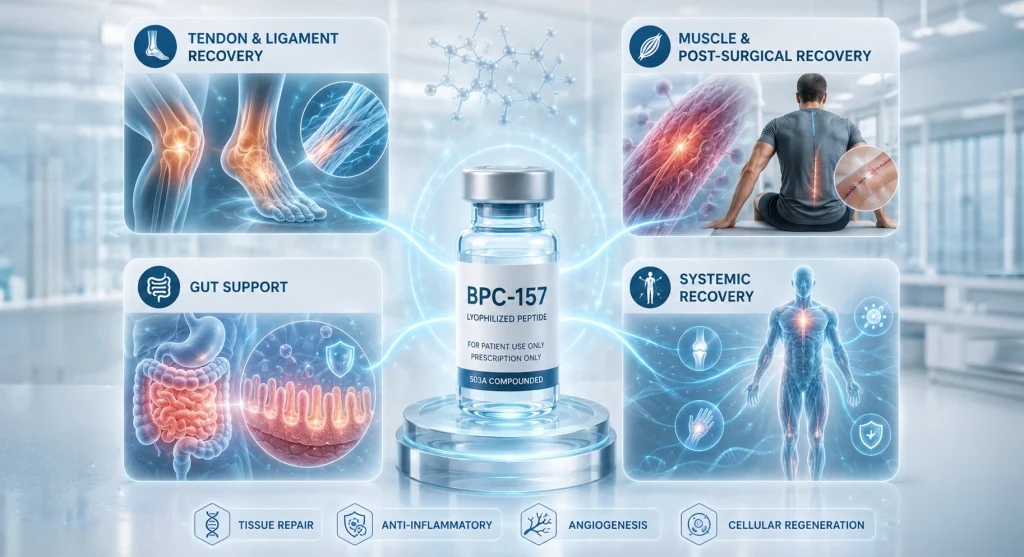
BPC-157 Dosage by Use Case: Injury, Gut, and Systemic Protocols
The right BPC-157 protocol depends on what you are treating. The peptide has been studied across several distinct use cases in preclinical models, and the dosing rationale differs between them.
Tendon and ligament injury
The most documented use case. Animal studies show BPC-157 accelerates tendon-to-bone healing, improves collagen organization, and reduces inflammatory markers in tendon tissue. At Perfect B, tendon and ligament injuries are the most common reason patients request BPC-157. Rotator cuff, Achilles, patellar, and plantar fascia injuries are frequent presentations in Doral patients. Dose and cycle length are set at your APRN intake based on injury severity and response.
Muscle tear and post-surgical recovery
Muscle injuries may warrant higher dosing frequency in the acute phase, determined by your provider. Protocol length and adjustment points are discussed at your APRN intake and reviewed at the mid-cycle check-in. Post-surgical recovery protocols are individualized based on the procedure, the surgeon’s instructions, and the patient’s baseline labs.
Gut health and GI inflammation
Oral or sublingual BPC-157 is the preferred route for GI indications. The Sikiric group’s foundational research, published in major pharmacology journals and indexed at the NIH National Library of Medicine, demonstrates direct gastroprotective and anti-inflammatory action in the gut mucosa. Dose and cycle length for GI protocols are determined at your provider intake and adjusted based on symptom response.
Systemic recovery and general tissue repair
Patients without a specific acute injury but seeking general recovery optimization or connective tissue support work with their APRN to determine the appropriate dose and route at intake. This is the most conservative protocol and serves as the starting point for patients who are new to peptide therapy or who have multiple mild concerns rather than one acute target.
BPC-157 Cycle Length: How Long, How Often, and When to Stop
The standard BPC-157 cycle is four to eight weeks of daily dosing followed by a two to four week rest period. The cycle structure exists for a practical reason: continuous stimulation of the same receptor pathways can lead to reduced sensitivity over time, and a rest period allows the system to reset before the next cycle produces full effect. It is not a toxicity concern but an efficacy consideration.
Acute injury cycle
A six-week cycle is the standard for acute musculoskeletal injury. Most patients at our clinic assess progress at week four with a clinical check-in. If the injury is resolving well, they complete the full six weeks and then take a two-week break. If the injury is resolving well, most patients complete the full cycle and then take a two to four week break before evaluating whether a second cycle is needed.
Chronic condition cycle
Patients with chronic gut conditions, recurring joint issues, or ongoing tissue inflammation often run two to three consecutive cycles with rest periods between each. The total program is typically three to four months of active protocol time. We evaluate at the end of each cycle before deciding whether to repeat, adjust the dose, add a stack partner like TB-500, or transition to a maintenance approach.
When to stop
Stop the protocol and contact your provider if you experience persistent redness or swelling at injection sites beyond 72 hours, fever, or any systemic symptom that does not correlate with the expected mild post-injection reaction. Most patients complete full cycles without interruption.
BPC-157 and TB-500 Stacked: Dosage Adjustments for the Wolverine Protocol
The Wolverine Stack combines BPC-157 with TB-500 (Thymosin Beta-4) in a single cycle designed for patients with significant acute injuries or post-surgical recovery timelines who want to leverage both peptides’ complementary mechanisms simultaneously. Our full guide to the Wolverine Stack and why the combination works differently than either peptide alone covers the rationale in detail.
From a dosage standpoint, the stack structure we use:
- BPC-157: Subcutaneous injection near the injury site. Dose individualized at intake based on injury type and severity
- TB-500 loading phase: Higher frequency in the first weeks. Dose set by your provider
- TB-500 maintenance phase: Reduced frequency as healing progresses
- Stack pricing at Perfect B: $795 for the Wolverine cycle, compared to $445 for BPC-157 alone
Both peptides are dosed individually to avoid overlapping pathways and maintain their complementary mechanisms. Your prescribing provider adjusts the protocol based on injury severity, your response, and lab findings at intake.
Wolverine Stack or Single Peptide? Compare Protocols Side by Side
The Wolverine Stack combines BPC-157 and TB-500 at specific dose ratios. Before deciding between the $445 single-cycle and the $795 stack, see what patients with your recovery profile are using.
What Supervised Dosing Looks Like at Perfect B in Doral, FL
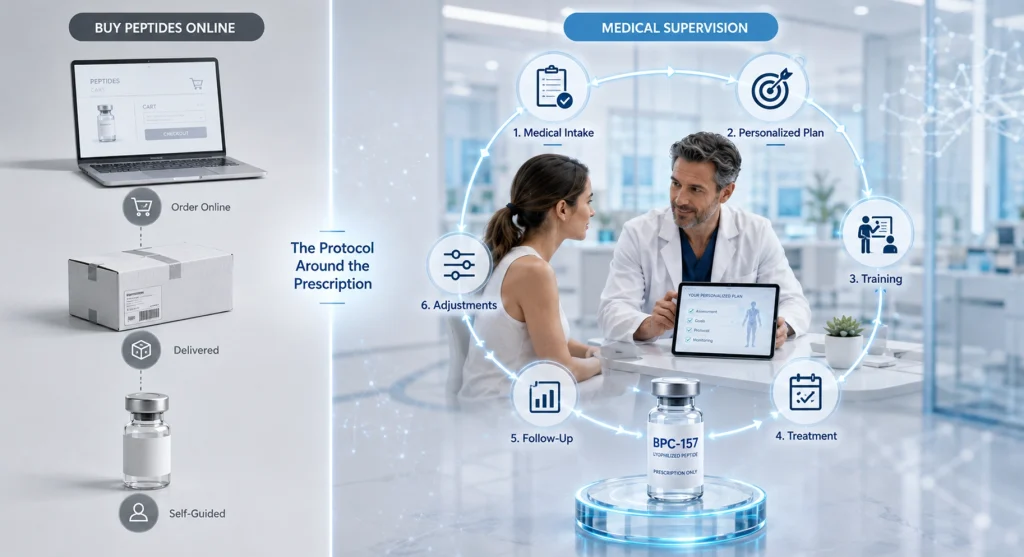
Every BPC-157 protocol at our clinic starts with a medical intake, not a vial and a pamphlet. The difference between supervised dosing and ordering peptides online is the clinical context that surrounds the prescription.
- Medical history and medication review to flag any interactions or contraindications before prescribing
- Goal-specific protocol selection based on injury location, duration, and severity rather than a one-size-fits-all 500 mcg recommendation
- Written reconstitution and injection instructions with the exact mL and unit markings for the patient’s specific vial and prescribed dose
- Injection training for self-administration patients, either in-clinic or via telehealth video walkthrough
- Week-four check-in to assess response, adjust dose or frequency if needed, and confirm the patient is completing the cycle correctly
- Pharmacy-grade 503A product with verified purity, sterility, and potency from an FDA-registered compounding pharmacy
For patients who have never injected a peptide before, we also review the BPC-157 benefits and mechanism in detail before starting the protocol so the patient understands what the peptide does, what to expect during the cycle, and what results realistically look like at four, eight, and twelve weeks.
Frequently Asked Questions About BPC-157 Dosage
1. What is the correct BPC-157 dosage for tendon injury?
BPC-157 for tendon injury is administered subcutaneously near the affected tendon. The dose and frequency are set at your APRN intake based on injury severity and your health profile. Cycle length is typically 4 to 8 weeks, with a clinical review at the midpoint to assess response.
2. How do I convert BPC-157 mcg to units and mL?
The conversion depends on your vial size and reconstitution instructions from your provider. Your prescribing APRN at Perfect B gives written dose markings specific to your vial and prescribed dose. Never reconstitute or self-dose without written instructions from your provider.
3. How long should a BPC-157 cycle be?
The standard cycle is four to eight weeks of daily dosing followed by a two to four week rest period. Four weeks is used for milder injuries or first-time protocols where response is being assessed. Six weeks is standard for acute musculoskeletal injuries. Longer uninterrupted dosing is not recommended because receptor sensitivity can diminish without cycling.
4. Is oral or injectable BPC-157 better for gut health?
Oral or sublingual BPC-157 is preferred for gut health because the peptide acts directly on the GI mucosa when delivered through the digestive tract. For IBS, leaky gut, or inflammatory bowel conditions, the oral or sublingual troche is the first-choice route. Your APRN sets the dose at intake based on your specific GI indication.
5. Can I take BPC-157 every day?
BPC-157 is administered daily during an active cycle. Frequency and duration are set by your provider based on your indication. The rest period between cycles is equally important for maintaining long-term response quality.
6. What is the maximum BPC-157 dosage?
There is no FDA-approved maximum dose for BPC-157. Dosing is entirely determined by your prescribing APRN based on your indication and clinical response. At Perfect B, dose adjustments are made at the mid-cycle check-in. This is not a formal ceiling because no FDA-approved limit exists, but it represents the upper range of what is supported by preclinical scaling and provider experience. The prescribing provider sets the dose and adjusts based on clinical response throughout the cycle.
7. How does BPC-157 dosage change for the Wolverine Stack?
When combined with TB-500 in the Wolverine Stack, both peptides are dosed individually by your provider. The BPC-157 and TB-500 portions are calibrated to work on complementary pathways without overlap. Your provider adjusts the stack based on injury severity, your response, and lab findings at intake.
8. Does BPC-157 need to be injected near the injury?
Proximal injection near the injury site is preferred for musculoskeletal applications because it appears to increase local tissue concentration. Systemic distribution via abdominal fat pad injection also delivers BPC-157 throughout the body and is effective for general or gut protocols. For patients who cannot access the injury site with a self-injection, abdominal injection with the understanding that response may be somewhat slower is a practical alternative.
Closing: Dosage Is Only One Variable in a Protocol
A properly sourced, clinic-prescribed BPC-157 protocol, within a structured four to eight week cycle supervised by a licensed APRN, is a fundamentally different intervention than a research-grade powder ordered online without medical oversight. The peptide may carry the same name. The safety, quality, and clinical support behind it do not compare.
Patients who come to our Doral clinic for BPC-157 consistently ask why supervised protocols outperform the self-directed approach. The answer is not the mcg number. It is the intake evaluation that matches the dose to the injury, the compounding pharmacy relationship that guarantees the product quality, and the mid-cycle check-in that catches suboptimal response before the full cycle is wasted. The cost of BPC-157 at Perfect B includes all of these components, not just the vial.
📍 Perfect B | 8200 NW 41st St, Suite 100, Doral, FL 33166
📞 (786) 502-2260