
Perfect B, Doral Fl. | 05.20.26 | 11 min read.
This article is for educational purposes only and does not substitute professional medical advice. Always consult a licensed provider before starting any laser treatment.
PiQo4 is a laser system made by Lumenis that combines picosecond and nanosecond pulse technology in a single device with four wavelengths. It is FDA-cleared for tattoo removal, pigmented lesion treatment, and skin rejuvenation. At Perfect B in Doral, FL, PiQo4 is the laser we use for tattoo removal and laser skin treatments because of its ability to treat the widest range of ink colors and skin types with fewer sessions than older laser systems. This is one part of a larger plan, so see how laser tattoo removal works at Perfect B in Doral, including how the PiQo4 handles different inks and skin tones.
Most patients searching “what is PiQo4” are comparing laser options, preparing for a consultation, or trying to understand why their provider chose this specific system over alternatives. This guide covers exactly that: how the technology works, what makes it different, what it treats, and what to expect if you are considering PiQo4 at our clinic in Doral.
Key Takeaways on PiQo4 Technology
- Dual pulse technology: PiQo4 combines picosecond and nanosecond pulses in a single session, which breaks down both large and small ink particles more completely than systems that use only one pulse type.
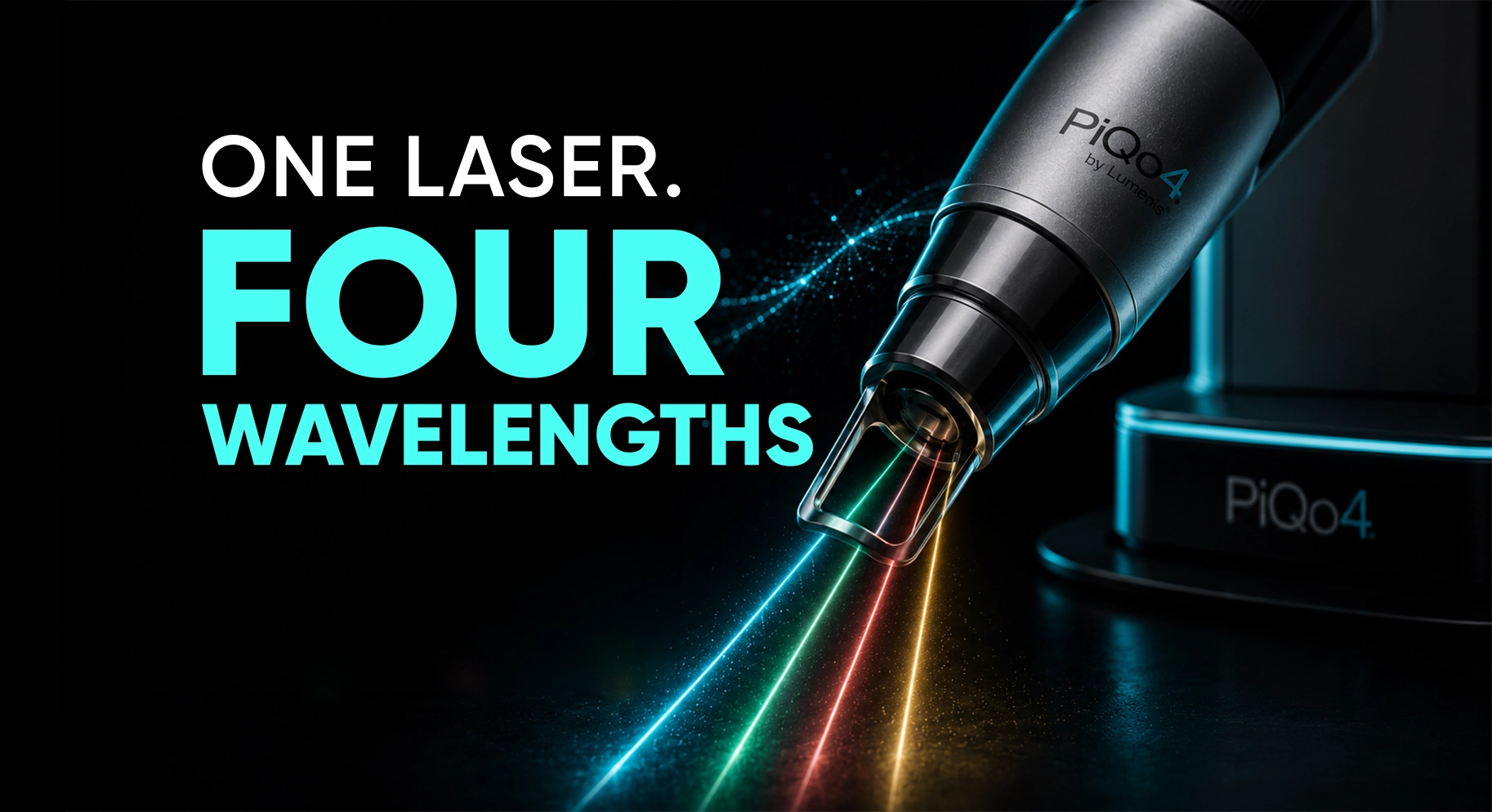
- 4 wavelengths: 1064nm, 532nm, 650nm, and 585nm allow PiQo4 to target 9 of the most common tattoo ink colors, including colors that many single-wavelength lasers cannot address.
- Largest spot size in its class: At up to 15mm, PiQo4 covers more surface area per pulse, allowing deeper energy penetration and faster treatment sessions.
- 40% fewer sessions: According to Lumenis clinical data, PiQo4 achieves comparable results in significantly fewer sessions than competing laser systems.
- Safe on all skin types: PiQo4 treats Fitzpatrick skin types I through VI, including darker skin tones that require careful wavelength and fluence calibration.
- More than tattoo removal: PiQo4 also treats pigmented lesions, sun damage, lentigines, and performs PicoFractional skin rejuvenation treatments.
What Is PiQo4? The Technology in Plain Terms
PiQo4 is a Q-switched laser platform developed by Lumenis, one of the most established medical laser manufacturers in the industry. The name combines “Pi” for picosecond, “Qo” for Q-switch (the mechanism that creates short pulses), and “4” for the four wavelengths the system delivers.
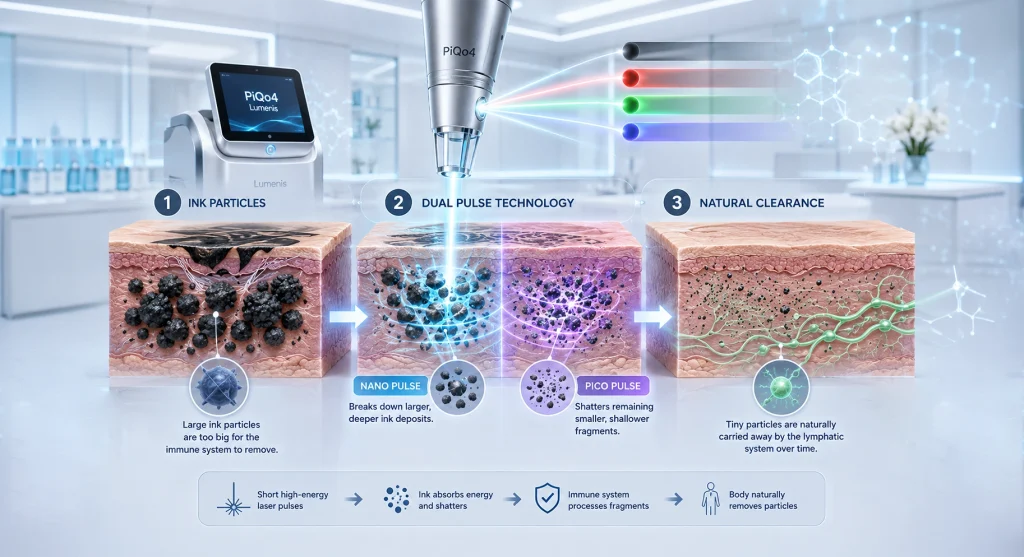
Tattoos are permanent because the ink particles embedded in the dermis are too large for the body’s immune system to break down and remove on its own. PiQo4 solves this by emitting extremely short, high-energy pulses of laser light that are absorbed by the ink particles. The energy converts to acoustic pressure waves that shatter the ink into fragments small enough for the lymphatic system to carry away over time. This process is repeated across multiple sessions as the body clears each round of fragmented particles.
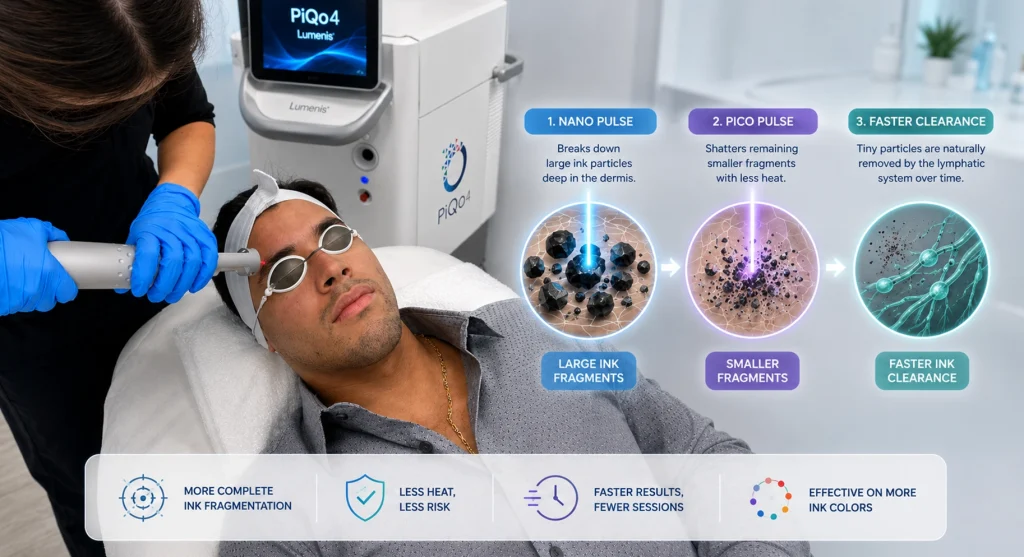
What distinguishes PiQo4 from older Q-switched nanosecond-only systems is that it delivers two types of pulses: nanosecond pulses that break down the larger, deeper ink deposits, followed immediately by picosecond pulses that shatter the remaining smaller, shallower fragments. This two-stage approach produces more complete fragmentation per session than either pulse type alone.
Pico and Nano Dual Pulse: Why Two Technologies Work Better Than One
The dual pulse design is the core of what makes PiQo4 clinically distinct. Lumenis describes this mechanism using a “rocks to pebbles to sand” analogy that explains the treatment progression accurately.
Nanosecond pulses (billionths of a second) deliver longer bursts of energy that are absorbed by the larger, deeper ink particles sitting in the lower dermis. These particles respond better to the longer pulse duration because they require more sustained energy to begin fracturing. Once broken, the fragments are smaller but still present in the tissue.
Picosecond pulses (trillionths of a second) are then used to target the smaller, shallower fragments. Because picosecond pulses are 1,000 times shorter than nanosecond pulses, they create a more intense photomechanical effect with less thermal energy. This means the ink is fragmented more efficiently with less heat transferred to surrounding tissue. The result is faster ink clearance and reduced risk of heat-related side effects such as blistering or pigmentation changes.
Clinical studies cited in the Lumenis PiQo4 documentation confirm that treating ink with both pulse types produces significantly better results than using either nanosecond or picosecond technology alone.
The 4 Wavelengths: Which Ink Colors Each One Targets
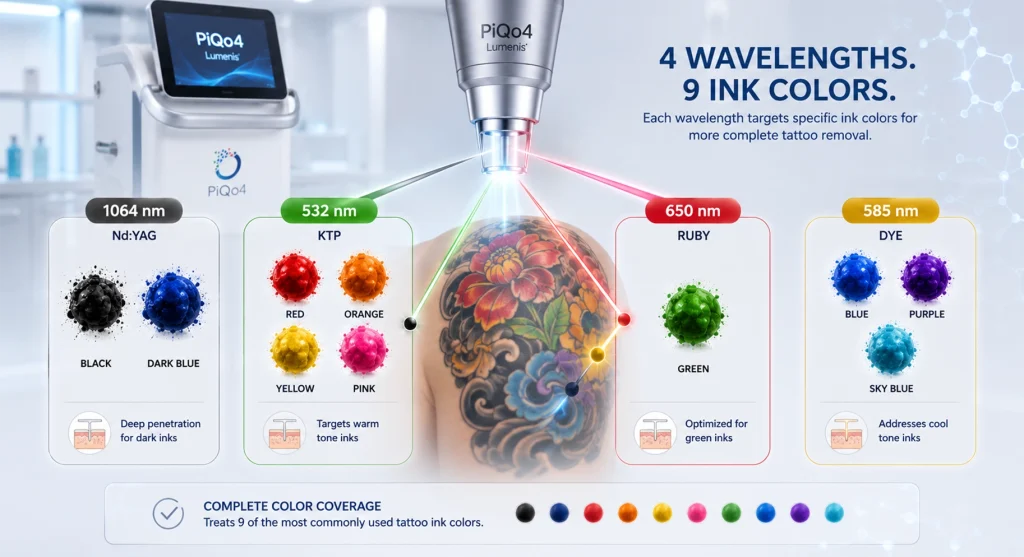
Each wavelength of laser light is absorbed by a specific range of ink pigment colors. This is why single-wavelength lasers cannot remove multicolor tattoos completely. PiQo4’s four wavelengths together address 9 of the most commonly used tattoo ink colors.
1064nm (Nd:YAG)
The 1064nm wavelength targets black and very dark blue ink, which are the most common colors in both amateur and professional tattoos. Black ink sits in the deepest layers of the dermis and requires maximum energy penetration. PiQo4 delivers up to 2,000 mJ at 1064nm, which Lumenis documents as 10 times more energy than the closest competing system at this wavelength. This higher energy level is particularly important for older, densely saturated black tattoos and for treating dark ink on Fitzpatrick IV through VI skin tones without overstimulating the surrounding melanin.
532nm (KTP)
The 532nm wavelength targets red, orange, yellow, and pink inks. Red is the second most common tattoo ink color and one of the most resistant to removal with older laser systems. PiQo4 delivers up to 650 mJ at 532nm, again 10 times the output of competing systems at this wavelength. This elevated energy is what allows PiQo4 to achieve results on warm-tone inks that many clinics decline to treat with older equipment.
650nm (Ruby)
The 650nm wavelength is optimized for green ink, the third most popular tattoo color. Green has historically been one of the hardest colors to remove with laser technology because of its specific light absorption profile. The 650nm addition in PiQo4 closes this gap and allows for effective treatment of green-dominant designs that would be left partially intact by a system without this wavelength.
585nm (Dye)
The 585nm wavelength addresses blue, purple, and sky blue inks, completing coverage for multicolor tattoos. Together with the 650nm wavelength, the 585nm range is what allows PiQo4 to treat the full spectrum of colored tattoos rather than leaving residual ink in non-black shades.
The 15mm Spot Size Advantage: Deeper Reach, Fewer Sessions
Spot size refers to the diameter of the laser beam as it contacts the skin. PiQo4 offers up to 15 spot sizes ranging from 2mm to 15mm, with the 15mm setting being almost four times larger than the maximum spot size of its closest competitor.
A larger spot size matters for two reasons. First, larger spots allow the energy to penetrate deeper into the dermis while maintaining uniform distribution across the treatment zone. This means ink particles sitting at deeper layers are reached more effectively. Second, a larger spot size reduces the number of passes required to cover a tattoo, shortening session time and improving consistency across the treated area.
Lumenis clinical data also shows that treatment with a large spot size at appropriate fluence significantly decreases the occurrence of blistering, discoloration, and scarring compared to smaller spot sizes at equivalent energy densities, because the energy is distributed over a wider area rather than concentrated in a narrow point.
What PiQo4 Treats Beyond Tattoos
PiQo4 is cleared for a broader range of indications than tattoo removal alone. At Perfect B, we use PiQo4 for several skin concerns where photoacoustic energy and wavelength precision produce results that are difficult to achieve with other technologies.
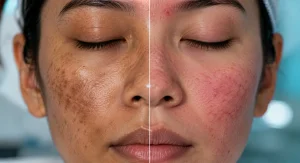
- Pigmented lesions: Lentigines (age spots), cafe-au-lait birthmarks, and sun-damage-related hyperpigmentation respond well to PiQo4 because the same wavelength precision that targets ink also targets excess melanin deposits in the skin.
- Vascular lesions: Certain superficial vascular discolorations can be addressed with appropriate wavelength selection.
- PicoFractional skin rejuvenation: Using the picosecond pulses in a fractional delivery pattern, PiQo4 stimulates collagen and elastin production through photoacoustic energy without thermal injury to the surface skin. This approach treats fine lines, skin texture irregularities, and acne scarring with minimal downtime.
- Melasma and post-inflammatory hyperpigmentation: PiQo4 is one of the more versatile options for managing pigmentation conditions that are common in our Doral patient population, where Fitzpatrick III through VI skin types are the majority.
Who Is a Good Candidate for PiQo4 at Perfect B?
PiQo4 is one of the most inclusive laser systems in terms of skin type compatibility, but a consultation is still the right starting point before any treatment. The following factors make someone a strong candidate.
- Unwanted tattoo of any color: Black, red, green, blue, purple, orange, yellow, and multicolor tattoos are all addressable with PiQo4. Patients with darker skin tones at Perfect B are treated regularly with PiQo4 calibrated for their specific Fitzpatrick type.
- Pigmented lesions or sun damage: Age spots, lentigines, and uneven tone from chronic UV exposure are good candidates for PiQo4 pigmentation protocols.
- Realistic timeline expectations: Tattoo removal with PiQo4 takes an average of 6 to 18 months depending on ink density, colors, and location. Patients who understand the process and commit to the full protocol see the best results.
- No active skin infection at treatment site: Active breakouts, cold sores, or skin conditions in the treatment zone require postponing the session.
- Not pregnant or breastfeeding: Elective laser treatments are postponed during pregnancy and the breastfeeding period.
- No history of keloid scarring at the treatment site: Patients with documented keloid response are evaluated individually before treatment approval.
What to Expect During a PiQo4 Session at Perfect B in Doral
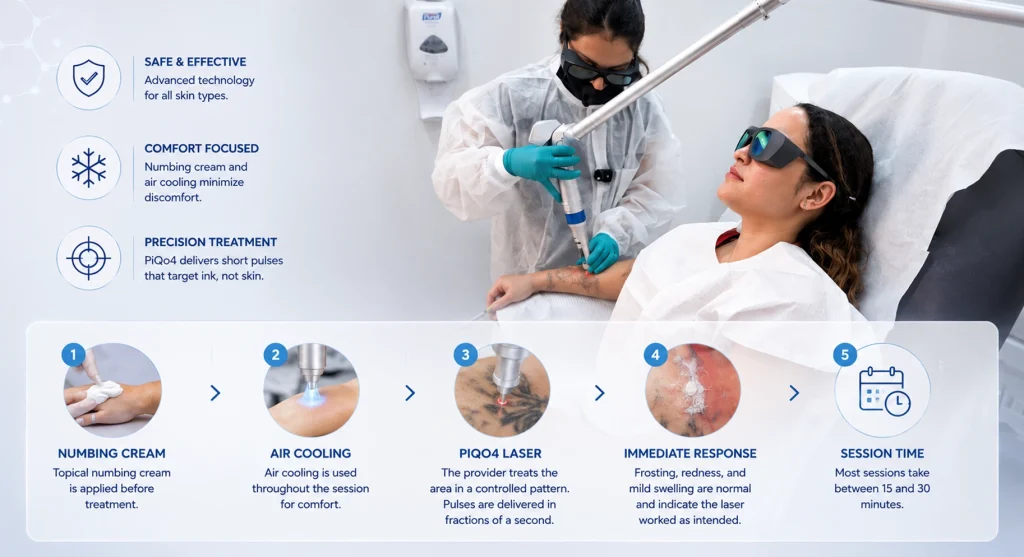
Sessions at Perfect B follow a consistent protocol designed for both effectiveness and comfort. Before the laser is applied, a topical numbing cream is placed on the treatment area and given time to take effect. Air cooling is used during the session to minimize surface discomfort and protect the surrounding skin.
The provider passes the PiQo4 handpiece over the treatment area in a controlled pattern. Each pulse delivers energy in a fraction of a second. Most patients describe the sensation as similar to a rubber band snap against the skin, which is more manageable than the original tattooing process for the majority of our patients.
Session duration depends on the size and complexity of the tattoo or the treatment area. Most tattoo removal sessions at Perfect B take between 15 and 30 minutes. Immediately after treatment, the skin may show frosting (a white reaction at the surface), redness, and mild swelling. These are expected responses and indicate the laser worked as intended. A detailed guide to what to expect at each stage of the healing process session by session covers the full recovery timeline from the first 24 hours through the weeks of lymphatic clearance that follow.
How Many PiQo4 Sessions Does Tattoo Removal Take?
The number of sessions depends on several variables: the age of the tattoo, the ink colors present, the density of the ink deposit, the location on the body, and the patient’s individual immune response and lymphatic clearance rate.
According to Lumenis data, PiQo4 achieves results in approximately 40% fewer sessions than competing laser systems. In practice at Perfect B, most single-color black tattoos require between 4 and 8 sessions. Multicolor tattoos or tattoos with high ink density may require more. Sessions are spaced a minimum of 6 to 8 weeks apart to allow the lymphatic system to fully clear the shattered ink particles before the next treatment.
Perfect B offers unlimited sessions as part of the tattoo removal treatment plan, which means patients are not billed separately per session once enrolled. The total removal timeline from first session to complete clearance typically ranges from 6 to 18 months. The complete guide to managing aftercare, pain, and recovery between sessions outlines what to do in the days following each treatment to support the best possible outcome.
PiQo4 vs Other Laser Systems: What Sets It Apart
The tattoo removal laser market includes several competing technologies. Understanding where PiQo4 fits helps patients evaluate their options before committing to a provider.
PiQo4 vs Q-switched nanosecond lasers (older technology)
Traditional Q-switched lasers operate only in nanosecond mode. They are effective at breaking down larger ink particles but less efficient at clearing the smaller fragments that remain after initial fragmentation. This is why older nanosecond-only systems typically require more sessions. PiQo4 addresses this by adding the picosecond mode for the secondary fragmentation pass in the same session.
PiQo4 vs picosecond-only systems (PicoWay, PicoSure)
PicoWay and PicoSure are widely used picosecond-only laser systems. PiQo4 differentiates from both through its combination of picosecond and nanosecond pulses, its four wavelengths compared to typically two on PicoWay, and its significantly larger spot size. For deeply embedded ink or high-density tattoos, the nanosecond pulse component of PiQo4 provides a capability that picosecond-only systems do not have. PiQo4 also delivers 10 times more energy at the 532nm and 1064nm wavelengths than competing systems, which is a clinically meaningful advantage for treating resistant ink and darker skin tones.
PiQo4 at Perfect B in Doral, FL
Perfect B uses PiQo4 as the core technology for tattoo removal and laser skin treatments in Doral. Our patient population in South Florida includes a high proportion of Fitzpatrick III through VI skin tones, which is exactly the patient group that benefits most from PiQo4’s higher energy output, larger spot size, and precise wavelength control.
Every PiQo4 treatment at Perfect B begins with a consultation where we assess the tattoo or skin concern, evaluate skin type, and discuss the expected number of sessions and timeline. Treatments are performed by licensed providers trained in laser operation. We do not delegate laser treatments to non-medical staff.
For patients considering tattoo removal, our complete laser tattoo removal treatment plan at Perfect B outlines the full process including unlimited sessions, timeline, and what to expect from consultation through final clearance.
Frequently Asked Questions About PiQo4 Laser
1. What is the difference between PiQo4 and other tattoo removal lasers?
PiQo4 is the only laser in its class that combines both picosecond and nanosecond pulse modes with four wavelengths and a spot size of up to 15mm. This combination allows it to treat the widest range of ink colors on the widest range of skin types, with 40% fewer sessions than competing systems according to Lumenis clinical data. Most other systems use either nanosecond or picosecond technology alone, and typically offer two wavelengths rather than four.
2. How many sessions does PiQo4 take to remove a tattoo?
Most single-color black tattoos require between 4 and 8 sessions. Multicolor tattoos or densely saturated designs may require more. Sessions are spaced 6 to 8 weeks apart. The full removal timeline at Perfect B typically ranges from 6 to 18 months. Perfect B’s treatment plan includes unlimited sessions so patients are not billed per session once enrolled.
3. Does PiQo4 work on colored tattoos?
Yes. PiQo4’s four wavelengths address 9 of the most common tattoo ink colors including black, red, orange, yellow, green, blue, purple, pink, and sky blue. This makes it one of the most complete systems for treating multicolor tattoos, including colors that single-wavelength or two-wavelength systems cannot fully address.
4. Is PiQo4 safe for dark skin?
Yes. PiQo4 is designed for use across all Fitzpatrick skin types, including III through VI. The 1064nm wavelength penetrates deeply while minimizing interaction with surface melanin, and the larger spot size allows lower fluence settings that reduce the risk of post-inflammatory hyperpigmentation. At Perfect B in Doral, the majority of our tattoo removal patients are Fitzpatrick III through V and are treated safely and effectively with PiQo4.
5. What does PiQo4 feel like during treatment?
Most patients describe the sensation as a quick rubber band snap against the skin. Topical numbing cream is applied before each session and air cooling is used throughout. The discomfort is generally described as more manageable than the original tattooing process. Session duration is short, typically 15 to 30 minutes, which also helps with tolerance.
6. How long does a PiQo4 session take?
Most sessions at Perfect B take between 15 and 30 minutes depending on the size and complexity of the treatment area. The PiQo4’s 15mm maximum spot size allows faster coverage than smaller-spot systems, which contributes to shorter session times for larger tattoos.
7. Can PiQo4 treat pigmentation and sun damage, not just tattoos?
Yes. PiQo4 is FDA-cleared for pigmented lesions including lentigines (age spots), cafe-au-lait marks, and sun-damage-related hyperpigmentation. It also performs PicoFractional treatments for skin rejuvenation, targeting fine lines, texture irregularities, and acne scarring through collagen stimulation without thermal surface damage.
8. How is PiQo4 different from PicoWay or PicoSure?
PiQo4 differs from PicoWay and PicoSure primarily in three ways: it combines picosecond and nanosecond pulses (the others use picosecond only), it offers four wavelengths compared to typically two, and it delivers up to 15mm spot size compared to smaller alternatives. PiQo4 also outputs 10 times more energy at the 532nm and 1064nm wavelengths than the closest competing systems, according to Lumenis specifications.
Closing: Why Technology Choice Matters for Tattoo Removal
The laser a clinic uses determines what it can treat, how many sessions it takes, and how safely it can work across different skin types. PiQo4 is one of the most technically capable systems in its category because of its dual pulse design, four wavelength coverage, and energy output advantage. These are not marketing claims but measurable specifications documented by Lumenis and reflected in the clinical outcomes our patients see at Perfect B in Doral.
If you are evaluating laser options or preparing for a consultation, the right questions to ask any provider are: what laser do you use, how many wavelengths does it have, and does it combine picosecond and nanosecond technology? The answers tell you more about expected outcomes than any before-and-after photo alone.
📍 Perfect B | 8200 NW 41st St, Suite 100, Doral, FL 33166
📞 (786) 502-2260