
Perfect B, Doral Fl. | 06.03.26 | 9 min read.
This content is for educational purposes only and does not constitute medical advice. Consult a licensed provider before beginning any laser treatment. Results vary by patient and tattoo characteristics.
Why the Cover-Up vs. Laser Removal Decision Is More Complex Than It Looks
Most people facing tattoo regret assume there are two options: find a talented artist to cover it up with something new, or go through laser removal sessions until the skin is clear. The reality is that the decision depends on four or five specific variables about your tattoo, your skin, and your goals, and the wrong choice can mean spending more time, more money, and ending up with a result you did not want. A cover-up over dense black ink without any preparation can leave you with a design locked into solid black patterns. Full removal when two sessions of fading would have been enough adds months and cost to a process that did not require them.
At Perfect B in Doral, FL, we see patients across the full range of this decision. Some come in for full removal, some for the three to four sessions needed to lighten a piece before their tattoo artist can do something creative with it, and some come in for a consultation that ends with us telling them honestly that their tattoo is a straightforward cover-up candidate and they do not need laser at all. That honest assessment is what this guide is built on.
Key Takeaways
- Cover-ups work without laser when the existing tattoo is lightly saturated, faded, or small enough that a darker design can realistically contain it.
- Dense black ink, solid fills, and tribal designs cannot be covered by most artists without partial laser fading first, because covering dark ink requires even darker ink on top, which limits design options severely.
- Full laser removal is the right path when you want clean skin, plan no future tattoo in that area, or the placement makes a cover-up impractical (hands, neck, visible forearm).
- Partial fading, typically 2 to 4 sessions, is a third path that preserves your option for a cover-up while giving your artist a significantly better canvas, specifically for dense, dark, or multicolor pieces.
- Skin tone affects the plan. Fitzpatrick III-VI patients in South Florida require adjusted laser settings and longer spacing between sessions, which affects fading timelines before cover-up work can begin.
The Three Paths Out of Tattoo Regret
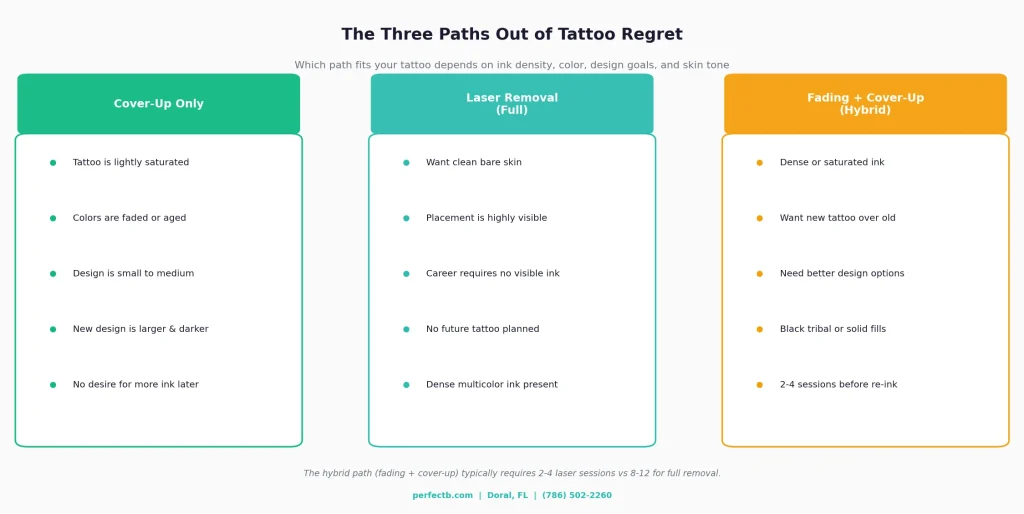
The framing of “cover-up or removal” misses the option that is often the smartest choice. There are three paths, and which one applies to you depends entirely on what your tattoo looks like and what your goal is for the skin afterward.
- Path 1: Cover-up without laser. The tattoo is lightly saturated, aged and faded, or small enough that an experienced artist can work with the existing ink. No laser sessions required.
- Path 2: Full laser removal. The tattoo is coming off entirely. The goal is clean skin, no future tattoo over the area, or the design and placement make a cover-up impractical.
- Path 3: Partial fading, then cover-up. The tattoo has density or coverage problems that would lock a cover-up into a very dark, large design. A short series of 2 to 4 laser sessions lightens the ink enough that the cover-up artist has real design flexibility.
When a Cover-Up Works Without Any Laser At All
A cover-up is viable without laser when the artist has enough to work with. The conditions that make a straight cover-up achievable are specific and worth knowing before you book anything.
- The tattoo is old and significantly faded. Older tattoos that have lost saturation over the years are far easier to work over than fresh, dark pieces. The ink has already begun to diffuse and lighten naturally.
- The design is small or has light coverage. A small line tattoo, a name in thin script, or a simple symbol with minimal solid fill can be covered by the right design without needing laser preparation.
- The cover-up design can be substantially larger. Every cover-up is bigger than the original. If the patient is willing to go larger and darker in the design, the original piece has more room to disappear underneath.
- The placement allows a bold new design. Arms, thighs, and backs give artists more design space than fingers, wrists, or the front of the forearm.
- The patient wants more ink anyway. If the goal is always to have something on that area of skin, a well-executed cover-up is often faster and less expensive than removal.
The honest answer for whether a cover-up is viable without laser is that this is a decision best made by the cover-up artist looking at the actual tattoo in person. Artists know what they can and cannot execute over existing ink, and the best ones will tell you directly when laser prep would improve what they can offer.
When the Cover-Up Fails and Why It Happens
The failure mode for cover-ups over unprepared dense ink is predictable and well-documented in the laser removal community. Patients arrive at laser clinics with a cover-up tattoo they now want removed, and the new piece is significantly larger and darker than the original. This is the most expensive outcome: two tattoos to remove instead of one.
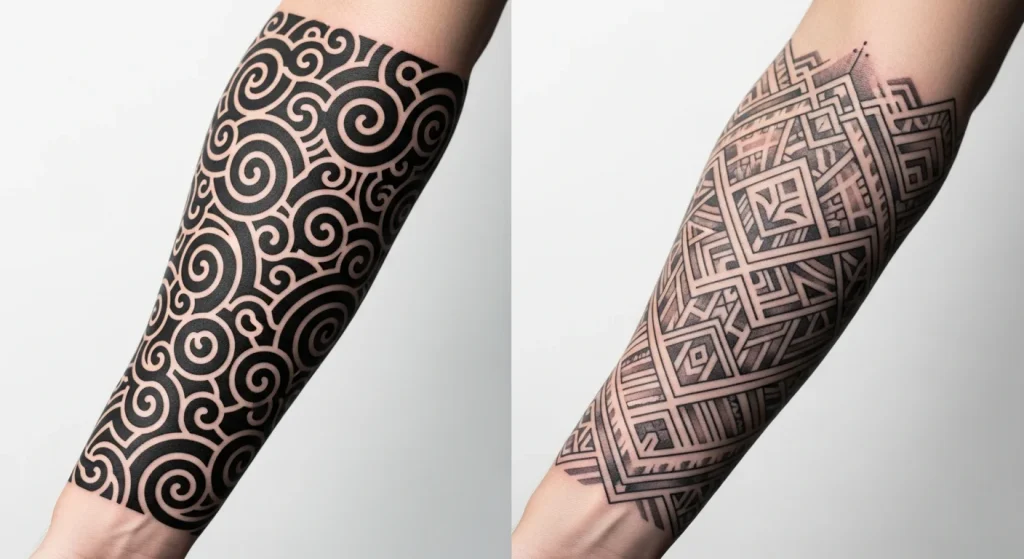
The core problem is physics. Tattoo ink absorbs light. Darker ink absorbs more light. When you place new ink over existing dark ink, the colors underneath pull through any lighter pigment applied on top. To prevent that, artists use darker pigments in the new design, which means the cover-up almost always ends up as a large, dark, heavy piece. The original tattoo is hidden, but the patient often ends up with something they find just as limiting.
Dense black tribal designs, solid fills, and heavily saturated pieces are the most common cases where cover-ups fail without preparation. An experienced laser provider can tell you in the first consultation whether your tattoo is in this category. If it is, the choice is not really cover-up vs removal. It is: cover-up with severe design limitations, or cover-up after 2 to 4 sessions of targeted fading.
When Laser Removal Is the Right Choice
Laser removal is the correct path when the goal is skin that does not have a tattoo on it. The following are the clinical indicators that point toward a full removal plan over a cover-up, regardless of how feasible a cover-up might technically be.
- You want clean skin. If the goal is no ink at all in that area, there is no version of a cover-up that achieves that.
- The tattoo placement is on a high-visibility, career-sensitive area. Hands, neck, face, and forearms in client-facing professional environments are common reasons patients choose removal over re-inking the area.
- The tattoo has been covered up once already. Multiple cover-up layers mean the ink density is extremely high. The design options for another cover-up narrow dramatically with each pass.
- You have no desire for any tattoo in that location going forward. Partial fading is only worth the time and cost if a cover-up follows. If future tattooing is not the plan, full removal makes more clinical sense.
- The multicolor ink includes colors resistant to cover-up. Specific pigments, particularly yellows, oranges, and certain greens, do not cover cleanly under any design. These colors are also harder to remove with laser, which affects the full removal timeline.
→ See your personalized session estimate and upfront price for laser tattoo removal at Perfect B.
The Ink and Design Factors That Determine Your Options
The decision framework for tattoo removal vs cover up is most precisely described at the ink level. Two peer-reviewed resources help frame this: a clinical update on laser tattoo removal in the Journal of Clinical and Aesthetic Dermatology covering the relationship between pigment depth, color, and laser response, and research on nano-picosecond laser systems and their efficacy on multicolor tattoos including the role of wavelength selection in targeting specific pigments. The practical summary for patients follows.
Black and Dark Blue Ink
Black ink is the easiest to remove with laser and the most straightforward to fade before a cover-up. It absorbs the 1064nm wavelength efficiently. Lightly saturated black designs (grey wash, sketch-style) are strong candidates for cover-ups or a short fading protocol. Heavily saturated solid black pieces require more sessions before a cover-up artist has real options.
Red and Warm-Toned Ink
Red ink responds well to the 532nm wavelength. However, some red pigments contain mercury, and a small percentage of patients have allergic reactions to the ink that affect how treatment proceeds. A patch test is standard at our clinic for any red ink removal plan.
Green, Blue, and Purple Ink
These colors are the most resistant to removal in the laser world. Older single-wavelength devices struggle with green and blue significantly. The PiQo4 at Perfect B addresses this with dedicated 585nm and 650nm wavelengths targeting these specific pigments, which is one of the reasons it performs better than two-wavelength devices on multicolor pieces being prepared for a cover-up. Even with the right wavelengths, light-toned greens and blues may not achieve full clearance in all cases.
Yellow and White Ink
Yellow and white inks behave unpredictably under laser energy. They can darken or shift color before clearing, which is the same paradoxical darkening phenomenon seen in iron-oxide permanent makeup pigments. For tattoos with significant yellow or white, the cover-up fading strategy needs to be planned carefully to avoid creating a darkened area that is harder to work over. Our guide on how each ink color responds to laser treatment at Perfect B in Doral covers the full color breakdown in detail.
What Skin Tone Means for Your Decision in South Florida
South Florida has one of the highest concentrations of Fitzpatrick III-VI patients in the United States. This matters for both laser removal and for the cover-up fading path specifically. Melanin in darker skin tones competes with ink pigment for laser energy absorption, which requires lower fluence settings and longer spacing between sessions. That affects timelines.
For a patient on Path 3 (fading before cover-up), a Fitzpatrick IV or V patient may need 5 or 6 sessions to achieve the same level of fading that a Fitzpatrick II patient achieves in 3. This does not change the recommendation, but it changes the timeline conversation that needs to happen at the consultation. Year-round UV exposure in Miami also means sun protection between sessions is a clinical requirement, not a suggestion, because laser-treated skin has elevated hyperpigmentation risk when exposed to UV before it has fully recovered. This is especially relevant for the lighter areas being created during the fading process.
How Partial Fading Before a Cover-Up Expands Your Design Options
The hybrid path, laser sessions targeted specifically at fading rather than full removal, is the option that creates the most flexibility for the patient and the most creative room for the cover-up artist. It is different from a full removal plan in both goals and structure.
- The target is density reduction, not clearance. The artist decides how much lightening is needed based on the proposed design, not a fixed standard.
- Typically 2 to 4 sessions instead of 8 to 12, which means significantly shorter timelines and lower cost.
- Black and dark blue ink, the most common problem colors for cover-ups, are also the easiest to fade, so the fading protocol tends to be efficient even on dense pieces.
- Once the ink is lightened to the right threshold, the patient moves to the tattoo artist phase. The laser work stops.
The specific session count for fading before a cover-up, how the treatment parameters differ from a full removal plan, and what the timeline typically looks like are covered in depth in our guide to how many sessions tattoo removal actually takes, including the dedicated section on fading for cover-up preparation and what a real fading plan looks like from the first consultation through the handoff to a tattoo artist. That post has the clinical detail on session spacing and fading progression that this one summarizes.
What a Good Candidate for Each Path Looks Like From a Laser Clinic
The consultation at a laser clinic is where the path decision becomes concrete. This is what each candidate profile looks like from the provider side.
Good Cover-Up Only Candidate
The tattoo is visibly faded with significant loss of saturation over the years. Line work is blurred and soft. There is minimal solid fill. The patient has a clear idea of what they want to cover it with and has already spoken with a tattoo artist who has confirmed a cover-up is feasible without prep. In this case, our assessment confirms it and the patient goes directly to the artist.
Good Fading-Before-Cover-Up Candidate
The tattoo has dense black fill, solid color sections, or coverage that would lock the cover-up into a large dark design. The patient has a specific new piece in mind and has either spoken with a tattoo artist or comes in wanting to know how many sessions it would take to give that artist a better canvas. This is the most common case we see for this path.
Good Full Removal Candidate
The patient wants skin without a tattoo. They are not planning another piece in the area, the placement is career-sensitive, or the tattoo has a complex ink history with multiple prior cover-ups already layered in. Full removal plans are built around complete clearance, and the consultation focuses on realistic timeline, session count, and what to expect at each stage.
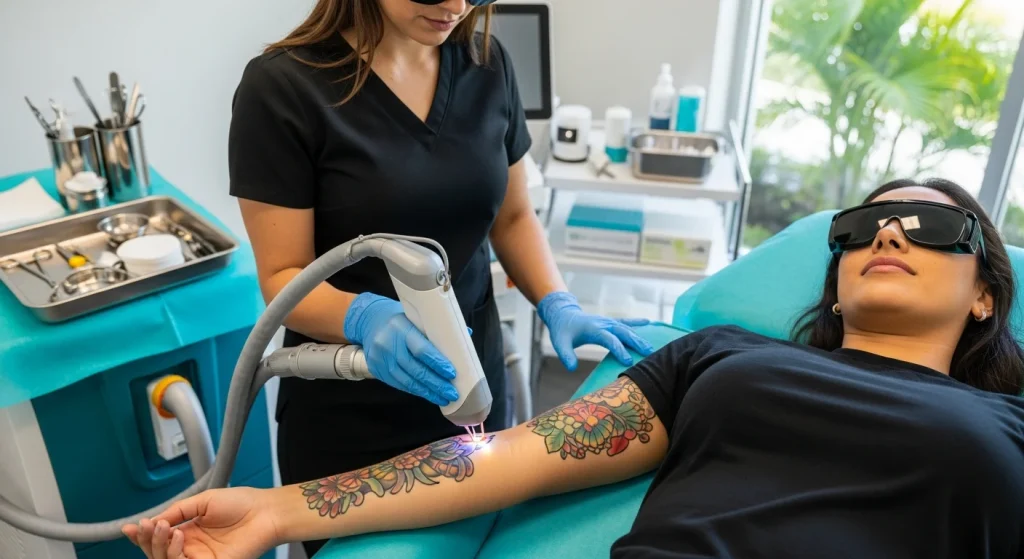
The difference between a good outcome and a poor one, whether for removal or for fading before a cover-up, is almost always the quality of the clinical assessment at the start. The technology matters, and the PiQo4 laser at Perfect B with its four wavelengths and combined picosecond and nanosecond pulse modes is significantly more capable than older single-wavelength devices for multicolor cases and selective fading. But the laser is only as useful as the treatment plan behind it.
Frequently Asked Questions
1. Is it better to get a cover-up or remove a tattoo?
There is no universal answer. The right choice depends on the tattoo’s ink density, color, age, placement, and your goals for the skin afterward. A lightly saturated, faded tattoo may be a strong cover-up candidate without any laser. A dense, heavily saturated piece, particularly a solid black tribal or a design that has already been covered up once, typically needs partial laser fading before a cover-up gives the artist real design options. If you want clean skin with no future tattoo in that area, removal is the only path that achieves that.
2. How many laser sessions do I need before a cover-up?
Most cover-up fading protocols require 2 to 4 sessions, compared to 8 to 12 sessions for complete removal. The exact number depends on the ink density and colors in your tattoo and how much lightening your tattoo artist needs to work with. The session plan for fading is set in collaboration with your artist, not based on a fixed clearance target. For a detailed breakdown of the session structure and what fading progress looks like over time, our full guide on how many sessions tattoo removal takes covers the cover-up fading path specifically.
3. Can you cover a black tattoo without laser removal first?
Sometimes, yes. Lightly saturated black designs, aged grey wash pieces, and small black tattoos are often cover-up viable without laser preparation. Heavily saturated black tattoos, solid fills, tribal designs, and pieces with dense blackwork are significantly harder to cover without laser prep because covering dark ink requires darker ink on top, which locks the new design into large, dark patterns. An experienced tattoo artist will tell you directly whether your piece needs fading before they can execute the design you want.
4. What happens if a cover-up tattoo fails?
A failed cover-up, where the original tattoo shows through or the new design is not what the patient wanted, typically ends up requiring laser removal of both the original piece and the cover-up layer. This is the most expensive outcome because the combined ink density of two tattoos is significantly higher than either one alone. The most common preventable failure is attempting a cover-up over dense black ink without any laser fading, which leaves the artist with so few options that the result disappoints the patient. Addressing the ink density before the cover-up session is the best way to avoid this.
5. Does PiQo4 work better for tattoos being faded for cover-up?
For multicolor tattoos being prepared for a cover-up, the PiQo4 has a real advantage because of its four wavelengths: 1064nm for black and dark blue ink, 532nm for red and orange, 585nm and 650nm for the green and blue shades most resistant to removal. Single or dual wavelength devices have to work around colors they cannot effectively target, which slows the fading process and can leave uneven clearance. The four-wavelength architecture means the fading protocol can address the full color range in the same session, which is particularly relevant when the artist needs specific zones lightened more than others.
6. How long do I need to wait between laser sessions before getting a cover-up tattoo?
Between sessions, you need to allow at least 6 to 8 weeks for the lymphatic system to clear the fragmented ink before the next treatment. Once your laser provider and your tattoo artist agree the fading has reached the right threshold, you need to wait a minimum of 4 to 6 weeks after the final laser session before the skin has recovered enough for tattooing. The combined timeline from first laser session to cover-up tattoo appointment is typically 3 to 8 months depending on how many fading sessions are needed and your skin’s healing rate.
Closing: The Clinical Case for Making an Informed Decision Before You Ink or Remove
The question of tattoo removal vs cover up looks simple on the surface, but the answer is specific to your tattoo and your goals. The tattoos that end up costing patients the most time and money are almost always the ones where the decision was made without understanding the ink density problem, the color resistance issue, or the option of a short fading protocol that would have given the cover-up artist something real to work with.
At Perfect B in Doral, FL, a consultation on this question starts with looking at the tattoo, not at a pricing sheet. The clinical assessment tells us which path actually fits your situation, and we build the plan from there, whether that means a full removal protocol, a two-session fading series before you go to your artist, or telling you honestly that your tattoo is a strong cover-up candidate and you do not need us at all.
- 📍 Visit us at Perfect B, Doral FL, serving Miami and South Florida patients for laser tattoo removal, cover-up fading sessions, and clinical tattoo consultations.
- 📞 Call (786) 502-2260 or message us to schedule your tattoo removal vs cover-up consultation with a licensed medical provider.