
Perfect B, Doral FL. | 05.12.26 | 8 min read.
This post is for educational purposes only and does not substitute for a clinical consultation. The number of sessions required for laser tattoo removal varies significantly by individual factors. Consult a licensed provider for a personalized assessment.
Why There Is No Universal Answer, and What Determines Yours
The most common question we hear at the laser tattoo removal consultation at Perfect B is also the one with the most unsatisfying honest answer: it depends. Most tattoos require between 6 and 12 sessions for complete removal, spaced 6 to 12 weeks apart, but that range covers scenarios as different as a small amateur symbol and a full-sleeve professional design. Giving a specific number without examining the tattoo, the skin, and the patient’s goals is a sales pitch, not a clinical answer. What we can give you is the framework that clinicians actually use, and the South Florida-specific factors that most guides skip entirely.
Key Takeaways
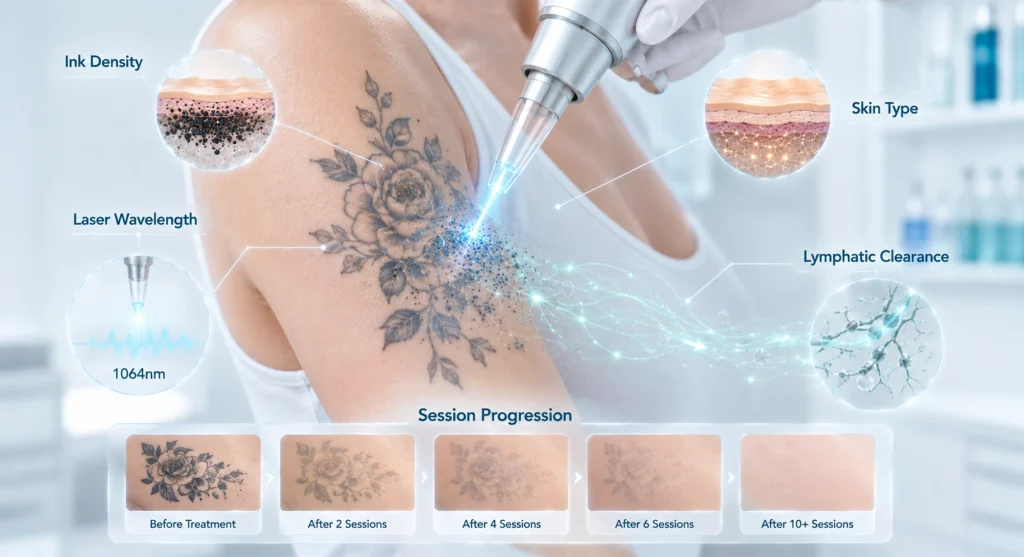
- Most tattoos require 6 to 12 sessions for complete removal, but amateur tattoos with black ink on lighter skin can clear in 3 to 6, while large professional multi-color pieces may need 15 to 20 or more.
- The Kirby-Desai scale scores six factors, skin type, location, ink color, density, scarring, and layering, to predict your session range before treatment begins. This is the clinical tool providers use, not a simple average.
- Ink color is the variable that changes the range most. Black ink responds to all laser wavelengths. Green, teal, and light blue are the hardest to remove and require significantly more sessions than any other color.
- Rushing between sessions reduces effectiveness. Your immune system clears the shattered ink particles through the lymphatic system. More time between sessions means more clearing, and better results per session.
- Miami patients often need longer timelines because year-round sun exposure and the prevalence of Fitzpatrick IV-VI skin types in South Florida require lower fluence settings and longer spacing between treatments.
The Kirby-Desai Scale: The Clinical Tool That Predicts Your Session Count
The Kirby-Desai scale is a scoring system developed specifically to estimate the number of laser tattoo removal sessions a patient will need before treatment begins. It assigns a numeric score across six variables, and the total predicts the likely session range. Most guides list “factors that affect removal” without explaining how those factors are actually weighted clinically. The Kirby-Desai scale is why a well-trained provider can give you a realistic estimate at the first consultation rather than a vague range.
The 6 scored factors
- Fitzpatrick skin type: Lighter skin types (I-III) score lower and require fewer sessions. Darker skin types (IV-VI) require lower laser fluence per session to avoid hyperpigmentation, which means less ink cleared per treatment and more sessions overall.
- Location on the body: Areas with high blood flow and active lymphatic drainage, neck, chest, upper back, respond faster. Extremities like ankles, fingers, and feet have poor circulation and need more sessions for the same result.
- Ink color: Black and dark blue score lowest and respond fastest. Yellow, green, and teal score highest and are the most resistant. Each color requires a specific laser wavelength, and some colors resist all currently available wavelengths.
- Ink density and layering: Professional tattoos place ink more densely and deeply than amateur work. Layered tattoos, a new design placed over an older one, carry double or triple the ink load and score significantly higher.
- Presence of scarring: Scarred tattoo tissue scatters laser energy and reduces penetration depth. Tattoos with raised or textured areas require more sessions and produce less complete results.
- Tattoo age: Older tattoos (5+ years) have undergone natural fading and some ink migration toward the surface, making them more responsive. Fresh tattoos with dense, untouched ink score higher.
What your total score means
A low Kirby-Desai score (around 3-4) corresponds to an estimated 1 to 4 sessions, the simplest scenario. A score in the 7-10 range corresponds to 6 to 10 sessions. Scores above 14 indicate 10 or more sessions will likely be required, and some tattoos in this category may not achieve complete clearance. At Perfect B, we use this scoring framework at every initial consultation so patients understand the realistic range before they commit to treatment.
By Ink Color: The Variable That Changes the Range Most
Ink color is the single variable that most dramatically shifts the session count, and the relationship between color and laser wavelength is the reason. Different ink pigments absorb different wavelengths of light. The laser has to emit the right wavelength to be absorbed by the ink and converted to heat that shatters the particles. Black ink absorbs virtually all visible wavelengths, which is why it responds to every laser type. Other colors are selective, and some have no ideal match in current clinical laser technology. A clinical review in the Journal of Clinical and Aesthetic Dermatology examining Q-switched and picosecond laser parameters for tattoo removal, confirming that ink color is the primary determinant of treatment response and wavelength selection across all tattoo removal protocols provides the scientific foundation for how color guides clinical decisions.
Black and dark blue: 5 to 8 sessions typical
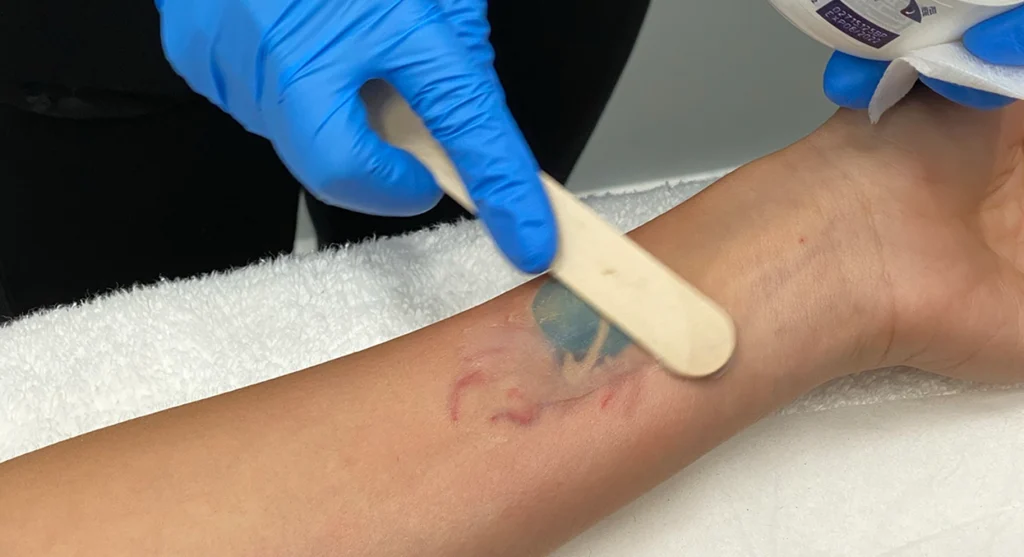
Black ink is the easiest to remove. It absorbs the 1064nm Nd:YAG wavelength efficiently, which is available on virtually every clinical laser platform. For a professional black tattoo on Fitzpatrick I-III skin in a well-vascularized location, 6 to 8 sessions is a realistic complete removal target. Amateur black tattoos on the same profile often clear in 3 to 6. Dark navy and dark grey behave similarly to black and fall in the same range.
Red, orange, and yellow: 8 to 12 sessions
Red ink responds best to the 532nm wavelength. It clears reasonably well but requires more sessions than black because the energy absorption is less complete. Orange fades more slowly than red. Yellow is among the most resistant colors in the visible spectrum because it absorbs green laser wavelengths poorly and reflects most light energy. Yellow elements in a tattoo often require additional sessions beyond the rest of the design.
Green, teal, and light blue: 10 to 15 or more sessions
Green and teal are clinically the hardest tattoo colors to remove. They require the 694nm ruby laser wavelength for best response, which is less commonly available in standard med spa settings. Where the 694nm is not available, green and teal respond only partially to the 755nm alexandrite wavelength and minimally to the 1064nm Nd:YAG. Light blue behaves similarly. Patients with tattoos that include significant green or teal elements should expect more sessions and should verify the laser platform available at their clinic before starting treatment.
Amateur vs Professional Tattoos: Why the Numbers Are Very Different
The distinction between amateur and professional tattoos is one of the most clinically significant variables in the Kirby-Desai score. Amateur or homemade tattoos, applied with a sewing needle, tattoo gun purchased online, or by someone without formal training, deposit ink at inconsistent depths and densities. The ink tends to sit in the upper dermis layers, close to the surface, which makes laser penetration more effective and clearance faster. These tattoos typically require 3 to 7 sessions for complete removal.
Professional tattoos are placed at a consistent depth in the mid-dermis with high ink density. The needle passes are precise and the ink load is significantly greater per square centimeter. A professional tattoo with dense black shading is structurally very different from a hand-poked design, even if they look similar on the surface. This depth and density means more laser energy is required to reach and shatter all particles, and more sessions are needed for the lymphatic system to clear the resulting volume. Professional tattoos typically require 8 to 15 sessions, and complex full-color pieces may require 15 to 20 or more. → See Perfect B’s full guide to how laser tattoo removal works at the cellular level, including how Q-switched and picosecond lasers target ink particles differently and what that means for your treatment plan.
How Long to Wait Between Sessions, and Why More Time Often Means Better Results
The lymphatic clearing mechanism
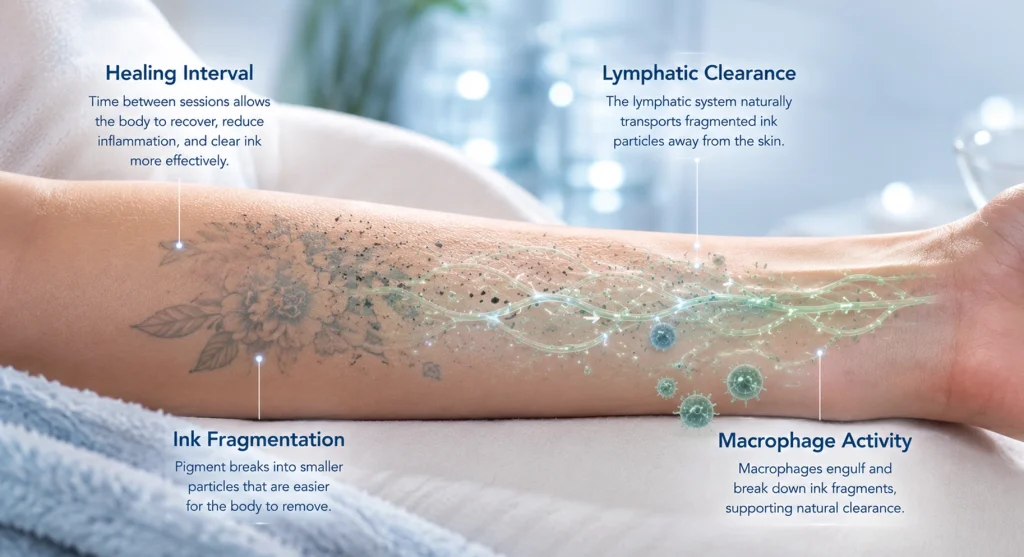
Understanding why session spacing matters requires understanding what actually happens after each laser treatment. The laser does not remove ink, it shatters ink particles into fragments small enough for your immune system to process. Once fragmented, those particles are carried away by macrophages through the lymphatic system and eventually eliminated. This process takes weeks. If you return for a second session before the lymphatic system has cleared a significant portion of the previous session’s fragmented ink, the laser is working against a still-dense field, reducing its effectiveness. You are essentially re-treating ink that has already been disrupted but not yet cleared.
Why 8 to 12 weeks often outperforms 6
The standard recommendation of 6 to 8 weeks between sessions reflects the minimum needed for safe re-treatment, not the optimal window for maximum clearance. Studies and clinical experience consistently show that patients who wait 10 to 12 weeks between sessions see better fade per session than those who return at 6 weeks. The additional healing time allows more complete lymphatic clearing, so each subsequent laser pass is working against a lighter ink load. Rushing sessions to finish faster is counterproductive. Research published in the Archives of Dermatology documenting that extended intervals between laser tattoo removal sessions produce significantly greater ink clearance per treatment compared to the minimum 6-week spacing, supporting the clinical recommendation for longer waiting periods particularly in later sessions supports this recommendation directly.
The Fitzpatrick Scale and South Florida Patients: Why Miami Timelines Run Longer
This is the section that most online guides skip, and it is the one most directly relevant to patients in the Miami area. South Florida has one of the most diverse Fitzpatrick skin type distributions of any major US market, with a large proportion of patients presenting with Fitzpatrick IV, V, and VI skin types, common among Hispanic, Caribbean, and Afro-Latino populations. Managing tattoo removal on darker skin requires a fundamentally different approach than the protocols described in most general guides, which are written primarily for Fitzpatrick I-III skin.
Lower fluence settings mean more sessions
Darker skin types contain more melanin, which competes with tattoo ink for laser energy absorption. If fluence, the energy delivered per pulse, is set too high on darker skin, the melanin absorbs excess energy and the result is post-inflammatory hyperpigmentation (PIH), meaning the treated area darkens rather than clears. To avoid this, laser parameters must be adjusted to lower fluence settings and longer pulse durations. The clinical tradeoff is that lower fluence clears less ink per session. This is not a problem with the laser or the clinic, it is the physics of how melanin and ink interact with light energy. It simply means that darker-skinned patients require more sessions than lighter-skinned patients with identical tattoos, and this should be communicated clearly at the consultation.
Year-round sun exposure extends spacing
A second Miami-specific factor is the climate. Laser tattoo removal should not be performed on recently tanned or sun-exposed skin. The increase in melanin from UV exposure raises the risk of hyperpigmentation and reduces treatment safety on the target area. In a northern market, this is primarily a summer concern. In South Florida, it is a year-round reality. Patients who spend significant time outdoors, a common profile in the Miami area, often need to extend the spacing between sessions beyond the standard 6 to 8 weeks to allow sun-exposed skin to return to baseline. For active outdoor patients, 10 to 12 weeks between sessions is frequently the realistic interval. At Perfect B in Doral, we build this into the timeline projection at the first consultation so patients are not surprised when their total removal timeline extends beyond what a generic guide suggested. → See Perfect B’s complete aftercare guide for laser tattoo removal, including sun protection protocols specific to South Florida patients and what to do between sessions to maximize fading.
Fading for a Cover-Up vs Complete Removal: Two Goals, Two Different Plans
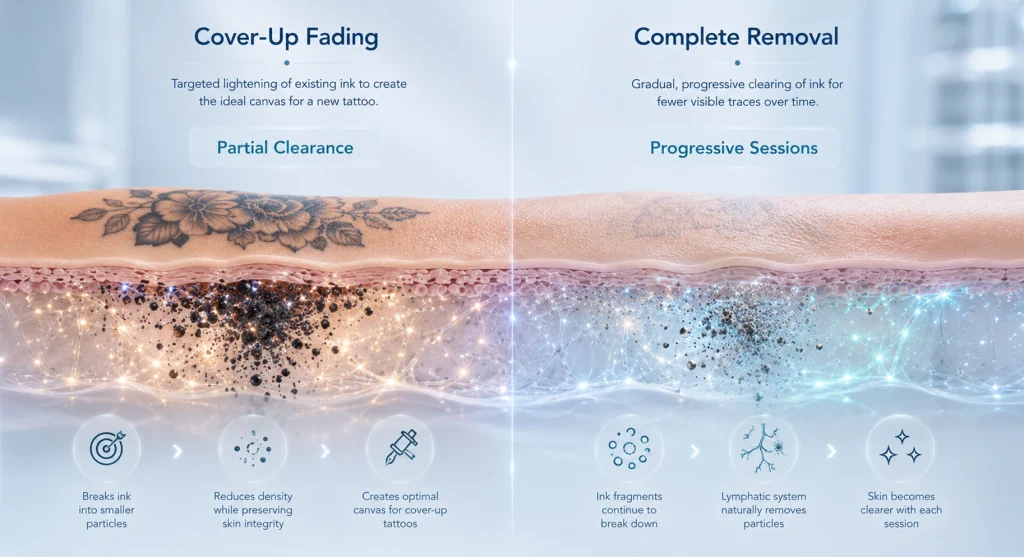
Not every patient wants complete removal. A significant portion of patients at our Doral clinic come in with a specific goal: fading an existing tattoo enough that a cover-up design becomes possible. This is a fundamentally different objective, and it changes the entire treatment plan. For cover-up preparation, the target is not clearance, it is reducing ink density and contrast enough for a tattoo artist to work over the area. That typically requires 2 to 5 sessions rather than 6 to 15. Communicating this distinction at the first consultation is essential. A patient planning a cover-up does not need to be managed on a complete removal protocol, and treating it as such wastes sessions and extends a timeline unnecessarily.
The practical guidance: if you are fading for a cover-up, tell your provider at the first appointment. The treatment parameters, session count target, and spacing recommendations will be different than for complete removal. You should also coordinate with your tattoo artist before starting laser treatment, because some artists prefer 3 sessions of fading while others want 5 or 6, and that difference significantly affects the plan we build with you.
What a Realistic Timeline Looks Like for Each Tattoo Type
Translating session counts into real-world time requires accounting for spacing. Using 8 weeks as the standard interval and 12 weeks as the Miami-adjusted interval, the timelines look like this:
- Amateur black ink tattoo (avg 4-5 sessions): 8 to 10 months at 8-week spacing; 12 to 15 months at 12-week spacing
- Professional black ink tattoo (avg 8-10 sessions): 14 to 18 months at 8-week spacing; 21 to 27 months at 12-week spacing
- Professional multi-color tattoo (avg 10-14 sessions): 18 to 26 months at 8-week spacing; 27 to 39 months at 12-week spacing
- Cover-up fading (avg 3-4 sessions): 6 to 8 months at 8-week spacing; 9 to 12 months at 12-week spacing
- Large sleeve with color (avg 15-20 sessions): 28 to 38 months at 8-week spacing; 3 to 5 years at 12-week spacing
These are realistic estimates, not worst-case scenarios. The timelines feel long because the biology of lymphatic clearance is slow, and it cannot be meaningfully accelerated. What can be improved is the quality of each session through proper spacing, sun protection, and following aftercare instructions consistently between appointments. → See Perfect B’s laser tattoo removal treatment plan in Doral, FL, including pricing, what to expect at your first appointment, and how we build a personalized session plan for your specific tattoo and skin type.
Frequently Asked Questions
1. How many sessions does tattoo removal take on average?
Most tattoos require 6 to 12 laser sessions for complete removal. The range reflects real variation based on ink color, skin type, tattoo age, ink density, location on the body, and whether the design has been layered over a previous tattoo. Amateur tattoos with black ink on lighter skin may clear in 3 to 6 sessions. Large professional pieces with multiple colors may require 12 to 20 or more. At Perfect B, we use the Kirby-Desai scoring system at the first consultation to give patients a realistic estimate specific to their tattoo rather than a generic average.
2. Can a tattoo be removed in 3 sessions?
Yes, in specific scenarios: amateur or homemade tattoos with black or dark ink, placed on Fitzpatrick I-III skin, in a well-vascularized body location. Under those conditions, 3 sessions can produce near-complete or complete clearance. For most professional tattoos, 3 sessions will produce noticeable fading but not complete removal. Setting an expectation of 3 sessions for a professional tattoo is misleading.
3. Why does tattoo removal take so many sessions?
The laser shatters ink particles but does not remove them. Your lymphatic system carries the fragmented particles away over several weeks. Each session can only clear a portion of the ink load, and the next session cannot proceed effectively until the lymphatic system has processed a significant portion of the previous treatment’s results. The process is iterative by biological design, not because of limitations in the laser technology.
4. What is the 1/3 rule in tattoo removal?
The 1/3 rule is a clinical guideline stating that each laser session produces roughly a one-third reduction in remaining ink density. Under this model, complete removal takes more sessions than patients intuitively expect because each pass clears proportionally less as the tattoo fades. Progress is cumulative and tends to accelerate in later sessions when the remaining ink density is lower and each session has more relative impact.
5. Why do Miami patients need longer timelines?
Two factors extend timelines for South Florida patients. First, Fitzpatrick IV-VI skin types, common among the Hispanic, Caribbean, and Afro-Latino populations in Miami, require lower laser fluence settings to avoid hyperpigmentation. Lower fluence means less ink cleared per session and more sessions needed overall. Second, year-round sun exposure in South Florida means patients frequently need to wait for sun-exposed skin to return to baseline before each treatment, extending spacing from 6-8 weeks to 10-12 weeks. At Perfect B in Doral, we project this into the timeline estimate at the initial consultation so patients have accurate expectations from the start.
6. How many sessions to remove a black ink tattoo?
Black ink is the most responsive color to laser treatment. Amateur black tattoos typically clear in 3 to 6 sessions. Professional black tattoos with dense, deep ink typically require 6 to 12 sessions. Location on the body and Fitzpatrick skin type also influence the total number. Black ink is the best-case scenario for tattoo removal regardless of other variables.
7. How many sessions to fade a tattoo for a cover-up?
Fading for a cover-up is a different goal from complete removal and typically requires 2 to 5 sessions, significantly fewer than complete clearance. The target is reducing contrast enough for a tattoo artist to place a new design, not eliminating all visible ink. We recommend coordinating with your tattoo artist before starting laser treatment, because different artists have different preferences for how much fading they need before they can begin the cover-up design. That preference directly affects your session plan.
Closing: The Honest Answer Is a Range, Not a Number
Any clinic that quotes you a specific session count before examining your tattoo and asking about your skin type, sun exposure habits, and treatment goals is giving you a marketing number, not a clinical projection. The honest answer to how many sessions tattoo removal takes is a range, derived from six scored factors, adjusted for your specific situation. At Perfect B in Doral, we score those factors at the first consultation and build a realistic timeline before you commit to treatment, because managing expectations accurately from the start is a better patient experience than optimistic projections that miss by a year.
For South Florida patients especially, the timelines require extra honesty. Sun exposure, skin tone, and the demographics of the Miami market all push timelines longer than the national averages suggest. That is not a limitation of the technology, it is the reality of treating a diverse, sun-exposed patient population with the precision those patients deserve.
📍 Visit us at Perfect B, Doral FL
📞 Call or message us at (786) 502-2260