
Perfect B, Doral Fl. | 05.18.26 | 12 min read.
This article is for educational purposes and does not replace a medical evaluation. Tattoo removal treatments require a personalized consultation with a licensed medical provider in Florida. Information based on peer-reviewed dermatology literature and clinical experience at our Doral medical aesthetic clinic.
If your tattoo has more than one color, the removal conversation is fundamentally different from removing an all-black tattoo. Black ink absorbs almost every laser wavelength. Colored inks each absorb a narrow slice of the spectrum, which means your laser, your number of sessions, and even the realistic outcome depend on the specific colors you have on your skin.
This guide explains how each color responds to laser treatment, which laser wavelengths target which pigments, the predictive scale dermatologists use to estimate your sessions, and why our Doral Florida clinical protocol adjusts for patients with Fitzpatrick III to V skin (common across Miami’s Latino and Caribbean population).
Key Takeaways on Colored Ink Tattoo Removal
- Tattoo color determines two things at once: how many sessions you need and which laser wavelength can target the ink. Not every laser works on every color.
- Black is the easiest color to remove (5 to 8 sessions). White is the hardest and can sometimes darken instead of fade due to titanium dioxide oxidation.
- Picosecond lasers with multiple wavelengths (1064 nm, 532 nm, 694 nm, 755 nm) are the current gold standard for multi-color tattoos. Older nanosecond Q-switched lasers struggle with several colors.
- Skin tone matters as much as ink color. Fitzpatrick IV to VI patients need adjusted settings to protect surrounding melanin while still fragmenting the tattoo pigment underneath.
- The Kirby-Desai Scale predicts your total session count based on six clinical factors. Your provider should use it (or a similar tool) at consultation.
How Laser Tattoo Removal Works on Color: The Wavelength Science
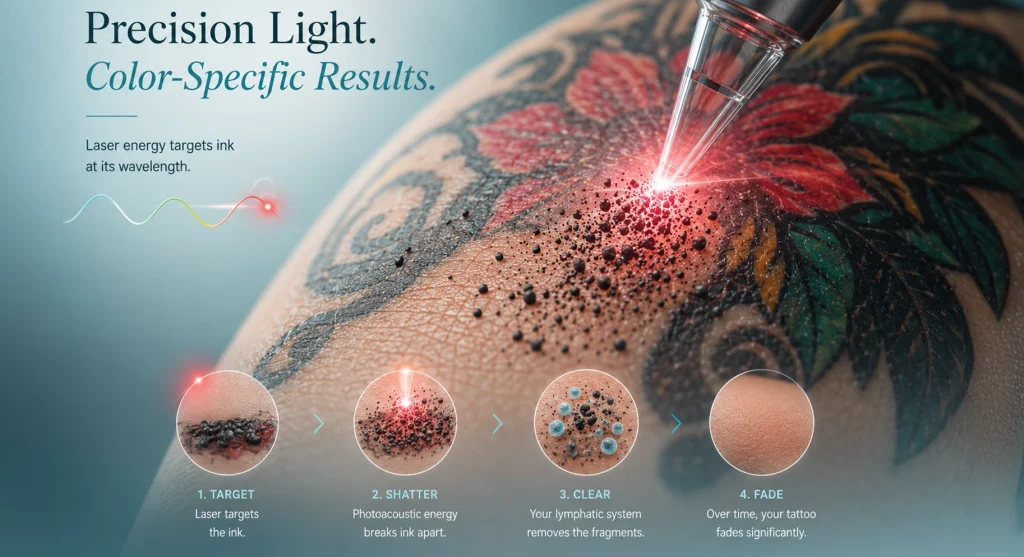
Laser tattoo removal does not erase ink. It fragments ink into particles so small that your lymphatic system can carry them away over weeks. The laser delivers an ultra-short pulse of light at a specific wavelength. When that wavelength matches the absorption spectrum of the ink pigment, the ink heats up faster than the surrounding skin can cool, generating a photoacoustic shock wave that shatters the pigment particle. Over multiple sessions, your body gradually clears the fragments.
The catch: different pigments absorb different wavelengths. Black ink is special because it absorbs the entire visible spectrum, so almost any tattoo removal laser will work on it. Colored inks are selective. Red ink absorbs green light. Green ink absorbs red light. Yellow ink reflects most of the visible spectrum, which is why it remains stubborn. White ink contains titanium dioxide, which can oxidize unpredictably under laser energy. For a deeper explanation of the underlying physics, see our complete guide, How Does Laser Tattoo Removal Work? The Science, the Technology, and What to Expect.
Modern picosecond lasers deliver pulses measured in trillionths of a second, which is roughly 100 times faster than older nanosecond Q-switched lasers, an evolution documented in peer-reviewed reviews of laser tattoo removal technology and pigment-specific wavelength selection. The shorter pulse generates more photoacoustic energy and less heat, which makes them substantially more effective at fragmenting stubborn colors with fewer sessions and less risk of thermal injury.
Tattoo Color Removal Difficulty: The Five-Tier Reality
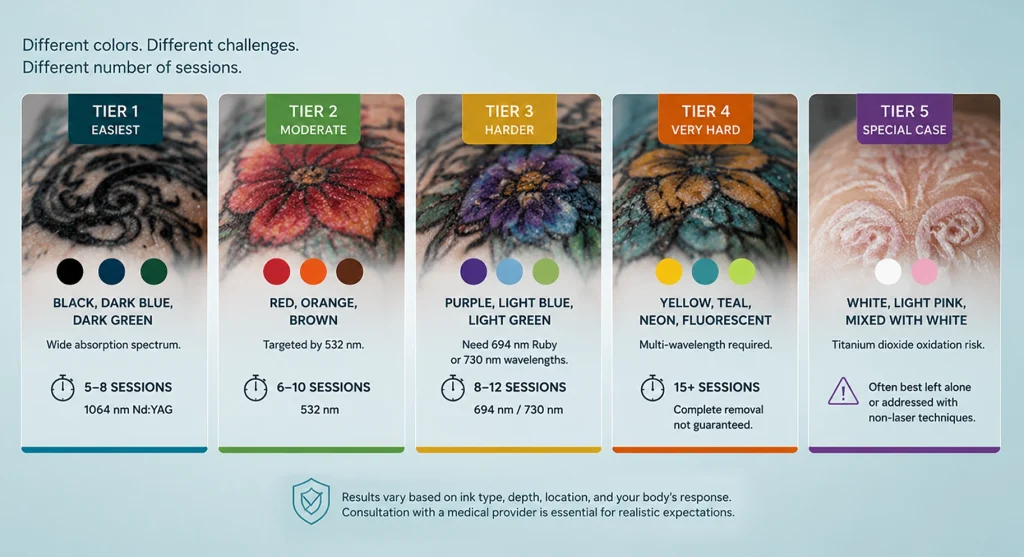
Across published dermatology literature and clinical practice, tattoo inks fall into five tiers of removal difficulty:
- Tier 1, easiest: Black, dark blue, dark green. Wide absorption spectrum. Typically 5 to 8 sessions with 1064 nm Nd:YAG.
- Tier 2, moderate: Red, orange, brown. Targeted by 532 nm. Typically 6 to 10 sessions.
- Tier 3, harder: Purple, light blue, light green. Need 694 nm Ruby or 730 nm wavelengths. Typically 8 to 12 sessions.
- Tier 4, very hard: Yellow, teal, neon, fluorescent. Multi-wavelength required. Typically 15 sessions or more, with complete removal not guaranteed.
- Tier 5, special case: White, light pink, anything mixed with white. Titanium dioxide oxidation risk. Often best left alone or addressed with non-laser techniques.
Black, Dark Blue, and Dark Green: Why These Colors Disappear Fastest
Black is the most predictable color to remove. Black ink absorbs essentially every wavelength of visible light, which means the 1064 nm Nd:YAG laser (the workhorse of tattoo removal) heats the ink very efficiently. The pigment fragments into particles small enough for macrophages to absorb and transport to lymph nodes, where they are eventually cleared. Most patients see meaningful fade after the first 2 to 3 sessions and substantial clearance by sessions 5 to 8.
Dark blue behaves similarly to black because the 1064 nm wavelength penetrates deeply and is well absorbed by the copper-phthalocyanine and indigo pigments commonly used. Dark green, despite being a “color,” is often easier than light green because the pigment density is higher and the molecular structure absorbs near-infrared wavelengths more effectively.
The number of sessions depends on more than color, of course. For a full breakdown of what drives the total count for any tattoo, see How Many Sessions Does Tattoo Removal Take? The Honest Answer, which covers the variables every patient should weigh before starting.
Red, Orange, and Brown: The Mid-Range Colors and Their Wavelength Match
Red ink is the most commonly used colored pigment in tattooing, and fortunately it responds well to laser treatment. The frequency-doubled Nd:YAG at 532 nm produces green light, which is the complementary color of red on the absorption spectrum. Red pigment particles absorb that green energy and fragment efficiently. Typical session counts run from 6 to 10, slightly more than pure black tattoos but substantially fewer than tier 3 and 4 colors.
Orange and brown sit just behind red. Orange pigment usually contains a mix of red and yellow components, so the 532 nm laser handles most of it well, with some residual yellow fragments requiring additional treatment. Brown contains a mix of black, red, and yellow, which means a multi-wavelength session protocol works best.
A clinical note worth raising before treatment: red ink is responsible for the highest rate of tattoo allergic reactions, typically due to mercury sulfide or organic azo pigments. If your red ink has caused itching, raised bumps, or persistent inflammation in the past, your provider should evaluate that history before laser treatment. Heating and fragmenting an allergenic pigment can trigger a stronger immune response.
Purple, Light Blue, and Light Green: The Harder Removals
Purple, light blue, and light green sit in the difficult middle of the difficulty curve. They are removable, but the wavelengths that target them well are less commonly equipped on standard tattoo removal lasers. Purple usually responds to a combination of 694 nm Ruby and 1064 nm Nd:YAG, since the pigment commonly contains a blue and red mix. Light blue and turquoise respond to 730 nm, while light green typically requires 755 nm Alexandrite or specialty wavelengths.
The practical implication: if your tattoo contains these colors and your provider does not have multi-wavelength capability, you will likely see partial fade rather than complete clearance. Patients in this situation often opt for fade-for-coverup, which uses fewer sessions to lighten the original tattoo enough for a new design to be placed over it.
Yellow, Teal, and Neon: The 15 Plus Session Colors
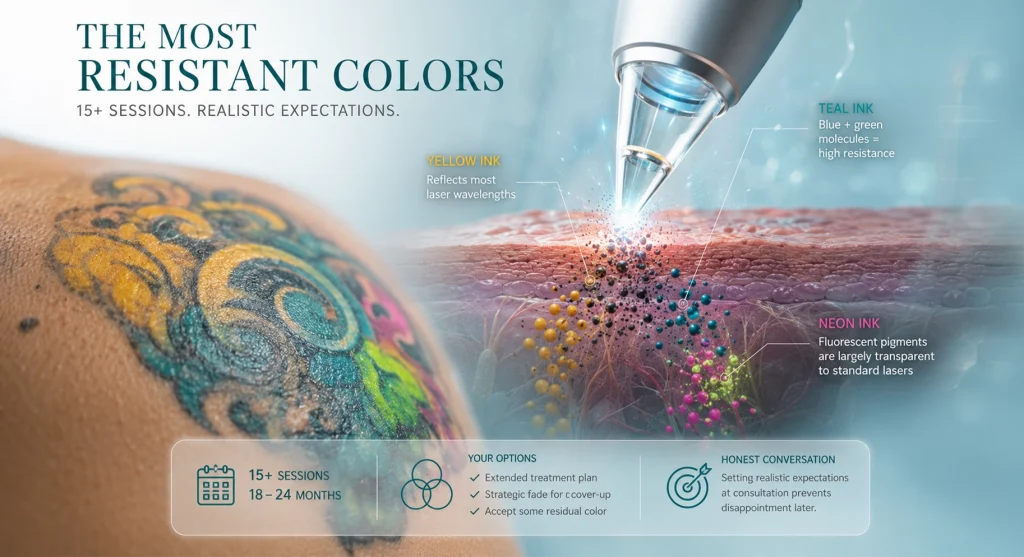
Yellow ink is one of the most resistant pigments because it reflects almost all common laser wavelengths instead of absorbing them. Some clinics use specialty 532 nm settings or experimental wavelengths to address it, but realistic session counts begin at 15 and complete removal is not always achievable. Teal pigments combine blue and green molecules, which makes them similarly resistant. Neon and fluorescent inks are designed to be highly visible under UV light, and many of them are essentially transparent to standard tattoo removal lasers.
If your tattoo contains heavy yellow, teal, or neon work, a realistic conversation with your provider should include three options: extended treatment plans (15 plus sessions across 18 to 24 months), strategic fade-for-coverup, or accepting some residual color. Setting that expectation honestly at consultation prevents disappointment later.
White, Light Pink, and the Titanium Dioxide Problem
White is the only color in tattoo removal where the standard answer is often “do not attempt it.” Most white tattoo inks contain titanium dioxide (TiO2), the same compound used in sunscreens and white paint. When laser energy interacts with titanium dioxide in skin, it can trigger a chemical reduction reaction that converts the TiO2 into a darker oxide. The visible result is a tattoo that gets darker (brown, blue-gray, or black) after the first laser session, and that darkening can be permanent or extremely difficult to reverse.
This is not a rare reaction. It is a chemistry-driven outcome that affects most white inks, as documented in peer-reviewed dermatology research on paradoxical darkening of cosmetic and white tattoo inks containing titanium dioxide. The same principle applies to anything that contains white as a base or mixer: light pink, pastel colors, faded portions of older tattoos that the original artist whited out.
Our protocol at Perfect B Doral when a patient presents with white-containing tattoos is to run a test spot first, document the reaction at 4 weeks, and recommend an alternative path (cover-up with a new design, non-laser fading, or leaving it alone) if the test darkens. This conservative approach prevents the much worse outcome of treating a full tattoo and creating permanent unwanted pigmentation.
Wavelength by Color: The Complete Reference
For patients who want a precise picture of which wavelength a provider should be using on which color, here is the clinical mapping:
- 1064 nm Nd:YAG: Black, dark blue, dark green. Penetrates deeply, safe for all skin types including Fitzpatrick IV to VI.
- 532 nm (frequency-doubled Nd:YAG): Red, orange, brown, some pinks. Higher melanin absorption, so settings are adjusted carefully for darker skin.
- 694 nm Ruby: Blue, light blue, some greens. Better tolerated by darker skin than 532 nm.
- 755 nm Alexandrite: Green, dark green, some blues. Used widely for color tattoos.
- 730 nm: Light blue, teal, cyan. Specialty wavelength on multi-platform picosecond lasers.
- 785 nm: Specialty greens and blues. Less common, found on advanced multi-wavelength platforms.
If your provider is running a single-wavelength system (typically 1064 nm only), they can probably remove black tattoos efficiently but will struggle with any colored ink beyond Tier 1. Ask what wavelengths their laser supports before committing to a treatment plan.
The Kirby-Desai Scale: How We Estimate Your Sessions
Dr. Will Kirby and Dr. Alpesh Desai published the Kirby-Desai Scale in Dermatologic Surgery in 2009 as a predictive scoring tool for estimating laser tattoo removal sessions before starting treatment. It is the most cited objective method in dermatology for setting realistic patient expectations. The scale assigns points across six clinical variables:
- Fitzpatrick skin type (1 to 6 points, lighter skin scores lower because of fewer melanin interference issues)
- Location on body (1 to 5 points, areas with poor circulation like ankles and hands take longer)
- Color quantity (1 to 5 points, more colors require more sessions)
- Amount of ink (1 to 4 points, professional tattoos load more pigment than amateur)
- Scarring or tissue change (0 or 1 point, prior trauma slows clearance)
- Layering or cover-up history (0 or 2 points, layered tattoos have substantially more ink)
Total scores range from roughly 1 to 23. As a rough guideline used in our consultations: scores below 8 typically suggest 5 to 10 sessions, scores 8 to 14 suggest 10 to 15 sessions, and scores above 14 typically need 15 or more sessions. The scale was developed before picosecond laser technology became standard, so modern timelines may be slightly shorter than the original predictions.
Color Tattoo Removal in Fitzpatrick IV to VI Skin: The Doral Patient Protocol
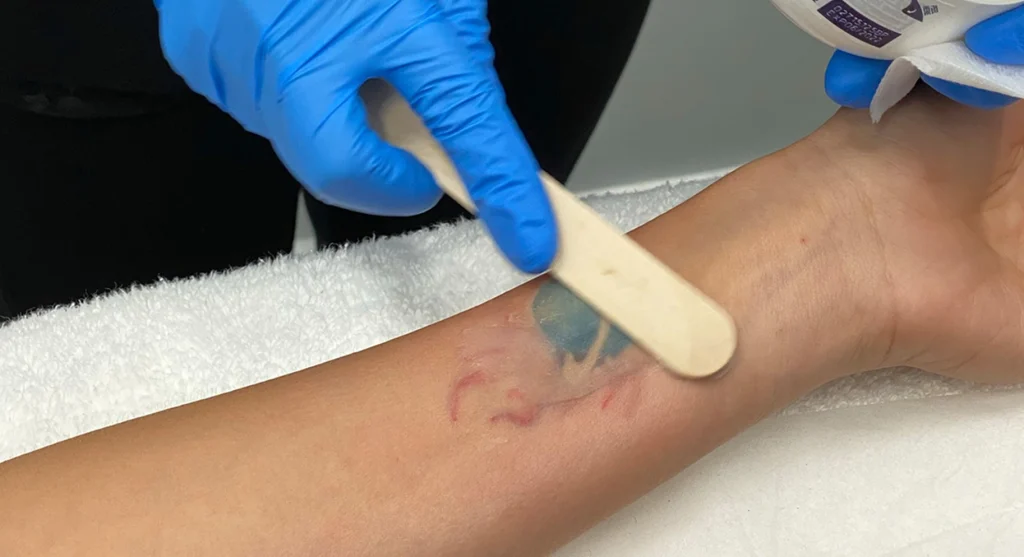
Doral and the greater Miami area have one of the most Fitzpatrick-diverse patient populations in the United States, with a large share of patients in skin types III, IV, and V (Hispanic, Caribbean, Mediterranean, and Mixed Latino backgrounds). For colored tattoo removal in this population, three adjustments matter clinically:
- Wavelength preference: 1064 nm Nd:YAG is preferred whenever possible because longer wavelengths bypass surface melanin and target deeper ink without burning the upper layers of skin. Shorter wavelengths like 532 nm are used carefully, with lower fluence and test spots.
- Fluence (energy density) calibration: Settings are reduced compared to lighter skin types to limit melanin absorption. This may extend the total session count slightly but prevents post-laser hypopigmentation or hyperpigmentation.
- Mandatory test spots: Every patient in Fitzpatrick IV to VI receives a test spot at the lowest planned settings, evaluated at 4 weeks before full treatment begins. This is not optional. It is the only reliable way to predict pigmentary response.
South Florida’s UV intensity adds a final layer of complication. Patients are instructed to avoid direct sun exposure on the treatment area for at least 4 weeks before each session, and to use SPF 50 plus daily for the duration of the treatment course. Sun-tanned skin in the treatment area is a contraindication for that session and will require rescheduling.
For a complete view of how we sequence and customize tattoo removal across all skin types and tattoo profiles, see our Tattoo Removal Treatment Plan, which outlines our staged protocol from consultation through final session.
Frequently Asked Questions About Colored Tattoo Removal
1. Can colored tattoos be removed completely?
Most colored tattoos can be fully removed with modern picosecond laser technology and a complete multi-wavelength treatment plan. The exceptions are Tier 4 colors (yellow, teal, neon) where 100 percent clearance is not always achievable, and Tier 5 (white, light pink with titanium dioxide) where treatment can actually darken the ink permanently. Realistic expectations should be set at consultation based on your specific color palette.
2. Why is black easier to remove than colored ink?
Black ink absorbs essentially the entire visible light spectrum, which means almost any tattoo removal laser wavelength heats it efficiently and fragments the particles. Colored inks each absorb only a narrow slice of the spectrum, so you need the exact matching wavelength for that pigment. If your laser does not have that wavelength, the colored ink reflects the energy and remains in place.
3. How many sessions does a colored tattoo typically need?
Session counts depend on the colors involved, skin type, ink density, tattoo age, and body location. Rough guidelines: black or dark blue 5 to 8 sessions, red and orange 6 to 10, purple and light blue 8 to 12, yellow and teal 15 plus, white often inadvisable. Sessions are spaced 6 to 8 weeks apart for adequate lymphatic clearance between treatments.
4. Why is white ink dangerous to treat with laser?
White tattoo inks typically contain titanium dioxide (TiO2). When laser energy hits TiO2 in skin, it can trigger a reduction reaction that converts the compound into a darker oxide, causing the previously white area to turn brown, blue, gray, or black. This darkening can be permanent and very difficult to reverse. A test spot is the only way to predict whether your particular ink will react this way.
5. What is the Kirby-Desai Scale?
The Kirby-Desai Scale is a predictive scoring tool published by Drs. Will Kirby and Alpesh Desai in 2009 to estimate the number of laser sessions a tattoo will require. It scores six factors (skin type, location, color count, ink amount, scarring, and layering) and produces a total between 1 and 23. Higher scores predict more sessions. Most dermatology practices use it (or a similar internal tool) to set realistic patient expectations at consultation.
6. Can I get colored tattoo removal on darker skin?
Yes. Fitzpatrick III to VI patients can safely undergo colored tattoo removal with the right protocol: longer wavelengths preferred (especially 1064 nm Nd:YAG), lower fluence settings, mandatory test spots at 4 weeks, longer treatment intervals, and strict sun protection between sessions. Total session count is typically 20 to 30 percent higher than the same tattoo on lighter skin, but full clearance remains achievable.
7. What is the gold standard laser for colored tattoos?
A multi-wavelength picosecond laser is the current gold standard. The picosecond pulse duration (trillionths of a second) generates a stronger photoacoustic effect than older nanosecond Q-switched lasers, which fragments stubborn pigments more efficiently with fewer sessions and less thermal injury. The multi-wavelength capability (typically 1064, 532, 694, and 755 nm on the same platform) lets the provider address every ink color in a single session.
8. How long between tattoo removal sessions?
Most providers recommend 6 to 8 weeks between sessions to allow the lymphatic system to clear fragmented ink particles. Treating too soon (less than 4 weeks) can cause inflammation, hyperpigmentation, and incomplete fragmentation. Patients with darker skin (Fitzpatrick IV to VI) often benefit from 8 to 10 week intervals to fully resolve any residual pigmentation between sessions.
Why a Doral Medical Clinic Is the Right Place for Your Colored Tattoo Removal
Colored tattoo removal is one of the procedures where the gap between a high-end medical setting and a discount laser studio shows up most clearly. The lasers required to handle every color tier cost six figures, the protocols for darker skin require medical training, and the test-spot and aftercare workflows demand consistent clinical oversight. Patients who try to save money by going through underequipped providers often end up paying for incomplete removal or treating side effects later.
At our Doral medical aesthetic clinic, every colored tattoo removal consultation includes a full Fitzpatrick assessment, color-by-color review of your tattoo, Kirby-Desai scoring, photo documentation, a written staged plan, and a transparent estimate of sessions and total cost. We treat colored tattoo removal as a medical procedure, not a cosmetic add-on, which is why our outcomes hold up across the full range of skin types we see in South Florida.
📍 Perfect B Medical Aesthetic Clinic, Doral, FL
📞 +1 (786) 502-2260