
Perfect B, Doral FL. | 06.05.26 | 10 min read.
This content is for educational purposes only and does not constitute medical advice. Dermal filler protocols for acne scars vary by scar type, depth, skin tone, and individual anatomy. Consult a licensed medical provider before beginning any treatment.
Dermal Fillers Correct Acne Scars by Replacing What the Inflammation Destroyed
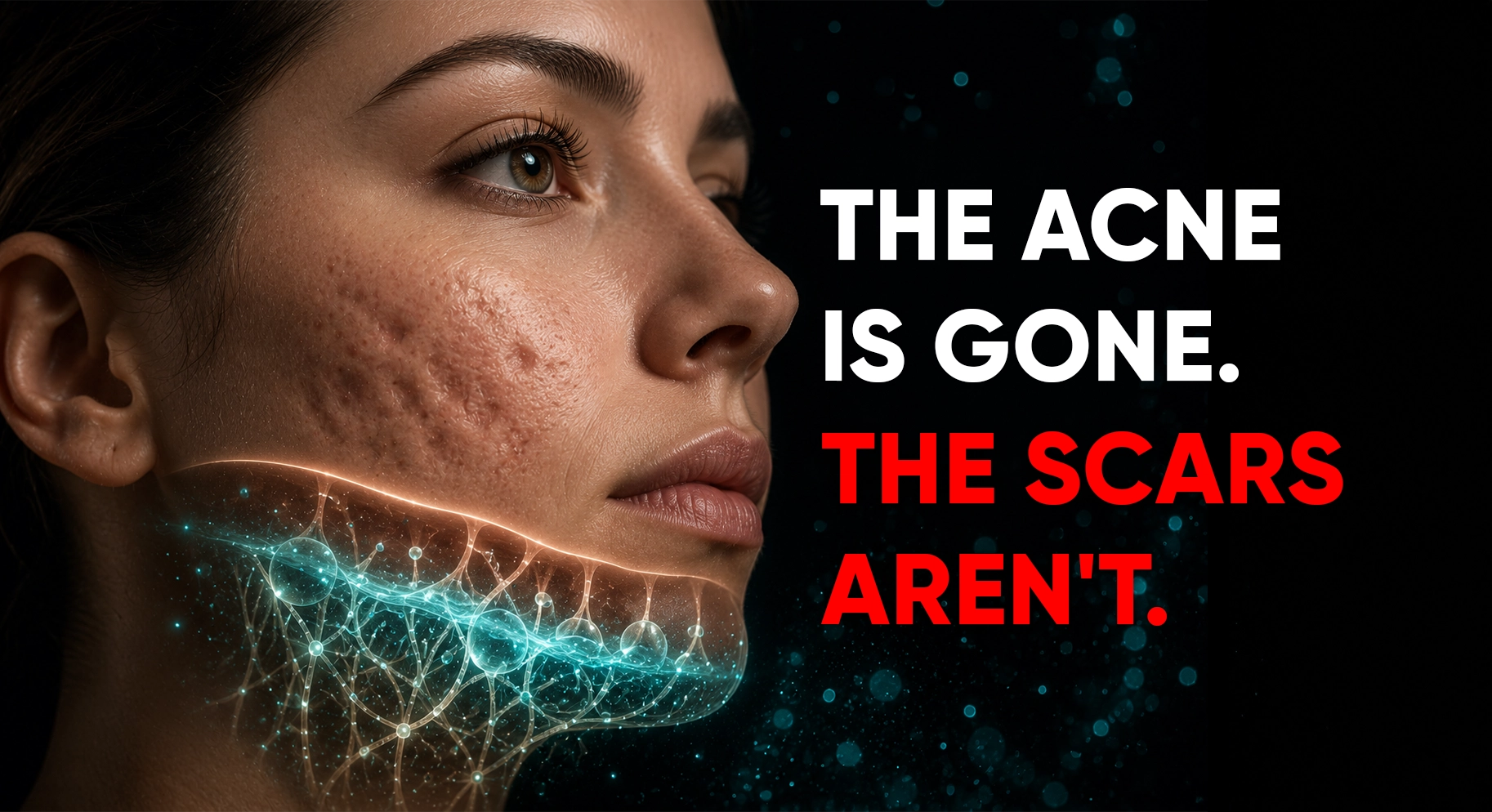
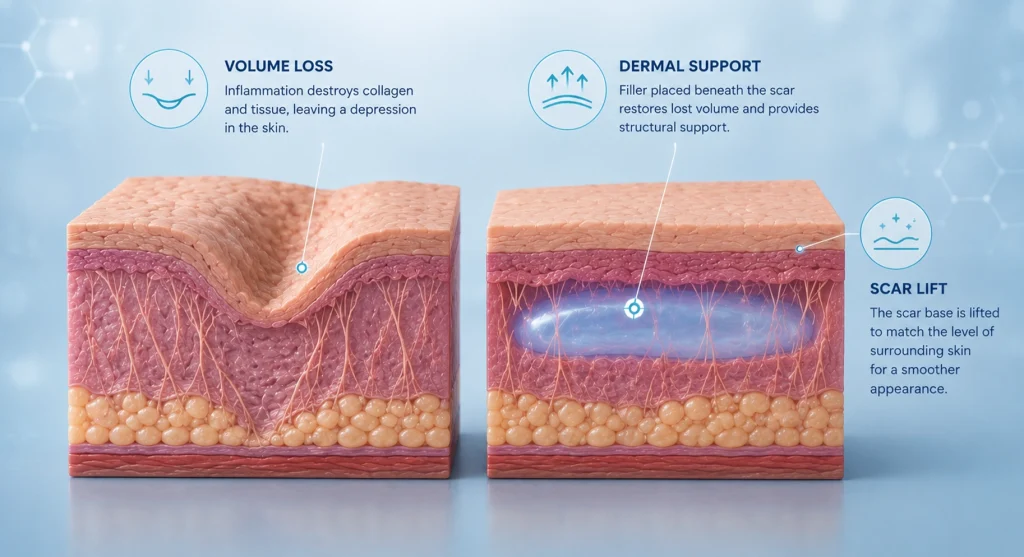
Atrophic acne scars are depressions in the skin. The inflammatory cascade that produced the acne consumed collagen and dermal tissue, leaving a deficit that the skin cannot rebuild on its own. Dermal fillers address that deficit by restoring volume from below, lifting the floor of the scar to match the level of the surrounding skin. They do not remove scar tissue, resurface the epidermis, or remodel the dermal architecture. Those functions belong to microneedling, laser, and RF devices. What fillers do is restore the three-dimensional geometry that the scar disrupted, in ways those other modalities cannot.
At Perfect B in Doral, FL, fillers are rarely used as a standalone treatment for acne scars. The most consistent results come from a staged protocol where subcision releases fibrous tethering first, filler restores volume second, and RF microneedling or laser remodels scar walls and skin texture third. Each step prepares the tissue for the next. Patients who receive filler over active tethering see partial improvement at best. Patients who follow the staged sequence see substantially more. The model post from our clinic documents this approach in detail, built from Victoria Diartt’s clinical protocols for the South Florida patient population, which skews heavily toward Fitzpatrick III through V.
Key Takeaways
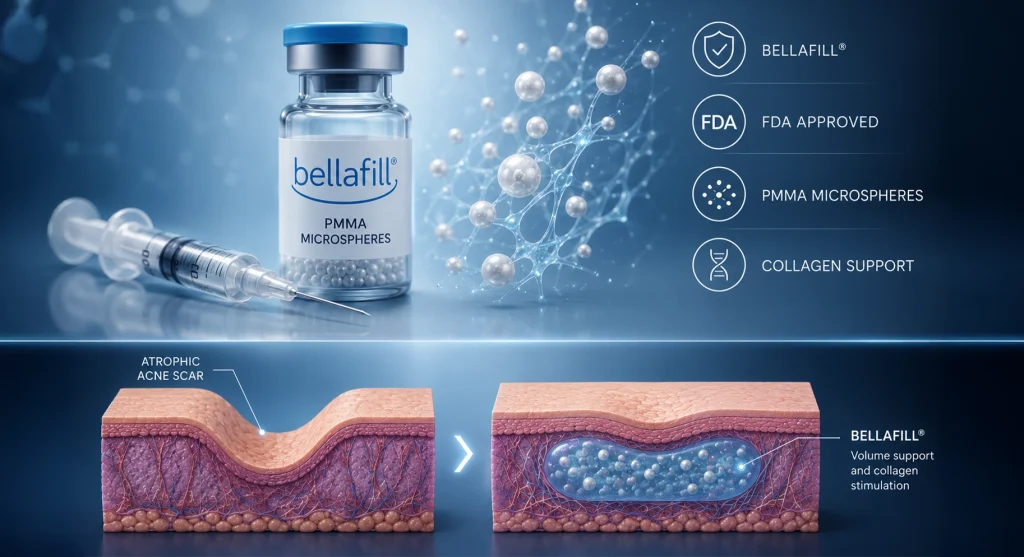
- Bellafill is the only FDA-approved filler specifically for acne scars. Its PMMA microspheres are permanent and stimulate collagen formation that builds correction over 3 to 6 months. Results last 5 or more years.
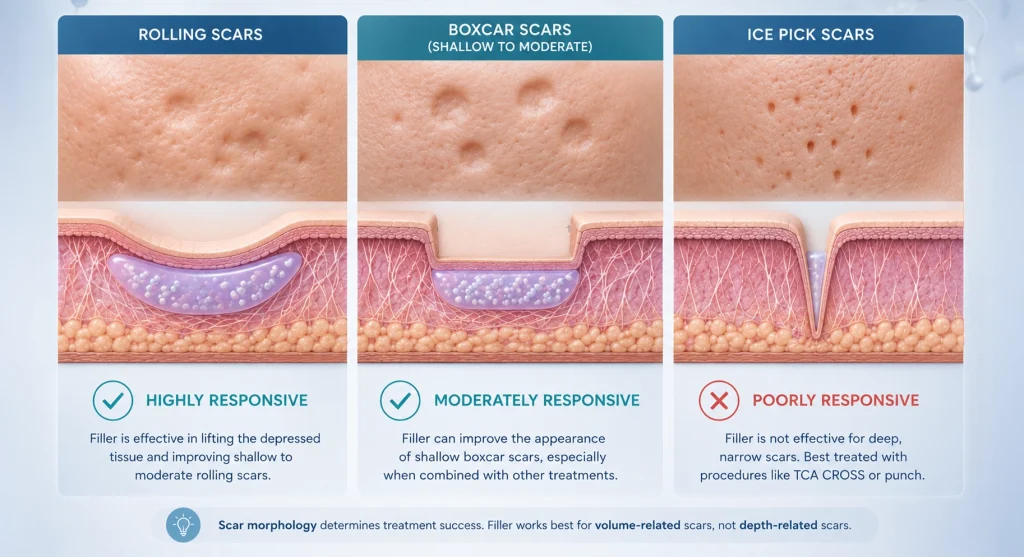
- Rolling and shallow boxcar scars are the best candidates for filler. Ice pick scars are not suitable. Deep boxcar scars require RF microneedling or laser in addition to filler to address the scar walls.
- Sculptra works differently than other fillers. It does not fill the scar directly. It stimulates a broad collagen response that gradually reduces diffuse shallow scarring over 3 to 6 months across 2 to 3 treatment sessions.
- HA fillers are reversible and produce immediate results, making them a lower-risk starting point. Duration in scar tissue is shorter than in soft facial tissue because enzyme activity in fibrotic scar degrades HA faster.
- Fitzpatrick III-VI patients in South Florida require a modified protocol. PIH risk with any needle-based treatment is higher in darker skin tones. At Perfect B in Doral, a tyrosinase inhibitor protocol is standard before and after every filler session for these patients.
Which Acne Scars Respond to Filler and Which Do Not
The clinical decision is not which filler to use. It is whether filler is appropriate at all. Scar morphology determines eligibility, and the distinctions are clinically significant.
Rolling scars respond best to filler
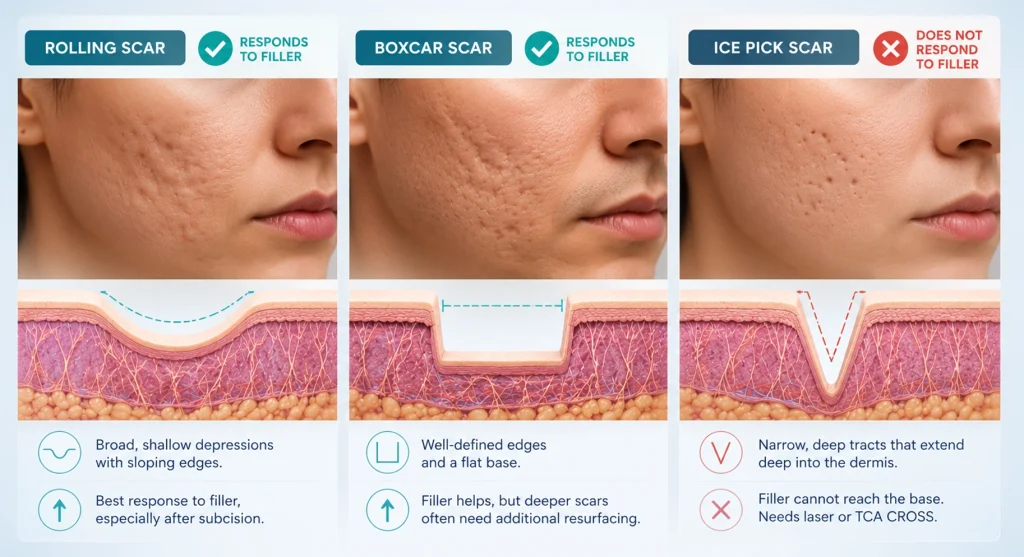
Rolling scars have broad, shallow bases and soft edges that slope gradually into the surrounding skin. The defect is primarily volume loss. Filler injected in a fan pattern beneath the scar lifts the base from below, and the result is often immediately visible on the table. When tethering is present, subcision before filler placement dramatically improves outcomes by releasing the fibrous bands that hold the scar floor down. At Perfect B in Doral, subcision with a cannula is the standard first step for rolling scars before any filler is placed, following the staged protocol documented in the complete acne scar treatment guide for Miami patients at Perfect B, which covers every scar type and the sequenced clinical plan we follow.
Boxcar scars respond selectively depending on depth
Boxcar scars have defined vertical or near-vertical walls with a flat base. Shallow boxcar scars can be lifted with filler injected beneath the base. Deep boxcar scars are more challenging: the sharp walls remain visible even when the floor is raised, so filler alone produces incomplete results. For deep boxcar scars, filler is most useful as part of a sequence that also includes RF microneedling or fractional laser to remodel the walls. Attempting to treat deep boxcar scars with filler only wastes product and leaves the patient unsatisfied. A full breakdown of what distinguishes these scar types is covered in the clinical guide to ice pick, boxcar, rolling, and hypertrophic acne scars at Perfect B and how each morphology determines the treatment approach.
Ice pick scars are not filler candidates
Ice pick scars are narrow, deep channels extending into the lower dermis. The opening is too small and the defect too deep for filler to achieve meaningful correction. Attempting to fill an ice pick scar with standard filler technique risks migration and does not address the structural problem. The appropriate treatments for ice pick scars are punch excision or punch grafting.
Bellafill: The Only FDA-Approved Filler for Acne Scars
Bellafill received FDA approval specifically for the correction of atrophic acne scars in 2014. That distinction separates it from every other filler used off-label for the same purpose. The product combines bovine collagen gel as an immediate carrier with PMMA microspheres that remain at the injection site permanently. As the collagen gel absorbs over 3 to 5 months, the body forms a collagen capsule around the PMMA beads that provides long-term structural support. A 2015 review in Clinical, Cosmetic and Investigational Dermatology documenting the clinical evidence for soft-tissue fillers in atrophic acne scar correction, including HA fillers, PMMA, and biostimulators, with the mechanism and outcomes for each filler class provides the foundational clinical framework.
Who is a good Bellafill candidate
Bellafill requires a mandatory skin test 4 weeks before treatment to rule out bovine collagen allergy. Patients with a history of severe allergies, multiple drug sensitivities, or autoimmune conditions are not appropriate candidates. For patients who clear the skin test, Bellafill is well-suited for rolling scars with significant volume loss, for patients who have already tried HA fillers and want longer-lasting results, and for cases where the number of scars makes repeated HA treatments costly over time. The permanence is an advantage when placement is correct and a complication when it is not, since correction requires hyaluronidase in the collagen gel phase only. PMMA component issues cannot be reversed.
Sculptra: Collagen Stimulation That Reduces Diffuse Scarring Gradually
Sculptra (poly-L-lactic acid) does not fill individual scars. It stimulates a broad collagen response across the treated zone over 3 to 6 months that reduces the visible depth and shadowing of atrophic scars diffusely. The material dissolves completely over 18 to 24 months, but the collagen it induces persists significantly longer. Results require 2 to 3 sessions spaced 4 to 6 weeks apart before the full outcome is visible.
When Sculptra is the better clinical choice
Sculptra is most useful when scarring is diffuse rather than concentrated in a few discrete depressions. Patients with large zones of shallow textural irregularity across the cheeks, loss of skin thickness from years of inflammatory damage, or combination scarring spread broadly benefit more from a biostimulator approach than from trying to individually address each depression with targeted filler. It is also preferable for patients who want gradual, natural-looking improvement and are comfortable with a multi-session protocol. The tradeoff is patience: results are not visible for months and cannot be assessed after one session.
Hyaluronic Acid Fillers: Reversible, Immediate, and the Right Starting Point for Many Patients
Hyaluronic acid fillers (Juvederm, Restylane) are the most commonly used fillers for acne scars in general practice because they are reversible with hyaluronidase and produce immediate visible correction. A thin HA filler injected superficially beneath a rolling or shallow boxcar scar lifts the depression instantly. The limitation is durability: HA fillers in scar tissue typically last 6 to 9 months, shorter than in soft tissue sites, because enzyme activity in fibrotic scar accelerates HA degradation.
HA fillers as a first step before committing to Bellafill
At Perfect B, we often use HA fillers as the first filler treatment for patients who have not had fillers before. The immediate result shows both patient and provider how the scar responds to volumization, and reversibility provides a safety net if placement is not ideal. Patients who respond well and want longer-lasting results often move to Bellafill in a subsequent cycle after the HA has degraded and the tissue has been assessed.
Filler Effectiveness by Scar Type: A Clinical Reference
The chart below reflects clinical suitability and approximate duration for the four main filler categories used for acne scars. A 2025 systematic review in the Journal of Cosmetic Dermatology comparing PMMA, PLLA, HA, and CaHA fillers for acne scars, confirming Bellafill as the only FDA-approved option and documenting the evidence base for each filler class supports the clinical framework shown.
Why Filler Works Better as Part of a Staged Protocol Than Alone
Fillers address volume loss. They do not address tethering, scar wall texture, or overall skin quality in the surrounding tissue. Combining filler with subcision and RF microneedling addresses all three mechanisms, and the results are consistently better than any single modality alone.
Subcision before filler for tethered scars
Subcision uses a beveled needle or cannula inserted at the subdermal level to cut fibrous attachments anchoring the scar floor to deeper tissue. Once those bands are released, the scar lifts more freely and the filler placed afterward has more effective space to work. At Perfect B, subcision with a cannula is standard for rolling scars before filler placement, following the staged sequence documented from Victoria Diartt’s clinical protocol for Miami patients.
RF microneedling after filler for scar wall remodeling
After filler lifts the scar floor, RF microneedling remodels the walls and edges of boxcar scars and improves skin texture across the treated zone. The two treatments address complementary mechanisms: filler replaces volume, RF microneedling rebuilds collagen structure. They are not performed in the same session. The standard interval is 4 to 6 weeks after filler before introducing RF energy. The Morpheus8 protocol for South Florida patients with Fitzpatrick III-VI skin is covered in detail in the clinical guide to RF microneedling for acne scars at Perfect B, including how Morpheus8 settings are adjusted for darker skin tones in the Miami population.
Fitzpatrick III-VI Patients and Filler for Acne Scars in South Florida
Most of our Miami patients are Fitzpatrick III through V. That changes the protocol for every needle-based treatment including filler. Post-inflammatory hyperpigmentation is a real risk whenever a needle punctures the skin in a patient with higher melanin density, and filler injection creates multiple puncture sites across the treated area.
At Perfect B, Fitzpatrick III-VI patients beginning filler treatment for acne scars receive a tyrosinase inhibitor protocol before and after every session to reduce melanin production during the inflammatory response period. We also use a cannula technique where clinically appropriate, which minimizes puncture sites compared to multiple needle entry points. Initial filler volume is conservative: starting with less and building at a follow-up appointment gives us the ability to assess tissue response before committing to full correction. This matters especially for Bellafill, where any overcorrection is not straightforwardly reversible.
Frequently Asked Questions
1. Which filler is best for acne scars?
Bellafill is the only FDA-approved filler specifically for acne scars and provides the longest-lasting structural correction for rolling scars. Sculptra is the best option when scarring is diffuse and the goal is broad collagen stimulation across a large zone. HA fillers offer immediate reversible correction and are the best starting point for first-time patients. There is no single best option across all patients and all scar types.
2. Can dermal fillers permanently correct acne scars?
Bellafill provides long-term correction because its PMMA microspheres are permanent and the collagen they stimulate persists for years. Studies document maintained correction at 5 years. HA fillers require maintenance every 6 to 9 months in scar tissue. Sculptra results last approximately 2 years. No filler fully removes a scar. It lifts and softens the depression. The underlying structural change in the dermis remains.
3. How long do fillers last in acne scars?
HA fillers last approximately 6 to 9 months in scar tissue, shorter than in soft facial tissue because enzyme activity in fibrotic scar degrades HA faster. Bellafill results are long-term, with correction maintained at 5 years in clinical studies. Sculptra results typically last 2 or more years after the treatment series is complete.
4. Does Bellafill require a skin test?
Yes. Bellafill contains bovine collagen requiring a mandatory skin test 4 weeks before treatment to rule out allergic reaction. Patients with a history of severe allergies, multiple drug sensitivities, or known sensitivity to bovine products are not appropriate candidates for Bellafill.
5. Can filler be combined with microneedling for acne scars?
Yes, and the combination consistently produces better results than either alone. Standard sequencing is filler first to restore volume, then RF microneedling 4 to 6 weeks later to remodel scar walls and improve skin texture. They are not performed in the same session. For a full picture of how microneedling fits into the acne scar treatment sequence, see the clinical guide to microneedling for acne scars at Perfect B, covering which scars respond, how many sessions are needed, and what the combination protocol looks like.
6. Are dermal fillers for acne scars safe for darker skin tones?
Yes, with a modified protocol. Fitzpatrick III-VI patients require tyrosinase inhibitor pre-treatment, conservative initial filler volume, and cannula technique to minimize puncture sites and PIH risk. At Perfect B in Doral, where most of our patients are Fitzpatrick III-V, this modified approach is the standard of care, not an exception.
7. What does dermal filler treatment for acne scars cost?
HA filler sessions for acne scars typically range from $600 to $1,200 per syringe depending on product and area treated. Bellafill is priced higher per syringe given its long-term efficacy. Sculptra treatment series typically run $1,500 to $3,000 for 2 to 3 sessions. The full staged acne scar treatment plan at Perfect B, including combination protocols and pricing, is reviewed at the initial consultation.
Closing: Filler Is One Step in the Plan, Not the Whole Plan
Dermal fillers are among the most effective tools for atrophic acne scar correction when matched to the right scar type and used within a staged protocol. For rolling scars with significant volume loss and minimal tethering, a single well-placed Bellafill or HA filler session produces meaningful, visible improvement. For diffuse shallow scarring, Sculptra offers progressive improvement without individual scar targeting. The limitation is consistent: no filler works on ice pick scars, deep boxcar scars without complementary remodeling, or scars where tethering has not been addressed with subcision first.
At Perfect B in Doral, FL, every acne scar consultation includes a morphology assessment that determines which scars are filler candidates, which need resurfacing first, and which combination of treatments produces the most improvement per session over the fewest total appointments. That staged assessment is what separates a filler treatment that improves a patient’s skin from one that temporarily masks a depression without addressing what caused it. The full clinical approach for every scar type at our clinic, built from years of treating the South Florida patient population, is detailed in the acne scar treatment plan at Perfect B.
📍 Perfect B | 3905 NW 107th Ave, Suite 104, Doral FL 33178
📞 Call or message us at (786) 502-2260 to schedule your acne scar consultation with a licensed medical provider.
💳 Buy Now Pay Later: Cherry, Klarna, Afterpay, CareCredit
→ Review the full acne scar treatment plan at Perfect B and see every available option by scar type.