Perfect B, Doral Fl. | 06.30.26 | 11 min read.
This article is for educational purposes only and is not a substitute for individualized medical advice, diagnosis, or treatment. Please consult a qualified provider about your specific skin.
What Is Subcision and Why Does It Work When Lasers Do Not?
Subcision is a minor in-office surgical procedure that uses a special needle or a blunt cannula to cut the fibrous bands tethering a depressed acne scar to the deeper tissue below. Once those bands are released, the skin floor lifts toward the surface, and the controlled injury triggers new collagen to fill the space. It is one of the few treatments that addresses the mechanical cause of rolling scars, not only their appearance.
Many patients arrive at our Doral clinic after years of resurfacing that softened their skin texture but never lifted the deep, shadowy depressions that bother them most. That is not a failure of effort; it is a mismatch between the tool and the problem. Rolling and tethered scars are anchored from underneath, and you cannot polish away an anchor from the top. Understanding what is subcision is the first step toward a plan that targets the scars pulling your skin down.
The “Tethered Scar” Problem in Plain English
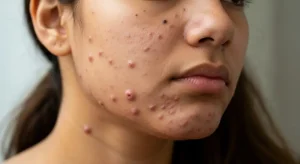
When a deep acne lesion heals, the body sometimes lays down bands of scar tissue that run vertically, like tiny ropes, from the surface of the skin down into the dermis. These bands tug the overlying skin downward and create a depression that catches light and casts a shadow. This is the classic look of a rolling scar: a soft, sloping dip with a normal-looking surface, often most visible under overhead lighting. The skin on top is healthy; the problem lives underneath, in the tether. To see how these compare to other patterns, read our guide to the different types of acne scars and how each one behaves.
Nokor Needle Versus Blunt Cannula: Two Ways to Release the Same Band
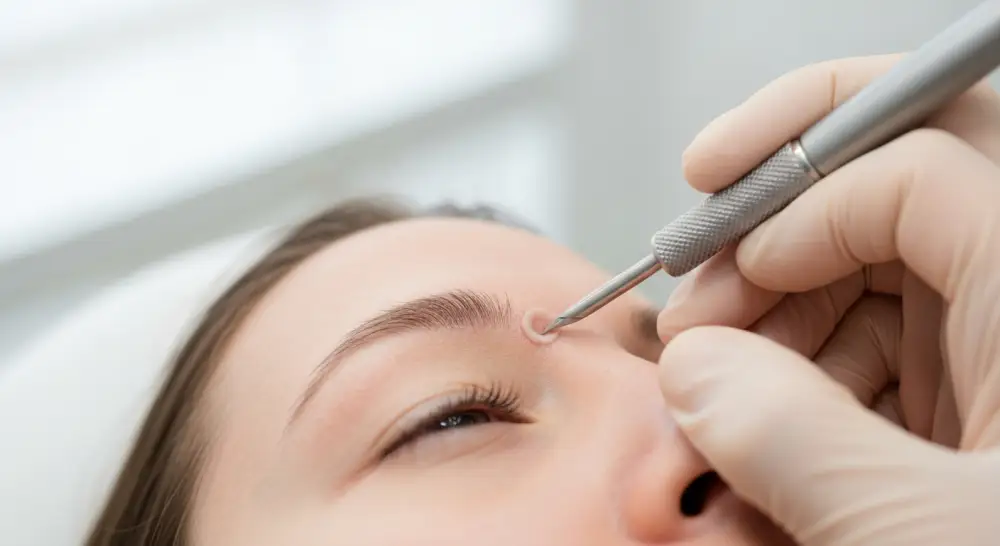
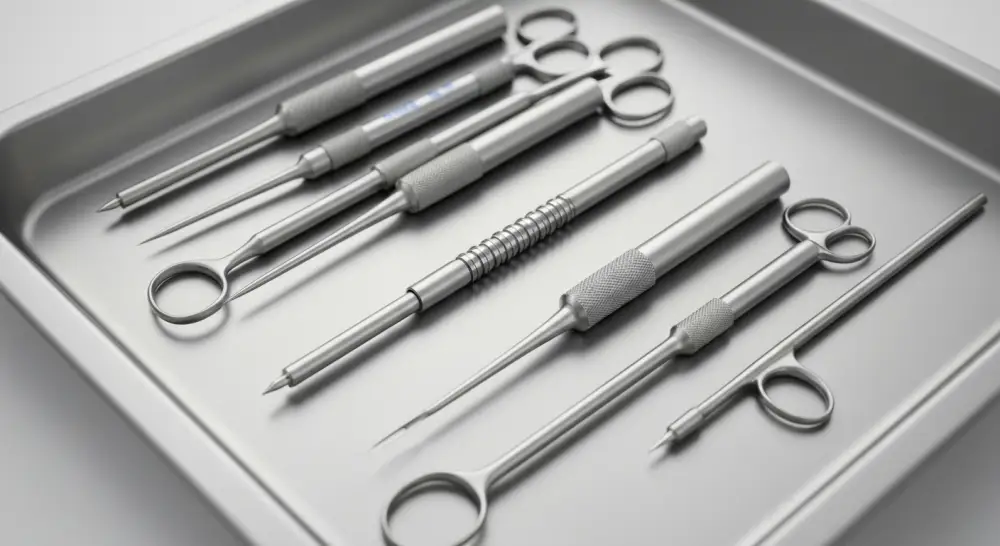
Providers use one of two instruments, and both have a long track record in dermatology. A Nokor needle is a tribeveled hypodermic needle with a small angled cutting tip. It is inserted under the scar and moved in a fanning motion to sever the tethers directly. A blunt-tip cannula is a flexible, rounded instrument that slides through a single entry point and separates the bands by sweeping rather than cutting, which tends to produce less bruising and reduces the chance of nicking a vessel. The choice depends on scar depth, location, and how many scars are being treated. At Perfect B, your provider selects the instrument that fits your skin and scar pattern, not a one-size protocol.
Key Takeaways
- Subcision physically releases the fibrous bands that tether rolling and some boxcar scars, allowing the skin to lift and stimulating new collagen from within.
- It works on problems that lasers and needling cannot reach, because depressed scars are anchored from underneath, not just textured on the surface.
- Most patients need two to three sessions spaced roughly four to six weeks apart, though your provider sets the plan based on your scars.
- Expect bruising and swelling for several days up to about two weeks; visible collagen remodeling continues over two to six months, which is why a true subcision before and after is a months-long story, not a same-week one.
- For Fitzpatrick III to V skin, which is common in Miami, gentler technique and strict sun protection are essential to prevent post-inflammatory hyperpigmentation after the procedure.
Why Tethered Scars Cannot Be Lasered or Needled Away First
Resurfacing treatments work from the top down. A laser ablates or heats the upper layers so the skin regenerates with smoother texture, and standard microneedling creates microchannels that prompt collagen near the surface. Both are excellent for fine texture and shallow irregularity, but neither reaches the deep band physically pulling a rolling scar down.
Picture a button tufted into a cushion. You can steam and brush the fabric all day, but the dimple stays until you cut the thread holding it down. A tethered scar behaves the same way: resurface the top without releasing the tether and the depression returns, because the anchor was never addressed. This is why so many people feel stuck after multiple laser packages. Releasing the tether first, then remodeling and resurfacing, is the sequence that produces durable change. Read more on our page about how Perfect B treats rolling acne scars.
What Happens During a Subcision Session, Step by Step?
The appointment is short and well tolerated. Here is what to expect at our Doral clinic.
- Mapping. Your provider examines your skin under good lighting, often while you are seated upright, and marks each tethered scar. Scars look different lying down, so mapping while you sit targets the depressions that actually show.
- Numbing. The area is cleaned and local anesthetic is injected to numb each treatment site. This is the part most patients feel; once numb, the procedure itself is largely painless.
- Release. Using a Nokor needle or a blunt cannula, your provider passes under each scar and releases the fibrous bands with a controlled fanning or sweeping motion. You may feel pressure or hear a faint snapping as a tether gives way.
- Hemostasis. Gentle pressure is applied to control minor bleeding and limit bruising. Some pooling of blood under the skin is normal and part of how the area fills.
- Aftercare review. You receive specific instructions on cold compresses, activity, and sun protection before you leave.
The active treatment usually takes about fifteen minutes for a typical area, though larger cases run longer. What does it feel like afterward? Most patients describe a sensation like a deep bruise: tender, swollen, and tight for a few days. You can drive yourself home and return to most daily activities the same day, with cosmetic downtime mainly tied to visible bruising.
How Much Does Subcision Cost, and What Drives the Price?
Subcision cost is not a single sticker number, because no two scar maps are the same. The investment depends on how many scars you are treating, the size and number of areas, whether one instrument or a combination approach is appropriate, and how many sessions your scars realistically need. A responsible subcision cost is always quoted after an in-person assessment.
The honest answer is that exact pricing is provided at your consultation, once your provider has examined your skin and built your plan. We would rather give you a number you can trust than a guess that changes the moment we see your scars. To make care accessible, Perfect B offers Buy Now, Pay Later financing through Cherry, Klarna, Afterpay, and CareCredit, so the cost can be spread into manageable monthly payments.
How Many Subcision Sessions Will You Need?
Tethers do not all release in a single pass, and collagen builds gradually, so this is typically a short series rather than a one-time event. In many cases, most patients do well with two to three sessions spaced roughly four to six weeks apart, which gives the skin time to heal and reveal how much each treatment has lifted before the next one. Deeper or denser scarring may call for additional sessions.
This is a typical range, not a guarantee. Your provider will reassess your scars at each visit and adjust the plan based on how your skin responds rather than following a fixed count. Some patients see meaningful improvement after the first session; others need the full series. Pairing the procedure with a remodeling treatment, explained below, can also influence how many sessions you ultimately need.
Subcision Before and After: A Realistic Timeline of What You Will See
Setting honest expectations is the most important part of this conversation. A subcision before and after photo set rarely shows its best result the week of the procedure, because the early phase is dominated by healing, not yet by collagen. The first one to two weeks involve bruising and swelling. The meaningful improvement, the lift of the scar floor, develops over the following months as collagen matures.
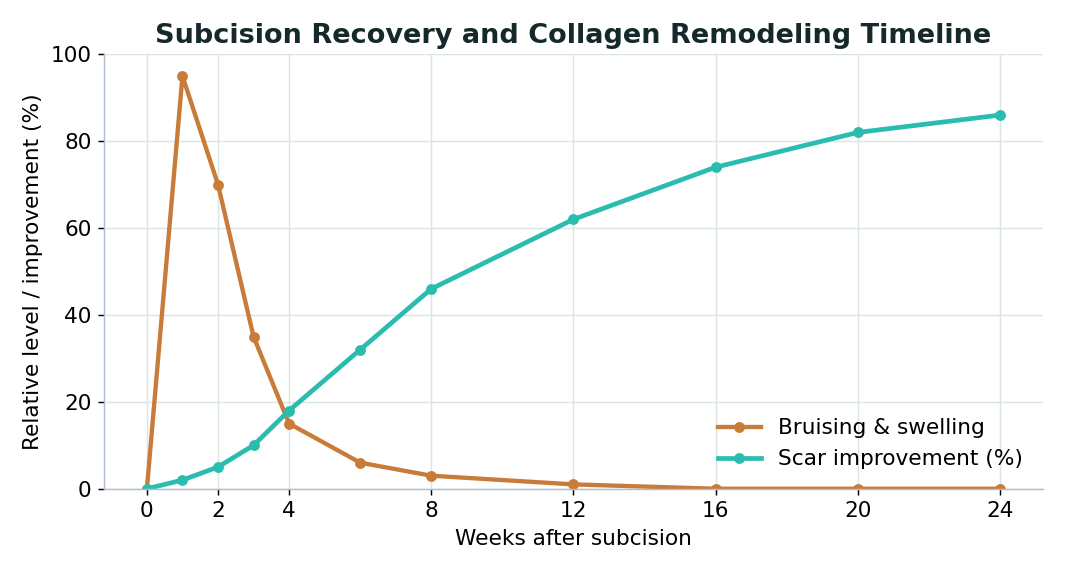
When patients ask to see a subcision before and after, we frame it in months rather than days. Here is a general timeline; your own course may differ.
| Time after subcision | What is typically happening | What you may notice |
|---|---|---|
| Days 1 to 3 | Local inflammation and bruising; minor blood pooling under the scar | Tenderness, swelling, visible bruising, a tight feeling |
| Days 4 to 14 | Bruising fades; swelling resolves; early healing begins | Discoloration lightens; skin starts to feel normal again |
| Weeks 3 to 6 | New collagen production ramps up; tethers stay released | Scar depressions begin to look shallower; ready to assess next session |
| Months 2 to 6 | Collagen remodels and matures; final lift develops | Smoother contour and reduced shadowing; the result you compare in a true before and after |
Because the early weeks involve visible bruising, timing matters in South Florida. If you have a major event, plan your first session so the bruising phase passes before the day you want to look your best.
Subcision for Fitzpatrick III to V Skin: Managing Post-Inflammatory Hyperpigmentation
This is the part a careful provider will not skip, especially in a diverse community like Doral. Melanin-rich skin, broadly Fitzpatrick types III through V, is more prone to post-inflammatory hyperpigmentation, the brown or tan discoloration that can appear after any inflammatory event in the skin, including a procedure. The same trauma that triggers helpful collagen can also stimulate pigment-producing cells, leaving temporary dark marks if the skin is handled too aggressively or exposed to sun while it heals.
For brown skin, the priorities are gentler technique, conservative intensity, and disciplined aftercare. A blunt cannula is often favored because it tends to cause less bruising and less collateral trauma than a cutting needle. Just as important is what happens after you leave: strict daily broad-spectrum SPF, deliberate sun avoidance while bruising heals, and sometimes a pigment-calming regimen if your provider recommends one.
This is where the Florida climate becomes a clinical factor, not a side note. Intense South Florida sun and high Miami humidity make sun avoidance harder and pigment flares more likely, so the post-procedure window is exactly when melanin-rich skin needs the most protection. We counsel every patient with deeper skin tones to treat sunscreen and shade as part of the treatment, because protecting the skin while it heals keeps a good result from being undone by pigment. The American Academy of Dermatology offers plain-language guidance in its resource on acne and acne scarring, and peer-reviewed dermatology literature indexed on PubMed on subcision and atrophic acne scars supports a measured approach in skin of color.
Subcision Versus Microneedling: Which One Do You Need, or Do You Need Both?
This is the most common question we hear, so let us make the subcision vs microneedling decision concrete. They are not competitors; they solve different parts of the same problem, and the subcision vs microneedling distinction comes down to depth and mechanism. Subcision releases the deep tether that holds a scar down. Microneedling, especially radiofrequency microneedling such as Morpheus8, remodels the surrounding tissue and refines surface texture. Treating subcision vs microneedling as either-or often leaves the best result on the table.
| Feature | Subcision | RF Microneedling (Morpheus8) |
|---|---|---|
| Main target | Deep fibrous bands tethering the scar | Surface texture and dermal remodeling |
| How it works | Mechanically cuts or sweeps the tethers free | Microchannels plus radiofrequency heat stimulate collagen |
| Best for | Rolling and some boxcar (tethered) scars | Texture, fine scarring, skin tightening |
| Typical downtime | Bruising and swelling for several days to about two weeks | Redness for one to a few days |
| Role in the plan | Release the anchor first | Remodel and refine after release |
The sequence we use thinks of scar correction in stages: release, then remodel, then resurface, then re-color. First we release the tethers with subcision so the skin can lift. Next we remodel the area, often with RF microneedling with Morpheus8 for acne scars, to build collagen and refine texture. Then we resurface remaining irregularity as needed, and finally we re-color, addressing any leftover redness or pigment once the skin has settled. Many patients combine both tools precisely because each does what the other cannot.
Who Is and Is Not a Good Candidate for Subcision?
The procedure is most rewarding for people whose primary concern is rolling scars or tethered boxcar scars, the soft, shadowed depressions with a normal-looking surface. If your skin pulls down into dips that worsen under direct light, you are likely a strong candidate.
It is not the right tool for every scar. Narrow icepick scars, which look like tiny puncture marks, do not respond because there is no broad tether to release. Subcision is also approached with caution or avoided in situations including:
- Active skin infection or inflamed, breaking-out skin in the treatment area
- A personal tendency to form keloid or hypertrophic scars
- Bleeding disorders or use of medications that significantly affect clotting
- Pregnancy or other conditions your provider determines make timing inappropriate
The only way to know your candidacy is an in-person evaluation. At Perfect B, we map your scars, review your history, and tell you honestly whether subcision, a combination plan, or a different approach will serve you best.

Frequently Asked Questions About Subcision
1. Does subcision hurt?
The injections of local anesthetic are the part most patients feel. Once the area is numb, the release itself is largely painless, though you may sense pressure or a faint snapping as tethers give way.
2. How long is the downtime after subcision?
Expect bruising and swelling for several days up to about two weeks, depending on how many scars were treated and how easily you bruise. Most people return to daily activities the same day, the main limitation being visible bruising while it fades.
3. When will I see my final subcision before and after result?
The lift you are looking for develops as new collagen matures, generally over two to six months. The first weeks are about healing, so a meaningful subcision before and after comparison is a months-long story.
4. How does subcision cost compare to other scar treatments?
Subcision cost varies with the number of scars, areas treated, and sessions needed, so it is quoted after an in-person assessment rather than as a flat fee. Perfect B offers Buy Now, Pay Later financing through Cherry, Klarna, Afterpay, and CareCredit.
5. Subcision vs microneedling: should I pick one?
For deep rolling scars, they work best together rather than as an either-or choice. Subcision releases the tether; RF microneedling such as Morpheus8 remodels and refines the surface. Your provider will advise one, the other, or a staged combination.
6. Is subcision safe for darker skin tones?
Yes, when performed with appropriate technique and aftercare. Melanin-rich skin is more prone to post-inflammatory hyperpigmentation, so gentler instruments, conservative settings, and strict sun protection lower that risk. This matters especially in sunny, humid South Florida, where diligent SPF and sun avoidance during healing protect your result.
7. Can subcision treat icepick scars?
No. Icepick scars are narrow and deep, with no broad fibrous tether to release, so they do not respond to subcision and are better addressed with other techniques.
Closing: The Clinical Case for Subcision First
If rolling scars have not budged despite lasers and creams, the tether underneath is the reason, and subcision is built to address it exactly. The procedure releases the fibrous bands mechanically, the skin lifts, and new collagen fills the space from within. That structural change is what resurfacing treatments alone cannot deliver.
The tools that remodel and refine the skin work best after the anchor has been released. At Perfect B in Doral, that is the sequence we follow: release first, then remodel and resurface, then re-color. Working with a provider who understands the full staged plan is what turns one procedure into a lasting result.
- 📍 Visit us at Perfect B, 3905 NW 107th Ave, Suite 104, Doral FL 33178
- 📞 Call or message us at (786) 502-2260
- 💳 Financing available through Cherry, Klarna, Afterpay, and CareCredit