Perfect B, Doral Fl. | 07.10.26 | 12 min read.
This article is for general educational purposes and is not medical advice, a diagnosis, or a substitute for an in-person evaluation. Laser tattoo removal results, session counts, and timelines vary by ink, depth, color, location, and skin type, and complete clearance is never guaranteed. Treatment must be planned and performed by a trained provider, and pricing is confirmed at a personal consultation.
Why Some Tattoos Resist Removal, and the Ink That Will Not Fully Fade
If your tattoo is fading slower than you hoped, you are not imagining it. Some tattoos genuinely resist laser removal, and knowing why some tattoos resist removal before you start saves you frustration, money, and false expectations. The single biggest reason is ink color: black clears the fastest, while colors like green, red, and yellow can be stubborn. Depth, density, amateur work, and cover-ups all add to the challenge. None of it means your tattoo is hopeless, it means the plan has to be honest and matched to what you actually have on your skin.
This guide explains exactly what makes a tattoo hard to remove, why certain inks resist, how the PiQo4 by Lumenis laser uses multiple wavelengths to tackle those colors, and what realistic expectations look like at our Doral clinic. The goal is a clear, honest picture so you can decide with real information rather than a marketing promise.
Key Takeaways
- Color leads: black clears fastest, while green, red, and yellow are the inks that most often resist removal.
- Depth and density matter: heavily saturated or deeply placed ink, and amateur work, take more sessions.
- Cover-ups are the hardest: layered ink stacks multiple colors and densities, so it resists the most.
- The device counts: a multi-wavelength laser like PiQo4 targets resistant colors a single-wavelength device cannot.
- Honest expectations: stubborn ink may fade dramatically without reaching 100 percent, and a provider tells you that up front.
What Makes a Tattoo Hard to Remove?
Laser removal works by sending light that shatters tattoo ink into fragments small enough for your body to carry away over the weeks between sessions. A tattoo resists when something interferes with that chain, and several factors can. Ink color changes how well the light is absorbed. Ink depth and density change how much light reaches the pigment. The quality of the original work, whether it was amateur or professional, changes how evenly the ink sits. And layered cover-ups pile several of these problems on top of each other. Understanding which apply to your tattoo is the first step to a realistic plan. For the underlying mechanism, our explainer on how laser tattoo removal actually works, from shattering the ink to how your body clears the fragments between sessions is a helpful primer.
Ink Color Is the Number One Factor
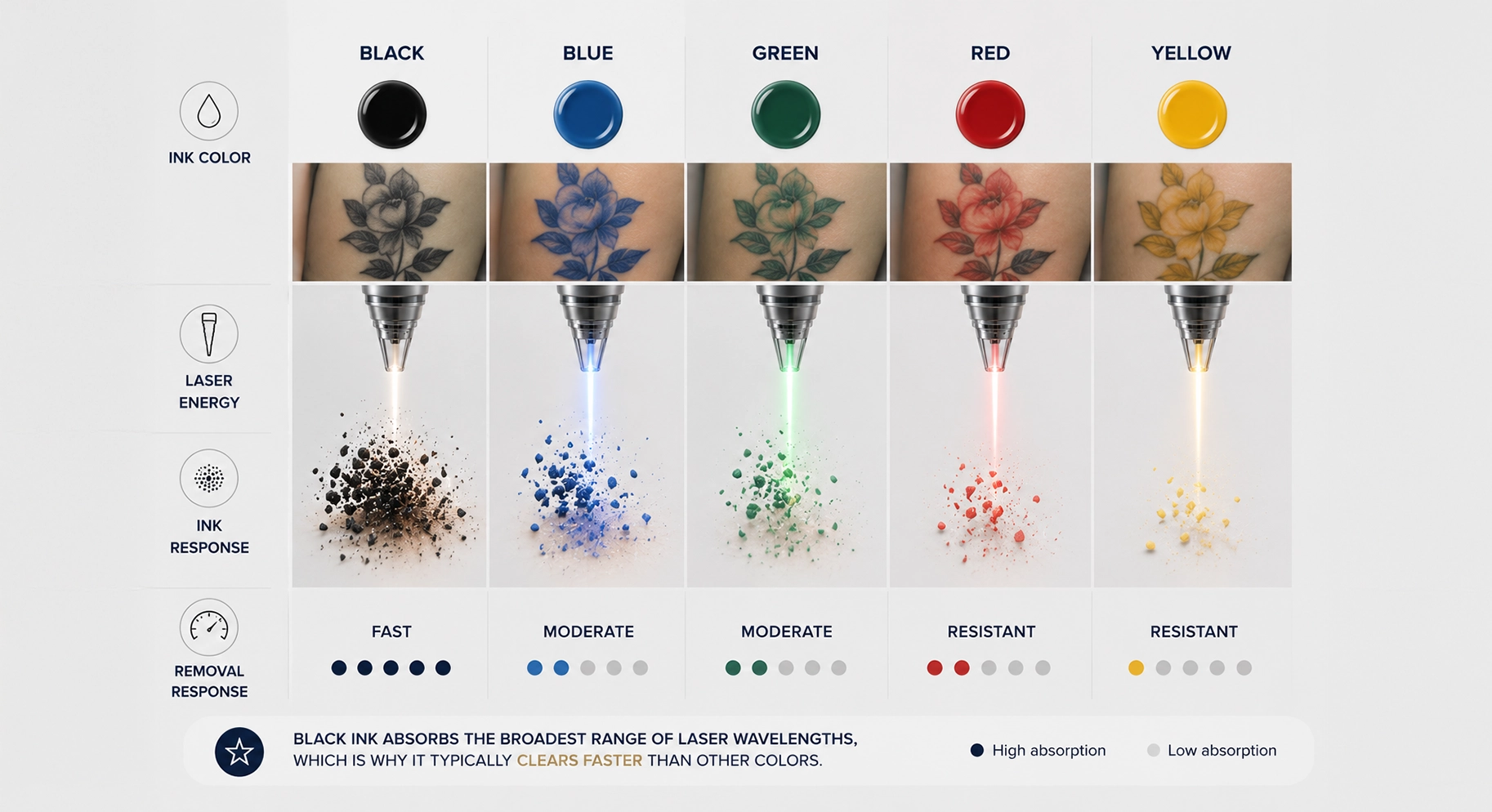
The color of your ink is the strongest predictor of how easily it clears. That is because each color absorbs specific wavelengths of laser light, and if the laser cannot deliver the wavelength a color absorbs, that ink barely responds. Black is the easy winner because it absorbs the broadest range of wavelengths. Warm colors like red, orange, and yellow, and some greens, are the classic hold-outs. The table below shows the general pattern, though your provider confirms how your specific ink behaves.
| Ink color | Typical removal response | Why |
|---|---|---|
| Black | Fast, most responsive | Absorbs the broadest range of laser wavelengths |
| Dark blue | Good | Responds well to the 1064 nm wavelength |
| Green | Slower, often resistant | Needs a specific wavelength such as 650 nm |
| Red and orange | Slower, often resistant | Needs a shorter wavelength such as 532 nm |
| Yellow | Most resistant | Reflects most laser light, so little is absorbed |
Why Black Ink Clears the Fastest
Black is the most cooperative ink for a simple reason: it absorbs essentially all visible wavelengths, so whatever the laser delivers, black soaks it up and shatters. That broad absorption also means black responds well to the 1064 nm wavelength, which penetrates deeply and, helpfully, is the wavelength least absorbed by the melanin in your skin. That combination makes black both effective to treat and safer across skin tones, which matters for Miami’s darker and tanned patients.
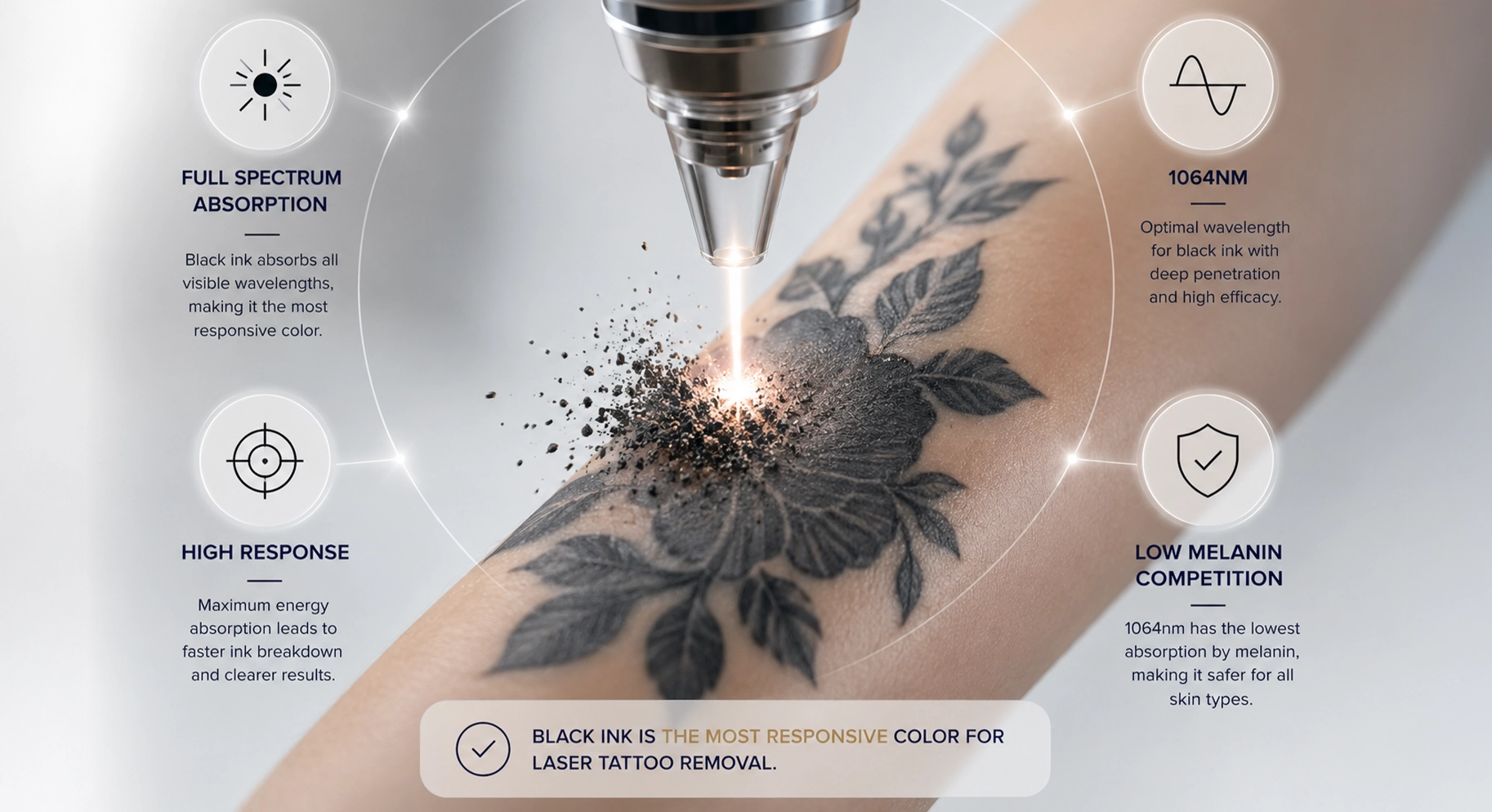
This is why an all-black tattoo is usually the most predictable to remove, while a colorful piece is a mixed bag where the black outlines clear early and the colors lag behind. You can read more on this in our guide to why black ink tattoo removal tends to be the most straightforward, and what to expect when black is the only color involved.
Depth, Density, and Amateur Versus Professional Work
Beyond color, how the ink was put in matters a lot. Professional tattoos are often more saturated and deposited deeper and more densely, which means more pigment for the laser to break down and more sessions to do it. Amateur or stick and poke tattoos are less predictable: the ink sits at uneven depths, so some spots clear quickly while others linger, and the result can look patchy along the way. Older tattoos have sometimes faded and dispersed on their own, which can make them a little easier, while a fresh, heavily saturated piece is at the harder end.
None of this is a dealbreaker, it simply feeds into the honest session estimate a provider gives you. The point is that two tattoos that look similar can behave very differently based on how they were made.
Cover-Ups and Layered Ink: The Hardest Case
The single most resistant scenario is a cover-up. A cover-up stacks a new tattoo on top of an old one, which means layers of different colors and densities piled into the same skin. The laser has to work through all of it, often finding resistant colors hidden beneath dense black, so cover-ups reliably need the most sessions and the most patience. They are absolutely treatable, but they are the clearest example of why a provider needs to see the tattoo in person before estimating anything. If you are weighing removal against another cover-up, that is a conversation worth having at a consultation.
How PiQo4’s Four Wavelengths Tackle Resistant Colors
Here is where the device makes a real difference. A laser that offers only one wavelength can clear black and a few colors, but it leaves the resistant ones behind. The PiQo4 by Lumenis offers four wavelengths, 1064 nm, 532 nm, 650 nm, and 585 nm, each tuned to a different part of the color spectrum. That range lets a provider match the wavelength to the ink: 1064 nm for black and dark blue, 532 nm for warm reds and yellows, and 650 nm and 585 nm for stubborn greens and cool tones. Covering nine of the most common ink colors is exactly what a resistant, multi-color tattoo needs.
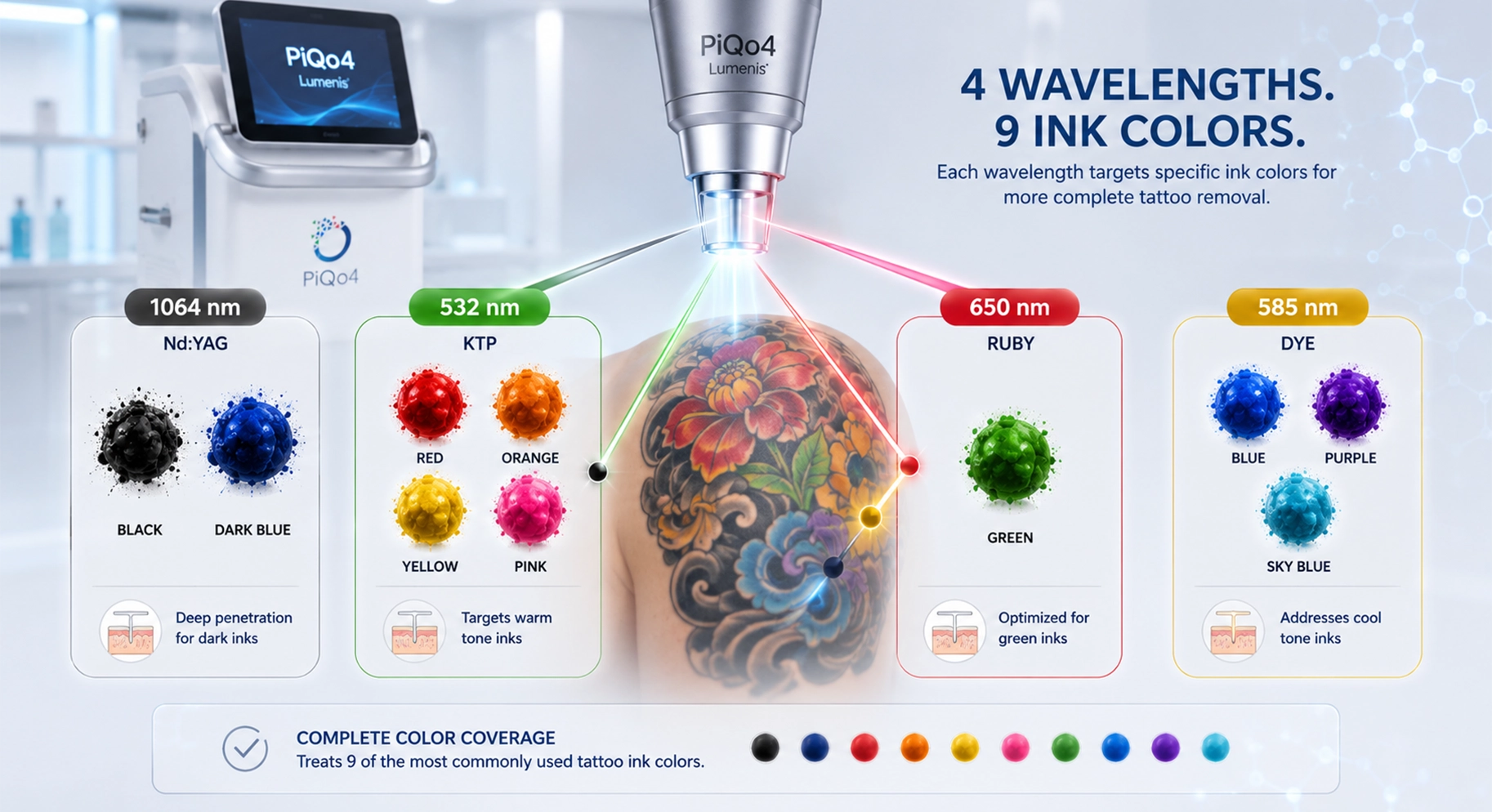
This is why device choice belongs on your checklist when picking a provider. For the full breakdown, see how the PiQo4 by Lumenis laser uses four wavelengths and both picosecond and nanosecond pulses to shatter a wider range of ink colors while protecting the skin.
What a Session Looks Like, and Honest Expectations
Even with the right device, resistant tattoos reward patience. A session is short, usually numbing cream and cooling for comfort, then the provider works the area in a controlled pattern, and mild frosting and redness afterward are normal signs the laser did its job. Sessions are spaced several weeks apart so the skin recovers and the body clears shattered ink. For a resistant, multi-color tattoo, expect more sessions than a simple black one, and understand that some colors, especially yellows and certain greens, may fade a great deal without reaching total clearance.
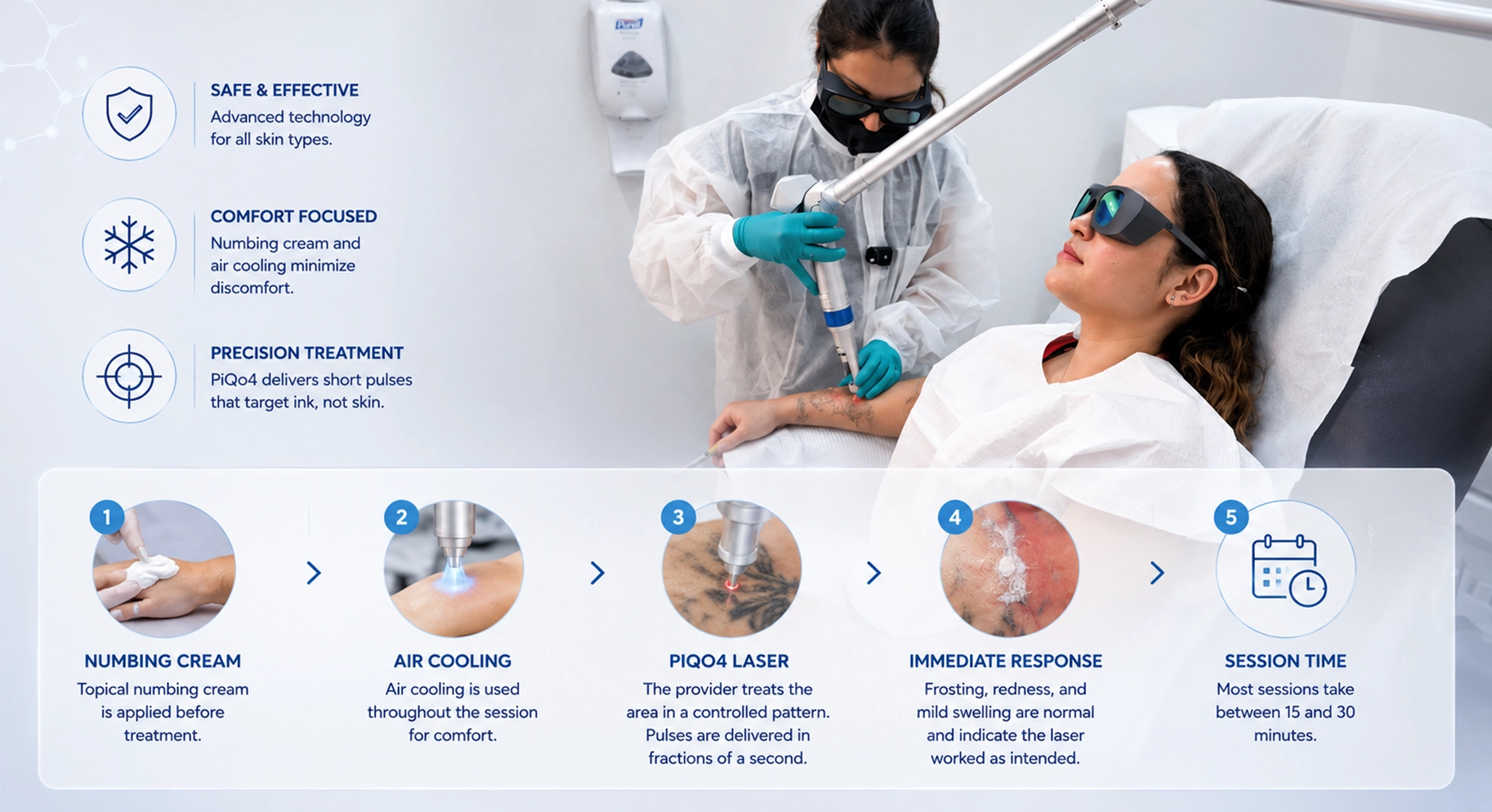
That honesty is the point of choosing a medical setting. For a realistic view of how clearance builds, what realistic laser tattoo removal before and after results look like across a full course of sessions, including how gradually stubborn ink lightens is a useful reference, and our session by session guide to how laser tattoo removal heals for South Florida patients, including what each stage looks and feels like covers the recovery between visits.
Skin Tone, Location, and Other Factors
A few more factors round out the picture. Your skin tone matters, because on darker and tanned skin the settings must be matched to your Fitzpatrick type so the laser targets ink and protects your pigment, which can mean a more measured pace. The location on your body matters too, since areas with thinner skin and weaker circulation, like the hands, feet, and fingers, clear more slowly than the torso. And your overall health and habits, such as hydration, not smoking, and sun protection, support the lymphatic clearance that removal depends on.
For skin of color specifically, the right approach is well established. See how laser tattoo removal is done safely on dark skin in Miami using Fitzpatrick matched PiQo4 settings to lower the risk of pigment changes and burns for how skin tone shapes a safe plan.
What to Do About a Resistant Tattoo
If your tattoo has stalled, the answer is rarely to give up or to blast it harder, it is to reassess with a provider who can see what you are working with. A proper evaluation identifies your ink colors, depth, and any cover-up layers, checks your skin type, and builds a realistic plan with the right wavelengths and spacing. Pushing a resistant tattoo with excessive energy is how you risk scarring and pigment change, so a careful, matched approach is both safer and, over the full course, more effective. If scarring is a worry, what actually causes scarring from laser tattoo removal and the steps a proper protocol and good aftercare take to prevent it is worth reading.
Cost depends on the tattoo, so it is quoted after a provider sees it, and financing keeps a full course manageable. When choosing where to go, what to look for when choosing a laser tattoo removal provider near you, from the device used to the operator’s training and how they handle resistant ink and skin of color is a practical checklist. According to the American Academy of Dermatology guidance on how dermatologists remove tattoos and why some colors are harder than others, matching technology and technique to the tattoo is what drives results.
Frequently Asked Questions
1. Why is my tattoo not fading with laser removal?
The most common reasons are ink color and density. Colors like green, red, and yellow resist more than black, and heavily saturated or deep ink needs more sessions. A single-wavelength laser also leaves some colors behind. A provider can identify which factor is slowing your tattoo down.
2. Which tattoo ink colors are hardest to remove?
Yellow is usually the most resistant because it reflects most laser light, followed by certain greens, reds, and oranges. Black is the easiest because it absorbs the broadest range of wavelengths. A multi-wavelength laser is what makes resistant colors treatable.
3. Can a resistant tattoo be fully removed?
Often it can fade dramatically, but some resistant ink, especially yellow and certain greens, may not reach 100 percent clearance. An honest provider sets significant fading as the realistic goal and tells you up front where full clearance is unlikely rather than promising a blank slate.
4. Why are cover-up tattoos so hard to remove?
A cover-up layers a new tattoo over an old one, stacking multiple colors and densities in the same skin. The laser has to work through all of it, often reaching resistant colors hidden under dense ink, so cover-ups reliably need the most sessions and patience.
5. Does the type of laser really matter for resistant ink?
Yes. A single-wavelength laser cannot break down colors it does not target. A multi-wavelength device like the PiQo4 by Lumenis offers four wavelengths that cover nine common ink colors, which is what allows a provider to treat resistant reds, greens, and yellows.
6. Do amateur tattoos remove differently than professional ones?
They can. Amateur or stick and poke ink often sits at uneven depths, so some areas clear quickly and others linger, giving a patchy look mid-course. Professional tattoos are usually more saturated and evenly placed, which can mean more sessions but a more predictable pattern.
7. Will pushing higher laser settings remove a stubborn tattoo faster?
No, and it is risky. Excessive energy raises the chance of scarring and pigment change, especially on darker skin, without reliably speeding up clearance. A careful provider matches the wavelength and settings to your ink and skin, which is safer and more effective over the full course.
8. Where can I get a resistant tattoo evaluated in Miami?
Perfect B in Doral evaluates resistant tattoos with the PiQo4 by Lumenis, matching wavelengths to your ink colors and settings to your skin type. A consultation identifies why your tattoo has resisted and builds a realistic plan with clear expectations and financing options.
Get Your Resistant Tattoo Assessed in Doral
A tattoo that resists removal is not a dead end, it is a tattoo that needs the right wavelengths, the right pace, and honest expectations. At Perfect B in Doral, a provider identifies your ink colors and depth, matches the PiQo4 settings to your skin, and tells you plainly how much fading to expect and where full clearance may not be realistic. That honesty, plus a multi-wavelength laser, is what gives a stubborn tattoo its best shot.
Reach out for an evaluation and a clear plan, with financing available so a full course stays within reach. Knowing what you are working with is the difference between frustration and steady progress.
- 📍 Visit us at Perfect B, 3905 NW 107th Ave, Suite 104, Doral FL 33178
- 📞 Call or message us at (786) 502-2260
- 💳 Financing available through Cherry, Klarna, Afterpay, and CareCredit