Perfect B, Doral Fl. | 04.21.26 | 11 min read.
This content is for educational purposes only and does not constitute medical advice. Consult a qualified medical provider before beginning any peptide therapy protocol. All peptide medications referenced on this page require a clinical evaluation and prescription from a licensed provider. Results vary by patient. This is one part of a larger plan, so see how medically supervised peptide therapy at Perfect B in Doral works and how each protocol fits a complete, monitored plan. For more on this, see our guide to Does Tesamorelin Suppress Appetite?, and how it is evaluated and treated at Perfect B in Doral.
What Is BPC-157 and Why Every Recovery-Focused Patient Is Asking About It
If you have been searching for what is BPC-157, you have landed on the most requested recovery peptide in our clinic. BPC-157, short for Body Protective Compound 157, is a synthetic pentadecapeptide derived from a naturally occurring protein fragment found in human gastric juice. It is a sequence of 15 amino acids that acts like a biological repair signal, telling injured tissue to do what healthy tissue already knows how to do: build blood vessels, lay down collagen, close wounds, and calm inflammation. In our Doral, FL clinic we prescribe BPC-157 as an injectable peptide for patients with tendon injuries, joint pain, chronic gut issues, and systemic inflammation who are not getting results from rest, physical therapy, or over-the-counter anti-inflammatories alone.
BPC-157 is not a steroid, not a hormone, and not a stimulant. It is a signaling peptide. It works by upregulating growth factors your body already produces, particularly VEGF (which grows new capillaries) and growth hormone receptors in tendon and ligament tissue. The practical result is faster, cleaner tissue repair. This is why athletes, post-surgical patients, and people with stubborn soft tissue injuries keep landing on our peptide treatment plan page with the same question: what is BPC-157 and can it do for me what nothing else has?
Key Takeaways on What Is BPC-157
- BPC-157 is a synthetic 15-amino-acid peptide derived from a protein found in human gastric juice. It is not a hormone, not a steroid, not a stimulant.
- Its primary mechanism is angiogenesis: BPC-157 triggers new blood vessel growth (via VEGF upregulation) in injured tissue, which accelerates tendon, ligament, gut, and joint repair.
- The strongest clinical use cases are musculoskeletal injuries, gut lining integrity, and systemic inflammation. The human research is early but the preclinical literature is deep and consistent.
- BPC-157 must be compounded and prescribed. Over-the-counter BPC-157 powders sold online are unregulated and not the same as clinical injectable BPC-157 from a licensed US compounding pharmacy.
- BPC-157 is often stacked with TB-500 in the Wolverine protocol for patients needing comprehensive repair. At Perfect B in Miami, every BPC-157 protocol starts with a licensed APRN intake and individualized dosing.

The Full Answer to What Is BPC-157 at the Molecular Level
BPC-157 is a pentadecapeptide, meaning a chain of 15 amino acids. The sequence is Gly-Glu-Pro-Pro-Pro-Gly-Lys-Pro-Ala-Asp-Asp-Ala-Gly-Leu-Val. The parent molecule is a larger protein called BPC (Body Protective Compound) that was first isolated from human gastric juice in the 1990s by a research group at the University of Zagreb. Researchers noticed that the stomach, despite being exposed to acid that would destroy most tissues, is remarkably self-repairing. They isolated the protein responsible, then synthesized the active 15-amino-acid fragment. That fragment is what we now call BPC-157 peptide, and it is what patients in Miami ask for when they want accelerated soft tissue recovery.
How BPC-157 Peptide Works Inside the Body
BPC-157 does not create new tissue out of nothing. It amplifies pathways your body already uses to heal. The primary mechanisms we see cited in the literature include:
- VEGF upregulation: BPC-157 increases vascular endothelial growth factor, which drives new capillary formation in injured tissue. More blood supply means more oxygen and nutrients to the repair site.
- Nitric oxide pathway modulation: BPC-157 influences NO signaling, which regulates vascular tone and wound-site perfusion.
- Growth hormone receptor expression in tendons: Preclinical work has shown BPC-157 increases GH receptor expression in tendon fibroblasts, which may explain its strong effect on tendon-to-bone healing.
- Gut-brain axis support: Because BPC-157 is derived from gastric juice, it has particularly strong effects on gut lining repair, intestinal anastomoses, and enteric nervous system signaling.
- Anti-inflammatory cytokine balance: BPC-157 has been shown to reduce pro-inflammatory cytokines while preserving normal immune function, a combination most anti-inflammatories cannot match.
For a comprehensive review of these mechanisms, a peer-reviewed study in Cell and Tissue Research documenting the role of gastric pentadecapeptide BPC-157 in accelerating musculoskeletal soft tissue healing lays out the signaling cascade in detail.
What Is BPC-157 Used For in a Medical Clinic
The BPC-157 uses we see most often in our Miami peptide practice fall into four categories: musculoskeletal injury, gut health, joint pain, and systemic inflammation. Patients searching BPC-157 benefits online find a long list of claims. In clinical practice, the high-confidence indications are narrower and more specific than the internet suggests.
Tendon and Ligament Injuries
This is the single most common reason patients request BPC-157 at our Doral clinic. Partial tendon tears, chronic tendinopathy (rotator cuff, patellar, Achilles, elbow), and ligament sprains that are not healing with rest are where BPC-157 shines. In our experience, patients with a subacute tendinopathy that has stalled at 6 to 12 weeks of physical therapy tend to notice a meaningful change in pain and range of motion within 3 to 4 weeks of starting a BPC-157 protocol.
Gut Lining and Gastrointestinal Support
Because BPC-157 was originally isolated from gastric juice, its gut effects are arguably the best-studied of all its applications. Preclinical studies have shown benefit for gastric ulcers, inflammatory bowel conditions, and intestinal anastomoses. At our clinic, patients who come in with chronic GI inflammation, SIBO residuals, or a history of NSAID-induced gastritis are the group most likely to report subjective improvement on BPC-157 within the first 30 days.
Joint Pain and Cartilage Support
BPC-157 is frequently prescribed for chronic joint pain, particularly knees, shoulders, and hips that have plateaued after standard orthopedic treatment. The effect is not a cure for arthritis, it is an inflammation and repair assist that often pairs well with a weight management plan to reduce mechanical joint load. Many of our weight-loss patients who are rebuilding exercise tolerance run BPC-157 alongside our medically supervised Weight Loss Treatment Plan at Perfect B in Miami to keep joints tolerant of new activity volume.
Systemic Inflammation and Post-Injury Recovery
For patients with widespread musculoskeletal inflammation, chronic soft tissue pain, or a recent surgical recovery, BPC-157 is most often prescribed as part of the Wolverine Stack, which combines BPC-157 with TB-500 (Thymosin Beta-4) for synergistic tissue repair. In patients whose inflammation is also linked to metabolic issues, we often pair BPC-157 with interventions discussed in our clinical write-up on GHK-Cu and weight loss, which explains how copper peptide signaling integrates with body recomposition goals. We break down the full stack protocol in our dedicated guide to the Wolverine Peptide Stack at Perfect B, explaining the BPC-157 plus TB-500 combination protocol for comprehensive recovery.

BPC-157 Benefits Our Miami Patients Actually Report
Online content about BPC-157 benefits can read like a miracle list. In our clinic the pattern is more specific. Here is what we see in the first, second, and third month of a typical protocol, based on the indications above.
- Weeks 1 to 3: Reduced pain at rest in the injured tissue. Patients with tendinopathy often describe the first noticeable shift as “less sharp” pain when loading the tendon.
- Weeks 3 to 6: Measurable range-of-motion improvements. Patients who had been plateaued in physical therapy often break through their stuck ROM milestones during this window.
- Weeks 6 to 12: Strength return and tolerance of progressive loading. This is the window where patients can resume more demanding training volumes without relapsing into the original injury pattern.
- Gut-specific patients: Subjective “calmer” gut feeling often appears in the first 2 to 4 weeks. Bloating and food reactivity improvements tend to follow by week 4 to 6.
- Inflammation-driven patients: Reduced morning stiffness and overall systemic “feels better” response within 3 to 5 weeks in most cases.

Not sure which peptide protocol fits your goals?
Perfect B’s peptide protocol tool is built on real clinical data from 2,000+ patients treated in South Florida.
Answer 6 questions and see what patients with similar goals are running: which peptides they use, typical dosing, injection schedule, reconstitution steps, cycle length, and when they pause.
How BPC-157 Peptide Is Administered
BPC-157 can theoretically be delivered several ways, but in a medical clinic like ours, the clinically relevant routes are two: subcutaneous injection and, in selected cases, oral capsules for gut-specific indications. Injectable BPC-157 has the more robust clinical record and is how the overwhelming majority of our Miami patients run it.
Subcutaneous Injection Protocol
Injections are delivered with a small insulin-size needle into the subcutaneous fat, typically the abdomen or thigh. Site rotation is daily to prevent tissue buildup. Dosing is individualized, but a typical protocol titrates from a starting dose up to a target dose over 2 to 4 weeks, injected 5 days on and 2 days off, in defined cycles with scheduled breaks between them. Patients leave our Doral consultation with a full kit (vials, bacteriostatic water for reconstitution, syringes, alcohol swabs, sharps container, and a written calendar) and are walked through the reconstitution and injection process live before they leave.
Timing and Stacking
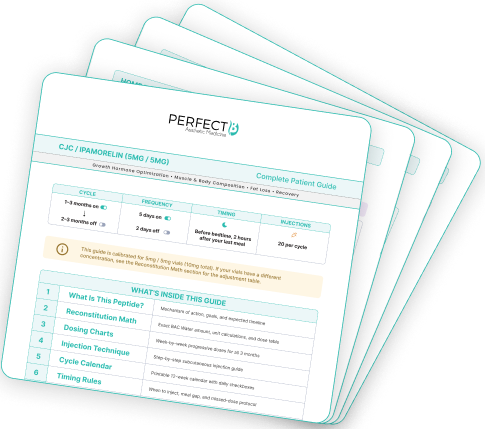
BPC-157 is most often injected in the evening, on an empty stomach, to align with overnight repair windows. It is often stacked with TB-500 in the Wolverine protocol, and for patients pursuing broader recovery goals it can be combined with a growth hormone peptide protocol. Patients who want the full growth hormone optimization protocol alongside recovery support frequently run BPC-157 with CJC-1295/Ipamorelin, which we detail in our complete CJC-1295/Ipamorelin dosage and injection protocol guide at Perfect B.

BPC-157 Safety, Side Effects, and Who Should Not Use It
One of the most common questions we field in Doral is about BPC-157 side effects. The honest answer is that the human safety data is limited compared to decades-old pharmaceuticals, but the preclinical safety record across multiple species is unusually clean for a peptide with this level of biological activity. The side effects we occasionally see in clinic are mild and typically transient.
Reported and Observed Side Effects
- Injection site reaction: Small, brief redness or mild soreness at the injection site. Typically resolves within hours.
- Mild nausea or gut flushing: Rare, most often in patients starting at a higher dose than recommended. Titration addresses this.
- Lightheadedness: Uncommon, usually dose-related and resolves with adjustment.
- Headache: Occasional, usually transient during the first week.
Who Should Not Start BPC-157
Every BPC-157 intake at Perfect B includes a contraindication review. Patients who are pregnant or breastfeeding, patients with active malignancy, patients with certain vascular conditions where angiogenesis is a concern, and patients on specific anticoagulants may not be candidates. This is one of the reasons we insist on a licensed provider intake rather than a direct-to-consumer model. A peptide that stimulates new blood vessel growth is exactly the kind of molecule that requires a case-by-case risk review. For a plain-language overview of how BPC-157 is currently classified from a regulatory standpoint, the U.S. Department of Defense Operation Supplement Safety bulletin reviewing BPC-157’s regulatory status and the risks of unregulated consumer products is a useful read.

Is BPC-157 Legal and How Do You Get It Safely
This is where the BPC-157 market gets murky. BPC-157 is not an FDA-approved drug, which means it is not available as a retail prescription the way a branded pharmaceutical is. It is legally obtainable in the United States through licensed compounding pharmacies when prescribed by a medical provider for a specific patient after a clinical evaluation. That is the route we use at Perfect B. The peptides we prescribe are sourced from FDA-registered U.S. compounding pharmacies, not from overseas research chemical suppliers.
What is widely sold online as BPC-157 powder or BPC-157 nasal spray is typically labeled “for research use only” and is explicitly not intended for human use. The purity, concentration, and contamination profile of those products are not clinically verified. This is the single most important thing patients in Miami and South Florida need to understand when shopping the BPC-157 space. A compounded, prescribed, individually dosed product from a US pharmacy is an entirely different category from an unverified research powder ordered online.
How BPC-157 Fits into a Broader Peptide Treatment Plan
BPC-157 is rarely prescribed in isolation. In our peptide treatment plan at Perfect B, it is most commonly stacked with TB-500 for comprehensive repair, or layered with a growth hormone optimizer like CJC-1295/Ipamorelin for patients who want both repair and body composition improvement. For patients whose primary goal is return-to-sport after injury, a typical structure is Wolverine Stack for the first cycle, then CJC-1295/Ipamorelin for the body-composition rebuilding phase.
Our full integration of BPC-157 into a personalized peptide protocol is detailed on our Peptide Treatment Plan page at Perfect B in Miami, which explains how we select and stack peptides for each patient’s goals.
See how BPC-157 fits into real patient protocols.
Perfect B’s peptide protocol tool is built on real clinical data from 2,000+ patients treated in South Florida.
Answer 6 questions and see what patients with similar goals are running: which peptides they use, typical dosing, injection schedule, reconstitution steps, cycle length, and when they pause.
Frequently Asked Questions
1. What is BPC-157 and how is it different from a regular anti-inflammatory?
BPC-157 is a synthetic 15-amino-acid peptide derived from a protein found in human gastric juice. Unlike an anti-inflammatory like ibuprofen, which suppresses an inflammatory signaling cascade, BPC-157 amplifies the body’s own repair signals, particularly VEGF-driven angiogenesis and tendon growth factor receptor expression. It is not blocking a pathway, it is speeding up a repair that would otherwise take much longer or stall entirely. That is the core distinction.
2. How long does it take to see results from BPC-157?
For musculoskeletal indications, most patients at our Doral clinic report a noticeable reduction in pain within 2 to 3 weeks and a functional improvement (range of motion, strength, load tolerance) by weeks 4 to 8. Gut-focused patients often feel a calming effect sooner, within the first 2 to 4 weeks. Chronic cases may require a full 12-week cycle and occasionally a second cycle after a break to reach the target endpoint.
3. Is BPC-157 the same thing as the Wolverine Stack?
No. BPC-157 is one peptide. The Wolverine Stack is BPC-157 combined with TB-500 (Thymosin Beta-4). The two peptides work on complementary repair pathways, and stacking them is a common protocol in our clinic for patients who need comprehensive recovery rather than isolated tissue repair. BPC-157 alone is appropriate for more targeted indications, especially gut-focused cases.
4. Does BPC-157 have side effects I should worry about?
The side effects we see in clinic are generally mild: transient injection site reaction, occasional mild nausea if starting at too high a dose, infrequent headache or lightheadedness in the first week. The human safety dataset is limited compared to FDA-approved drugs, which is exactly why a medical intake and licensed provider oversight matter. Patients with active cancer, pregnancy, or specific vascular conditions may not be candidates.
5. Is BPC-157 legal in the United States?
BPC-157 is not an FDA-approved drug, which means it is not available as a retail prescription product. It is legally dispensed through licensed US compounding pharmacies when prescribed by a medical provider for a specific patient after a clinical evaluation. Products sold as BPC-157 online without a prescription are generally labeled “research use only” and are not the same category of product as a compounded clinical prescription.
6. Can I take BPC-157 orally instead of injecting?
Oral BPC-157 capsules exist and have some utility for gut-specific indications because of localized activity in the GI tract. For musculoskeletal, joint, and systemic inflammation indications, the subcutaneous injection is the clinically preferred route. Injectable BPC-157 reaches tissue concentrations the oral route cannot match for most non-gut uses. Your provider will help decide which route is appropriate for your specific case.
7. How much does a BPC-157 protocol cost at Perfect B in Miami?
At Perfect B all peptides are priced equally per stack size and cycle count. A single-peptide BPC-157 protocol starts at a 1-cycle level with 2- and 3-cycle options that bring the per-cycle cost down. Stacked protocols like the Wolverine Stack are priced as a 2-peptide stack. Flexible financing through Cherry is available for most patients, split into up to 26 monthly payments.
Closing: The Clinical Bottom Line on What Is BPC-157
BPC-157 is a synthetic signaling peptide with a narrow, high-confidence clinical use case: accelerating soft tissue repair, calming gut lining inflammation, and supporting joint recovery in patients who have stalled with standard care. It is not a cure for arthritis, it is not a general wellness supplement, and it is not interchangeable with the unregulated powders sold online. It is a prescribed compounded medication that needs a provider intake, dose titration, and follow-up, exactly like any other clinical prescription.
The difference between a BPC-157 protocol that works and one that does not is rarely the peptide itself. It is the intake, the individualization, the quality of the compounded product, and the follow-up. That is what supervised clinical care provides and what a direct-to-consumer research-powder model cannot.
See what patients like you are running at Perfect B.
Perfect B’s peptide protocol tool is built on real clinical data from 2,000+ patients treated in South Florida.
Answer 6 questions and see what patients with similar goals are running: which peptides they use, typical dosing, injection schedule, reconstitution steps, cycle length, and when they pause.
- 📍 Visit us at Perfect B, Doral FL, serving Miami and South Florida patients seeking clinical peptide therapy.
- 📞 Call (786) 502-2260 or message us today to schedule your BPC-157 consultation with a licensed medical provider.