
Perfect B, Doral Fl. | 05.28.26 | 9 min read.
This article is for educational purposes only and is not a substitute for medical advice. Peptide therapy should be evaluated and supervised by a licensed medical provider.
Peptides for Inflammation: A Smarter Way to Calm the Body
Peptides for inflammation have become one of the most searched topics in regenerative medicine, and the interest makes sense. Inflammation sits underneath most of what brings people into a clinic: stiff joints, slow recovery, gut issues, and skin that will not settle. Peptides are short chains of amino acids that act as signaling molecules, and certain ones can help the body dial down inflammation in a targeted way rather than shutting the whole immune system off. That selectivity is the appeal. This guide explains which anti-inflammatory peptides actually have a clinical role, organized by goal, and what a supervised medical clinic in South Florida can responsibly offer. For the bigger picture, read how peptide therapy is supervised at Perfect B in Doral and where a specific peptide fits within a complete treatment plan.
Key Takeaways
- Peptides for inflammation work by signaling, nudging the body to lower pro-inflammatory messengers rather than broadly suppressing immunity the way steroids do.
- The anti-inflammatory peptides with a real clinical role at a medical clinic include BPC-157, TB-500, GHK-Cu, and MOTS-c, each matched to a different goal.
- Peptides for joint pain and recovery are the most common reason patients ask about this therapy.
- They are not a replacement for diagnosis or for anti-inflammatory medication, and they work best alongside a real plan.
- Supervision is the product: prescription, lab work, and quality sourcing separate a clinical protocol from a gray-market purchase.
Dealing With Inflammation or a Tissue Injury That Will Not Heal? See What BPC-157 and TB-500 Patients Are Running at Perfect B.
Perfect B’s peptide protocol tool is built on real clinical data from 2,000+ patients treated in South Florida.
Answer 6 questions and see what patients with similar goals are running: which peptides they use, typical dosing, injection schedule, reconstitution steps, cycle length, and when they pause.
How Peptides Calm Inflammation Differently Than Steroids
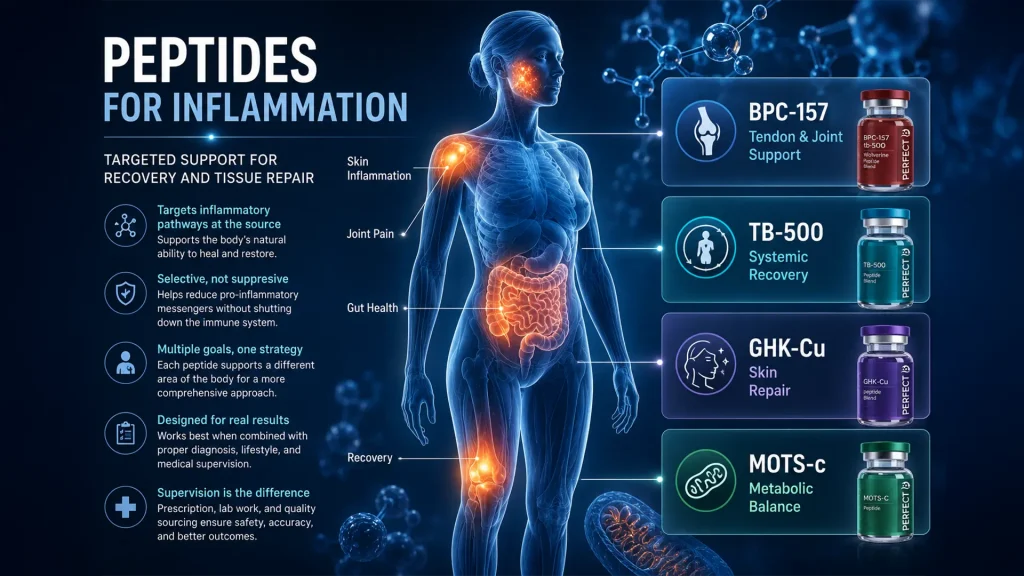
Anti-inflammatory medications like corticosteroids work by broadly suppressing the immune response. They are powerful, but that blunt approach can also slow healing and carry side effects over time. Peptides for inflammation tend to act more selectively. They bind to specific receptors and lower the production of pro-inflammatory messengers called cytokines, while often promoting repair at the same time. According to a peer-reviewed review in the International Journal of Molecular Sciences on peptides as therapeutic agents for inflammatory-related diseases, which describes how peptides can selectively modulate inflammatory signals such as cytokines and NF-kB, this targeted signaling is exactly why peptides are being studied so heavily as anti-inflammatory agents. The practical takeaway is that peptides aim to calm the fire without dousing the whole system.
The Best Peptides for Inflammation, Organized by Goal
There is no single best peptide for inflammation. The right choice depends on where the inflammation lives and what you are trying to recover. Below are the anti-inflammatory peptides we see most often, grouped by goal. Each of these is offered and supervised at our clinic.
Joint, Tendon, and Gut: BPC-157
BPC-157 is the peptide patients ask about most for inflammation. It is studied for accelerating the repair of tendons, ligaments, and the gut lining, and for calming local inflammation in the process. If your inflammation shows up as a cranky joint, a nagging tendon, or gut irritation, this is usually the starting point. You can read our full breakdown of BPC-157 benefits and how it supports tissue repair for the full picture.
Soft Tissue and Mobility: TB-500
TB-500 is often paired with BPC-157 because it supports cell migration and soft tissue repair, which matters when inflammation is tied to an injury that will not heal. We cover our guide to TB-500 benefits for tissue repair and mobility, and if you are deciding between the two, our side-by-side comparison of BPC-157 versus TB-500 for recovery breaks down when each makes sense.
Skin and Surface Tissue: GHK-Cu
GHK-Cu is a copper peptide with a strong record in skin biology. It supports tissue remodeling and has anti-inflammatory effects, which makes it a fit when inflammation shows up at the surface as irritation, slow-healing skin, or visible aging tied to chronic low-grade inflammation.
Metabolic and Cellular Energy: MOTS-c
MOTS-c is a mitochondrial peptide studied for metabolism and cellular energy. For patients whose inflammation is tied to metabolic stress and fatigue, it can play a supporting role inside a broader plan.
You will see other anti-inflammatory peptides discussed online, such as Thymosin Alpha-1 and KPV. These are not part of what we offer at Perfect B, so we mention them only for context and do not recommend sourcing them on your own.
Peptides for Joint Pain and Arthritis
Peptides for joint pain are the single most common request we hear in this category. When a joint is inflamed, the goal is to calm the inflammation while supporting the surrounding tendon and cartilage tissue, which is where BPC-157 and TB-500 are most often used. That said, joint pain has many causes, and not all of them are a good fit for peptides. Cleveland Clinic overview of the common causes of joint pain and when to see a medical provider is a helpful starting point for understanding when joint pain needs a fuller medical workup. At our clinic in Doral, FL, the first step is always figuring out what is actually driving the pain before reaching for any peptide.
Are Peptides Better Than NSAIDs or Supplements for Inflammation?
This is the wrong way to frame it. NSAIDs and supplements have their place, and peptides are not a like-for-like replacement. What peptides for inflammation offer is a more targeted, repair-oriented approach for the right person, used under supervision. For someone in Miami dealing with stubborn, recovery-limiting inflammation that has not responded to the basics, a supervised peptide protocol can be a worthwhile next conversation, not a first-line self-treatment.
See how anti-inflammatory peptides fit into a real supervised protocol at Perfect B.
Perfect B’s peptide protocol tool is built on real clinical data from 2,000+ patients treated in South Florida.
Answer 6 questions and see what patients with similar goals are running: which peptides they use, typical dosing, injection schedule, reconstitution steps, cycle length, and when they pause.
Prescription, Supervised Peptides vs Research Peptides Online
This is the most important distinction for anyone considering anti-inflammatory peptides. Much of what is sold online is labeled as research material, is not intended for human use, and carries no guarantee of purity or dosing accuracy. A medical clinic prescribes peptides through licensed compounding pharmacies, screens your history, runs appropriate labs, and adjusts dosing based on how you respond. That oversight is the difference between a result and a risk. If you want to see how a supervised plan is structured, start with the supervised peptide therapy program at Perfect B in Doral, where a protocol is built around your labs and goals.
Safety, Side Effects, and Who Is a Candidate
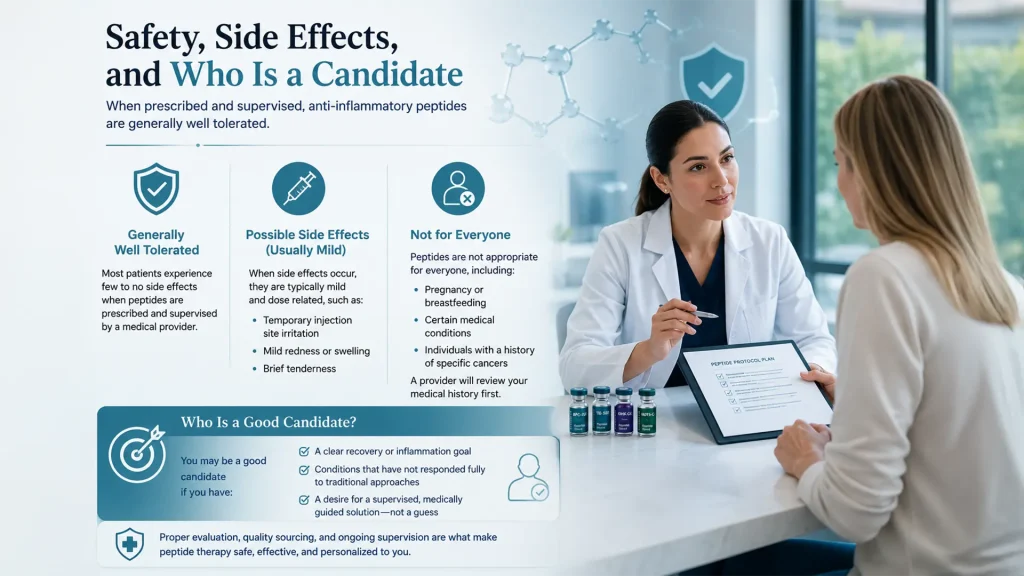
When prescribed and supervised, these peptides are generally well tolerated. Side effects, when they occur, tend to be mild and dose related, such as temporary irritation at the injection site. They are not appropriate for everyone, including during pregnancy or breastfeeding, or for certain medical conditions, which is why a provider reviews your history first. A good candidate is someone with a clear recovery or inflammation goal who wants a supervised, medically guided approach rather than a guess.
How to Start Peptide Therapy for Inflammation
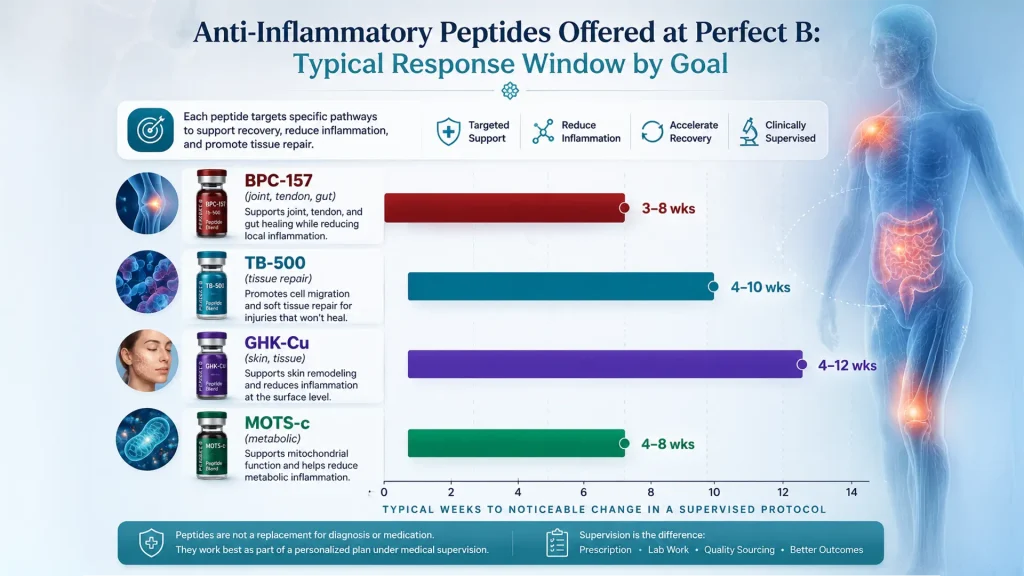
A responsible start looks the same regardless of where the inflammation is. It begins with a consultation and history, moves to appropriate lab work, and ends with a protocol matched to your goal rather than a stock stack. Most patients begin with one or two targeted peptides, monitor their response over roughly four to twelve weeks, and adjust from there. At our clinic in Doral, FL, patients most often come in for joint and tendon recovery, gut inflammation, and skin, and the plan is built around whichever matters most.
See what patients like you are running at Perfect B.
Perfect B’s peptide protocol tool is built on real clinical data from 2,000+ patients treated in South Florida.
Answer 6 questions and see what patients with similar goals are running: which peptides they use, typical dosing, injection schedule, reconstitution steps, cycle length, and when they pause.
Frequently Asked Questions
1. Which is the best peptide for inflammation?
It depends on the goal. BPC-157 is the most requested for joint, tendon, and gut inflammation, TB-500 for soft tissue repair, and GHK-Cu for skin and surface tissue. The right choice is matched to your physiology in a supervised plan.
2. Is BPC-157 an anti-inflammatory?
BPC-157 is studied for calming local inflammation while supporting the repair of tendons, ligaments, and the gut lining. It is one of the most requested anti-inflammatory peptides at a medical clinic, used under supervision.
3. What are the side effects of peptides for inflammation?
For most healthy, supervised patients, side effects are mild and dose related, such as temporary irritation at the injection site. They are not appropriate during pregnancy or breastfeeding or for certain conditions, which is why medical evaluation comes first.
4. Do peptides reduce inflammation better than NSAIDs?
They work differently. NSAIDs broadly reduce inflammation, while peptides aim to calm specific inflammatory signals and support repair. Peptides are not a replacement for medication and are best used under medical guidance.
5. How long do peptides take to help with inflammation?
It varies by peptide and goal. Many patients notice change over four to twelve weeks in a supervised protocol. Peptides support consistent habits and a real plan, they do not replace them.
6. Can peptides help with joint pain?
Peptides for joint pain are the most common reason patients ask about this therapy, and BPC-157 and TB-500 are the ones most often used. Because joint pain has many causes, the first step is a proper evaluation of what is driving it.
Closing: The Clinic Takeaway on Peptides for Inflammation
Peptides for inflammation are not a magic switch, and they are not a replacement for a real diagnosis. They are a set of targeted tools that, matched to the right goal and supervised properly, can help the body calm inflammation while supporting repair. The difference between a result and a risk is rarely the peptide itself. It is whether a licensed provider screened you, ran your labs, sourced the compound responsibly, and adjusted your dose over time.
If you are in Miami or South Florida dealing with inflammation that is limiting your recovery, the safest next step is a conversation with a medical clinic that treats this as medicine.
- 📍 Visit us at Perfect B, Doral FL, serving Miami and South Florida patients seeking anti-inflammatory peptide therapy.
- 📞 Call or message us at (786) 502-2260 to schedule your peptide consultation for inflammation with a licensed medical provider.
→ See how a personalized, supervised peptide therapy plan is built at Perfect B in Doral.